Search results for The

Cross-posted at Jezebel.

Sociologist Michael Kimmel passed along a fantastic and entertaining example of resistance.  In the video below, a Columbia University a cappella group sings Dr. Dre’s Bitches Ain’t Shit.  The appropriation of the song works on so many levels: the all heavily-white, all-female group, the sweet choral arrangement, the pastel prep fashion, the strategically placed tennis rackets. They use race, class, and gender contradictions to force us to see and hear the song in a new way. All serve to mock the original, taking the teeth out of the language at the same time that they expose it as grossly misogynistic. Awesome.

Lisa Wade, PhD is an Associate Professor at Tulane University. She is the author of American Hookup, a book about college sexual culture; a textbook about gender; and a forthcoming introductory text: Terrible Magnificent Sociology. You can follow her on Twitter and Instagram.
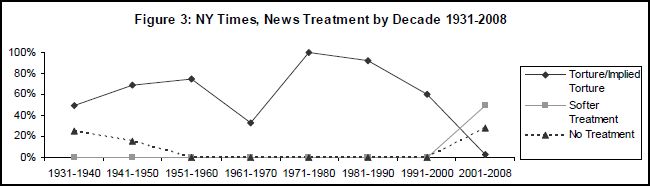
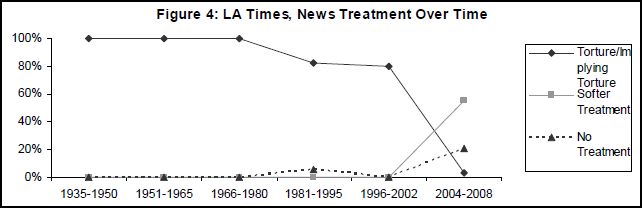
In an analysis of the language newspapers used to describe waterboarding, four Harvard students — Neal Desai, Andre Pineda, Majken Runquist, and Mark Fusunyan — discovered that the use of the word torture significantly declined after the Bush administration began contesting its definition as such (read the full paper here).  The figures below, for the New York and the Los Angeles Times, shows that in the last decade the newspapers switched from calling it “torture,” to using descriptors (they call it “softer treatment” and include adjectives like “harsh,” “controversial,” or “aggressive”), or simply calling it waterboarding (“no treatment”).

According to BoingBoing, the executive editor of the New York Times, Bill Keller, argues that to use the term “torture” would be to take sides.  The authors of the study argue that the reverse is true, especially given that the change coincided with the Bush administration’s dismissal of waterboarding’s definition as torture.  They conclude:

The status quo ante was that waterboarding is torture, in American law, international law, and in the newspapers’ own words.  Had the papers not changed their coverage, it would still have been called torture.  By straying from that established norm, the newspapers imply disagreement with it, despite their claims to the contrary.  In the context of their decades‐long practice, the newspaper’s sudden equivocation on waterboarding can hardly be termed neutral.

Lisa Wade, PhD is an Associate Professor at Tulane University. She is the author of American Hookup, a book about college sexual culture; a textbook about gender; and a forthcoming introductory text: Terrible Magnificent Sociology. You can follow her on Twitter and Instagram.
Dr. Paul Baker, a linguist at the University of Lancaster, sent us some graphs from his analysis of use of gendered language over time in the U.K. His data consisted of “four sets of data from written British English from 1931, 1961, 1991 and 2006 (a million words each)” — a full discussion of the methodology will be available in the forthcoming article in Gender and Language.*

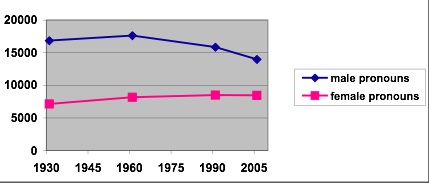
First, Dr. Baker looked at use of male and female pronouns (he/his/him vs. she/hers/her) over time:

Clearly male pronouns are still used more than female ones, but the gap is narrowing. Baker found that though part of the reason is that male pronouns are more likely to be used generically to refer to everyone than female pronouns are, the major reason is that men are discussed more than women.

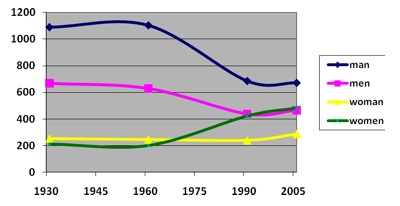
Here are the data specifically for the four words “man,” “men,” “woman,” and “women”:

Notice that the use of the plurals — “men”and “women” — have converged, though we still see higher usage of the male singular than of “woman.”

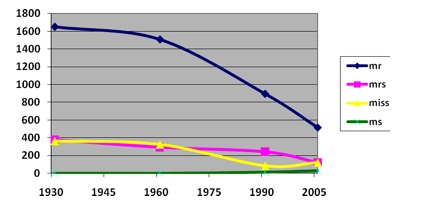
And finally, Dr. Baker looked at the usage of four gendered titles:

A large decrease, obviously, especially in the use of “Mr.,” but all have tapered off since the 1930s with the exception of “Ms.,” which never did really catch on. Baker argues that while some of the decrease may be due to attempts to use less sexist language, it’s more likely because of more informalization of society in general — titles of address often seem stiff and overly formal today.

Of course, this analysis just tells us the frequency with which these terms are used, not what is actually being said about men and women, a topic he addresses in the full article. But he concludes that the trend is rather encouraging for those who want to see more equal gender representation in terms of language.

* Baker, P. (2010) ‘Will Ms ever be as frequent as Mr? A corpus-based comparison of gendered terms across four diachronic corpora of British English.’ Gender and Language. Forthcoming.


In the TED video below, Lisa Margonelli of the New America Foundation Energy Policy Initiative gives a fascinating 17-minute talk on the political psychology and the political economy of oil… and how the former distracts us from the latter.

Among other revelations, she tells us that:

1.  Oil pumps are purposefully designed to look like ATMs to make us feel better about using them.

2.  Having a car that runs predicts employment more than a GED.

3.  Oil production reform has amounted, largely, to exporting the risk to other countries, and…

4. We pay for our oil dependence not only at the pump, but with our taxes.

Watch:

Via BoingBoing.

Lisa Wade, PhD is an Associate Professor at Tulane University. She is the author of American Hookup, a book about college sexual culture; a textbook about gender; and a forthcoming introductory text: Terrible Magnificent Sociology. You can follow her on Twitter and Instagram.
Dmitriy T.M. sent in an interesting discussion of tax collection in Pakistan by the New York Times.   The narrator argues that rich Pakistanis, among others, do not pay taxes, forcing the government to rely on foreign aid.  Essentially, then, it is argued, “[t]he American taxpayer is subsidizing the Pakistani rich.”   Since the politicians are rich themselves, and happily evading taxes, there is little will to change the system.

One solution? Send in a team of transgender people to embarass homeowners into paying their property taxes, of course!

Lisa Wade, PhD is an Associate Professor at Tulane University. She is the author of American Hookup, a book about college sexual culture; a textbook about gender; and a forthcoming introductory text: Terrible Magnificent Sociology. You can follow her on Twitter and Instagram.
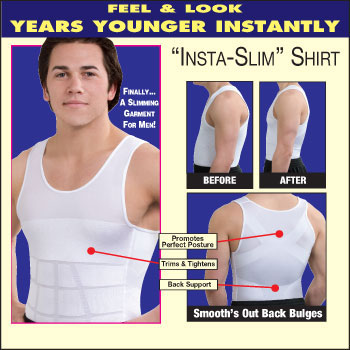
Elizabeth C. sent along two advertisements for body slimming garments from DreamProductsCatalog, one for men and one for women.  Side-by-side, they reveal subtlety different expectations for male and female bodies:

Notice that the women’s garment is aimed solely at making her thinner and more fit appearing.  It “slims,” “eliminates unsightly bulges,” “lifts,” and makes her look “20 pounds thinner.”   Her sexy pose and come hither look emphasizes that her main job is to look good.  In contrast, the man looks confidently and calmly into the camera and, while his garment is also aimed at making him look more “slim” and “trim,” it is also supposed to make him “feel” better and look younger.  It improve his posture and offer back support, too.

The difference here is subtle, and I don’t mean to make too much of it, but it is nonetheless an illustration of the variety of uses to which men’s bodies are believed to be put (aesthetic, yes, but also functional and personal) and the one primary thing that women’s bodies are supposedly for (being looked at).

Lisa Wade, PhD is an Associate Professor at Tulane University. She is the author of American Hookup, a book about college sexual culture; a textbook about gender; and a forthcoming introductory text: Terrible Magnificent Sociology. You can follow her on Twitter and Instagram.
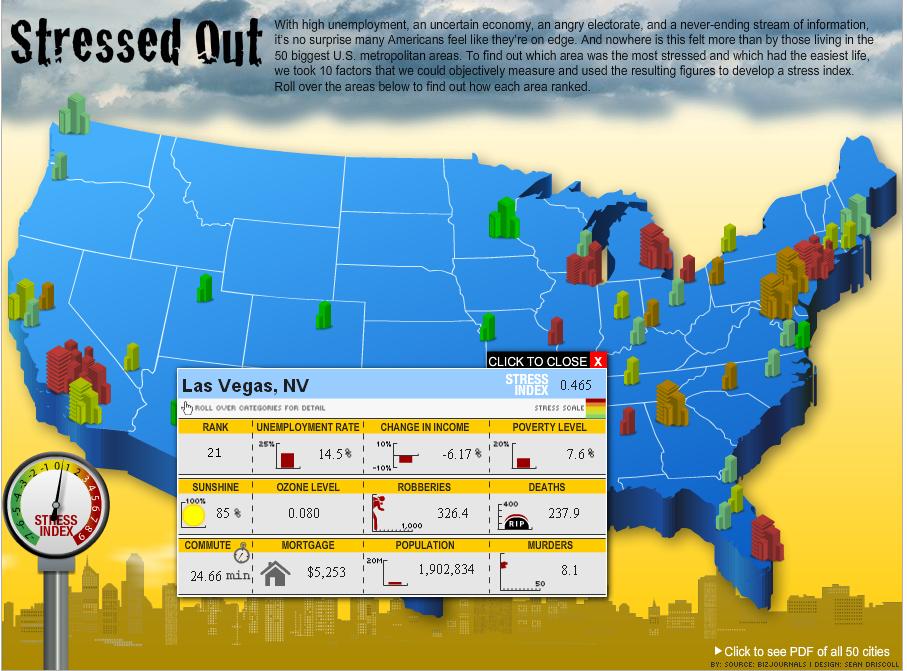
My friend Captain Crab (happy late birthday!) pointed out a graphic at Portfolio that displays the results of their metropolitan “stress test,” in which they use ten measures such as poverty level, unemployment rate, commute, mortgage affordability, etc., to quantify how stressful different metro areas are to live in currently. Obviously it’s a rough measure — they usually use the rates of central cities rather than the larger metro area, people may interpret the same seemingly objective levels of negative or positive factors very differently in terms of how stressed they feel, only the 50 largest metro areas are included, and I don’t know if there’s clear evidence linking less-sunny places to less stress (anyone know?) — but it does provide a snapshot of how different cities compare.

You can hover over a city to get info on its ranking; since I live in Vegas, I checked it out, which has the highest unemployment rate of the 50 metro areas studied, but hey, we get lots of sun!

Just to clarify, the mortgage indicator isn’t the average mortgage, it’s the “affordability” of the mortgage “expressed as median house value per $1,000 of median household income”. The most unaffordable city? New York, followed by L.A.

The overall most stressful city is Detroit; the least is Salt Lake City. If you want to waste more time comparing the rankings on each of the ten measures, they have tables listing the results.

In a fascinating essay, A. J. Patrick Liszkiewicz argues that we do, indeed, play Farmville because we’re polite.  More people in the U.S. play Farmville than any other video game.

…over seventy-three million people play Farmville. Twenty-six million people play Farmville every day. More people play Farmville than World of Warcraft, and Farmville users outnumber those who own a Nintendo Wii.

(source)

The game isn’t popular, he argues, because it’s a good game.  In fact, Liszkiewicz thinks it’s a decidedly bad game.

…games offer a break from responsibility and routine, yet Farmville is defined by responsibility and routine. Users advance through the game by harvesting crops at scheduled intervals; if you plant a field of pumpkins at noon, for example, you must return to harvest at eight o’clock that evening or risk losing the crop. Each pumpkin costs thirty coins and occupies one square of your farm, so if you own a fourteen by fourteen farm a field of pumpkins costs nearly six thousand coins to plant. Planting requires the user to click on each square three times: once to harvest the previous crop, once to re-plow the square of land, and once to plant the new seeds. This means that a fourteen by fourteen plot of land—which is relatively small for Farmville—takes almost six hundred mouse-clicks to farm, and obligates you to return in a few hours to do it again…

Farmville is so laborious and tedious, that one of the rewards of playing Farmville is playing less Farmville:

As you advance through Farmville, you begin earning rewards that allow you to play Farmville less. Harvesting machines let you click four squares at once, and barns and coops let you manage groups of animals simultaneously, saving you hundreds of tedious mouse-clicks.

(source)

So why the heck is Farmville the most popular video game in America?  Liszkiewicz says, “people are playing Farmville because people are playing Farmville.”

(source)

In other words:

Farmville is popular because in entangles users in a web of social obligations. When users log into Facebook, they are reminded that their neighbors have sent them gifts, posted bonuses on their walls, and helped with each others’ farms. In turn, they are obligated to return the courtesies. As the French sociologist Marcel Mauss tells us, gifts are never free: they bind the giver and receiver in a loop of reciprocity. It is rude to refuse a gift, and ruder still to not return the kindness. We play Farmville, then, because we are trying to be good to one another. We play Farmville because we are polite, cultivated people.

(source)

* Title borrowed from BoingBoing.

Lisa Wade, PhD is an Associate Professor at Tulane University. She is the author of American Hookup, a book about college sexual culture; a textbook about gender; and a forthcoming introductory text: Terrible Magnificent Sociology. You can follow her on Twitter and Instagram.