Search results for The

Sociologist Amy Schalet has done wonderful research comparing American and Dutch approaches to teen sexuality.  Among other fascinating findings, she has shown that, American parents approach their children’s sexual initiation with fear and loathing; while Dutch parents treat sexuality like any other realm of life that a child must learn to manage.  Accordingly, most American teenagers hide their virginity loss from their parents, furtively popping the cherry in risky situations, often without protection against pregnancy or sexually transmitted infections (STIs).  In contrast, most Dutch teenagers lose their virginity in their own bedrooms with their parents approval… and condoms.

This different approach to teen sexuality helps explain the dramatic differences between the U.S. and the Netherlands in rates of contraceptive use, teen pregnancy, abortion, and STI transmission.  Check it this data from Advocates for Youth:
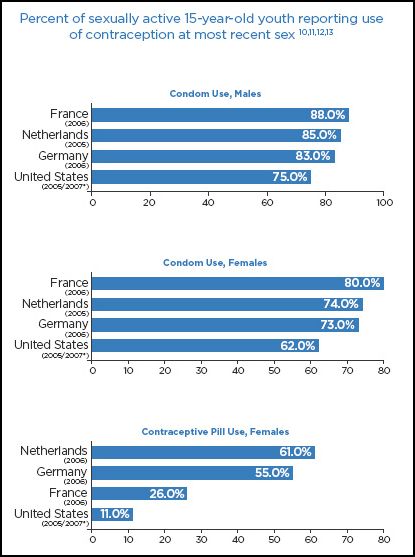
You can read the full report here (thanks to Du Hoang for the specific link!).

Lisa Wade, PhD is an Associate Professor at Tulane University. She is the author of American Hookup, a book about college sexual culture; a textbook about gender; and a forthcoming introductory text: Terrible Magnificent Sociology. You can follow her on Twitter and Instagram.


Count how many times the players wearing white pass the basketball, then continue after the jump:

more...

Please accept this newest edition of violence is sexy, courtesy of Lisa R.  The promo below, designed to advertise two shows about female murderers (Deadly Women and Wicked Attraction), sexualizes murder. The narration goes:

In the heat of summer, temperatures rise, passions erupt, and sometimes, things… turn… deadly.

They “erupt.” Get it? Get it!?

The thing is, these are stories about real women who actually murdered people. Lisa writes:

…the crimes they’re talking about on these shows are not all sex-related, and I’m just going to go out on a limb and say none of them are sexy, either. The only reason I can even fathom for a promo like this is just the notion that women are sex personified, like the green M&M. Even committing horrible, gruesome murders can’t change that.

In other words, if women are involved, best to sexify. If a man murders a man, it’s just violence. But if a man murders a woman or a woman murders a man, it’s sexy, sexy violence. If a woman murders a woman, will the murder be sexualized? I bet it would.

This calls into question the idea that we sexualize violence against women because we find pleasure in harming her. Instead, maybe we sexualize violence against women simply because we sexualize women.

Also in random, bizarre things sold with sex, see our post on using sex to sell the most unlikely things.

Lisa Wade, PhD is an Associate Professor at Tulane University. She is the author of American Hookup, a book about college sexual culture; a textbook about gender; and a forthcoming introductory text: Terrible Magnificent Sociology. You can follow her on Twitter and Instagram.

an average looking washroom sign where the men's and women's  washrooms are indicated with stick figures

Women’s and men’s washrooms: we encounter them nearly every time we venture into public space. To many people the separation of the two, and the signs used to distinguish them, may seem innocuous and necessary. Trans people know that this is not the case, and that public battles have been waged over who is allowed to use which washroom. The segregation of public washrooms is one of the most basic ways that the male-female binary is upheld and reinforced.

As such, washroom signs are very telling of the way societies construct gender. They identify the male as the universal and the female as the variation. They express expectations of gender performance. And they conflate gender with sex.

I present here for your perusal, a typology and analysis of various washroom signs.

[Editor: After the jump because there are dozens of them… which is why Marissa’s post is so awesome…]

more...

NEWS:

Happy fall semester everyone!

For me, classes begin today and just yesterday the doc gave me the a-okay to walk without the “boot.”  So “hello” to students and “goodbye” to the summer-of-a-broken-leg!

You may have noticed that our parent site has changed to The Society Pages.  This is a name change only and we’re still thrilled to be under the stewardship of Doug, Chris, Jon, Letta and the wonderful folks at the University of Minnesota.  Word on the street is that SocImages crashed their servers so many times that they had to reconfigure them!  We’re so grateful to have their support and patience!

Gwen and I are proud to announce a new SocImages essay, What is Indian Art?, published in Contexts magazine (based on our original post).  If you’d like a pdf of the essay, send a note to socimages@thesocietypages.org and we’ll send it along.  You can see a list of our teaching essays here.  They’re all super short and great for in class exercises.

Finally, this is your monthly reminder that we’re on Twitter and Facebook (where we update with featured posts everyday).

NEWLY ENRICHED POSTS (Look for what’s NEW! Aug ’10):

Women clean because they love it, don’tcha know!

Facebook has added a generic female avatar.

Another example of boys are kids and girls are girls.

More pinkification of manly items for the ladies.

We added a 38th example of food items conflated with sexy women.

Lisa Wade, PhD is an Associate Professor at Tulane University. She is the author of American Hookup, a book about college sexual culture; a textbook about gender; and a forthcoming introductory text: Terrible Magnificent Sociology. You can follow her on Twitter and Instagram.


Rachel sent in a commercial for Dove chocolate that, as she says, sends “mixed messages…about unrealistic beauty standards for women.” Here’s the video:

Transcript:

We’re only human, but we try to be perfect.
We pretend that high heels are comfortable, and that waxing just takes getting used to.
We pretend we can manage anything that’s thrown at us, and sometimes we can.
And other times, we just have to cut ourselves some slack, and take a moment.
Because although we’re only human, that’s more than enough.
Your moment, your Dove.

The commercial seems to want to have it both ways. On the one hand, trappings of conventional femininity (heels, waxing, as well as being a superwoman who can handle “anything that’s thrown at us”) are accepted as “perfection,” elements of an ideal version of us we aspire to. On the other hand, it’s drawing on the idea that we should just accept ourselves — we’re “more than enough” — but in a way that implies that we have to do this not because there’s something wrong with an ideal of perfection that requires women to put ourselves through painful rituals, but just because sometimes we can’t manage to meet that ideal and have to give ourselves a break and eat some chocolate (of course!) to console ourselves before we get up the energy to throw ourselves back into the search for perfection again. As we often see in advertising, it uses a women’s empowerment message (you’re great the way you are! You can do anything!) in a superficial way that simply suggests consumption as a solution rather than truly challenging the beauty ideals it appears to be critiquing.

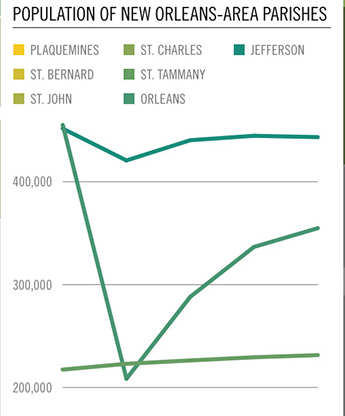
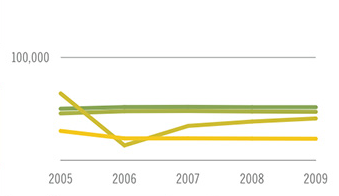
Allie B. sent us a link to an image at GOOD that presents some pre- and post-Katrina information about New Orleans. The map indicates levels of population recovery; the darker the shade of green, the more the population has rebounded:

A close-up of one section (areas with black shading had over 6 feet of floodwater):

Notice that the Lower Ninth Ward, one of the hardest-hit areas, has among the lowest level of redevelopment.

There’s a much larger version of the map (with a not-too-specific list of sources) here.

Changes in the populations of different parishes:

The income distribution has changed somewhat as well, with a smaller proportion in the lowest income categories (though notice that the dollar range included in each color isn’t consistent as you get into the higher incomes):

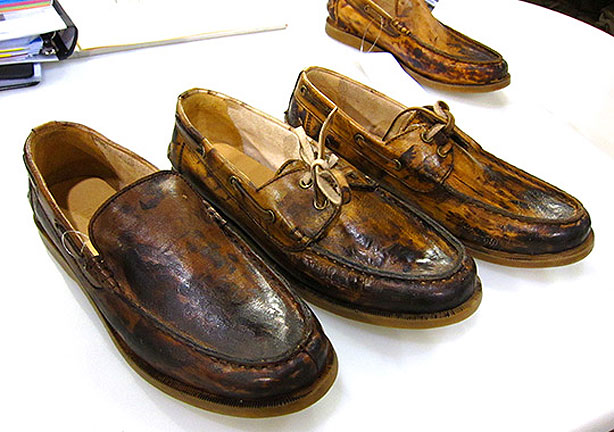
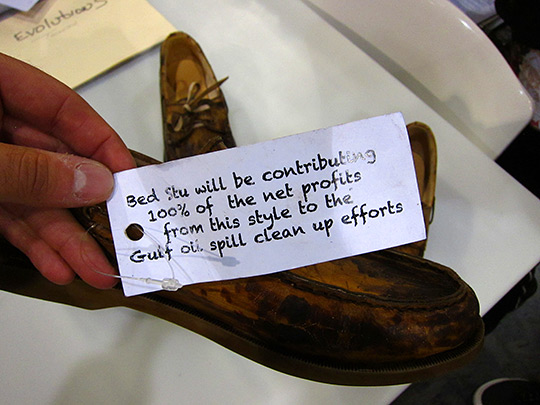
These Bed Stü shoes, sent in by Dmitriy T.M., are meant to appear as if they are covered in oil accumulated while cleaning up the BP oil spill in the gulf.

According to Selectism, 100% of the proceeds are going to help wildlife affected by the spill.

So Bed Stü makes no money on this collection, but gains a great deal of publicity and, potentially, good will from consumers.  And then some dude is going to be wearing shoes that look like they’re covered in oil at a garden party.

This looks to me like an example of “conspicuous conservation.”  The term was originally derived from the phrase “conspicuous consumption,” defined by Wikipedia as “lavish spending on goods and services acquired mainly for the purpose of displaying income or wealth.”  Conspicuous conservation, then, is the (often lavish) spending on “green” products designed mainly to advertise one’s environmentally-moral righteousness.

If you wear regular shoes and donate to the gulf spill clean up, your altruism is entirely invisible.  But if you buy these hideous things, everyone gets to know what a nice guy you are.

Lisa Wade, PhD is an Associate Professor at Tulane University. She is the author of American Hookup, a book about college sexual culture; a textbook about gender; and a forthcoming introductory text: Terrible Magnificent Sociology. You can follow her on Twitter and Instagram.