Search results for The


Following up on our cartoon poking fun at the skimpiness of battle gear for women, Lindsey V. sent in a considerably-humorous skit in which two great sports are dressed in the sexy outfits of two genuine-video-game-characters and set to battle.  Hijinks and wardrobe malfunctions insue:

Lisa Wade, PhD is an Associate Professor at Tulane University. She is the author of American Hookup, a book about college sexual culture; a textbook about gender; and a forthcoming introductory text: Terrible Magnificent Sociology. You can follow her on Twitter and Instagram.
Josh Leo brought our attention to something he started thinking about recently: the use of the word “hobo” among kids. This started when he saw a video of kids reacting to the Ted Williams, the man who became famous after a video of him panhandling at an intersection and displaying his “golden voice” went viral. Josh was struck with the way the kids talk about individuals who become homeless and, in particular, the repeated use of “hobo” to describe him (they discuss Williams in the first 2 minutes):

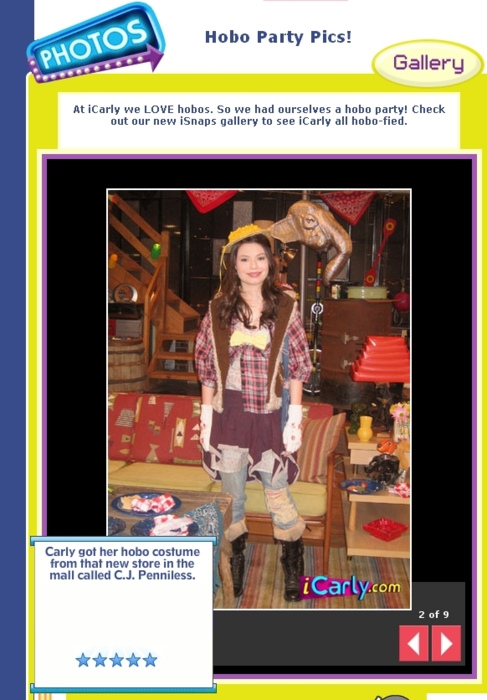
Since one girl attributed her use of “hobo” to the TV show iCarly, Josh did a little searching and discovered that the show’s official website contains a set of photos of the cast dressed up for a Hobo Party, complete with captions that make fun of or trivialize poverty and homelessness, including this first one that refers to the store “C.J. Penniless”:

A quick google search turns up lots of images of and suggestions for throwing hobo parties (including a video of a “Hobo House Party,” in which four people in costume dance in a cardboard box). Now, my guess is a lot of people would argue that references to hobos today aren’t really about homelessness now, since it’s a term often associated with the Great Depression. Indeed, a lot of the hobo party sites I found referred to the Depression or suggested 1930s-type clothing. But the video of the kids’ reactions certainly shows that they don’t just see it as a term for people in the past; they clearly connect it to homeless people today.

This trivialization of homelessness and poverty isn’t just on kids’ shows, though. It reminded me of a segment The Daily Show did recently about a news affiliate in Indianapolis that decided to see if any local homeless individuals could be the city’s own “golden-voice” (the segment starts at about 1:30 in):

Such a news story could humanize homeless individuals, of course. Instead, the news segment treats the two women as sources of entertainment whose value comes only from the possibility that they might surprise us by having a “hidden talent.” The idea that it would be shocking to find a homeless person with an amazing gift presumes that people who have skills or talents don’t become homeless, while also presenting the solution as very individualistic: if you’re the next Ted Williams, you can have a house and a job too!

Gwen Sharp is an associate professor of sociology at Nevada State College. You can follow her on Twitter at @gwensharpnv.

Coverage of the Egyptian protests this week disproportionately interviewed and photographed male protestors, occasionally using the terms “Egyptian men” and “protestors” interchangeably (excellent example here).  What images we did receive of women depicted them as separate from the demonstrations if not dependent on male guardianship.  The paucity of images or stories about women activists excludes them from the national uprising and silences their protests.

Outside of the mainstream media a widely circulated photo album, available to anyone with Facebook, collected over a hundred pictures of Egyptian women demonstrating. Curation of this album during the internet blackout, when nearly all images were filtered through the media, serves as a testament to the value of diaspora and transnational networks.  Additionally, placing these images side by side becomes a powerful counter to women’s media invisibility and highlights diversity of backgrounds, opinions, and forms of protest undertaken by Egyptian women.

It might be worth nothing that we’re seeing more stories about women since a You Tube video (below) of a woman calling for people to join her in protest on January 25th caught the attention of the media.  Namely this excellent NPR story and an AFP article.  Lastly, anyone interested in social media should visit this Facebook group.

April Crewson is completing her masters in Gender Studies at the School of Oriental and African Studies, University of London.

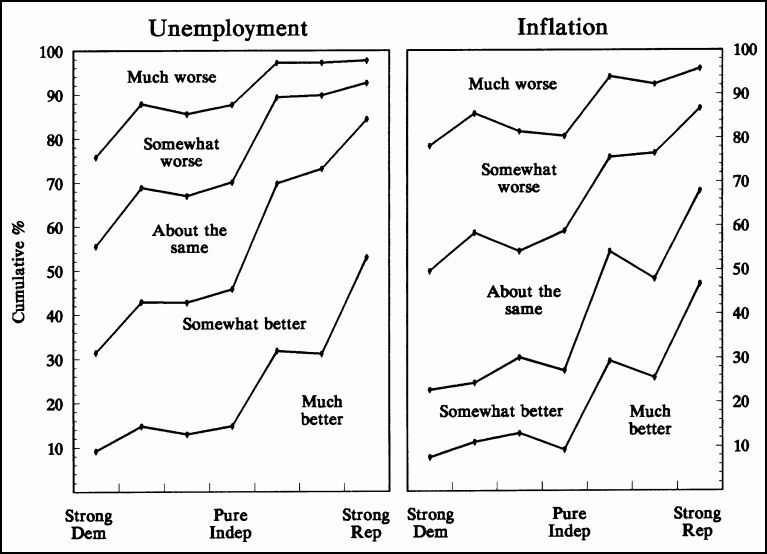
The figure below, featured in a paper by political scientist Larry Bartels, maps partisan identification — whether one identifies as a Democrat, an Independent, or a Republican, and how strongly — with opinions as to whether unemployment and inflation had gotten better or worse under Reagan’s presidency (1981-1988).  It shows that partisan beliefs strongly predict people’s opinions about discernable facts.

Via Gin and Tacos.

Lisa Wade, PhD is an Associate Professor at Tulane University. She is the author of American Hookup, a book about college sexual culture; a textbook about gender; and a forthcoming introductory text: Terrible Magnificent Sociology. You can follow her on Twitter and Instagram.
In a previous post I discussed A. J. Patrick Liszkiewicz’s suggestion that we play Farmville because we’re polite. Farmville, he argues, is a cooperative game; one needs help from others to get very far.  So you are invited to play by friends, entreated to assist them, and given gifts to encourage your participation.  The game “entangles users in a web of social obligations,” to the point where not playing would be rude or signal an effort to distance oneself from your friends who play.

Well Farmville is old news. Cityville was launched on November 18th, 2010.  Within 24 hours it had 290,000 players.  Within one month it had 84 million players, exceeding the total number playing Farmville, previously the most popular web-based game ever.  Today, more than 100 million people play Cityville.  And I’m one of them.

Well not really.  Bored on a plane flight over the holidays and enjoying free wifi on the plane, I decided to check it out.  And, despite expecting that there was a highly social dimension to the game, I was amazed — ah-mazed — at the pace at which Cityville asked me to publicize my participation and get others to join.  Below are the kinds of entreaties I received every 20 seconds or so.

Each time I achieved a “goal” Cityville suggested that I tell everyone and share coins with friends.  Sometimes Cityville would suggest that I get friends “started” by sending them gifts or help them with a city they’ve already got. It also suggested that I add neighbors and populate my own city with my friends in various roles. You can also visit your friends’ cities, help them out (e.g., harvest for them), or own businesses in their cities.  All of this earns both of you points of various kinds. In fact, Cityville would only let me do certain things if my friends helped me do them. Cityville also told me which of my friends were playing.

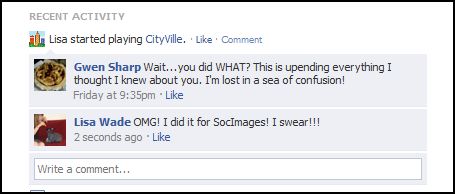
Then, despite having at no time clicking on “share” anything, Facebook put the news that I was playing Cityville on my wall (it was probably in the “I agree” contract at the very beginning).  Gwen was predictably surprised:

Finally, after about a week, Cityville got directly into my email inbox to tempt me to play again with FREE CASH!.

So there you have it. Cityville implores, pleads, begs, insists, threatens, and cajoles the user into getting their friends involved. It’s an insidious social network parasite… and it’s contagious…

Lisa Wade, PhD is an Associate Professor at Tulane University. She is the author of American Hookup, a book about college sexual culture; a textbook about gender; and a forthcoming introductory text: Terrible Magnificent Sociology. You can follow her on Twitter and Instagram.
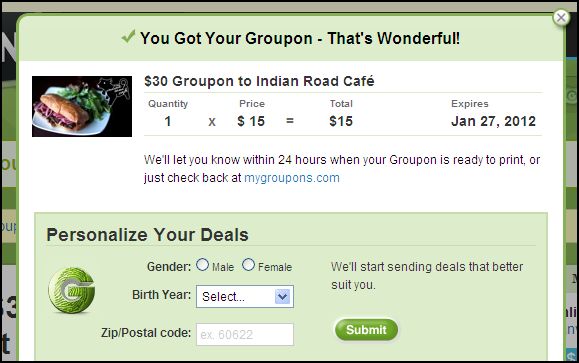
Sent in by Liz Yockey, who signed it for GroupOn, it is kind of interesting that all the site thinks it needs to know about you is your sex and your age to send you local coupons that suit you.

Are you just like every other n-something f or m you know?  Are we so predictable?  Perhaps marketers know better than we.  What do you think?

Lisa Wade, PhD is an Associate Professor at Tulane University. She is the author of American Hookup, a book about college sexual culture; a textbook about gender; and a forthcoming introductory text: Terrible Magnificent Sociology. You can follow her on Twitter and Instagram.
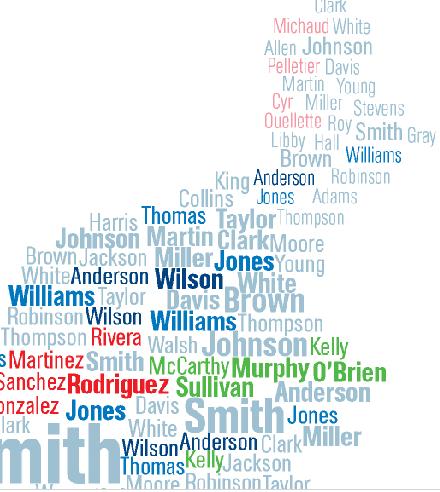
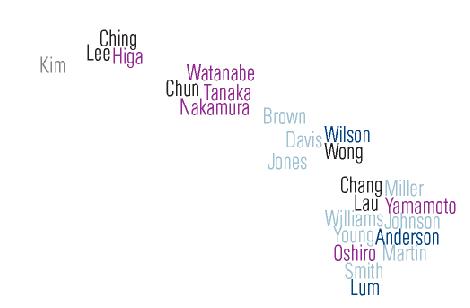
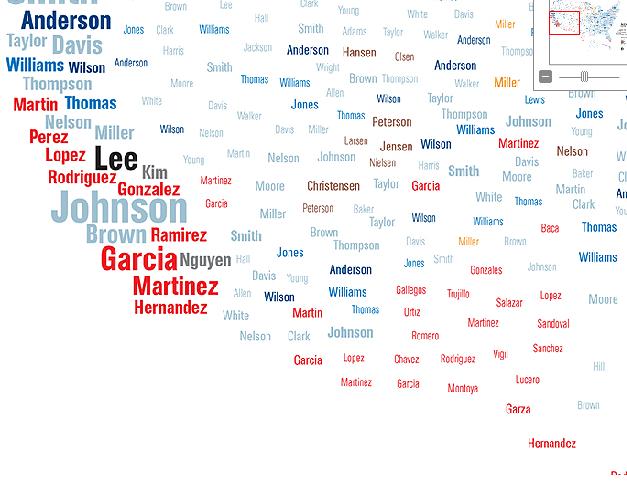
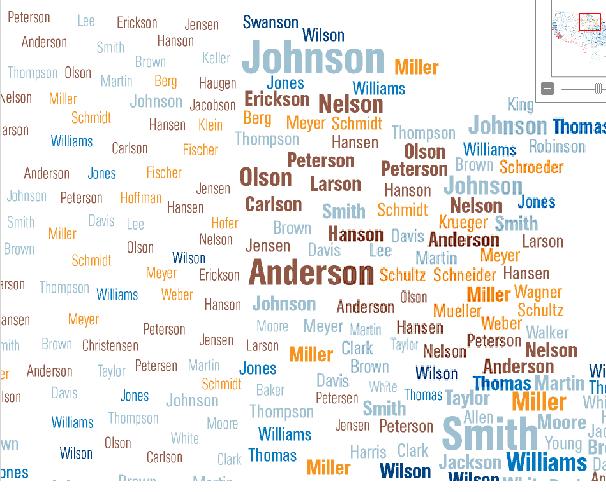
Sara P. let us know about a map at National Geographic that shows the distribution of surnames in the U.S.

The names are color coded by region of origin of the name:

A note on methodology: geographers looked at the most common by counting the most common last names in phone books and selecting the most common names in each state. This hides significant diversity in names in large cities that may have had a greater mix of immigrant groups that the state overall; for instance, a map of the most common names just in New York City might look quite a bit different than the most common names in New York state.

Nonetheless, the concentration of last names serves as an echo of immigration and settlement patterns. British-origin names tend to dominate across the U.S., unsurprisingly, particularly Smith, Johnson, and Williams. Because slaves were often given the last names of their owners, a significant proportion of individuals with British last names are African American — for instance, African Americans are about 20% of people named Smith.

Several Irish-origin names stand out in Massachusetts, as well as some French surnames in Maine:

The map of Hawaii reflects the significance of the Asian population there:

Spanish-origin names in the Southwest:

The names common in the Great Lakes/upper plains region reflects the fact that the area was a common destination for immigrations from Germany and Scandinavia:

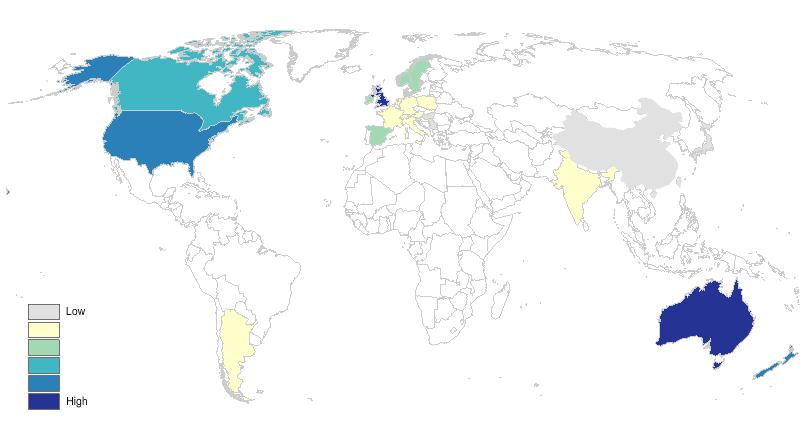
I looked up the geographers who created the maps (James Cheshire, Paul Longley, and Pablo Mateos at University College London) and that led me to an interesting website sponsored by UCL, the World Names Project. If you type in a surname, it will show where on the globe it is most common. You can also zoom in on individual nations and see the distribution within them. Here’s the global distribution of my last name, Sharp:

You also get some data about the name: its origin, the top 10 regions and individual cities for that name, and the most common first names that go with it (which, in all the names I tried, were overwhelmingly male, so I don’t know what to make of that).

As Sara said of the National Geographic map, many of the results are predictable, but that doesn’t mean it’s not fun to look at them.

UPDATE: Reader Kristina provides an explanation for why male names dominate the most common first names lists:

My explanation for Gwen’s finding that the most common first names are overly represented by male names is that names for boys are less variable than names for girls.

Interesting post on that here, which notes, “it [natural language geocoder] needs 4200 first names for girls to cover 90% of the population, but it only needs 1200 boy’s names to reach a 90% coverage. The reason for this huge difference is mainly found in the top positions. The ten most popular male names reach 23% whereas the ten most popular female names reach a comparatively meager 10%.”

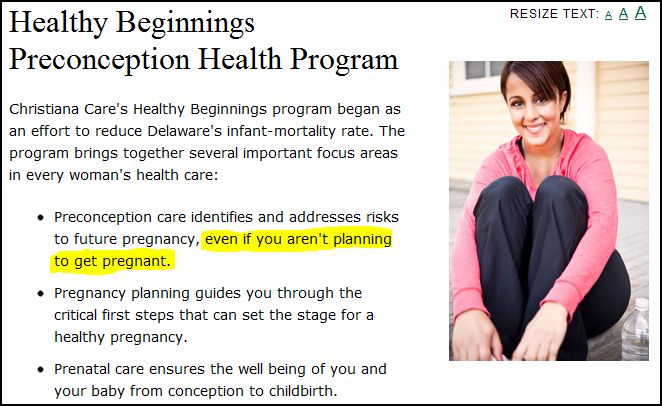
At Ms., Amy Williams posted about the pre-conception care movement.  Pre-conception care is health care aimed at making the bodies of fertile women most conducive to a healthy pregnancy.  The movement asserts that women of childbearing age should be receiving care with pregnancy in mind, whether or not the woman intends to get pregnant.  The Preconception Care webpage at Healthy Beginnings, for example, reads as follows:

In a presentation on the topic, Rebecca Kukla,  Professor of Philosophy and Obstetrics and Gynecology at the University of South Florida, explains that preconception care is an “official priority” for the Center for Disease Control and the US Office of Minority Health.   So what’s to be concerned about here?

First, the approach reduces women to their potential to make babies. Concern for women’s health is motivated not by concern for the woman herself, but her “merely imaginary future children.”   What is the value of old women, transgender women, involuntarily infertile women, and women who have been voluntarily sterilized?  What principles guide their health?

Second, treating women as potential fetus carriers sometimes interferes with the best practices for treating women. Kukla explains that doctors driven by this approach may be inclined to choose drugs that are known to improve fertility and enhance pregnancy outcomes, instead of the most effective drugs for whatever condition is at hand.  As an extreme example, consider a woman diagnosed with cancer for whom a hysterectomy is the most aggressive treatment?  Whose interests should the doctor consider?  Hers?  Those of her “merely imaginary future children”?

Third, treating women as potential fetus carriers encourages doctors and others to police women’s behaviors more stringently than men’s. Anything she does that doesn’t maximize her fertility and baby-making condition can be seen as a problem needing fixing.  Men’s life choices are simply not subjected to this sort of social scrutiny.  We already see this sort of intervention against women who are told to avoid alcohol even if they are unaware of being pregnant and have no intention of getting pregnant.

Fourth, Kukla points out that the approach skews women’s health towards those things that we think affect fetal outcomes. Should these conditions necessarily take priority over others?

Finally, this approach makes women, like myself, invisible. I am a fertile woman in my 30s who has chosen not to have children.  I truly hope that my health care is not being compromised by my doctor’s concern for the babies I am never going to have.  Nor do I think it’s cute that her concern for me is driven by my reproductive potential.

UPDATE: Heather Leila, in the comments, critiqued this post.  “Having participating in the Office of Minority Health´s preconception campaign,” she writes, “I can attest that none of the above 5 points speak to the reality of the program.”  She continues:

It´s easy for women commenting on this blog to be offended when it is suggested they are not in full control of their fertility. But the truth is that many women are not. They don´t have the access or the education about contaception. 50% OF ALL US PREGNANCIES ARE UNPLANNED.

OMH´s campaign addresses contraception and avoiding unwanted pregnancy. OMH recognizes that many women don´t want to become pregnant, now and later. The campaign seeks to reduce unwanted pregnancy alongside improving preconception health as a way to reduce infant mortality. The campaign also speaks directly to men – taking some of the pressure off women.

This post failed to mention that the OMH campaign is based on the very racial disparity in infant mortality that SI posted on just a few weeks ago.

Lastly, the campaign is geared towards women, not to their doctors. In no way would this campaign promote doctors valuing fertility over a woman´s life. Never would it suggest witholding a hysterectomy to protect fertility. The campaign is NOT about increasing fertility. It is about decreasing infant mortality. Two very different things.

It seems like neither Dr. Kukla nor Sociological Images has taken the time to fully understand this campaign before criticizing it. I think there is a lot to analyze and criticize within the campaign, but Dr. Kukla´s 5 points do not address true aspects of the program. They are invented.

Heather has posted about pre-conception care at her own blog, A Minha Vida.

Lisa Wade, PhD is an Associate Professor at Tulane University. She is the author of American Hookup, a book about college sexual culture; a textbook about gender; and a forthcoming introductory text: Terrible Magnificent Sociology. You can follow her on Twitter and Instagram.