Search results for The

In the wake of two rounds of racially-charged anti-abortion campaigns: “Black Children are an Endangered Species” and “The Most Dangerous Place for an African-American is in the Womb.” These campaigns are built around the fact that pregnant black women are more likely to have abortions than pregnant white women.  The one getting attention at the moment, sent in by Laura E., is a set of billboards from That’s Abortion in the South Side of Chicago:

I’ve said this before, and it’s being said elsewhere, but I think it deserves to be said again, and strongly.

Many women have abortions because they cannot afford to raise a(nother) child.  They would bring the fetus to term if only they weren’t all-but-crushed under the burdens of under-served neighborhoods, shitty public education, a dearth of jobs that pay a living wage, a criminal justice system that strips inner cities of husbands and fathers, a lack of health care, and stingy, penalizing, and humiliating social services (when they can get them).  So telling black women that they are bad; telling them that they are killing their race alongside their babies, is twisting a knife that already penetrates deep in the black community.

Not to mention the fact that as soon as those poor women have children, they’re demonized for irresponsibly bringing babies into the world that they cannot support.  It’s called a double bind; damned if you do, damned if you don’t.  And no they cannot “wait until they’re in a better place financially” or “not have sex until they can afford to raise a child” because many, many women will never be in such a place in their entire lives.  And they can’t just “practice responsible contraception” because half of all pregnancies are unintended, at least a third among even the most well-educated and resource-rich women.  So pregnancies will and do happen, even to people who don’t want or can’t have a child.

If pro-life groups want to stop abortion, they need to stop accusing black women of moral bankruptcy and start putting those billboards up across from the Capital Building.  What black women need isn’t an ethics lesson, they need resources.  They need those very same people who tsk tsk them to stand up for them, to fight for a living wage, investments in their schools and communities, protection instead of criminalization, more available and better subsidized child care, and guaranteed parental leave benefits for all (it’s not a fantasy).  If black women had those things, then they might feel like that had a choice to keep their baby, just as they have a choice to abort their fetus.

It’s not the parents who fail to care-about-the-children in America, it’s a government and it’s citizens that allow 1 in 5 to languish in poverty.

Lisa Wade, PhD is an Associate Professor at Tulane University. She is the author of American Hookup, a book about college sexual culture; a textbook about gender; and a forthcoming introductory text: Terrible Magnificent Sociology. You can follow her on Twitter and Instagram.
Mark Twain, Plato, Charles Dickens, John Stuart Mill, Voltaire, Ralph Waldo Emerson.  For years, these names were thought necessary components of higher education.  Without understanding these authors and their “great books,” so the story went, our students would lack in critical thinking skills and intelligence.  Yet, in the wake of the 1960s and challenges to white male dominance, students and educators begin to demand a more well-rounded and inclusive canon.  University curriculums constituted almost entirely by dead, white, male, European writers, were slowly accompanied by a few token “others.”

In the 1980s and ‘90s, the debate over what constituted a proper and effective “canon” reached a fevered pitch.  The supposed decline of American knowledge and intelligence was blamed on the multiculturalism’s rise in the Ivory Tower.  For example, University of Chicago philosophy professor Allan Bloom’s book The Closing of the American Mind (1987) vigorously argued for a return to the traditional canon.  In addressing this tension, sociologist Bethany Bryson wrote:

Two decades of heated battle would ensue between members of what would become known as the Cultural Left and the Cultural Right—academics and public intellectuals who engaged the debate in the national media.  Despite the appearance of an epic battle between opposing forces, however, the two “sides” shared an extraordinary premise: that every time an English teacher put together a reading list, the future of a nation hung in the balance.*

Years later, most agree that the “Cultural Left” won the canon wars.  It is generally assumed that today’s university curriculums and bookstores are repositories of diverse writers and viewpoints.

So, what does this cornucopia of diversity look like?   We don’t have to look far to answer the question.   A trip down the aisles of today’s college bookstores serve as off-hand metrics for what is “legitimate knowledge.”   Moreover, these bookstores decorate their store walls with uniform and corporate–approved book covers and authors’ likenesses.  By way of example, I headed over to the bookstore at Mississippi State University.

Throughout this bookstore, 3’ x 5’ posters of notable books are displayed above the shelves and sitting areas.  In total, thirty-three different book covers grace the walls, however, John Steinbeck’s Cup of Gold is displayed twice to bring the total to thirty-four.  Nine of these thirty-four (26%) titles were produced by nonwhite, female, and/or gay/lesbian writers: Rosario Castellanos’ The Book of Lamentations, Pablo Neruda’s Fully Empowered, James Baldwin’s Go Tell It On The Mountain, Maria Edgeworth’s The Absentee, Harper Lee’s To Kill a Mockingbird, Ayn Rand’s Atlas Shrugged, Sylvia Plath’s The Bell Jar, Louisa May Alcott’s Little Women, and Ralph Ellison’s Invisible Man.

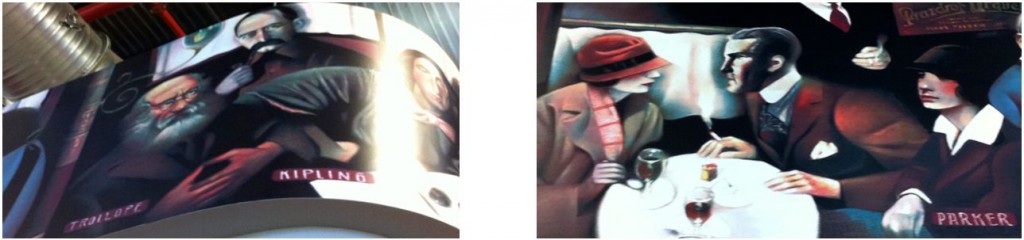
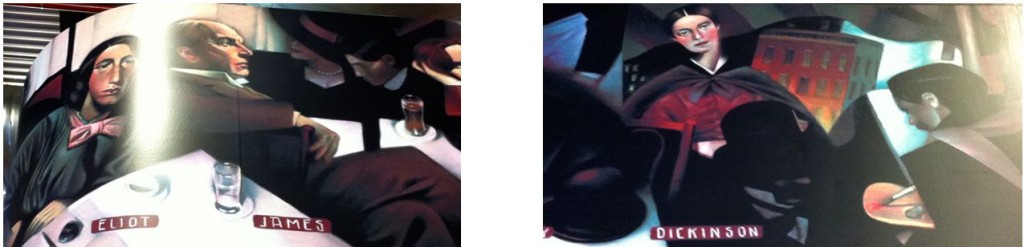
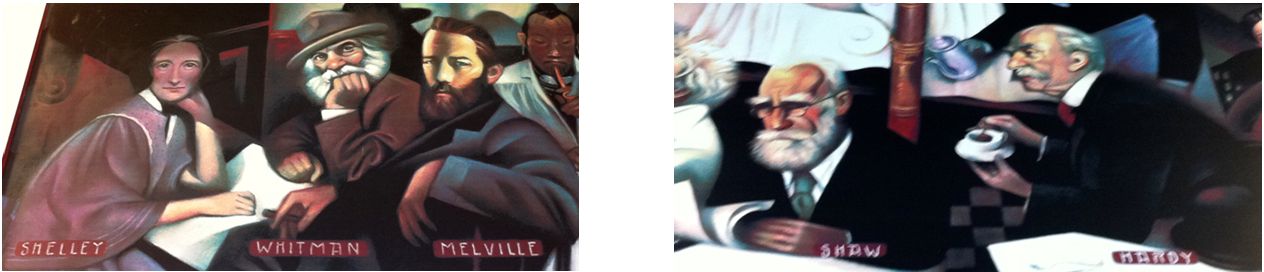
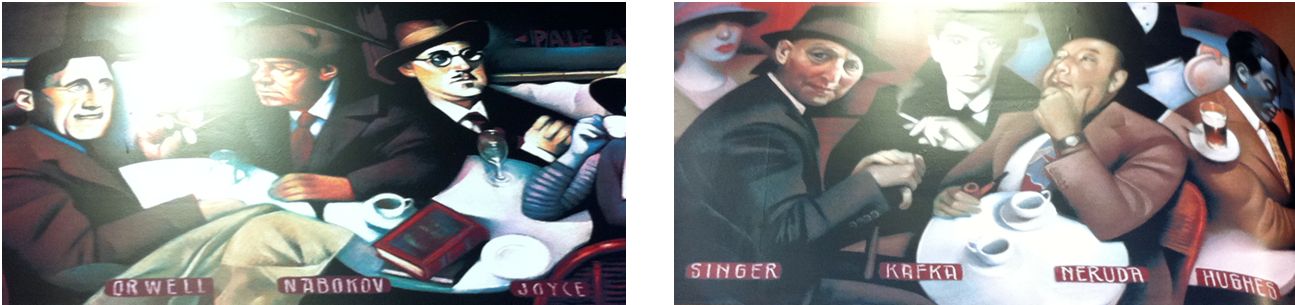
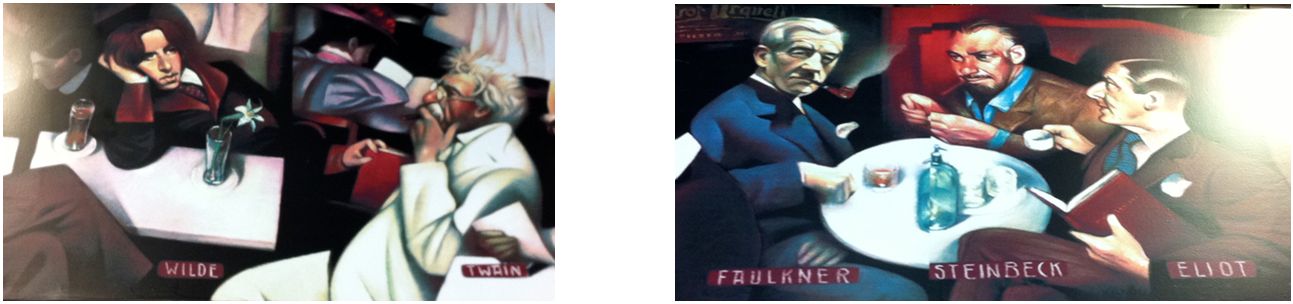
In addition to the posters, on a wrap-around,mural above the café, 23 authors sit in a restaurant, smoking, drinking, eating, and enjoying one another’s conversation and company.  As shown below, the authors displayed are: Shelley, Whitman, Melville, Trollope [spelled as “Troilope” here], Kipling, [George] Eliot, James, Wilde, Twain, Shaw, Hardy, Dickenson, Orwell, Nabakov, Joyce, Parker, Faulkner, Steinbeck, [T. S.] Eliot, Singer, Kafka, Neruda, and Hughes.

Out of the twenty-three authors displayed, four (17%) are women, two (9%) are people of color ( literally marginalized to the far right of the mural as it curls behind a support beam), and two (9%) are considered to have been gay.  Withstanding the overlap of Hughes in two categories (gay and nonwhite), we are left with only six out of twenty-three (26%) authors that do not conform to the white, male, straight demographic thought characteristic of traditional canon authors.

The twenty-six percent of book covers and paintings are the height of LGBT, female, and nonwhite author representation in this store.  While the shelves certainly carry more than nine books and six authors of this ilk, I’d wager that the total percentage does not come close to a quarter of their total inventory.  If these numbers and framing together epitomize the great victory of the Canon Wars by the Cultural Left, then it is certainly an unfinished battle.

* Bryson, Bethany. 2005.  Making Multiculturalism: Boundaries and Meaning in U.S. English Departments.  Palo Alto, CA: Stanford University Press, p 2.

Matthew W. Hughey is a recent graduate of the University of Virginia (2009) and is currently an assistant professor of Sociology at Mississippi State University.  He is co-editor (with Dr. Gregory Parks) of The Obamas as a (Post) Racial America?12 Angry Men: True Stories of Being a Black Man in America Today, and Black Greek-Letter Organizations, 2.0: New Directions in the Study of African American Fraternities and Sororities.  He is also author of the forthcoming White Bound: White Nationalists, White Antiracists, and the Shared Meanings of Race.  Please feel free to visit his website or contact him at MHughey@soc.msstate.edu.


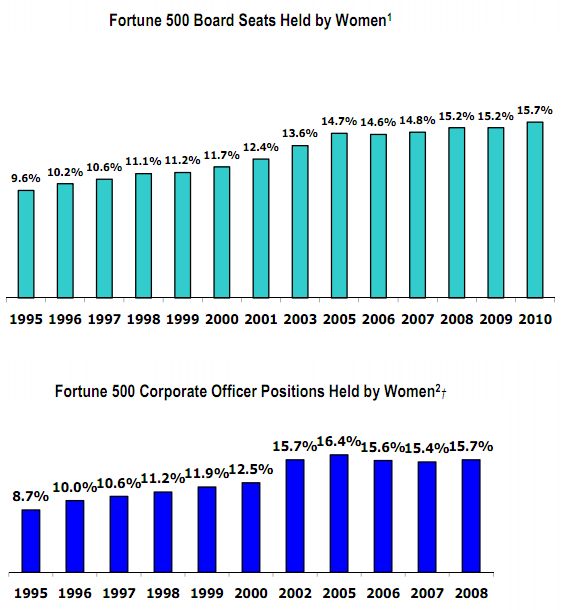
Going on 500 of you “liked” our recent post summarizing the statistical case against Walmart for gender discrimination.  A new Catalyst report, sent along by Washburn University Professor Sangyoub Park, reveals that Walmart isn’t alone in failing to promote women.  The study of Fortune 500 companies found that the percent of board seats and corporate officer positions held by women have been increasing, but not particularly quickly (source):

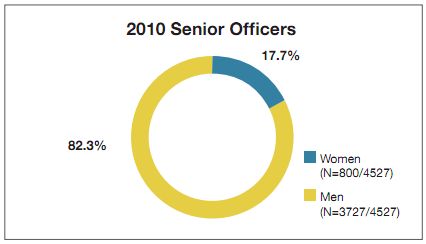
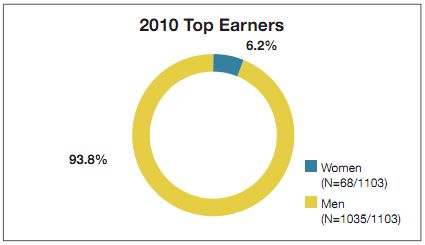
As of 2010, 18% of senior officers and 6% of their top earners were women (source):

136 of the 500 companies had exactly zero female executives.

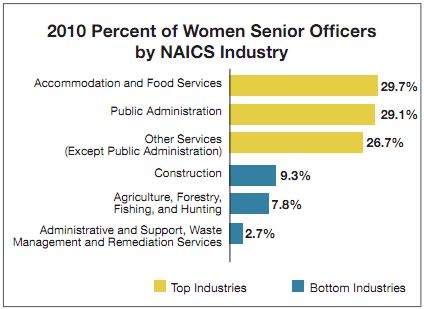
The data, however, actually varies quite tremendously by type of company (in a way that dovetails with general job segregation by sex):

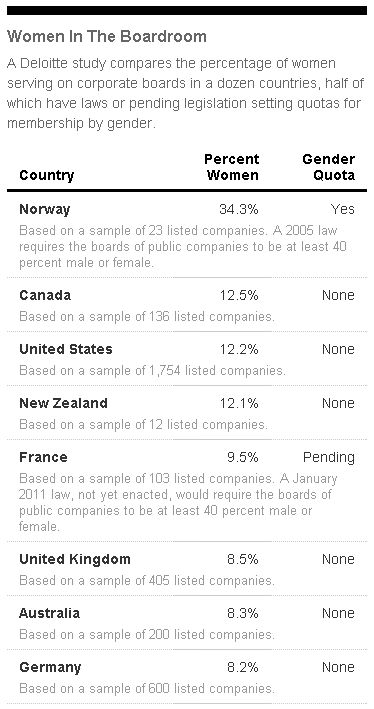
Data from the Deloitte Global Center for Corporate Governance, covered by NPR, reveal how the United States compares to other similar countries.  It shows that Europe is also struggling to achieve parity in the boardroom:

Lisa Wade, PhD is an Associate Professor at Tulane University. She is the author of American Hookup, a book about college sexual culture; a textbook about gender; and a forthcoming introductory text: Terrible Magnificent Sociology. You can follow her on Twitter and Instagram.
Sometimes public service announcements miss the mark.  Like really, really miss the mark.  In 2009 I described an anti-teen pregnancy PSA as gut-wrenchingly horrible and the feeling has not waned with time.  It suggests that teenagers who have gotten (someone) pregnant are dirty, cheap pricks, nobodies, and rejects.  We’ve also highlighted PSAs against statutory rape featuring children with giant breasts and an anti-domestic violence campaign in which you “hit the bitch.”

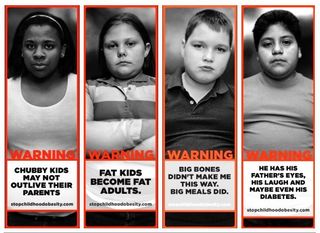
The campaign I’d like to discuss in this post is along these lines.  Brought to my attention by Debbie at Body Impolitic, it is the Georgia Children’s Health Alliance’s anti-childhood obesity campaign.  And it shames fat children and encourages viewers to retain negative stereotypes about them.  First, I wonder how it must feel to be chosen to be the posterchild for this campaign?

Second, some of the short videos available on the website confirm nasty stereotypes about fat people.  Like, all they do is eat:

Ironically, some of the videos acknowledge that fat children are subject to discrimination (at least from other kids), but that doesn’t appear to have stopped them from feeding that prejudice with their message.

Lisa Wade, PhD is an Associate Professor at Tulane University. She is the author of American Hookup, a book about college sexual culture; a textbook about gender; and a forthcoming introductory text: Terrible Magnificent Sociology. You can follow her on Twitter and Instagram.
Forbes magazine recently ranked Stockton California as the most miserable city in the US, a dubious award that comes as little surprise to the city’s struggling residents. Home prices have declined 67% since 2005, unemployment averaged a whopping 17.2% in 2010, and Stockton has the second highest crime rate in California.

In response, Gregory Basso, a retired Stockton businessman, created a video disputing Forbes’ findings. This clip went viral, at least locally, and was discussed by many Stockton residents. In his video, Basso highlights the attributes of Stockton he believes contribute to his high quality of life. These include “debating whether to wear my sun glasses or not in February,” and the many nearby opportunities for golfing, biking and hiking. He speaks of the seven professional sports teams found within a 2-hour radius, and the ability to sail from the yacht-lined downtown marina, along the Sacramento Delta, all the way to the San Francisco Bay. He ends by describing how Stockton has a great first time homebuyers market, and is a cheap central location for large businesses to come and set up shop.

But Basso’s lifestyle represents only a small minority of Stockton’s residents. The color of Mr. Basso’s skin, wealth, and class standing afford him privileges that most residents do not have access to. In a city with a median per capita income of $19,000, few residents have the opportunity to spend their days playing golf and yachting. Neither can they afford to live in the exclusive gated community where the beginning of the video was filmed. And Basso’s excitement about Stockton’s “first time home buyers market” might seem less compelling to the 58% of Stockton homeowners who owe more on their mortgages than their houses are worth.

It’s also worth noting that nearly all of the people depicted in Basso’s video (with the exception of University of the Pacific students) appear to be white. This is striking in a city where 32% of residents identify as Hispanic or Latino/a, 11% as African American and 20% as Asian (source). Because people of color tend to be less well off economically than whites, it stands to reason that many of these people are experiencing the misery that Basso claims that Forbes magazine “got all wrong” are people of color. And although Basso highlights many positive things about Stockton, he mentions neither its rich diversity nor its wide variety of ethnic cuisine.

Sociologist Ruth Frankenberg writes that “privilege is the (non) experience of not being slapped in the face.”*  What she means by this is not only that that white and middle class individuals have advantages over working class people and people of color, but that those of us with privilege often don’t see just how much these differences matter. She argues that race and class disparities are reproduced when those with more privileges do not look, and therefore do not see, just how different our circumstances can be.

Clearly, the goal of this video’s creator is not to erase the experiences of other Stockton residents. To the contrary, it seems he wants to diminish the stigma attached to being named the most miserable city in the US, and to cast it as a place that businesses might want to locate. This could even help generate opportunities for the very people experiencing hardships. However, in this video, Basso chooses not to see the real problems that affect many Stockton citizens. Without an understanding of these problems, Stockton residents are less prepared to address them.

* Frankenberg, Ruth. 1996. “When we are capable of stoppoing we begin to see” in Thompson and Tyagi (eds), Names We Call Home. NY: Routledge. p. 4

——————————

Brianna Gall is a senior sociology major at the University of the Pacific and was born and raised in Stockton, CA. Dr. Alison Hope Alko is Assistant Professor of Sociology at University of the Pacific, where she teaches a seminar in public sociology. Her research interests include inequality, environment, food and the social construction of place.

If you would like to write a post for Sociological Images, please see our Guidelines for Guest Bloggers.

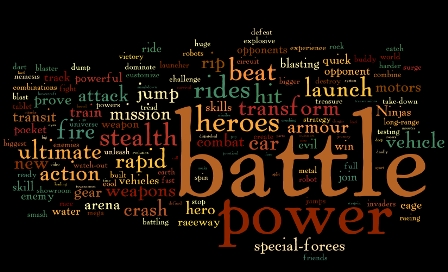
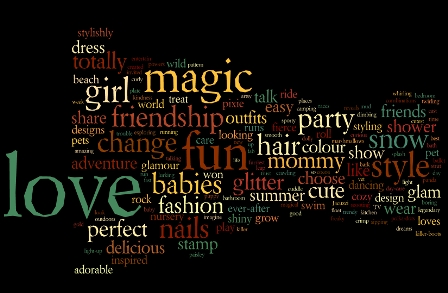
Alli, YetAnotherGirl, Molly W., and Laurence D. all sent in links (via The Mary Sue and Feminist Law Professors) to a post at The Achilles Effect on gendered language in children’s toy commercials. Crystal Smith created word clouds based on 658 words in 27 TV commercials generally aimed at boys (products included “Hot Wheels, Matchbox, Kung Zhu, Nerf, Transformers, Beyblades, and Bakugan”) and 432 words from 32 TV commercials generally aimed at girls (products: “Zhu Zhu Pets, Zhu Zhu Babies, Bratz Dolls, Barbie, Moxie Girls, Easy Bake Ovens, Monster High Dolls, My Little Pony, Littlest Pet Shop, Polly Pocket, and FURREAL Friends”).

This clearly isn’t a random sample of all toy commercials on all TV channels to all age groups; as Smith points out, it ignores toy companies that can’t afford TV ads, and it’s not a huge sample. However, given that these are popular toys that were being marketed during shows (such as cartoons) that are aimed at children, the word clouds provide a basic overview of gendered language in toy ads.

The word cloud for the boys’ list shows the emphasis on action and violence, with others depicted as opponents, a nemesis, or enemies:

For girls, the words are much more about appearance/fashion, relationships (friends, friendship, etc.), and playing mommy:

You can see larger versions at Wordle (girls and boys) and Smith says she has a reference list of all the commercials she a reference list of all the commercials available, which I requested. I’ll update the post with the list when I get it.

UPDATE: In response to my email, Crystal Smith cautioned, “This is a very small sample of brands that tend to appear frequently during kids’ cartoon blocks on TV. They are highly gendered toys, which explains the incredible contrast between the two lists.” She sent along the references; the girls’ list is available here, the boys’ list here.

When Alexandra Wallace’s video – the epiphanus interruptus* complaint about Asians at UCLA using their cell phones in the library – went viral, most of the reactions were accusations of racism. I’m not sure where the line between racism and ethnocentrism lies, but I was struck more by the underlying ethnocentric assumptions about family, assumptions that are widely shared here and by people who would never be accused of racism.

We Americans all agree that we value family. When I begin the unit on culture, I ask students to jot down three American values. The one that appears most frequently is family. If I asked students what things they themselves value, I’m sure many of them would say family. So, I suspect, would Ms. Wallace.

But here’s how she begins her rant, after a brief disclaimer:

It used to really bug me but it doesn’t bother me anymore the fact that all the Asian people that live in all the apartments around me – their moms and their brothers and their sisters and their grandmas and their grandpas and their cousins and everybody that they know that they’ve brought along from Asia with them – comes here on the weekends to do their laundry, buy their groceries, and cook their food for the week. It’s seriously, without fail. You will always see old Asian people running around this apartment complex every weekend. That’s what they do.

These Asian families, in Ms. Wallace’s view, include too many peripheral members (grandparents, cousins). And family members spend too much time together and do entirely too much for one another.

The trouble apparently is that Asians really do value family.

The too-much-family motif runs through her objections about cell phones as well.  She obviously doesn’t know what the callers are saying or who they’re talking to, but she suspects that it’s family back in Asia:

I swear they’re going through their whole families, just checking on everybody from the tsunami thing.**

Many international students in the US have noted this same contradiction between Americans’ proclaimed value on family in the abstract and what to the international students seems like a fairly thin and compartmentalized connection to family in the real world. As Rebekah Nathan says in My Freshman Year,

Americans, they felt, sharply distinguished their family from their friends and schoolmates; more than one international student remarked about the dearth of family photos on student doors,*** as if family didn’t exist at school. . . .Peter [a student from Germany] told me . . . “No one here says, “come on and meet my family.”

Do, do Americans value family? Yes, but. . . . The ‘but’ is a competing value that pervades American culture, including the family – Independence.**** As Ms. Wallace says in the conclusion to her complaint about Asian families, “They don’t teach their kids to fend for themselves.”

————————————-

* “I’ll be in like deep into my studying . . . getting it all down, like typing away furiously, blah blah, blah, and then all of a sudden when I’m about to like reach an epiphany… Over here from somewhere, ‘Ooooh Ching Chong Ling Long Ting Tong, Ooohhhhh.’”

** Adding “thing” to “the tsunami” makes Wallace seem especially callous. Linguists must have looked into this, but for some reason, “thing” here implies, “I don’t know or care much about this because it’s not very important.”  I vividly recall a scene in the 1993 film “Searching for Bobby Fischer,” where Joe Mantegna, as the competitive chess father, is at a parent-teacher conference. The teacher is concerned that Mantegna’s chess-prodigy son (age 8 or so) is falling behind academically and socially. She adds, “I’m sure he’s very good at this chess thing, but that isn’t really the issue.” Mantegna loses it. “My son has a gift. He has a gift, and once you acknowledge that, then maybe we’ll have something to talk about. Chess is what it’s called. Not the ‘chess thing.'”

*** If you watch the Wallace video, look at the board of photos behind her and try to find parents.

**** See my earlier post on the family-vs-independence conflict as it appears on American television, especially in sitcoms that have pretensions of seriousness.

NEWS:

We have lots of fun stuff to report this month!

First, please join us in thanking Jon Smajda for re-designing our website!  In addition to the aesthetic changes (always keeping us looking fresh, he is), he’s given us power over TABS.  We have lots of plans for these tabs, so keep an eye out and please be patient with our experimenting.

Second, SocImages sparked the outcry that led to Abercrombie Kids removing a product from their website.  Reader Allison K. sent in the tip, we put up a short post about the push-up bikini tops and the sexualization of young girls (Abercrombie Kids is for ages 7-14), the story went viral, and Abercrombie eventually folded.  All in all, a fun week. Plus I had the distinct pleasure of being quoted using the phrase “perverted uncle.”

Alongside the Abercrombie story, Gwen and I were interviewed by Tom Megginson for Change Marketing, my discussion of the blog Born This Way was picked up by ABC News, and we received a generous review at Shinpai Deshou.

Finally, this is your monthly reminder that we’re on Twitter and Facebook.

Oh, and we’d be remiss if we didn’t tell you that Sociological Images has been purchased by AOL!  The editors of The Society Pages have agreed to turn over editorial control to the mega-corporation in exchange for a principle-collapsing $315 million dollars.  Gwen and I must admit that we’re a bit confused by the whole thing.  Somehow we thought our 3,419 free posts were for something bigger than Chris and Doug’s pocketbook.  But, looking back, we have to admit that we were, um, tragically and enormously naive.  Hind-sight is 20/20 I guess; c’est la vie.