Search results for The

Dolores R. sent a link to a map created by Derek Watkins to show how the names given to geographic features reflect cultural patterns. Using a database of names officially accepted by the U.S. Board of Geographic Names, Watkins mapped generic terms used in the names of streams (excluding “creek” and “river,” which are commonly used throughout the U.S and were plotted in a gray that fades into the background):
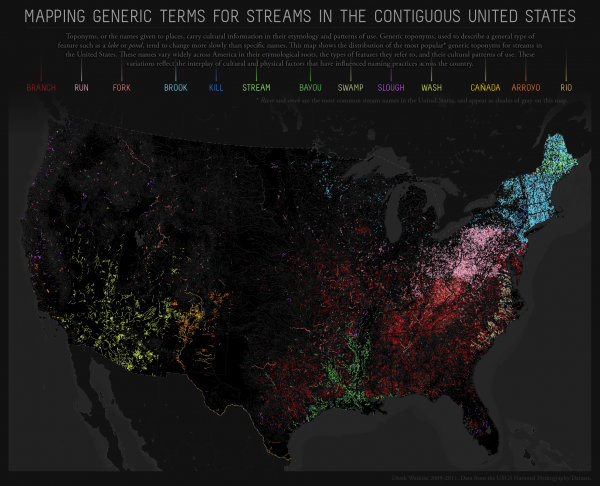
The generic terms reflect historical immigration patterns. “Kill” appears in areas of New York originally settled by the Dutch; “cañada,” “arroyo,” and “río” indicate areas of Spanish exploration and settlement in the Southwest; of course, Louisiana and the surrounding area still reflects its French heritage through the term “bayou.”

The map reflects internal migration and cultural diffusion within the U.S., as well. For instance, Watkins suggests that the patch of red in southwest Wisconsin, indicating the use of “branch,” may be due to the lead mining boom in the early 1800s. Lead mining attracted Appalachian miners to the area, and they may have influenced local naming practices, bringing along terms common in Appalachia.

For more on the interconnections between geographic names or terms and larger cultural patterns, Watkins suggests reading Names on the Land: A Historical Account of Place-Naming in the United States, by George Stewart (2008). Another excellent source is Wisdom Sits in Places: Landscape and Language among the Western Apache, by Keith Basso (1996).

Jake C. sent in a good example of the racialization and gendering of jobs within the service industry. This photo shows two notices for openings at a restaurant, one in English, one in (misspelled) Spanish:

The notice in Spanish isn’t a translation of the one about the hostess job; rather, it announces that two people are needed as dishwashers. It shows the way that particular positions within a workplace are often associated with certain groups, and how organizational policies may reinforce occupational segregation by sex or race/ethnicity. The role of greeting and seating customers is explicitly gendered as a hostess, while the language difference will channel applicants into different jobs. These types of practices are one part of the process that channels individuals into different positions in the workplace, both by restricting access to information about jobs and providing subtle messages to potential applicants about which positions are the best fit for them.

According to Federal Parliament member Charlie Angus, leaders of the Attawapiskat First Nation have declared a state of emergency. Living conditions are so terrible on the reserve that members of the community are at significant risk of illness and death.  Many residents have no electricity, heat, or running water.  They are living in uninsulated tents and shacks.  Many of these residences are filled with black mold and prone to quick-spreading fires.  Some use buckets as bathrooms; with no facilities, they dump their sewage into the streets.

Angus writes:

When it comes to the misery, suffering and even the death of First Nations people, the federal and provincial governments have developed a staggering capacity for indifference.

Try to imagine this situation happening in anywhere else in this country. We all remember how the army was sent into Toronto when the mayor felt that citizens were being discomforted by a snowstorm. Compare that massive mobilization of resources with the disregard being shown for the families in Attawapiskat.

The government waited a month to respond, but has now accepted some responsibility for the health and welfare of the residents.  Attawapiskat leaders are now trying to raise awareness of the other First Nation communities in Northern Canada with similar conditions.

Lisa Wade, PhD is an Associate Professor at Tulane University. She is the author of American Hookup, a book about college sexual culture; a textbook about gender; and a forthcoming introductory text: Terrible Magnificent Sociology. You can follow her on Twitter and Instagram.

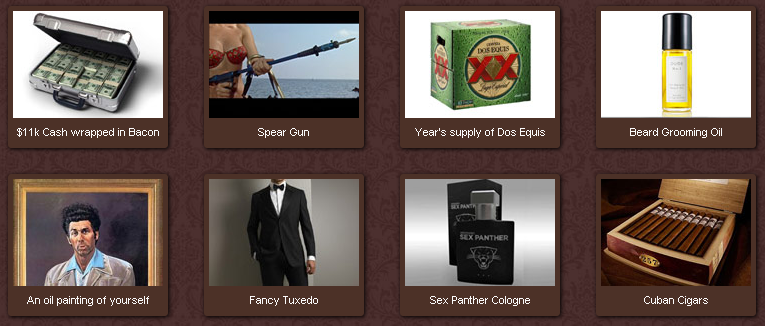
Kathy H. sent in a link to a story about a start-up in Los Angeles, Scopely, that’s trying to use humor to compete with the budgets of bigger companies.  Their aim is to hire engineers who are willing to trade a higher salary to get in on the ground floor of a promising, but nascent endeavor.  How are they doing it?  By promising silly signing-prizes, like $11,000 wrapped in bacon.  Cute, right?  But in their creative planning, they forgot that women exist. Here’s their list of bonuses:

Cigars and beer are masculinized items, but tuxedos, cologne, and beard grooming oil are actually for men.  Maybe the spear gun is for women?   They do, to be fair, show a pair of breasts operating it.

Maybe if Scopely recognized the other half of the population, they wouldn’t have to try so hard to find employees.

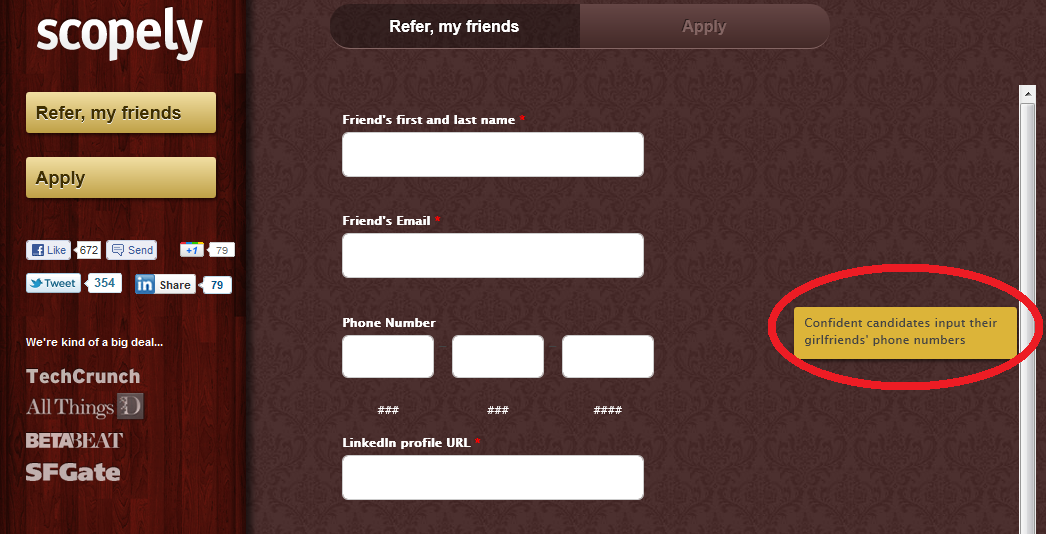
UPDATE: A reader, who also happens to be a female engineer, noticed that Scopely throws in another sexist (and this time heterocentrist) LOL on its job application form, where it prompts applicants to put in their girlfriend’s phone number if they’re confident (and, yes, this could include lesbians, but I don’t think that’s what they were going for):

Lisa Wade, PhD is an Associate Professor at Tulane University. She is the author of American Hookup, a book about college sexual culture; a textbook about gender; and a forthcoming introductory text: Terrible Magnificent Sociology. You can follow her on Twitter and Instagram.

Updated; originally posted July 2009.

Americans are notorious for their ignorance of global issues and international news.  This may be because Americans aren’t interested or it may be that our news outlets feed us fluff and focus us only on the U.S.  Probably it’s a vicious cycle.

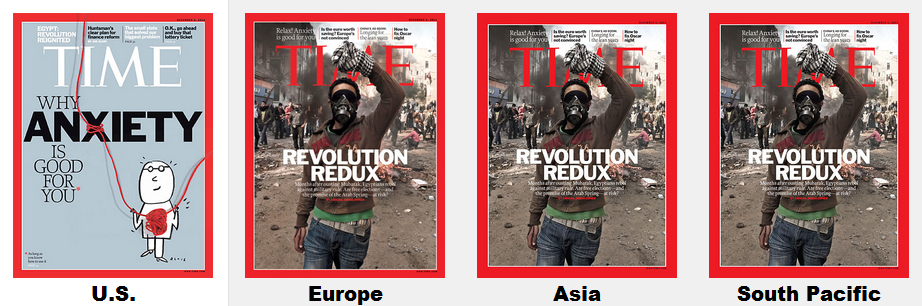
This month, for example, Time magazine’s cover story is about the political strife in Egypt… everywhere except the U.S. that is.  Americans get “pop psychology” (via Global Sociology):

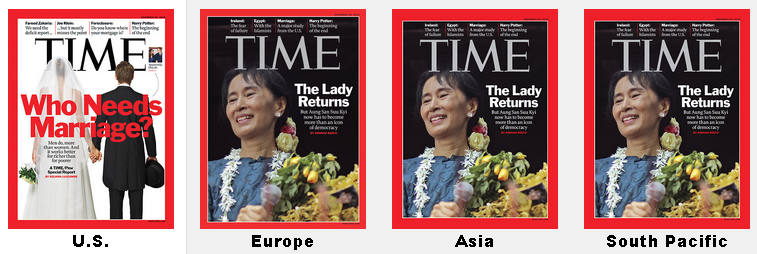
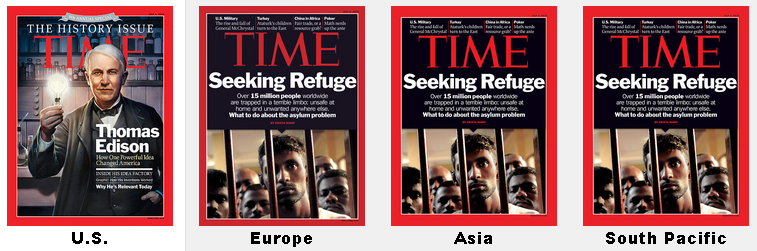
It turns out you can go to the Time website and compare covers from previous issues going back a long ways.  Here are some more examples from the last couple years (I cherry picked just a bit):

Dmitriy T.M. sent in these previous examples a while back.

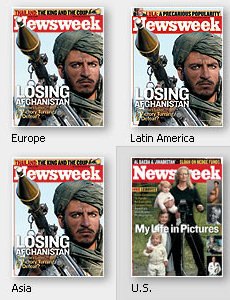
The cover story for Newsweek magazine’s September 2006 edition was “Losing Afghanistan” in Europe, Latin America, and Asia.  It was “My Life in Pictures,” a story about the photographer Annie Liebovitz in the U.S. (via):

newsweek

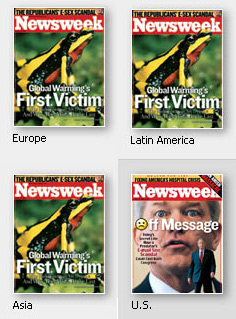
The cover story for Newsweek magazine’s October 2006 edition was “Global Warming’s First Victim” in Europe, Latin America, and Asia.  It was “Off Message,” a story about Republican Congressman Mark Foley’s sexually suggestive emails and IMs to teenage boys (via):

frogs

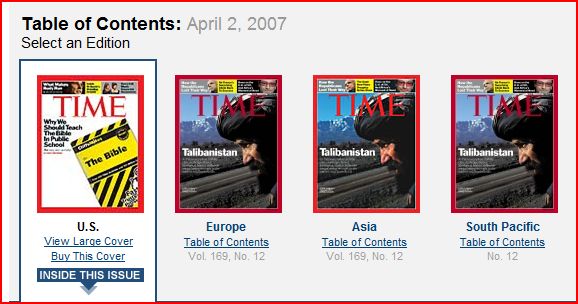
The cover story for Time magazine’s April 2007 edition was “Talibanistan” in Europe, Latin America, and Asia.  It was “Why We Should Teach the Bible in Public Schools” in the U.S. (via, also see Time):

Capture2

As SocProf writes:

Talk about self-fulfilling prophecy: Americans are assumed to not be interested in international and global affairs… ergo, Time decides to replace a perfectly legitimate and newsworthy cover on a significant event in Egypt with some pop psychology item. As a result, Americans are less informed and knowledgeable on global affairs because they do not get intelligent coverage on that topic.

Lisa Wade, PhD is an Associate Professor at Tulane University. She is the author of American Hookup, a book about college sexual culture; a textbook about gender; and a forthcoming introductory text: Terrible Magnificent Sociology. You can follow her on Twitter and Instagram.

Australian sparkling wine manufacturer Yellowglen has been running the Bubbly Girls campaign for about a decade in Australia. The brand’s self-proclaimed goal of the campaign is:

Yellowglen celebrates women everywhere.  We’re proud to be part of the celebration, and as such have asked three women who are living their dreams to be the Yellowglen Bubbly Girls.  Who are they?  They’re bright, beautiful girls who epitomise everything that we love about Australian women.

The marketing campaign actively employs a conflation of femininity and aspirational fantasy. The three women in the video were allegedly chosen because of “…the real life achievements of women and the female spirit.”

No evidence is given of any actual life achievements (i.e., experiences, career developments or highlights). Rather, the featured women talk about their dreams and desires to be famous by way of acting, music, or by spending their life travelling the world. No evidence is provided that they have even pursued these goals yet, let alone achieved anything worthy of note in these pursuits.

The rest of the campaign consists of the women modelling and drinking sparkling wine, sometimes making appearances at “fashionable” events such as the Melbourne Cup (a national Australian event worthy of it’s own post) as part of larger fashion-oriented campaign.

Thus, the campaign appears to re-enforce several patriarchal notions of femininity:

  • The genderization of “‘fun”: femininity, fashion, friends, social attention (and bubbles!).
  • Success is defined by fantasy; lofty and rather unattainable ambitions for careers based on appearances and social attention.
  • Celebration is “a day in the spotlight,” of pamper and attention; not the acknowledgement of tangible outcomes.

Has anyone seen a male-oriented campaign that ‘celebrates’ men in a similar fashion? I’m genuinely curious.

—————————

Nick Green studies Arts (Communications) at Monash University and Economics at University of New England, Australia, with particular interest in social economics. He performs in Heartbreak Club (a group that creates semi-satirical songs about male narcissism), writes about wine and loosely related topics at the Journal of Sparkling Shiraz, and is employed by an Australian media company.

If you would like to write a post for Sociological Images, please see our Guidelines for Guest Bloggers.

Lecture Tomorrow:

SocImages Contributor Caroline Heldman and I are giving a talk together titled “Do Friends Matter? Love, Family, and Friendship in U.S. Culture.”  If you’re in Los Angeles, find us at 6:30pm in Johnson Hall, Room 200.  We’re gonna talk about how great friends are and what short shrift friendship gets in American culture.  UPDATE: Because of the power outages in Southern California, the talk was rescheduled for Tuesday Dec. 6th at 6:00pm (Johnson Hall 200, Occidental College).  Say “hello” if you come by!

I’m also looking forward to talks at Harvard (for Sex Week) and the University of Massachusetts – Amherst (for a conference on public sociology).  Both are scheduled for March; I’ll keep everyone updated and try to arrange a SocImages Meet-Up in Boston.


New Publications:

I’m proud to report that two academic papers of mine came out this month.  The first, in Social Problems, uses the case of female genital cutting (FGC) to explore the challenges of building multicultural democracies.  Called “The Politics of Acculturation,” it traces a controversy between anti-FGC activists and physicians who wanted to offer a genital “nick” to Somali immigrants in Seattle.

The second shows how reporters sometimes have the power to socially construct issues as one-sided, thus creating conditions in which they can act like activists (instead of “objective” observers).  This paper, published in Media, Culture & Society, is called “Journalism, Advocacy, and the Social Construction of Consensus.”

Gwen and I also published two pieces together.  The next in our series of Contexts essays came out.  Titled “Land Management and the American Mustang,” it includes a picture of a burro!  You can’t beat that.

We also submitted a class exercise to TRAILS. In it, we use images to illustrate the social construction of race and racial stereotypes.  It’s been very popular with students.


Post Updates:

Remember that foreclosure firm that mocked people thrown out of their homes at their Halloween party?  Well, they’re closing their doors after Fannie Mae and Freddie Mac declined to give them anymore business.  Bye bye Steven J. Baum PC.

Apparently the company has been getting calls from consumers and reporters regarding the Molson Cosmo/Playboy ads we posted about yesterday.  It turns out the ad campaign is quite old (2002/2003) and they would like to distance themselves from it now.

Also, we’re still trying to figure out exactly what relationship PETA has to the anti-public hair advertisement for the Ministry of Waxing.  Weigh in if you have any insight.


Progress on Course Guides:

Gwen has added race/ethnicity, sex/gender, and health/medicine sections to her SocImages Course Guide for Introduction to Sociology.  It’s a pretty amazing collection.  We’ve got guides for Gender and Methods too.

Please do volunteer if you’re interested in collecting posts for a guide!  We’re happy to have as many as we can, duplicates even.  See our Instructors Page for more.


Best of November:

Our fabulous intern, Norma Morella, collected the stuff ya’ll liked best from this month.  Here’s what she found:


Links

It is super exciting to know that someone at the San Francisco ChronicleThink Progress, The Frisky, and BoingBoing is keeping an eye on us.  They featured our posts on that one sexist joke in every trailer (in this case, The Lorax)the relationship between entrepreneurship and social safety nets, PETA’s attack (?) on pubic hair, and the decline in income for college grads.


Social Media ‘n’ Stuff:

Finally, this is your monthly reminder that SocImages is on Twitter and Facebook.  Gwen and I and most of the team are on twitter, too:


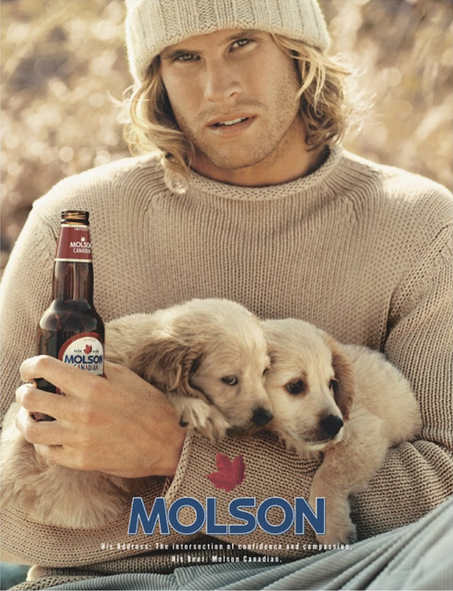
Anjan G. sent in an interesting pair of ads that ran as part of a Molson beer campaign in 2002/2003.  One appeared in Cosmo; it involves a man in a sweater cuddling with puppies and drinking a Molson.  It’s an example of an ad that glamorizes a soft and sensitive masculinity:

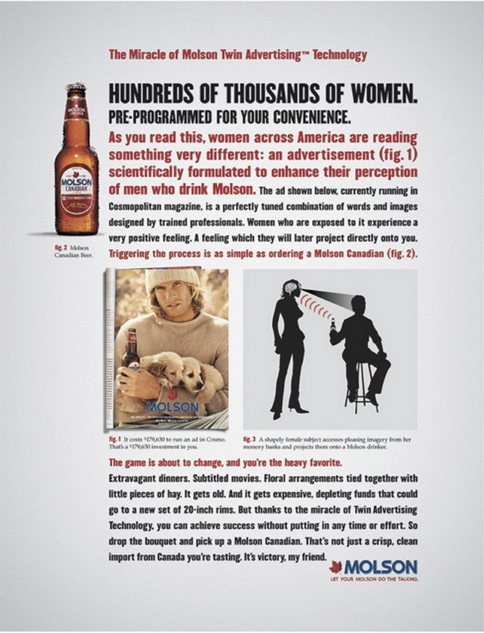
The other appeared in men’s magazines, including Playboy and FHM.  It tells readers, explicitly, that the first ad is designed to manipulate women into being sexually attracted to men who drink Molson:

The text is worth reading:

HUNDREDS OF THOUSANDS OF WOMEN.
PRE-PROGRAMMED FOR YOUR CONVENIENCE.

As you read this, women across America are reading something very different: an advertisement (fig. 1) scientifically formulated to enhance their perception of men who drink Molson. The ad shown below, currently running in Cosmopolitan magazine, is a perfectly tuned combination of words and images designed by trained professionals.  Women who are exposed to it experience a very positive feeling.  A feeling which they will later project directly onto you. Triggering the process is as simple as ordering a Molson Canadian (fig. 2).

Extravagent dinners.  Subtitled movies. Floral arrangements tied together with little pieces of hay. It gets old.  And it gets expensive, depleting funds that could go to a new set of of 20-inch rims. But thanks to the miracle of Twin Advertising Technology, you can achieve success without putting in any time or effort. So drop the bouquet and pick up a Molson Canadian…

The second ad, then, portrays men as lazy, shallow jerks who are just trying to get laid (not soft and sensitive at all).  And it portrays women as stupid and manipulable.

The two ads are a nice reminder that marketers count on their audiences being separate.  They can send each audience contradictory messages, confident that most women will never pick up Playboy and most men will never pick up Cosmo.  This is an assumption that marketers have long counted on. Miller Beer, for example, includes pro-gay advertising in magazines aimed at gay men, counting on the idea that heterosexual men, many of whom are homophobic, will never see that Miller markets itself as a gay beer.

So Molson was counting on women never seeing their ads in men’s magazines.  Alternatively, they were perfectly happy to alienate female customers.  Or maybe both.

Lisa Wade, PhD is an Associate Professor at Tulane University. She is the author of American Hookup, a book about college sexual culture; a textbook about gender; and a forthcoming introductory text: Terrible Magnificent Sociology. You can follow her on Twitter and Instagram.