Search results for The

Nickey R. sent in a commercial by Blue Cross and Blue Shield of Minnesota that aims to encouraging people to stop putting off exercising, eating healthy, and quitting smoking. The problem with these ads is a simple one. It represents all unhealthy people as overweight… or smokers. It ends by flashing the phrase “for the health of all.”

But while exercise and eating healthy may correlate with being thin (and to what degree this is true is still very much up for debate), there are, in fact, lots of non-thin people who do exercise and eat right and lots of thin people who do not. Being thin is not the same thing as being healthy (as research and real people demonstrate), but these ads say that it is, justifying anti-fat prejudice and miseducating the public.

Lisa Wade, PhD is an Associate Professor at Tulane University. She is the author of American Hookup, a book about college sexual culture; a textbook about gender; and a forthcoming introductory text: Terrible Magnificent Sociology. You can follow her on Twitter and Instagram.
Cross-posted at Love Isn’t Enough.

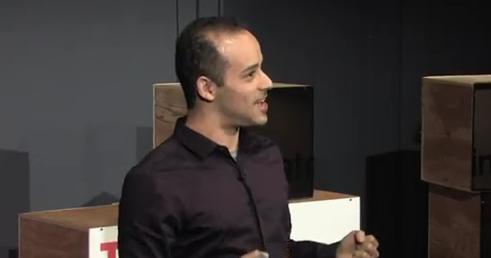
Jay Smooth, of Ill Doctrine, recent gave an excellent Tedx talk at Hampshire College about the difficulties of talking constructively about race and racism in the U.S. These conversations are tricky to navigate because they often devolve from discussions about structural inequalities and the consequences of certain positions or policies to individualistic arguments about whether a specific person is racist. As he points out, this backs people into corners. Because people are extremely defensive at anything they see as an accusation they are racist, there is little room to listen to someone who challenges a comment, and perhaps then acknowledge that a statement was hurtful, or based on incorrect information, or connects to larger cultural discourses and structural inequalities that we might want to examine critically.

It’s a great 11-minute video on how we might try to discuss race, and racism, constructively:

Also see Jay’s video on boundaries in mixed-race communities and Brother Ali talking about White rappers and the “n word.”

Cross-posted at Family Inequality.

In some societies it is expected that newly married couples will move into the husband’s family home.  This is called a “patrilocal system” or a “custom of marriage by which the married couple settles in the husband’s home or community” (OED).  Patrilocality is bad for women’s status: as outsiders in their new homes, they are alone and disconnected from their own families.

Patrilocal China

The patrilocal system in China is one of the foundations of its unique form of patriarchy, embedded in the religious tradition of family ancestor worship — and in the language.

This came up because I was learning the Chinese word for grandmother, which, like other family relationship words, differs according to the lineage in question (maternal grandmother, paternal grandmother, etc.). A common traditional term for maternal grandmother is wài pó, 外婆:

Those two characters separately mean outsider and woman. (If you put a space between them in Google translate, the English translation is “foreign woman.”) For comparison, the common term for paternal grandmother is nǎinai (奶奶), which is the word for “milk” twice.

Words as Gendered Images

I had been working on Chinese Characters for Beginners, and with my recent focus on language for union or marriage types (homogamy and heterogamy for same sex and other sex marriage, respectively), on the one hand, and sexual dimorphismgender, on the other, I was sensitive to my first lesson, in which I learned that the word for good is woman+son (好):

And the word for man is field+strength (田+力=男):

Someone who knows more about languages can say whether or how Chinese reveals more about the cultural contexts of its word origins than English does.

In the one-child-policy era the patrilocal tradition has become especially harmful to women. That’s because the lack of an adequate state pension system has increased the need for poor families to produce a son — a son whose (patrilocal) marriage will bring a caretaking daughter-in-law into the family — and decreased the return on investment for raising a daughter, who probably will leave to care for her husband’s parents. One consequence, amply documented in Mara Hvistendahl’s book Unnatural Selection, has been tens of millions of sex-selective abortions.

So, the next time someone sees a common pattern of gendered behavior, and attributes it to genetics or evolution, I’m going to ask them to first demonstrate that the pattern holds among people who aren’t exposed to any language at all (and raised by parents who haven’t been exposed to language either). Otherwise, the influence of ancient cultures is impossible to scrub from the data.

Cross-posted at My Viennese Adventures.

There is something that I love about the Vienna metro system (besides the fact that it is supremely fast and reliable).

Take a look at this:

What do you notice?

OK, first, the graphic design is fantastic. But what else?

The ‘old’ and ‘injured’ people are represented by male figures. The pregnant individual is (unavoidably) a woman, and the person carrying a child is also female.

So far, so typical.

Most public signage on Earth seems to follow this pattern. The generic individual is by default male, except when they are connected with child-rearing, when they magically become female. Never mind that women also get old and break their legs, or that men are perfectly capable of toting around a three-year old on public transport.

The difference with the U-Bahn is that you will see just as many of these signs as of the one above:

The preggers woman is still there, but who are those folks with her? An old lady! An injured gal! And, most radically, a dude with a pesky kid!

It might seem insignificant, but the signs that surround us are constantly sending us messages about who we are, and our place in society.

These signs are a small gender-victory, and they put a smile on my face!

——————————

Kate Shea Baird works at Women Without Borders in Vienna, specialising in the counter-radicalization of violent extremists. She has a BA in Politics, Philosophy, and Economics from the University of Oxford, and an MA in European thought from University College London.

If you would like to write a post for Sociological Images, please see our Guidelines for Guest Bloggers.

Click here to see a flickr slide show of dozens of people, starting with those below, with their BMI label (“underweight,” “normal,” “overweight,” “obese,” and “morbidly obese”). There’s something about seeing all these nice looking people with these judgmental labels applied to them that reveals that the BMI is a social construction. Also it’s a good illustration of the Foucauldian idea that knowledge (discourse, or even “science”) is used to label and control people, especially when it is internalized.

Erin Nieto’s project, How Much Do You Weigh, also puts the body front-and-center, challenging us re-think what numbers mean.  She counterposes photographs of volunteers with the number on the scale.  These women model a refusal to be embarrassed by their weight and show us the imprecision of the number itself.

See more images at Nieto’s tumblr.

Lisa Wade, PhD is an Associate Professor at Tulane University. She is the author of American Hookup, a book about college sexual culture; a textbook about gender; and a forthcoming introductory text: Terrible Magnificent Sociology. You can follow her on Twitter and Instagram.

Two years ago we posted about the Ashley Madison Agency. Several readers brought our attention to a new ad campaign for the company, so we’re reposting it; scroll down for new material.

Lisa C. sent in a link to the Ashley Madison Agency, which she heard advertised on a talk radio station that generally targets a male audience. The site specializes in providing dating services to married individuals looking to have an affair:

picture-12

The company clearly plays on its notoriety and the shock value of the idea that a dating site would cater to married people looking to cheat on their partners — as well as, in this case, appearing to promise men oral sex.

The company has come out with a new ad campaign that has received significant criticism. The ads, sent in by Danielle Q., Christie W., and an anonymous reader, combine “promotion of adultery, body shaming, and female objectification,” according to Christie. They present wives as fat (and therefore presumably unappealing) women who practically drive men to cheat on them with the thin, hot women they deserve to have sexual access to:

(Via.)

(Via Jezebel.)

One source of criticism comes from Jacqueline, the plus-sized model used in the two images. She apparently posed for a photographer years ago and is now faced with seeing her image used to elicit disgust at large bodies. As Jacqueline pointed out in a post she wrote for Jezebel, these images aren’t just about mocking large women; they’re about policing all women’s bodies:

A size 2 woman who sees this ad sees the message: “If I don’t stay small, he will cheat”. A size 12 woman might see this ad and think “if I don’t lose 30lbs, he will cheat”. A size 32 woman could see this ad, and feel “I will never find love”.

Thus, all women are told that they are perpetually in competition with all other women for the sexual attention and approval of men, and always on the verge of being ridiculed for the failure to meet impossible standards of feminine attractiveness.

Although Republicans and President Obama are said to disagree about economic policies, there is one initiative that they both enthusiastically support: free trade agreements.  President Obama single-handily resurrected the free trade agreements with Korea, Panama, and Colombia from political oblivion; they were ratified by the U.S. Congress in October.   

Now, he is eagerly pursuing a new multilateral agreement known as the Trans-Pacific Free Trade Agreement (involving Australia, Brunei Darussalam, Chile, Malaysia, New Zealand, Peru, Singapore, Vietnam, and the United States).  Significantly, as Public Citizen reports, “a leaked document revealed that the Obama administration signed a special pact to keep all documents relating to the Trans-Pacific Free Trade Agreement negotiations secret.” 

One might ask why the leaders of so many countries are anxious to sign such agreements, agreements which not only lower tariffs but also strip away the powers of governments to regulate international investment, production, and capital flows.

One answer is the enormous economic power of transnational corporations (TNCs), the main beneficiaries of these agreements. According to the United Nations Conference on Trade and Development:

TNCs worldwide, in their operations both at home and abroad, generated value added of approximately $16 trillion in 2010, accounting for more than a quarter of global GDP. In 2010, foreign affiliates accounted for more than one-tenth of global GDP and one-third of world exports.  

tnc1.jpg

The largest transnational corporations are from developed capitalist countries.  These corporations also tend to be among the largest and most powerful firms in their respective home countries.  At the same time, as the table below shows, their international operations now account for a majority of their assets, sales, and employment.  Looking at all TNCs, the United Nations reports that the value added by their foreign affiliates generated approximately 40% of their total value added in 2010, up from 35% in 2005.

tnc2.jpg

The estimates of TNC production cited above, although impressive, actually understate transnational control over global economic activity.  At one time, TNCs only engaged in international production through establishment of foreign affiliates.  In some cases, the parent company and its foreign affiliates operated relatively independently, each serving a different market. 

Now, transnational corporations generally rely on complex cross border production networks that involve the linking of production across many countries, with final sales often taking place in still other countries. Most importantly, these networks often include “independent” partner firms that undertake various activities according to an overall transnational corporate strategy.  While some of the partner firms may themselves be transnational corporations, many are not, which means that TNC controlled activity is greater than the combined activities of parent and affiliate firms. 

Transnational corporations use a variety of so-called “non-equity modes” (NEMs) of control to direct the operations of their partner firms, with contract manufacturing and service outsourcing among the most important. Cross border activity involving NEM relationships is conservatively estimated to have generated over $2 trillion of sales in 2010.  The United Nations reports that some 18–21 million workers are directly employed in firms operating under NEM arrangements. Around 80 per cent of NEM-generated employment is in developing and transition economies.

As the following figure reveals, cross border production activity anchored by NEM relations now dominates a number of key export industries.  For example, NEM production now accounts for more than 50% of all toy, footwear, garment and electronics exports.

 selected-exports.jpg 

The production of the iPhone offers one of the best examples of the logic and operation of these transnational corporate controlled cross border production networks.  As the Asian Development Bank explains:

iPhones are designed and marketed by Apple, one of the most innovative U.S. companies. Apart from its software and product design, the production of iPhones primarily takes place outside the US. Manufacturing iPhones involves nine companies, which are located in the PRC, the Republic of Korea (hereafter Korea), Japan, Germany, and the US. The major producers and suppliers of iPhone parts and components include Toshiba, Samsung, Infineon, Broadcom, Numunyx, Murata, Dialog Semiconductor, Cirrius Logic, etc. All iPhone components produced by these companies are shipped to Foxconn, a company from Taipei,China located in Shenzhen, PRC, for assembly into final products and then exported to the US and the rest of the world.

Not surprisingly, the division of profits, as shown below, reflects the overall hierarchy that structures this and other cross border production networks.

iphone.jpg

The importance of cross border production networks to transnational corporate profitability helps to explain why these corporations are such strong supporters of free trade agreements.  And, although I have focused on manufacturers, transnational retailers which sell the products produced by these networks and financial service companies which underwrite both the production and consumption of these products are also major beneficiaries and therefore powerful advocates. 

The operation of these networks, the majority of which are centered in East Asia, have greatly contributed to the growth of global imbalances, marked by East Asian trade surpluses and U.S. trade deficits.  These imbalances were papered over, and global capitalist accumulation sustained only because of the debt-driven housing bubble which financed U.S. consumption. 

The collapse of the bubble has led many analysts to call for a rebalancing of Asian and U.S. economies. However, rather than address this need, governments throughout the world, responding to dominant capitalist interests, continue to pursue new free trade agreements, a pursuit that if successful will only intensify existing economic and social problems and make needed changes harder to achieve.   

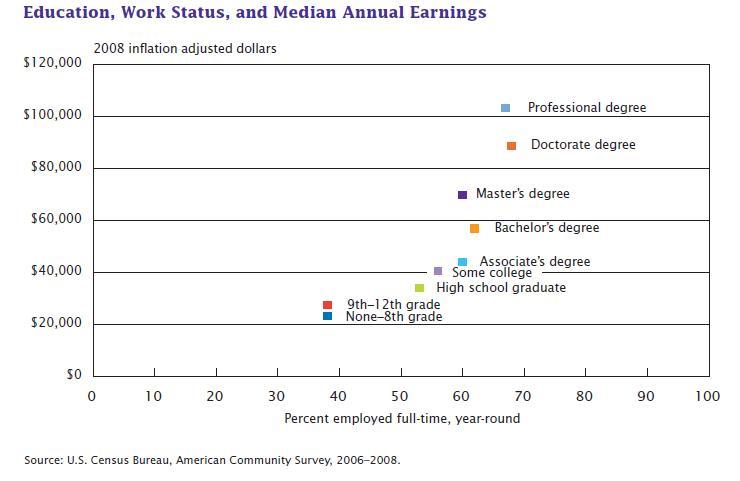
The Census Bureau posted some information about the economic payoff of a college degree on their blog, Random Samplings. A recent report indicated that educational level had a bigger impact than any other demographic factor on lifetime earnings. More education leads to both higher incomes not just because those with more education receive higher salaries, but also because they are more likely to be in full-time jobs. The x-axis here shows the % of people in full-time, year-round jobs:

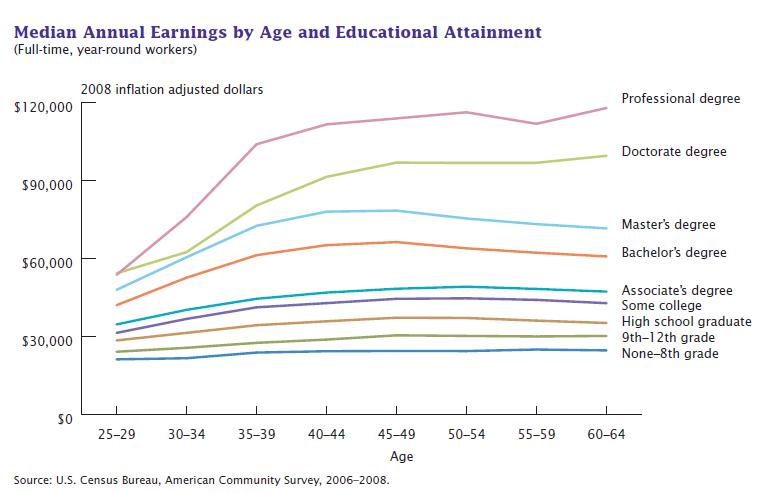
Not surprisingly, the gap in earnings widens over time, especially for those with a bachelor’s or higher degree compared to those with less:

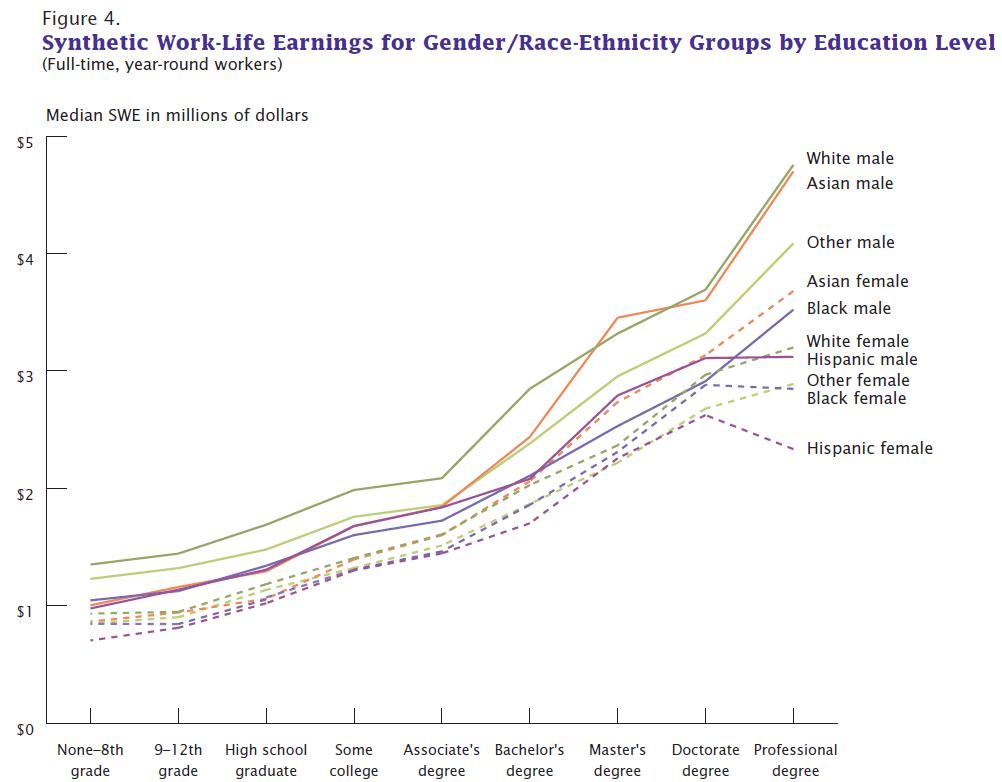
The report also estimated lifetime earnings by race/ethnicity for men and women separately. As they point out, except for a couple of cases at the very highest educational levels, men from even the most economically disadvantaged racial/ethnic groups out-earn women from the most economically advantaged ones:

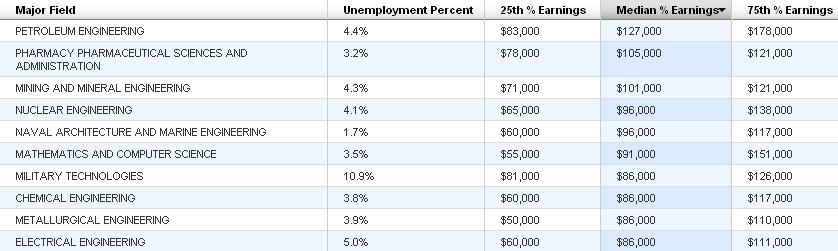
Of course, not all college degrees are equal. Dolores R. sent in a link to an interactive table from the Wall Street Journal that lets you look at earnings and the unemployment rate for various majors. I sorted them by median earnings; here are the ten with the lowest median earnings:


And the ten with the highest:

The highest unemployment rate? Clinical psychology, at 19.5%.

You can also search by area (art, engineering, etc.), though it looks like the categorization may be a little sketchy — for instance, “geology and earth science” and “liberal arts” show up under the arts.

For more on college majors, earnings, and future career opportunities, see the report College Clusters: Forecasting Demand for High School through College Jobs, 2008-2018, from the Georgetown University Center on Education and the Workforce.