Search results for The

Last year I posted about a map several geographers put together showing the distribution of last names across the U.S. Historical immigration and internal settlement patterns are reflected in the concentrations of names across the country.

Now one of the geographers involved in that project, James Cheshire, has done the same for London. Using 2001 electoral rolls, Cheshire plotted the 15 most common surnames in 983 separate London districts. Here’s a section of the map of the most common name:

The size of the font is scaled to represent the number of people with each name. They’re color-coded by place or origin (though since many immigrants have Anglicized names, origin of a name may not reflect a person’s ancestry).

As Cheshire points out, a few names fill the top slot throughout most of London. As you go a bit further down the list, London’s diversity becomes more apparent. Here’s a small slice of the map of the 10th most common surnames:

Those of you with more knowledge of London, what noteworthy patterns do you see?
Hanna Rosin, senior editor at The Atlantic and author of The End of Men, has written a piece about hook up culture on and off college campuses for the September issue of her magazine.  Given that I’ve done some research on hook up culture, W.W. Norton’s Karl Bakeman asked me to weigh in.  So, here are my two cents: Rosin isn’t wrong to argue that the culture offers women sexual opportunities and independence, but she mischaracterizes the objections to hook up culture and draws too rosy a conclusion.

Those who wring their hands and “lament” hook up culture, Rosin contends, do so because they think women are giving it up too easily, a practice that will inevitably leave them heartbroken.`She writes:

[Critics of hook up culture pine] for an earlier time, when fathers protected “innocent” girls from “punks” and predators, and when girls understood it was their role to also protect themselves.

If this is the problem, the answer is less sex and more (sexless?) relationships.  But, Rosin rightly argues, this wrongly stereotypes women as fragile flowers whose self-esteem lies between their legs.  It also romanticizes relationships.  Drawing on the fantastic research of sociologists Laura Hamilton and Elizabeth Armstrong, she explains that young women often find serious relationships with men to be distracting; staying single (and hooking up for fun) is one way to protect their own educational and career paths.

All this is true and so, Rosin concludes, hook up culture is “an engine of female progress — one being harnessed and driven by women themselves.”

Well, not exactly.  Yes, women get to choose to have sex with men casually and many do.  And some women truly enjoy hook up culture, while others who like it less still learn a lot about themselves and feel grateful for the experiences.  I make this argument with my colleague, Caroline Heldman, in Hooking Up and Opting Out: Negotiating Sex in the First Year of College.

But what young women don’t control is the context in which they have sex.  The problem with hook up culture is not casual sex, nor is it the fact that some women are choosing it, it’s the sexism that encourages men to treat women like pawns and requires women to be just as cunning and manipulative if they want to be in the game; it’s the relentless pressure to be hot that makes some women feel like shit all the time and the rest feel like shit some of the time; it’s the heterosexism that marginalizes and excludes true experimentation with same-sex desire; and it’s the intolerance towards people who would rather be in relationships or practice abstinence (considered boring, pathetic, or weird by many advocates of hook up culture including, perhaps, Rosin).

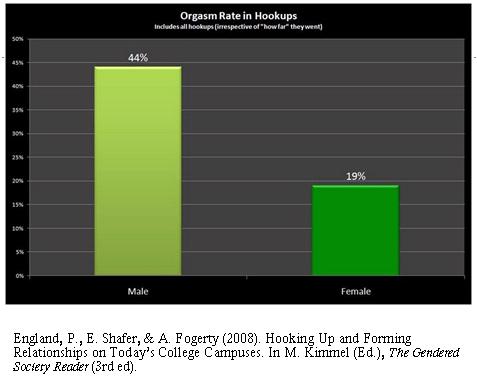
Fundamentally, what’s wrong with hook up culture is the antagonistic, competitive, malevolent attitude towards one’s sexual partners.  College students largely aren’t experimenting with sexuality nicely.  Hook ups aren’t, on the whole, mutually satisfying, strongly consensual, experimental affairs during which both partners express concern for the others’ pleasure.   They’re repetitive, awkward, and confusing sexual encounters in which men have orgasms more than twice as often as women:

The problem with hook up culture, then, is not that people are friends with benefits.  It’s that they’re not. As one of my students concluded about one of her hook up partners:  “You could have labeled it friends with benefits… without the friendship maybe?”

Hook up culture is an “engine of female progress” only if we take-for-granted that our destination is a caricature of male sexuality, one in which sex is a game with a winner and a loser.   But do we really want sex to be competitive?   Is “keep[ing] pace with the boys,” as Rosin puts it, really what liberation looks like?  I think we can do better.

Lisa Wade, PhD is an Associate Professor at Tulane University. She is the author of American Hookup, a book about college sexual culture; a textbook about gender; and a forthcoming introductory text: Terrible Magnificent Sociology. You can follow her on Twitter and Instagram.

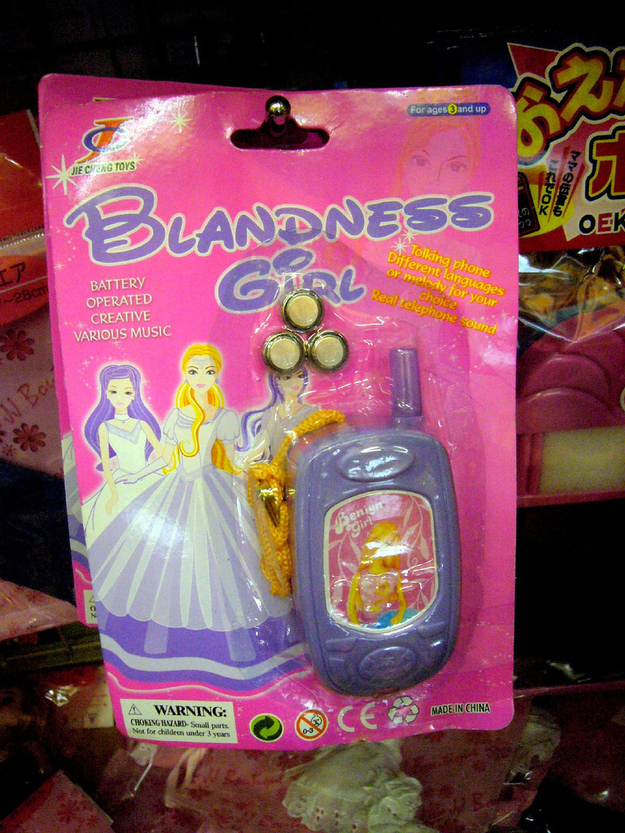
Somehow the accidental mis-translation of the Princess/Barbie character is just right

Buzzfeed and CookdandBombd, via Work that Matters.

Lisa Wade, PhD is an Associate Professor at Tulane University. She is the author of American Hookup, a book about college sexual culture; a textbook about gender; and a forthcoming introductory text: Terrible Magnificent Sociology. You can follow her on Twitter and Instagram.

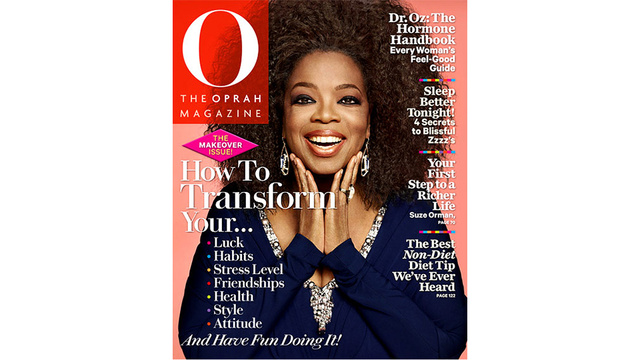
The September issue of Oprah’s magazine, sent in by YetAnotherGirl, features the woman herself on the cover wearing her hair in a “natural” (that is, real and non-straightened).  The O website announces that this is the first time in its 12-year history that Oprah has appeared on the cover without “blow-drying or straightening” her hair.

Black women’s hair is a touchy issue wrapped up deeply in racial power struggles.  The appearance of White people — in this case, the hair White people are more likely to have (that is, straight or slightly wavy) — is often considered the most beautiful or normal.  Black women who have tightly curled hair are faced with deciding to push back against white supremacy and wear their hair more-0r-less naturally (and face being seen as a “political” or “non-assimilating” Black person) or straighten their hair (and risk being accused of capitulating to racism).  Whatever they do, it’s sends a message.

What I think is notable here is that Oprah, of all people in the world, has never until now appeared on the cover of her own magazine with “natural” hair.   Lest we’ve forgotten who Oprah is, here’s a reminder (from wikipedia):

Winfrey was called “arguably the world’s most powerful woman” by CNN and Time.com, “arguably the most influential woman in the world” by the American Spectator, “one of the 100 people who most influenced the 20th Century” and “one of the most influential people” from 2004 to 2011 by TIME. Winfrey is the only person in the world to have appeared in the latter list on all eight occasions.

What I mean to say is, when even Oprah largely avoids being seen as she really is, we know we are seeing a powerful cultural force.  In this case, a racist and sexist one demanding that women of all races conform to an unreasonable White standard of beauty.  I’m glad that Oprah decided to appear this way for the cover, but I’m saddened by why it took this long.

Via Jezebel.

Lisa Wade, PhD is an Associate Professor at Tulane University. She is the author of American Hookup, a book about college sexual culture; a textbook about gender; and a forthcoming introductory text: Terrible Magnificent Sociology. You can follow her on Twitter and Instagram.

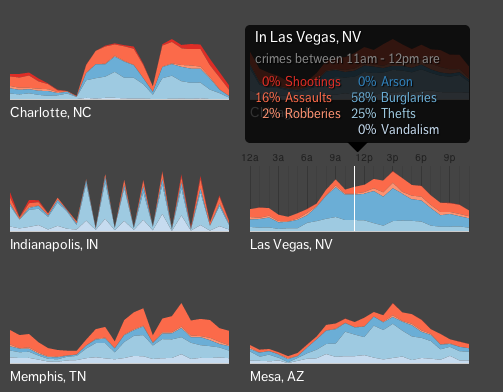
Trulia Trends has posted interactive graphs that let you look at crime by time of day in various cities in the U.S. Using data from SpotCrime (which largely relies on police reports to track crime), they plotted the commission of different types of crime. If you scroll over a city you can get details of the types of crime occurring at a specific time of day:

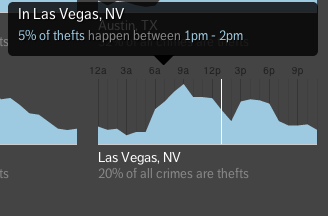
You can also choose types of crime, then get information on what percent of all crimes in each city fall into that category as well as its distribution throughout the day:

The graphs are useful for visually showing that, though violent crimes (shootings, assaults, robberies) understandably get more attention, the vast majority of crime is property crime.

I haven’t had time to go through and look for clear patterns or differences between cities or types of crime. Notice anything interesting?

Via Information Is Beautiful.


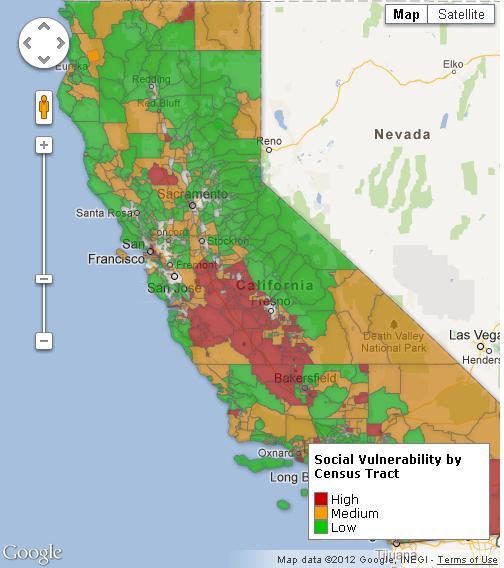
Scholars are busy attempting to predict the effects of climate change, including how it might harm people in some parts of the globe more than others.  A recent report by The Pacific Institute, sent in by Aneesa D., does a more fine-grained analysis, showing which Californians will be the most harmed by climate change.

They use a variety of measures for each Census tract to make a Vulnerability Index, including natural factors (like tree cover), demographic factors (like age), and economic factors (like income).  At the interactive map, you can see the details for each Census tract.  Their compiled index looks like this:

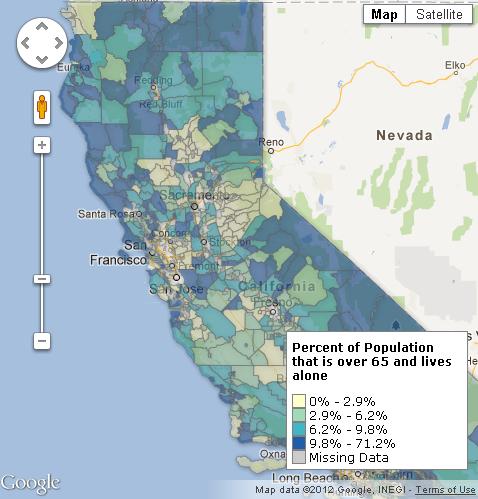
You can also see the Vulnerability Index for each measure individually.  Here is the data for the percent of people over age 65 who live alone, a variable we know increases the risk of death from heat wave.

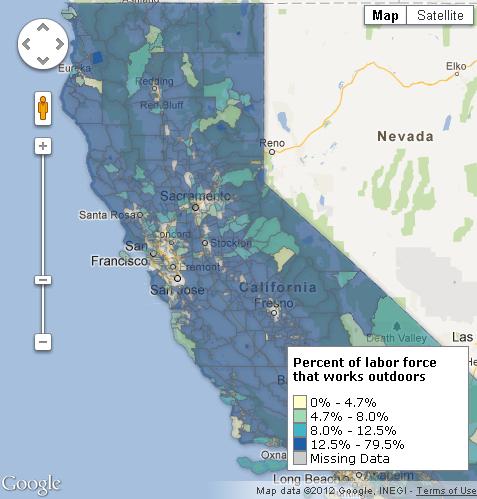
And here’s the data for the percent of workers who labor outside:

There’s lots more data at the site, but what’s interesting here is that, even in incredibly wealthy parts of the world, climate change is going to have uneven effects.  When it does, the most vulnerable people in the more vulnerable parts of the state are going to migrate to the other parts.  Most Californians don’t imagine that their cities will be home to refugees, but this is exactly what will happen as parts of California become increasingly difficult to live in.

Lisa Wade, PhD is an Associate Professor at Tulane University. She is the author of American Hookup, a book about college sexual culture; a textbook about gender; and a forthcoming introductory text: Terrible Magnificent Sociology. You can follow her on Twitter and Instagram.

Liz B. let us know about Slim Jim’s Spice Loss ad campaign, which features a number of commercials about men suffering from the horrible condition of spice loss, also known as emasculation. As Liz explains, “Apparently you need processed meat to stimulate your ‘man gland’, and give you ‘brolectrolytes’ for your ‘menergy’.” The ads feature themes that are common when marketing to men — a very circumscribed version of acceptable masculinity and the idea that women, and feminized things, are threats to masculinity.

Things that endanger men’s lives or just generally sap their will to live, according to the ads:

  • Shakespeare
  • Bird-shaped boats
  • Ironing
  • Making adjustments to their lifestyles to accommodate family life
  • Yoga
  • Salad
  • Spending time with women.

[vimeo]https://vimeo.com/42300742[/vimeo]

[vimeo]https://vimeo.com/151574343[/vimeo]

[youtube]https://www.youtube.com/watch?v=BmApg3M5LNY[/youtube]

It’s fascinating, really: femininity is depicted as weakness, the sapping of strength, yet masculinity is so fragile that apparently even the slightest brush with the feminine destroys it. This entire ad campaign — and the discourse about masculinity it draws from — is just an adult version of the game of cooties, with men fleeing the symbolic pollution of femininity.

Gwen Sharp is an associate professor of sociology at Nevada State College. You can follow her on Twitter at @gwensharpnv.

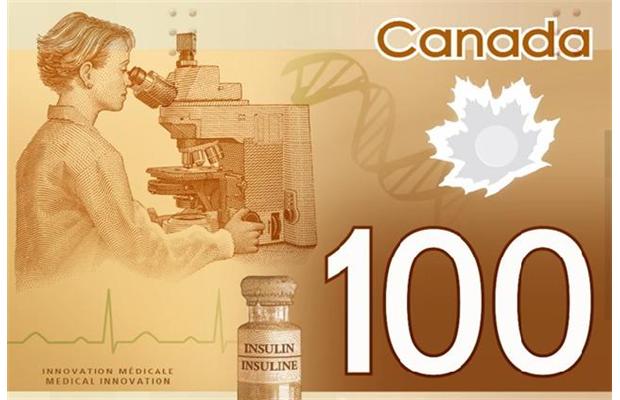
An emerging controversy in Canada is a good example of just how difficult it is to be racially-neutral when the context is racially-charged.  The country recently redesigned its money.  On the back of the $100 dollar bill celebrating medical innovation they sketched an Asian-appearing woman looking into a microscope.  In a focus group in Quebec, people complained that the bill reproduced the stereotype that Asians pursue careers in science and medicine.  The Vancouver Sun reports:

“Some have concerns that the researcher appears to be Asian,” says a 2009 report commissioned by the bank from The Strategic Counsel… “Some believe that it presents a stereotype of Asians excelling in technology and/or the sciences. Others feel that an Asian should not be the only ethnicity represented on the banknotes. Other ethnicities should also be shown.”

A few even said the yellow-brown colour of the $100 banknote reinforced the perception the woman was Asian, and “racialized” the note.

The Canadian government responded that they had never intended the woman to appear “ethnic” and ordered the image re-sketched so it would be more racially “neutral.”  

They were then accused of being prejudiced again. Mu-Qing Huang, a Chinese-Canadian interviewed for the story, objected to the deletion of the figure’s Asian features:

If Canada is truly multicultural and thinks that all cultural groups are equal, then any visible minority should be good enough to represent a country, including (someone with) Asian features.

This is a tricky problem.  By including racial or ethnic minorities on their bills, Canada risks reproducing a stereotype.  Including all “neutral” figures can be seen as exclusionary because neutral looks suspiciously like White people in a country dominated by White people.  The third option is to deliberately break stereotypes by putting, say, an Asian woman running the hurdles and a Black woman looking through a microscope, but this can seem overly contrived (as many attempts at diversity do).

The truth is that all of Canada’s options can be read in racially-charged ways.  This isn’t because people are unfairly reading into the sketches, it’s because life in Canada is, in fact, racially-charged.  When race matters, it matters, all claims to colorblindness aside.

Thanks to Craig G., Tom Megginson, Jesse, Helen, and Alex, an MLIS from McGill, for the submission!

Lisa Wade, PhD is an Associate Professor at Tulane University. She is the author of American Hookup, a book about college sexual culture; a textbook about gender; and a forthcoming introductory text: Terrible Magnificent Sociology. You can follow her on Twitter and Instagram.