Search results for The

Last month the president of fast-food chain Chik-fil-A publicly stated that the company opposed same-sex marriage. The restaurant then became a flash point in the struggle around who has the right to get married. Supporters of marriage equality called for boycotts, but opponents of same-sex marriage participated in Chik-fil-A, organized by Republican former governor of Arkansas (and Fox News commentator) Mike Huckabee. Huge numbers of people turned out to patronize the store last Wednesday, leading to enormous lines and long waits at some locations, and intense media coverage of the event.

So Chik-fil-A became clearly associated with the anti-same-sex marriage camp, and more generally with the conservative movement. But what about other restaurants?

Reader Peter N., of Pitzer College, sent in an image posted by the Los Angeles Times showing the politics and political engagement of patrons of a number of restaurants, as well as Whole Foods. A market research firm’s survey asked respondents if they had gone to any of these restaurants in the past 30 days (7 for Whole Foods), political leanings, and likelihood of voting. In this graph, the larger the bubble, the more respondents said they had gone to the restaurant. Those left of the center line had a disproportionate number of Democratic customers, while those to the right attracted Republicans. The higher the bubble on the graph, the more likely its customers were to vote:
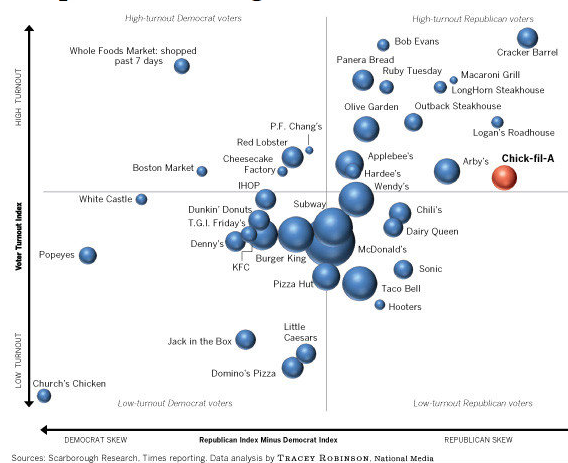
Aside from the political patterns, notice the differences in likelihood of voting. Generally, customers at sit-down restaurants like P.F. Chang’s and Macaroni Grill were more likely to vote than those at fast-food places, though there are a few exceptions (Denny’s, Hooters). This probably reflects class differences in voting: the restaurants in the upper half of the graph are generally more expensive than the fast-food places or chains like Denny’s, and they require more leisure time for a meal compared to getting a pre-made, or quickly-made, combo at the drive-through. Those with the money and time to spend on such restaurants are the same groups who are more likely to vote in general.
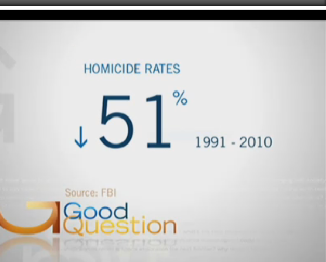
In the wake of the Aurora theater shooting and the shooting of a Sikh temple in Wisconsin, Minneapolis CBS affiliate WCCO asked, “Are we more violent than ever before?” They interviewed The Society Pages’ own Chris Uggen about historical changes in crime. Given the way local news often covers crime and violence, this is a surprisingly nuanced segment:

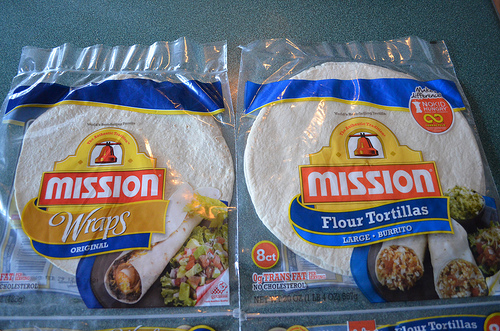
Tanita S. sent along a link to an interesting observation made over at Whatever.  John Scalzi, preparing to make lunch, noticed that he had two bags of an identical food product, except one was named “tortillas” and one was named “wraps.”

John did some sleuthing and discovered that the bag of wraps cost 26¢ more than the tortillas.  Moreover, since there were only 6 wraps in the package of wraps, but 8 tortillas in the package of tortillas, each wrap cost 19¢ more than each tortilla.

So, there is an interesting marketing story here.   Mission has figured out that they can sell their product for a higher price if they name it “wraps” (or, at least, they think they can). Let’s crowd source this.  After all, Mission is counting on our collective network of ideas (and a failure to notice the count difference) to push us towards the wraps instead of the tortillas.  What does “wraps” make you think of?  What else is that word linked to that might make a person prefer it?  Would you feel different bringing home a package of wraps?  In other words, what ideas, lying just beneath the surface, are they tapping into with this marketing strategy?

Lisa Wade, PhD is an Associate Professor at Tulane University. She is the author of American Hookup, a book about college sexual culture; a textbook about gender; and a forthcoming introductory text: Terrible Magnificent Sociology. You can follow her on Twitter and Instagram.

Often, the most socio-economically disadvantaged individuals of a group are used as a wide brush to paint a picture of an entire minority race or ethnicity.  Common examples include stereotyping all Black men as members of the inner-city underclass or as uneducated, unemployed, urban criminals, or all African-American women as “welfare queens.”  In the current cultural and political discourse, Hispanics are often prejudicially construed  as murderous drug-smugglers or as destitute immigrants who illegally cross the border to “drop babies” and exploit U.S. social programs.  As Eduardo Bonilla-Silva has argued, these prejudices then disadvantage minorities of all social classes who are stereotyped and experience discrimination regardless of their individual socio-economic status or accomplishments.

However, focusing on the marginal members during the social construction of an entire racial group does not usually occur with Whites.  The existence of poor Whites is often ignored as Caucasians are stereotyped as upper-class—which usually entails assumptions that they are hardworking, highly-moral, successful exemplars of American individualism, as Kirby Moss explains in The Color of Class.  “The Whitest People,” a skit from Carlos Mencia (a controversial comedian who built his career drawing upon his Hispanic background to explore race in America), illustrates the connections between whiteness and heightened class status (sorry about the ad):

Mencia’s construction of whiteness critiques the excesses and frivolousness of the upper-middle class lifestyle often conflated with whiteness.  While Mencia pokes fun at this lifestyle, outside comedy these same stereotypes mean Caucasians are usually viewed positively as many presume the upper class can only be reached through hard work and strong morals.  Whereas minorities are often presumed poor and thus viewed with suspicion, whites are often prejudged favorably.  For instance, Mencia himself mentions that because people are viewed through prejudicial lenses, when whites drink alcohol they are thought “sophisticated” but when Blacks drink they are accused of being “drunks.”  These differential prejudgments based on race are the basis of white privilege that replicates and reinforces both class, and racial stratification.

The open expression of Latino stereotypes and slurs in this video also highlights why Mencia’s comedy is controversial.  Detractors claim he engages in a process symbolic interactionists call trading power for patronage (see Schwalbe et al. 2000)This process occurs when an individual embodies a marginal identity in order to receive personal benefits that come at the expense of the larger group.  For example, while Mencia’s comedy career benefits from the self-deprecating humor in this video about low wage employment, family violence, and food insecurity his jokes might also reinforce negative stereotypes about Hispanics.

However, Carlos Mencia’s supporters describe the open confrontation of race and racial disadvantage in his comedy as contesting stigma (Goffman) by celebrating a minority group’s ability to persevere despite their marginalization.  To this group, Mencia’s frequent use of ethnic slurs to describe himself and other Latinos is an example of re-appropriation (Galinsky et al.), reclaiming a pejorative label in a way that redefines the meaning of racist slights and infuses the word with positive and empowering meanings.

—————

Jason Eastman is an Assistant Professor of Sociology at Coastal Carolina University who researches how culture and identity influence social inequalities.

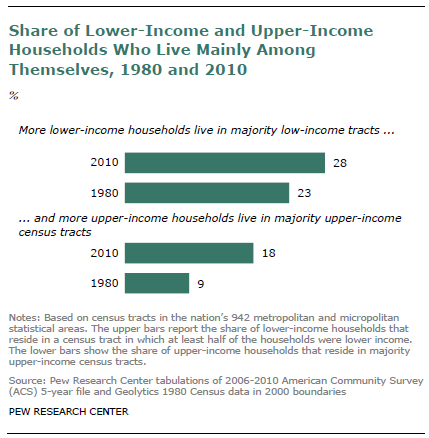
When we talk about residential segregation, we’re generally focusing on race, and for good reason — many cities in the U.S. still have incredibly high rates of racial segregation. However, a recent Pew Research Center report looks at economic segregation, which is increasing in U.S. neighborhoods.

Economic segregation refers to the degree to which people in different social classes live mostly among other people of their class. In 2010, the majority (76%) of people in the U.S. lived in middle-class or mixed-income neighborhoods. But economic segregation has increased in the last few decades. More of both lower-income and upper-income households live in Census tracts made up of households primarily like themselves:

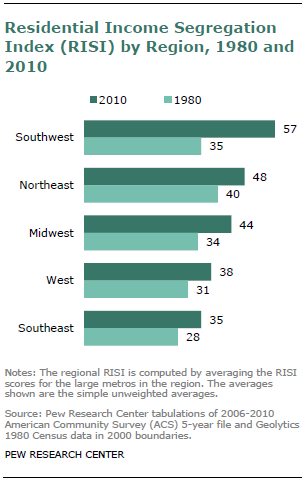
The RISI index for a city just combines the % of both groups that live in tracts dominated by their own income group (so the maximum score is 200). Looking at RISI scores by region, we see that the Southwest has the most economic segregation, and has increased more than any other region in the past 30 years:

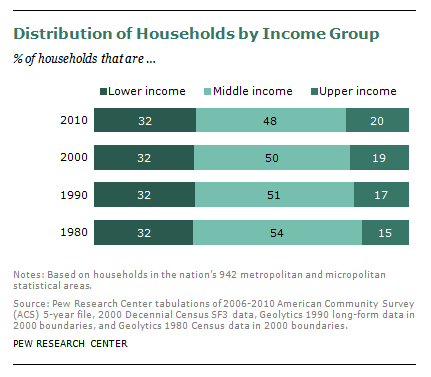
The Pew report argues that this is related to the general increase in income inequality, with less than half of the U.S. population falling into the middle class by 2010, and the upper class (here defined as those making more than $104,000) increasing:

Economic segregation is still a less prominent feature of cities than racial segregation is. But given its steady increase, it’s worth thinking about the consequences of the relative isolation of different social classes from one another. When the rich, poor, and middle-income groups live in different parts of town, who will have the political influence to draw municipal spending to their neighborhoods? How will this growing residential pattern affect who has access to nice parks, public facilities such as libraries and recreation centers, and maintenance for schools and roads — or, alternatively, whose neighborhoods become the location for generally undesirable or unpleasant industries or land uses?

Thanks to Leticia, Caely, Anjan G., Liz, Bradley K., and Kelsey P. for their patience.  Our SocImages email inbox is a hot mess, and sometimes things fall through the cracks.  This is certainly true for the short video below, one of the responses to the “Shit Girls Say” clip that inspired a round of copycats last December.  We decided to post about it belatedly because it remains a great example of something called a microaggression.

Microaggressions are “brief and commonplace daily verbal, behavioral, or environmental indignities, whether intentional or unintentional, that communicate hostile, derogatory, or negative… slights and insults” (source).  These are often subtle.  So the recipient feels badly, but it can be difficult to explain exactly why, especially to someone who isn’t sympathetic to issues of bias.  The Microaggressions Project has hundreds, maybe thousands, of examples.

In this video, Franchesca Leigh poses as a “White girl” and says many of the things that she and other “Black girls” hear routinely.  To Leigh, these are microaggressions.  They variously trivialize and show insensitivity towards race and racism, remind the listener that she is considered different and strange, homogenize and stereotype Black people, and more…

Lisa Wade, PhD is an Associate Professor at Tulane University. She is the author of American Hookup, a book about college sexual culture; a textbook about gender; and a forthcoming introductory text: Terrible Magnificent Sociology. You can follow her on Twitter and Instagram.

U.S. presidential candidate Mitt Romney recently traveled to Britain, Israel, and Poland, presumably to shore up his foreign policy credentials. Among a number of other statements that got a lot of attention, Romney praised Israel’s health care system, comparing it positively to the U.S. He stressed the cost differences, pointing out that Israel spends significantly less of its GDP on health care. This drew media attention because Israel has universal coverage provided by the state, and the glowing statements seemed a little odd in light of the Republicans’ opposition to the Affordable Care Act and the demonizing of the program as socialism.

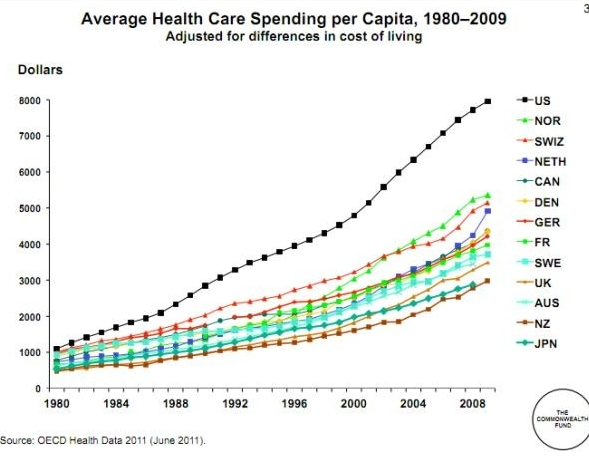
But all that aside, how much do Americans spend on health care? Well…a lot. Elizabeth McM. sent us a link to a story at The Atlantic comparing U.S. medical spending to a number of other nations:

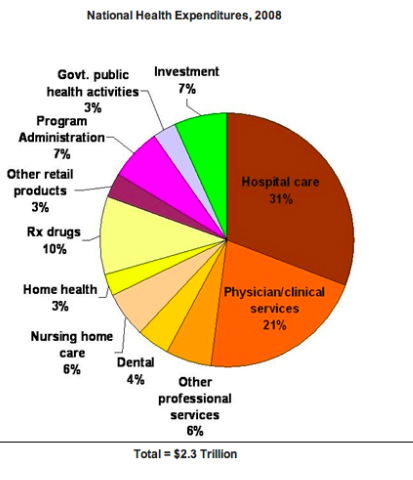
What are we spending it on? Hospital care is the single largest expense, followed by the cost of doctor/clinic visits. Another 10% is prescription drugs. The remainder falls into a variety of categories:

With overall spending distributed among so many different sectors of the health care sector, reducing costs requires more than just increased efficiency by hospitals or lowered drug costs — it requires changes and savings throughout the system.

I’ve heard critiques about both the uniforms of the beach volleyball players at this year’s Olympics in London (i.e., bikinis) and the photographic coverage of the athletes (i.e., “butt shots”).  Then yesterday eight readers — Tom Megginson, Cheryl S., Cerberus Xt, Richard D., Anna G., @sphericalfruit, @bfwriter, and @HaphazardSoc — sent us a link to a story that asked the question: “What if every Olympic sport was photographed like beach volleyball?”  More on that later.

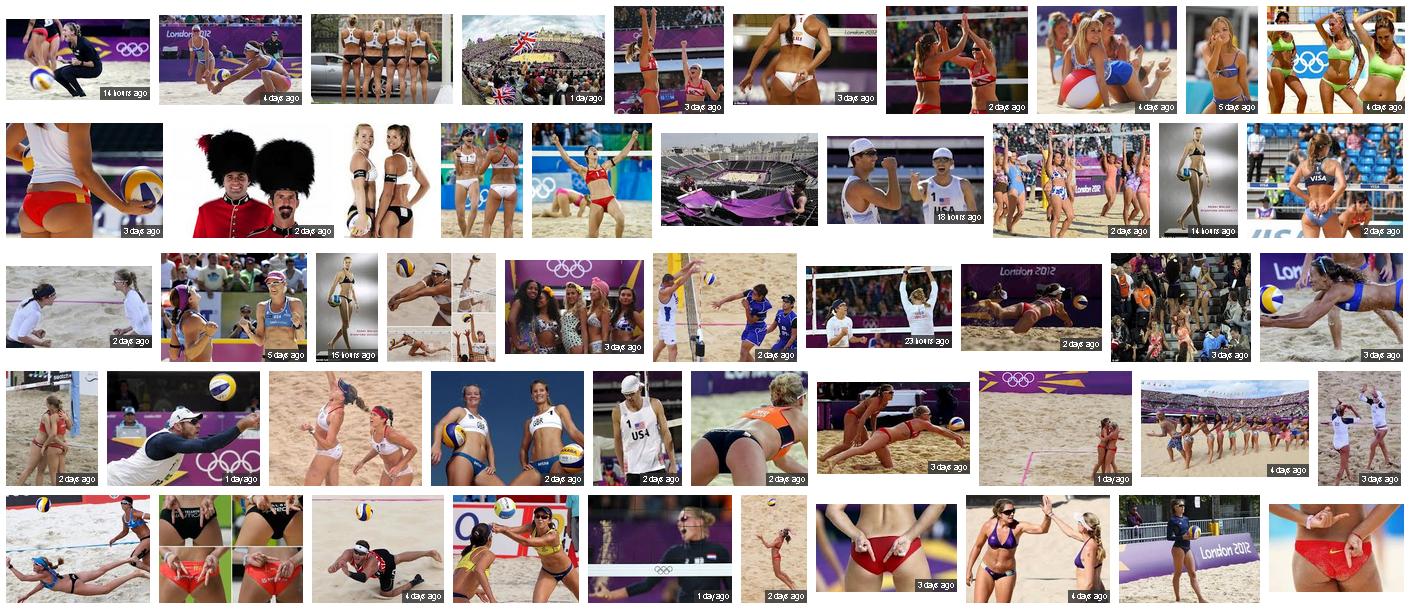
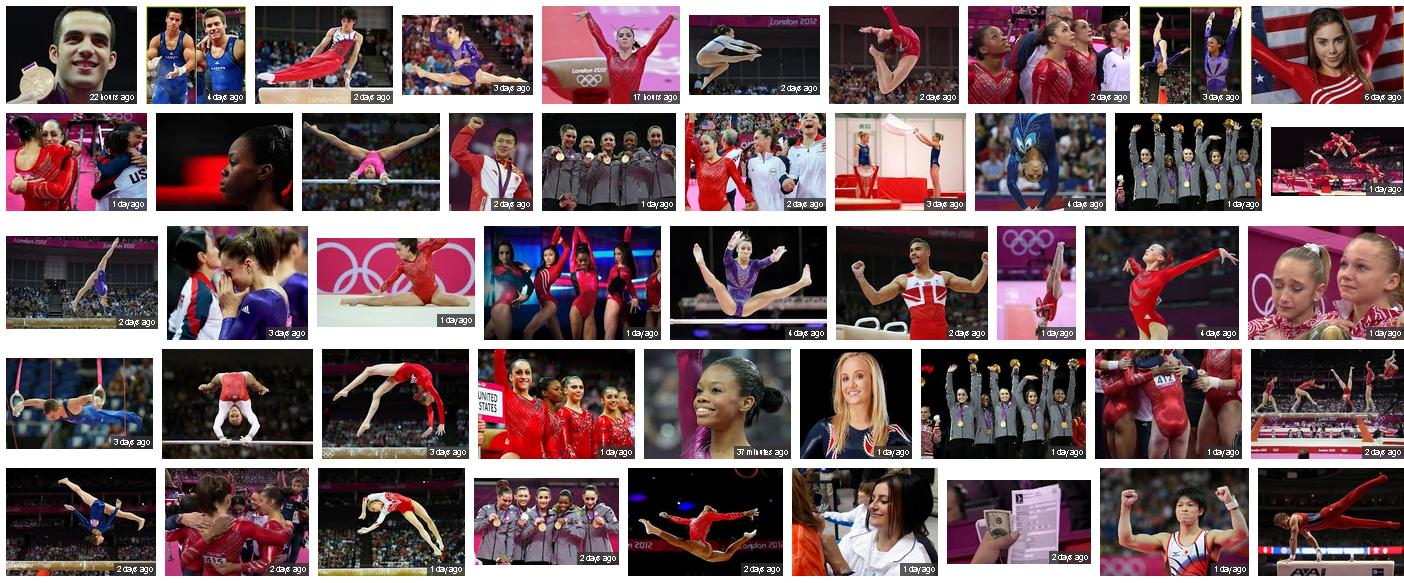
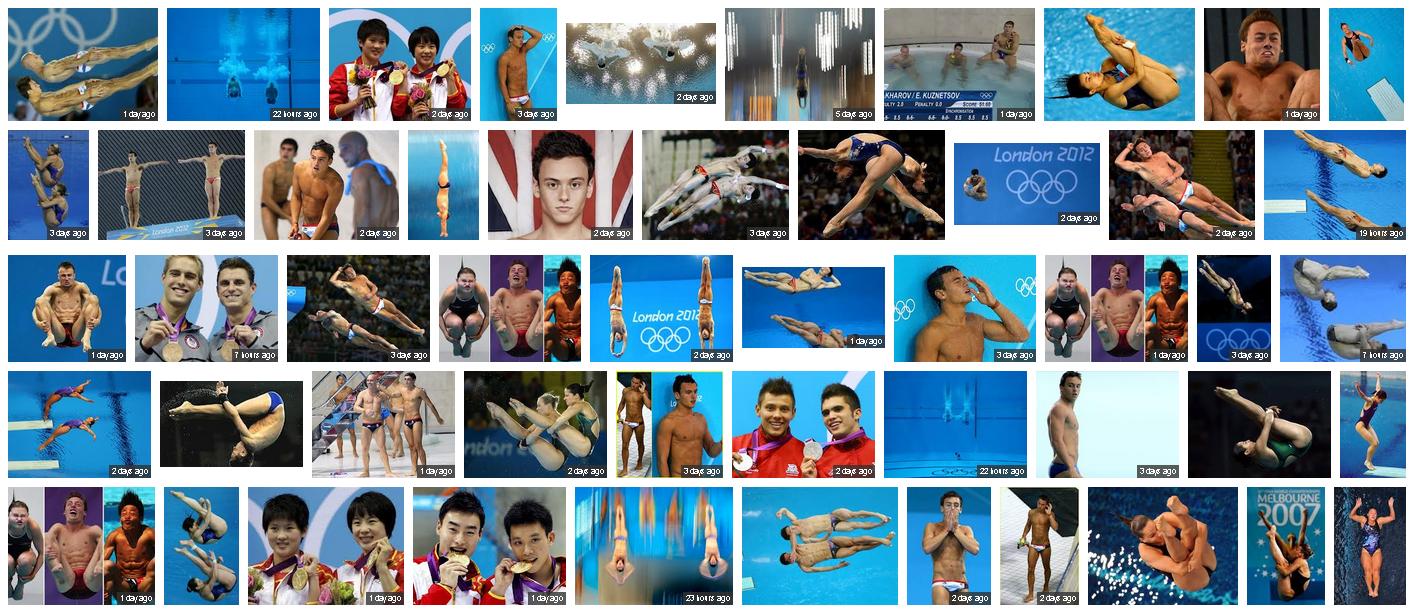
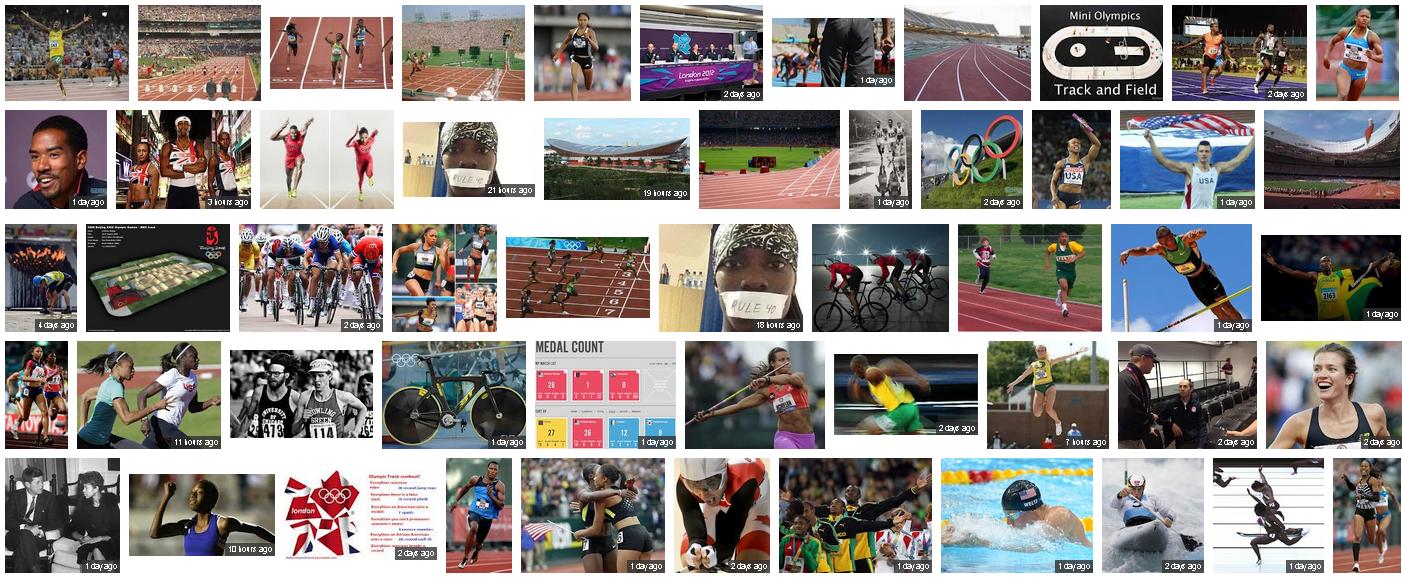
First, I wanted to see if the rumors were true, so I googled beach vollyball and three other sports: track, diving, and gymnastics.  All involve relatively skimpy uniforms, but beach volleyball certainly stood out.  The top results included five photographs of just butts in bikini bottoms and four “cheesecake” pictures in which women are posed to look like pin-ups and volleyball is not part of the picture (all images can be clicked to get a closer view).

That may not seem like a lot but, in contrast, none of the top photos for the other three sports included butt shots or pin-up poses (with the exception of one butt shot for track, but it was of a fully-clothed man and used as a photographic device, not a source of titillation).

There’s an interesting lesson here that goes beyond the sexual objectification of women and asks “which women? and why? (because the sport is associated with the beach?) and in response to whose rules? (who is in charge of uniforms?) and to whose benefit? (the photographers, the Olympics, their corporate and media sponsors?).”

Gymnastics: 

Diving:

Track:


Lisa Wade, PhD is an Associate Professor at Tulane University. She is the author of American Hookup, a book about college sexual culture; a textbook about gender; and a forthcoming introductory text: Terrible Magnificent Sociology. You can follow her on Twitter and Instagram.