Search results for The

Katrin sent in a set of signs and advertisements, collected at Buzzfeed, urging young people to refrain from doing methamphetamine, or “meth.”

What I found interesting was how many home made signs in rural areas were included.  It suggests that many people in small towns feel that their children are under attack.  Meanwhile, there’s no big money in drug addiction prevention.  Hence the town-specific, home made signs that contrast so starkly to the generic, glossy, high-production value advertising we are so used to seeing.

Many examples at Buzzfeed.

Lisa Wade, PhD is an Associate Professor at Tulane University. She is the author of American Hookup, a book about college sexual culture; a textbook about gender; and a forthcoming introductory text: Terrible Magnificent Sociology. You can follow her on Twitter and Instagram.
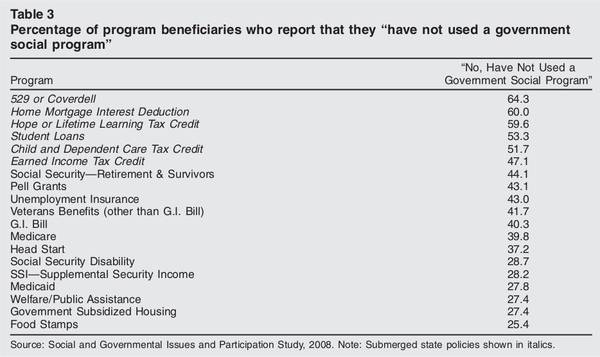
In light of Romney’s comments regarding those who depend on the government, we thought we’d re-post this great data showing that many people who are using government social programs don’t know they are doing so.  

————————

Dolores R. sent in a fascinating image posted at boingboing. It comes from a paper by Suzanne Mettler, a professor in the Department of Government at Cornell. Mettler first asked survey participants whether they had ever used a federal U.S. government program. Then later in the survey she specifically asked respondents whether they had ever benefited from or participated in specific federal programs. As it turns out, large number of people who have benefited from various federal programs or policies do not recognize themselves as having done so. This table shows what percent of people who said they had participated in or used these 19 federal programs had earlier in the surveys said they had never used any social program:

Mettler argues that recipients are less likely to recognize themselves as benefiting from programs that are part of what she calls the “submerged state” — programs and policies that provide incentives and motivations for particular behaviors in the private sector, rather than overtly directing behavior. If you receive food stamps, you interact directly with a government agency, are required to periodically meet with a government worker and reapply to re-establish eligibility, and can point to a specific thing that links you to the program (these days usually a debit-type card rather than the old style coupons/stamps).

On the other hand, if you participate in the government’s mortgage interest deduction program, which encourages home ownership by allowing people to deduct the cost of mortgage interest from their taxable income (which you can’t do with rent costs, for instance), it’s less noticeable that you are benefiting from a federal policy. You get a form from your mortgage company that provides the relevant number, and you transfer it over to the correct line when you’re filling out taxes.

Notably, the programs recipients seem least likely to recognize as a government program are among those the middle (and higher) classes are most likely to use, while those more common among the poor are more clearly recognizable to those using them as government programs. Yet allowing you to write off mortgage interest (but not rent), or charitable donations, or the money you put aside for a child’s education, are all forms of government programs, ones that benefit some more than others. But the “submerged” nature of these policies hides the degree to which the middle and upper classes use and benefit from federal programs.

One of our very first posts on SocImages was a Wrestle Mania billboard.  It featured a bunch of muscle-bound men without shirts, but their nipples were photoshopped out. They were too suggestive of women’s nipples (which are obscene, obviously) and possibly against the law.

Nipple-phobia is back with a particularly amusing example from Facebook.  Company policy requires deleting images of “female nipple bulges” (defined as “naked ‘private parts'”; male nipples, with or without bulges, are excluded from the ban).  This prompted Facebook to take down a New Yorker cartoon by Mick Stevens, see if you can figure why.

Robert Mankoff mocked the incident.

To be fair, and here I begin my own mockery, we are talking about Eve here.  And she had lost her innocence — and the innocence of the entire human race — with her “original” idea.  So… you know, she was a dirty, dirty gal who did a bad, bad thing and would realize the importance of covering up those “dirty pillows” sooner or later.  Facebook was just ahead of the curve. I guess.

Lisa Wade, PhD is an Associate Professor at Tulane University. She is the author of American Hookup, a book about college sexual culture; a textbook about gender; and a forthcoming introductory text: Terrible Magnificent Sociology. You can follow her on Twitter and Instagram.

Jarrah Hodge, the woman behind the Canadian feminist blog Gender Focus, has started a new video series called Feminism F.A.Q.s.  They’re short videos aimed at addressing myths about gender inequality and the people who care about it.  She’s already got 10 videos up, but here are a couple of my favs.

What Have Women Been Told They Can’t Do?

Ride bicycles (’cause of “bicycle face”), get a credit card, run marathons, and much more.

Did Feminists Burn Bras?

Answer: Nope!

Lisa Wade, PhD is an Associate Professor at Tulane University. She is the author of American Hookup, a book about college sexual culture; a textbook about gender; and a forthcoming introductory text: Terrible Magnificent Sociology. You can follow her on Twitter and Instagram.
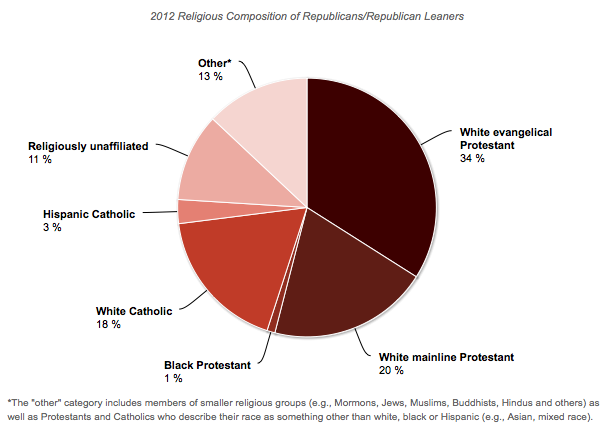
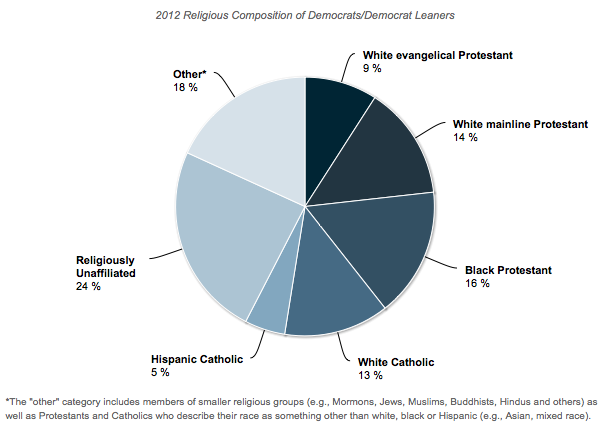
Peter N. sent in some data compiled by Chris Cillizza of the Washington Post.  It reveals the intersection of race and religion among Democrats and Republicans.   As Cillizza concludes, it’s “overblown” to say that the Republican party is made up of White Protestants and the Democratic of minorities and atheists, but there is definitely an argument to be made that each party is disproportionately so.

This first pie chart shows the racial and religious affiliation of people who identify with or lean towards the Republican party.  More than half are White Protestants, another 18% are White Catholics.  Only a small percentage of party faithfuls are religious Blacks and Hispanics (the two racial groups featured in in these data).

This second chart shows the same data for Democrats and Democratic-leaning individuals.  Almost a quarter of Democrats are White Protestants, but a slightly larger percentage of Democrats are religiously unaffiliated.  One in five Democrats identifies as either Black or Hispanic and religious.  The larger “other” category conceals smaller blocs that nonetheless add diversity to the party.

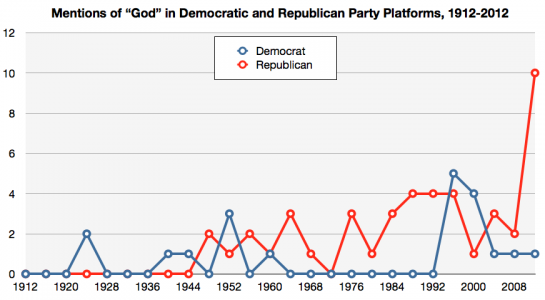
This is just one way to slice the pie, so to speak, but these are the kinds of data that both the Obama and the Romney campaigns are working with.  When they aim to bring out their “base,” this is what they’re talking about.  These numbers may give us a clue as to why they pick the strategies they do, such as the sudden spike in the inclusion of the word “God” in the Republican party platform.

Lisa Wade, PhD is an Associate Professor at Tulane University. She is the author of American Hookup, a book about college sexual culture; a textbook about gender; and a forthcoming introductory text: Terrible Magnificent Sociology. You can follow her on Twitter and Instagram.
I’m supervising senior theses this semester and so I have to be a super stickler about something that makes most students’ eyes roll back in their heads: operationalization.  Wait!  Keep reading!

The term refers to a careful definition of the variable you’re measuring and it can have dramatic influences on what you find.  Dmitriy T.C. sent in a great example.  It involves whether you include church donations in your definition of “charity.”   Friendly Atheist breaks it down.

If you include church donations, the South appears to be the most generous U.S. region:

But if you don’t, everyone looks a whole lot stingier and the Northeast comes out on top:

All you budding sociologists out there remember!  Think long and hard about how to define what you’re measuring.  It can make a huge difference in your results.

Lisa Wade, PhD is an Associate Professor at Tulane University. She is the author of American Hookup, a book about college sexual culture; a textbook about gender; and a forthcoming introductory text: Terrible Magnificent Sociology. You can follow her on Twitter and Instagram.
Cross-posted at Jezebel.

In 2009 R&B singer Chris Brown pled guilty to assaulting singer Rihanna.  At the time of the incident, photographs of her bruised and swollen face were passed all over the internet.  This week we learned that Brown has tattooed the face of a battered woman on a very public part of his body, his neck.

I was particularly impressed by Amanda Marcotte’s analysis of his decision, sent in by Tom Megginson.   I encourage you to read it at Pandagon, but I’ll also summarize here.

People, Marcotte begins, are “… scrambling to claim that Brown’s tattoo is somehow not what it seems. But it is what it seems.”

What it is, she contends, is a way of bragging about the beating.

Men who beat and rape women want to feel powerful. They want to feel manly. And because hitting women and raping women makes them feel these things, they want to brag about it… A tattoo commemorating beating down your girlfriend is a trophy.

A desire to brag is the reaction of violent men — instead of, say, shame — because they don’t feel ashamed.  Citing research by psychologist David Lisak, who found that certain men will happily tell stories about successful sexual assaults, Marcotte argues that batterers and rapists are proud of what they’ve done because they believe that they are right.

[Many perpetrators] are defiant. They believe they are entitled to dominate women, and they feel victimized by a world that doesn’t give them what they believe is theirs. They act out, looking for little ways to assert the right to dominate they believe is theirs.

Because they believe that they are in the right, they aren’t troubled by other people’s outrage.  Marcotte again:

…telling others about it and watching them recoil basically means reliving the power trip… Not only did they dominate the victim, but they have provoked anger and disgust in you, and that makes them feel powerful all over again.

As a further example, she includes a two-minute clip of TV evangelist Pat Robertson recommending, gleefully, that a man beat his wife into submission:

Robertson’s advice here is plain: Women should be subordinate to their husbands and, if they are not, husbands have a right to beat them into subordination.  Husbands can get together and chuckle about this; getting women into line is a good thing, not a bad thing.  Actor Sean Connery — and many other people — agree that it’s “absolutely right” to slap a woman.  It’s part of being a real man.  Those men who might object to your treatment of women?  They’re pathetic and weak and upsetting them makes us laugh.

In sum, while it might be hard to believe, I think Marcotte’s analysis here is right on.  The tattoo — especially on such an exposed and public part of the body — is a giant “fuck you” to everyone who thinks he shouldn’t have beaten Rihanna.   It seems that way and “it is what it seems.”

Lisa Wade, PhD is an Associate Professor at Tulane University. She is the author of American Hookup, a book about college sexual culture; a textbook about gender; and a forthcoming introductory text: Terrible Magnificent Sociology. You can follow her on Twitter and Instagram.
If you followed media coverage of the Democratic party convention last week, you may have heard about the short-lived controversy that broke out over the lack of the word “God” in the party platform (as well as the platform not explicitly mentioning Jerusalem as the capital of Israel). Fox News picked up on the lack of religious references and highlighted it as a major failing. Both items were hastily added to the platform.

Over at Organizations, Occupations and Work, Chris Prener posted a graph showing the number of times “God” appears in the party platforms over the last century. As Prener mentions, explicit references to a deity  were rare before World War II. After including it a few times in the ’40 and ’50s, the Democratic party platform mostly left it out until the 1996. The Republican party has much more consistently included “God” at least once in each platform since 1948, but 2012’s platform stands out, since it has more than double the mentions as in any prior platform:

Using the word “God” in official party platforms isn’t a tradition inherited from the earliest days of the two parties. It’s a relatively recent change, illustrating a trend toward more explicit inclusion of or reference to religion in U.S. politics and by political candidates.