Search results for The

Cross-posted at Jezebel.

Sara sent in an example of a phenomenon that I always find somewhat funny: the socially constructed life trajectory.

Never fear!  If you don’t know what to do next in life, the answer is out there.  When I filled my taxes out with Turbo Tax, it happily pointed a strong finger towards marriage, buying a house, and having children.  In that order of course.  A slide show about birth control options laid out my best choice depending on what it told me I was to be doing in each decade of my life.

Sara’s example is on the Weight Watchers website.  Under the phrase “Life Stages,” it nicely lays out a trajectory.  First you go to college, then you get married, then you have a child, and then you are old. (At every stage of life, though, you’re too fat!)

Get in line, ladies!  College, husband, babies, old person!  Oh, and make sure you’re losing weight every step of the way.

Lisa Wade, PhD is an Associate Professor at Tulane University. She is the author of American Hookup, a book about college sexual culture; a textbook about gender; and a forthcoming introductory text: Terrible Magnificent Sociology. You can follow her on Twitter and Instagram.

Salon posted a video by Benjamin Wheelock that illustrates changing voting patterns in the U.S. over the last century. He assigned each state a color based on voting for presidents, governors, and Congress for each year there were elections. Red indicates Republican, blue is Democratic; the darker the color, the more overwhelming the vote was for that party.

The video starts with 2011 and moves backward to 1912. What’s perhaps most striking today is that through the late 1970s, the South was a swath of Democratic blue. In the 1980s much of it turns purple, as presidential elections increasingly go Republican but Dems remain competitive in state elections. By the 2000s, it becomes much more solidly, and brightly, red as Republicans consolidate their popularity in the region.

It’s a quick way to highlight many major trends and turning points in U.S. political history, including changing stances on racial issues within the parties, the Democrats’ overwhelming dominance during the late ’30s as the country struggled to emerge from the Great Depression, and the clear shifts in the South and on the coasts over time.

Thanks to my colleague Pete for pointing it out!

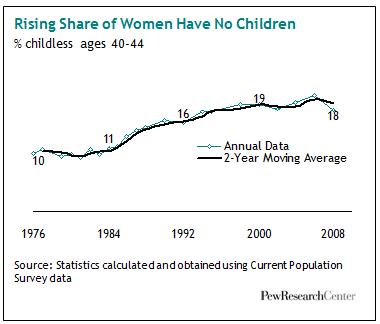
In doing research for a book I may write about voluntary childnessness, I came across a telling graphic from the Pew Research Center.  First, note that the percent of women age 40-44 without a biological child has almost doubled since the late ’70s.  Today about one-in-five such women (18%) have never given birth:

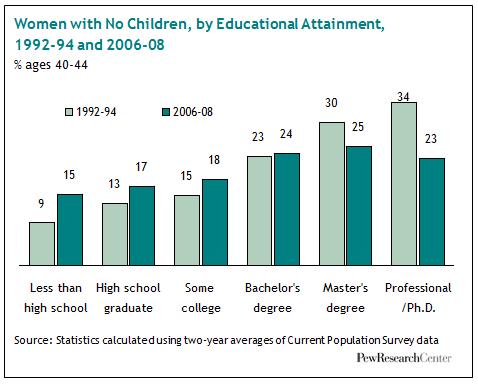
The percent of women is even higher among women with professional degrees (a master’s or equivalent and higher).  One-in-four women with a master’s degree, and nearly that many women with PhDs, have no biological children by ages 40-44.

Here’s where the really telling graph comes in.  Though women with higher levels of education are less likely to have biological children than other types of women, the trend  of increasing childlessness shown above doesn’t apply to them.  In fact, women with master’s and PhDs in the most recent data are more likely to have children than their counterparts 14 years ago.  In the first half of the 1990s, nearly one-in-three women with professional degrees did not have biological children; today it’s one-in-four. Childbearing among the most educated women, then, bucks the trend. It has gone up.

The data probably reflect greater endorsement of the idea that a woman can, or should be able to, balance both a career and a family, as well as the rise of policies that make that possible.  University of Florida sociologist Tanya Koropeckyj-Cox, who’s studied this stuff, says as much.  It may be hard to imagine now, but there was a time when having children would destroy a woman’s always-already fragile career; as much as we may love or hate the “mommy track,” at least today there is one.  Koropeckyj-Cox also suggests that women with higher incomes may have greater access to infertility treatments, making overcoming health problems or delayed childbearing more possible for them than it is among women with less education.

In any case, the data suggests an interesting story about gender, childbearing, educational achievement, and historical change.  I’d be happy to hear more interpretation in the comments.

Lisa Wade, PhD is an Associate Professor at Tulane University. She is the author of American Hookup, a book about college sexual culture; a textbook about gender; and a forthcoming introductory text: Terrible Magnificent Sociology. You can follow her on Twitter and Instagram.
Recently, the Tampa Bay Buccaneers shocked many American football fans with an act that might not seem particularly controversial: they continued playing until the game officially ended.

In the final seconds of their game against the New York Giants, the Bucs were behind and almost certain to lose, but not absolutely and inevitably defeated. With the score at 41-34, if the Bucs could get the ball before the clock ran out and manage a touchdown and a successful conversion, they could tie the game or even win outright, depending on the type of conversion.

When the Giants snapped the ball, Tampa’s players rushed forward.

The Bucs broke a taken-for-granted norm in football: they rushed a quarterback who was taking a knee. When a team has possession of the ball in the last moments of a game, the quarterback can run out the clock by holding onto the ball and touching a knee to the ground. When it’s obvious a quarterback is going to do so, the opposing team is expected to acknowledge that the game is effectively over and let the quarterback quickly take a knee without interference.

The Bucs didn’t. They continued playing serious defense. Giants quarterback Eli Manning was knocked backward by his teammates as they tried to protect him from the unexpected rush.

Tampa’s players, and in particular coach Greg Schiano, were widely accused of poor sportsmanship. The Giants’ coach yelled at Schiano on the field and Manning called it a “cheap shot”. Giants’ player Justin Tuck said the Bucs should have refused their coach’s order to carry out what he called a “classless” play.

But NFL officials confirmed that what they did was entirely within the rules of the game. Teams generally take a hands-off approach to a quarterback who is clearly planning to take a knee, but they aren’t actually required to stand around and let him do it unopposed.

And as NPR reported, if we look back a few decades, taking a knee was itself seen as a bit classless. In the 1978 “Miracle at the Meadowlands” game between the Giants and the Philadelphia Eagles, the Giants lost when they fumbled the ball at the last minute. Taking a knee would have ensured a win, but their coach ordered another play because he, like many coaches at the time, saw taking a knee as unsporting, an unworthy way to guarantee victory.

That loss changed the status of taking a knee. No one could believe a team had all but given away a victory. Giants fans were enraged. The coach was summarily fired and never worked in football again.

For coaches, the take-away message was clear. Running a play carried the risk of a last-minute interception and humiliating defeat, possibly followed by the abrupt end of your career. Taking a knee was a sure thing. It quickly became standard procedure. Teams developed formations for use specifically when they plan to take a knee (thus also signaling their intent to the other team). The stigma that remained around taking a knee disappeared; it has been redefined as an acceptable and even expected move. But for it to work — that is, for it to allow a quick end to the game while minimizing the possibility of risk to players (and especially the quarterback) — the opposing team has to play their role in the script and acquiesce to running out the clock.

Tampa’s coach challenged current norms by treating taking a knee as an outcome for the other team to successfully accomplish, not an opposition-less move that requires only a signal of intent. The Bucs’ violation of this norm has been widely condemned. Football fans viewed it as putting players in danger of injury from the unexpected defensive move with very little chance of actually changing the outcome of the game — a likelihood of success low enough that fans I spoke to questioned Schiano’s motives, suggesting he knew he couldn’t win and was actively intending to hurt the other team.

What counts as a “classy” play or a “cheap shot”? Schiano defended his choice by saying he asks his team to play hard for every second of the game, an attitude that might normally be praised. We romanticize the idea of never giving up, of playing as hard as you can against all odds. But because taking a knee has been accepted as reasonable, expected behavior, failure to follow its taken-for-granted script is widely perceived not as a daring move by the defense, but as an unsporting disregard for the spirit of the game.

In a related story, see footage of a middle school football team tricking their opponent into thinking they weren’t playing when they were.

Gwen Sharp is an associate professor of sociology at Nevada State College. You can follow her on Twitter at @gwensharpnv.

Noam sent in this 10 minute film, “What’s a Girl Doing Here?”, by Diana Diroy.  It includes a set of interviews with female cab drivers in New York.  They’re a rare breed.  According to the description by Narratively:

Loud flashes of yellow are all around you in New York—46,000 taxi sedans, vans and SUVs streaking the streets. Yet, only about 170 of them are driven by women, a percentage even lower than the national average.

Lisa Wade, PhD is an Associate Professor at Tulane University. She is the author of American Hookup, a book about college sexual culture; a textbook about gender; and a forthcoming introductory text: Terrible Magnificent Sociology. You can follow her on Twitter and Instagram.
Though laws varied, American slaves generally could not legally marry.  They were the subject of contracts, legally barred from entering into contracts themselves.  And while some enslavers encouraged their slaves to form romantic relationships because such relationships discouraged running away, slave families were always at risk of being torn apart at the whims of the “master.”

On this day in 1863, Abraham Lincoln signed the Emancipation Proclamation, an executive order that ended slavery for all people in territories that were under Union  control.  Two years later, the Thirteenth Amendment amended the constitution to prohibit slavery.  The next year, two newly-freed now ex-slaves, Thomas and Jane Taylor, were married in Kentucky.

Text:

This day came before me Thomas Taylor and Jane, his wife, persons of color and servants of Christian County and declared that they have been and still aim to continue living together as husband and wife. Given under my hand this 27th day of July 1866.

G.W. Lawson, Clerk
Geo. C. Long, D.C.

Thomas and Jane are the great-great-great-grandparents of Tami, who blogs at What Tami Said.  They had been together for many years before they were given the opportunity to marry and had two children.  According to Dr. Tera Hunter at NPR, they were one of many newly-freed couples to marry in the years after the abolishment of slavery extended them the right.  By 1900, she explains, marriage would be “nearly universal” among American blacks.

Lisa Wade, PhD is an Associate Professor at Tulane University. She is the author of American Hookup, a book about college sexual culture; a textbook about gender; and a forthcoming introductory text: Terrible Magnificent Sociology. You can follow her on Twitter and Instagram.

Cross-posted at Family Inequality.

You can’t get 18 pages into Hanna Rosin’s blockbuster myth-making machine The End of Men, before you get to this (on page 19):

One of the great crime stories of the last twenty years is the dramatic decline of sexual assault. Rates are so low in parts of the country — for white women especially — that criminologists can’t plot the numbers on a chart. “Women in much of America might as well be living in Sweden,* they’re so safe,” says criminologist Mike Males.

That’s ridiculous, as I’ll show. Rape is difficult to measure, partly because of limiting state definitions, but the numbers are consistent enough from different sources to support the conclusion that reported rape in the United States has become less common in the last several decades — along with violent crime in general. This is good news. Here is the rate of reported “forcible rape” (of women) as defined by the FBI’s crime reporting system, the Uniform Crime Reports.**  See the big drop — and also that the rate of decline slowed in the 2000s compared with the 1990s:

(Source: Uniform Crime Reports, 2010)

The claim in Rosin’s book — which, like much of the book, is not sourced in the footnotes — is almost too vague to fact-check. What is “much of the country,” and what is a number “so low” that a criminologist “can’t plot” it on a chart? (I’m no criminologist, but I have even plotted negative numbers on a chart.)

Even though she makes things up and her publisher apparently doesn’t care, we must resist the urge to just ignore it. The book is getting a lot of attention, and it’s climbing bestseller lists. Just staying with the FBI database of reported rates, they do report them by state, so we can look for that “much of the country” she’s talking about. I made a map using this handy free tool.

(Source: FBI Uniform Crime Reports, 2010, Table 47)

The lowest state rate is 11.2 per 100,000 (New Jersey), the highest is 75 (Alaska). You can also get the numbers for 360 metropolitan areas. For these, the average rate of forcible rape reported was 31.5 per 100,000 population. One place, Carson City, Nevada, had a very low rate (just one reported in 2010), but no place else had a rate lower than 5.1. (you can see the full list here). I have no trouble plotting numbers that low. I could even plot numbers as low as those reported by police in Europe, where, according to the European Sourcebook of Crime and Criminal Justice Statistics, for 32 countries in 2007, the median rate was just 5 per 100,000 — which is lower than every U.S. metropolitan area for 2010 (except Carson City, Nevada).

These police reports are under-counts compared with population surveys that ask people whether they have been the victim of a crime, regardless of whether it was reported to police. According to the government’s Crime Victimization Survey (CVS), 65% of rape/sexual assault is not reported. The CVS rate of rape and sexual assault (combined) was 70 per 100,000 in 2010. That does reflect a substantial drop since 2001 (although there was also a significant increase from 2009 to 2010).

And what about the “for white women especially” part of Rosin’s claim? According to the Crime Victimization Survey (Table 9), the white victimization rate is the same as the national average: 70 per 100,000.

I hope it’s true, as Rosin says, that “what makes [this era] stand out is the new power women have to ward off men if they want to.” But it’s hard to see how that cause is served by inventing an end of rape.

—————————

*That is an unintentionally ironic reference, because Sweden actually has very high (for Europe) rate reported rape, which has been attributed to its broad definition and aggressive attempts at prosecution and data collection.

** Believe it or not, this was their definition: “the carnal knowledge of a female forcibly and against her will. Attempts or assaults to commit rape by force or threat of force are also included; however, statutory rape (without force) and other sex offenses are excluded.” That is being changed to include oral and anal penetration, as well as male victims, but data based on those changes aren’t reported yet.

Check the Hanna Rosin tag for other posts in this series.

In “Rule Enforcement without Visible Means,” Theodore Caplow discusses conformity to the norms that guide the practice of celebrating Christmas. These norms are informal — that is, they aren’t enforced in any official way and aren’t encoded in policy — yet Caplow found consistent agreement on expectations, as well as conformity to them. Some of these are easily identifiable, such as the Wrapping Rule, which requires that gifts be wrapped in Christmas-appropriate wrapping paper (or at least marked with a bow if they’re too large or irregularly-shaped to be wrapped).

Others aren’t so readily apparent. For instance, Caplow discusses the Scaling Rule, which guides our purchases of gifts based on the relationship with the recipient. Everyone agreed that a spouse should get the single most valuable gift you buy; kids come next (and should have equal amounts spent on them), then parents/in-laws (who should get similarly valuable presents), and so on. There is a widely-accepted unspoken hierarchy for giving gifts. While we say “it’s the thought that counts,” we also believe that the gifts we give carry social messages about how much we care. Regardless of intent, giving a gift that is perceived as nicer or more expensive to a coworker than to your spouse, or spending more on friends than your kids, would likely be taken as a sign of inappropriate or misplaced loyalties.

Caplow’s point is that social interactions are highly regulated by informal norms, ones we learn and follow often without ever openly recognizing them. Will LaSuer sent in a video that illustrates this point. The video explains etiquette in men’s restrooms: proper spacing when selecting a urinal, flushing, making eye contact or speaking to others in the restroom, and so on. It’s an explicit discussion of the usually taken-for-granted norms of daily life.

One note: The first 4:40 of the video covers these basic norms. After that, it goes on to a long scenario that you may want to skip. While, as Will says, the language and imagery is nothing you wouldn’t see in, say, South Park, if you’re thinking of using the clip in class to illustrate norms, I’d definitely stop at the 4:40 point, both because of the content and because I don’t think the rest of the video contributes anything to the basic sociological point.

Will suggests using the video along with John Paul’s “urinal game” to help students grasp the concept of informal norms.

Caplow, Theodore. 1984. “Rule Enforcement without Visible Means: Christmas Gift Giving in Middletown.” American Journal of Sociology 89(6): 1306-1323.

Paul, John. 2006. “‘Flushing’ Out Sociology: Using the Urinal Game and Other Bathroom Customs to Teach the Sociological Perspective.” Electronic Journal of Sociology. ISSN: 1198 3655.