Search results for The

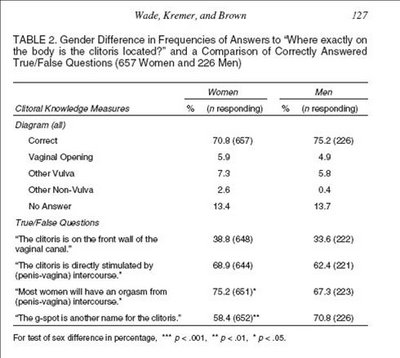
Shameless self-promotion… and some really interesting findings regarding knowledge and frequency of orgasm in a non-random population of undergraduates. This first graph shows the percent of male and female respondents who (1) correctly located the clitoris on a map of the vulva and (2) correctly answered a series of true/false questions about the clitoris.

You’ll see that there is surprising little difference between men and women (considering that women have had access to a clitoris all their lives and men have had access only recently, if at all), though you’ll see that men are more likely to think most women will have an orgasm from penile-vaginal sex (most women don’t) and women are more likely to think the g-spot is another name for the clitoris (it’s not). These two cancelled each other out such that the average knowledge score for men and women was statistically the same. The same!
 

It’s this next graph that’s the real kicker. This graph shows the relationship between how well a woman scored on the clitoral knowledge tests (on a 0-5 scale) and how frequently she has an orgasm during masturbation and with a partner. You’ll see a nice positive relationship between knowledge and orgasm in masturbation and no relationship at all between knowledge and orgasm with a partner. (For fun, notice that the average score on the clitoral knowledge measure for women who’d never had an orgasm with a partner and who always do is the same. Also notice that there are 124 women in that never category, it’s not just a handful of women who are somehow “dysfunctional.”)

So, for some reason (feel free to speculate), even when women know about their own bodies, they either keep it to themselves, or have partners that don’t want to hear it, or both.

You can download the paper here.

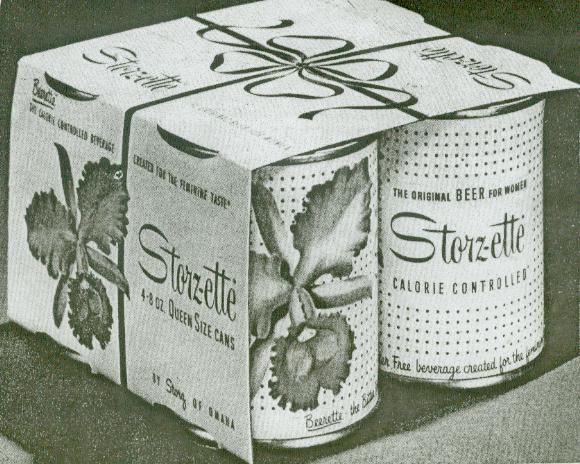
These images are of a beer marketed specifically to women in 1953, Storzette by Storz.


From the website:

“In 1953 Storz tried to market a new product for women, ‘Storzette.’ Designed to be a beer for the ladies it was supposedly not too bitter and was calorie controlled. it also came in a smaller can, 8 ounces, which Storz called “Queen sized” and it came in four can packs called “Princess Packs.” The brewery noted that market studies showed that many women felt that the standard 12 oz can provided too large a serving. The beer inside was also different, made to be less bitter than standard beers. The can even had a pink orchid pictured on it to help it appeal to women. It’s initial test market results in San Diego seemed positive, but in the end the effort was not successful and Storzette did not last long on the market. As a result, the little can with the orchid is very scarce. Storz also used a slogan on its regular cans for awhile in the 1950s, “the Orchid of Beer” which has to be one of the more unusual beer advertising slogans.”

This nice Barbie and Ken from 1961 might be useful for demonstrating just how much the ideal masculine body has changed.


Look at those skinny legs!

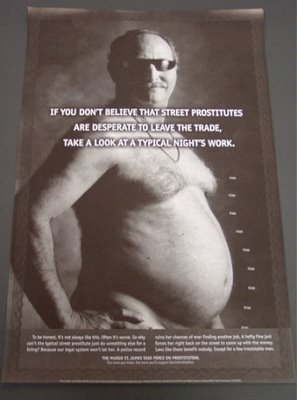
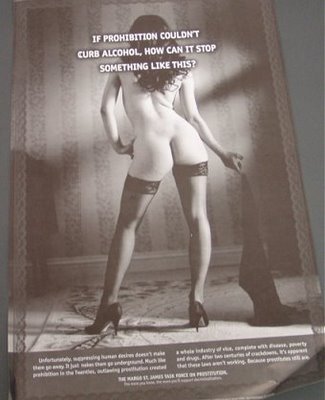
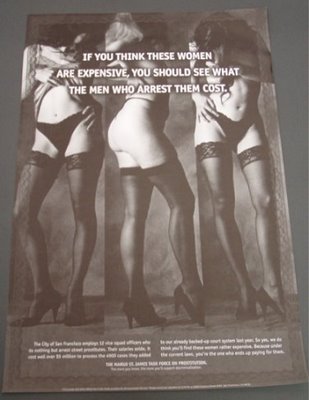
These posters were made by Call Off Your Old Tired Ethics (COYOTE), an association for sex workers’ rights.

Discussion of gender bending and transgender children on The View:[youtube]http://www.youtube.com/watch?v=78ND3vqPz90[/youtube] 

I LOVE this image. It’s a fashion spread.


Question:
Who’s taking care of those little tow-headed boys behind the white picket fence when both mommy and daddy go to work?

I use this picture to talk about the way in which middle- and upper-class women are “getting equal” with men by transferring their caretaking responsibilities to less privileged women… who are, as in this ad, invisible.