Search results for The

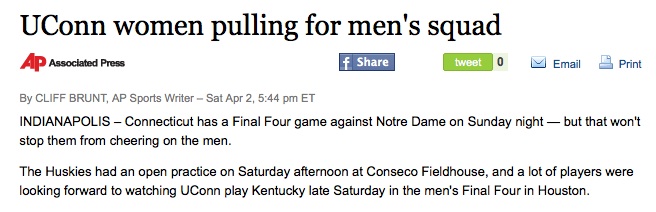
Well, I’m very late posting today, obviously. It was a long day. Anyway, Elliott J. sent in an AP news story that ran on Yahoo news. The article about the University of Connecticut women’s basketball team — which was in the Final Four of the women’s tournament — focuses not on their physical prowess, skill, or competitive spirit, but rather on the fact that they’re super excited to cheer on the UConn men’s team: Of course, there’s nothing shocking about the fact that one team from a school might want other teams from the same school to win. But there’s a tendency to feminize female athletes and to highlight their relationships with and appreciation for men, to reassure audiences that they’re still appropriately feminine despite their interest in sports and amazing athletic abilities. In this case, we learn that these female athletes still support and cheer for their male colleagues…and though the women in the article say the teams support each other, only examples of the women rooting for the men are included, and despite my googling, I couldn’t find any stories about how much the UConn men’s team was pulling for the women’s team.
UPDATE: Reader twostatesystem was able to find an article about the men of UConn cheering on the women that I didn’t find in my quick googling (I tried variations on “UConn men cheer/support/pull for women” and couldn’t find anything at the time).

Cross-posted at Ms.

Growing up in America, we learn that sweets and junk food are “guilty pleasures.” Women, especially, are supposed to refrain from such indulgences.  And, if they cannot — if they, for example, desire more than that modest slice of cake served to each birthday guest — then they should feel not only guilt, but shame.  For overindulging is grotesque and it, accordingly, should be hidden and kept secret.

This is the cultural background to Lee Price‘s realist paintings of women (mostly her) eating sweets and junk food.  She draws two contrasts.  First, she makes very public something we are supposed to do only in private.  Not only do the paintings literally display the transgression, the birds eye view and frequent nudity exaggerates the sheer display of the indulgence.  And, second, she takes something that is supposedly disgusting and shameful and presents it in a medium associated with (high) art, challenging the association of indulgence with poor character and a lack of refinement.  Fascinating.


Visit Lee Price’s website.
Via BoingBoing.

Lisa Wade, PhD is an Associate Professor at Tulane University. She is the author of American Hookup, a book about college sexual culture; a textbook about gender; and a forthcoming introductory text: Terrible Magnificent Sociology. You can follow her on Twitter and Instagram.

Christine sent us a link to some fabulous photos coming out of Toronto. In January a member of the Toronto Police force, Const. Michael Sanguinetti, suggested to students at York University that “women should avoid dressing like sluts in order not to be victimized” (source).  In response, SlutWalk was born.  The SlutWalk, which strode just yesterday, was a march designed to draw attention to the way in which the term “slut” is used to stigmatize and invalidate women.

As Leora Tanenbaum argues in Slut! Growing Up Female with a Bad Reputation, the term is used to control all women, not just women who want to have sex, because it can be applied to girls and women regardless of their sexual activity (as any virgin with a slut reputation can tell you).  Young girls grow up using, and fearing, the slut label.  And that label continues to be used against them as adults, even when it comes to sexual assault, as the police officer’s comment makes clear.

In an effort to bring attention to word and  its use as a mechanism of control girls, women and men of all sexual activity levels came together on Sunday, re-claiming and diffusing the “slut” label.

Lisa Wade, PhD is an Associate Professor at Tulane University. She is the author of American Hookup, a book about college sexual culture; a textbook about gender; and a forthcoming introductory text: Terrible Magnificent Sociology. You can follow her on Twitter and Instagram.

To great acclaim, we previously featured the work of Adriel Luis after Occidental student Samantha Figueroa illustrated his poem “Slip of the Tongue” with clips from Pocahontas.  Luis is back with a touching spoken word performance inspired by the Watts riots in Los Angeles.

Visit Luis at Ill-literacy.

Lisa Wade, PhD is an Associate Professor at Tulane University. She is the author of American Hookup, a book about college sexual culture; a textbook about gender; and a forthcoming introductory text: Terrible Magnificent Sociology. You can follow her on Twitter and Instagram.

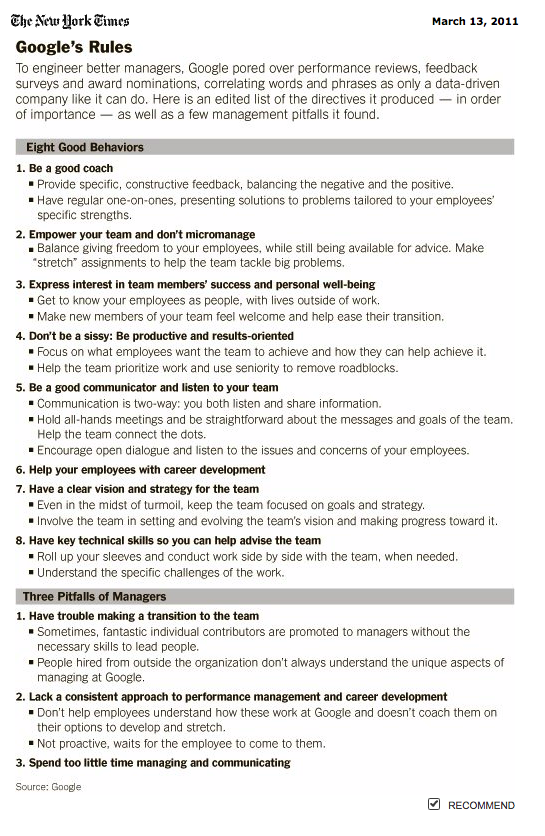
Men and women are told, in a myriad of daily ways, that being masculine is good and feminine bad. It sneaks into our daily language in ways that are so common that we fail to even see it anymore. For example, a recent New York Times article about Google’s effort to determine what makes managers successful featured a list, written by Google, of what makes a good boss.

I noticed that they added The New York Times added the phrase “Don’t be a sissy” to “Good Behavior” #4.  It reads “Don’t be a sissy: Be productive and results-oriented.”   It’s the only Good Behavior that includes a derisive slur. And while I’m accustomed to seeing terms like “sissy” thrown around as insults, it occurred to me that the very next rule #5, “Be a good communicator and listen to your team,” could easily have been prefaced with “Don’t be a man.”

But being a “sissy” (that is, feminine) is something that we can all agree is bad, while being a man is good.  So, even when the rules suggest that men take on feminized traits, they’re unlikely to adorn the suggestion with a denigration of masculinity.

Via Teppo at OrgTheory.

Lisa Wade, PhD is an Associate Professor at Tulane University. She is the author of American Hookup, a book about college sexual culture; a textbook about gender; and a forthcoming introductory text: Terrible Magnificent Sociology. You can follow her on Twitter and Instagram.

My great-grandma was born in 1914 and lived until 2005, so she witnessed an enormous amount of technological and cultural change during her life. I asked her once what single thing she found most impressive or was most grateful had been invented. She answered, without hesitation, “the electric washing machine.” As the mother of 7 children with a husband who did not do housework, laundry had been the bane of her existence. Getting a washing machine that had a hand-powered wringer helped, but it was still exhausting. The way she saw it, getting an electric washing machine changed her life. Her fear of ever again having to do laundry by hand with a washboard was so great that she kept the hand-crank-powered washer next to her electric one until the early 1990s, just in case.

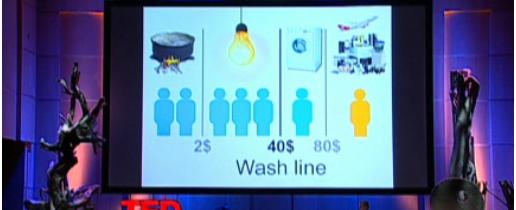
In this TED clip, “Hans Rosling and the Magic Washing Machine,” sent in by Dmitriy T.M., Rosling discusses the ethical problems involved in efforts to combat climate change that rest primarily on telling individuals in developing nations that because we need to use less energy globally, they just can’t have the same appliances and conveniences, like electric washing machines, that those of us living in (post-) industrialized nations do:

Transcript after the jump.

more...

Feminist Frequency‘s Anita Sarkeesian has released the first of her series of short videos examining the roles women are often assigned in movies and television.  In this one she goes after the “manic pixie dream girl,” or the female side character who helps the male main character find himself, love life again, or overcome some obstacle.  This character, Sarkeeisan argues, is problematic because she “perpetuates the myth of women as caregivers at our very core”; her main role is to “‘fix’ these lonely sad men, so that they can go ‘fix the world.'”  The women themselves?  They’re too busy being adorable.

(Transcript after the jump.)

more...

Cross-posted at Racialicious.

We owe many iconic images of American Indians to photographer Edward S. Curtis. Growing up in Wisconsin and Minnesota, Curtis began photographing Indians in 1895 and, in 1906, was offered $75,000 by JP Morgan to continue documenting their lives (wikipedia).  The 1,500 resulting photographs inevitably impacted the image of Indians in the American imagination.

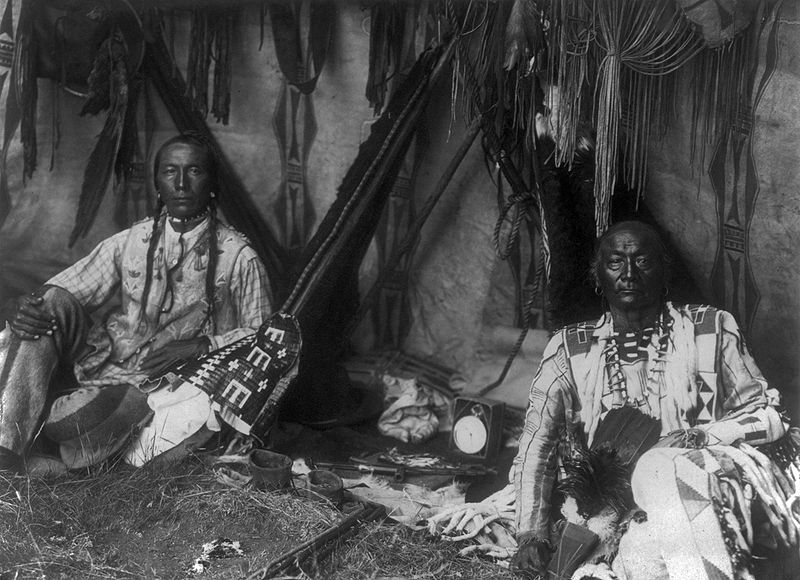
Later it came to light that Curtis’ photographs weren’t exactly pure representations.  In some photographs, for example, he erased signs of modernity.   The first photograph below, the un-edited version, includes a clock between the two men, whereas the edited version does not.

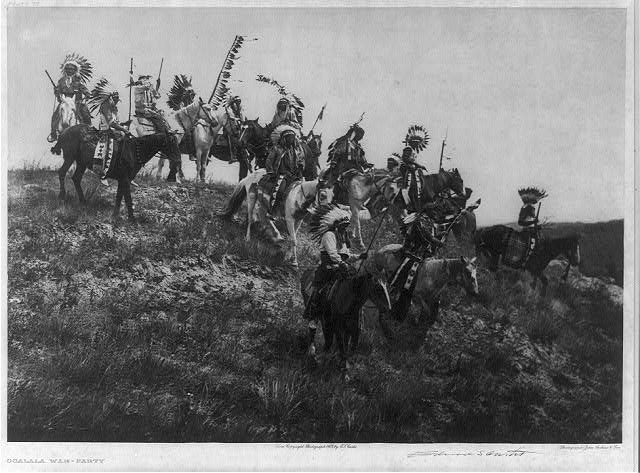
Curtis also sometimes staged scenes and dressed paid participants in costumes, as in this photograph:

12

According to Wikipedia contributors:

In Curtis’ picture, Oglala War-Party, the image shows 10 Oglala men wearing feather headdresses, on horseback riding down hill. The photo caption reads, “a group of Sioux warriors as they appeared in the days of inter tribal warfare, carefully making their way down a hillside in the vicinity of the enemy’s camp.”  In truth headdresses would have only been worn during special occasions and, in some tribes, only by the chief of the tribe.  The photograph was taken in 1907 when natives had been relegated onto reservations and warring between tribes had ended. Curtis paid natives to pose as warriors at a time when they lived with little dignity, rights, and freedoms.

Curtis’ photographs, then, pushed his subjects back into a false past that non-Indian Americans would misrecognize as authentic for a hundred years.

The problem of misrepresentation of groups who have little power to control their own images is a widespread one.  Shelby Lee Adams’ work was mired in controversy, with critics suggesting that he contributed to the belief that Appalachians were backward, imbred, and unintelligent.   We might apply the same critical eye to representations of marginalized peoples today, like the representation of Arabs in video games and Italian-Americans on Jersey Shore and spin-offs.

Thanks to Dolores R. and Adrienne at Native Appropriations for the post idea.

Lisa Wade, PhD is an Associate Professor at Tulane University. She is the author of American Hookup, a book about college sexual culture; a textbook about gender; and a forthcoming introductory text: Terrible Magnificent Sociology. You can follow her on Twitter and Instagram.