Search results for The

Nearly two years ago I wrote a post about the discovery that the president of Jacksonville State University blatantly plagiarized large segments of his dissertation. Yet his Ph.D. was not revoked, nor did he lose his job or face any discipline, as far as I know.

Another case recently came to light. Karl-Theodor zu Guttenberg, Germany’s Defense Minister, admitted plagiarizing part of his dissertation. Flowing Data posted this graph, created by Gregor Aisch, that visualizes the extent of the plagiarism. The taller bars represent regular text, while the shorter bars are footnotes. The dark red bars are direct plagiarism; the bright red ones are “other” plagiarism, which I can’t explain to you because the page about it is in German:

In this case, however, status didn’t outweigh the plagiarism. The University of Bayreuth, where he earned his J.D. degree, revoked it; over 20,000 academics signed a petition to Chancellor Merkel complaining about her continued support for Guttenberg; and he ultimately resigned.

UPDATE: Reader Kat asked that I provide the link to the original source, GuttenPlag Wiki. Kat explains,

The dissertation was NOT run just through a computer programme- it was posted on the internet and then people “crowd-sourced” passages to find where they were really from.

Secondly, there is another good graphic that I believe you should include in your post lower down on the page I posted above:
– Black are pages on which one source was plagiarized
– Red are pages with plagiarism of more than one single source
– White are pages where SO FAR no plagiarism has been found
– Light blue are the index and annexes

In total Baronet zu Guttenberg plagiarized 76.34 % of his dissertation (annexes and index were not included to compute this percentage).

Thirdly: The entire dissertation was VERY likely written by a ghost writer. Guttenberg was a Member of Parliament the entire time when the PhD was allegedly “written” (copy and pasted).

Here is the image she desscribes from the GuttenPlag Wiki page:

And reader Ellen says,

I took a crack at the German explanation of the “other plagiarism” and I think it refers to instances where the source was incorrectly cited, quotation marks were conveniently forgotten and other things of that nature. In other words, plagiarism that isn’t directly copied and pasted.

I suspect the academic world would be horrified by the results if someone had time to sit down and systematically run dissertations through anti-plagiarism software.

UPDATE 2: Kat sent along another link that makes the degree of plagiarism even more obvious. It shows in thumbnail form each page that has plagiarism, and you can click on the thumbnail to see a side-by-side comparison of the original and Guttenberg’s dissertation. The updated Wiki page indicates that over 94% of pages were plagiarized. Finally, she clarifies what “other plagiarism” means:

  • A source text in a language other than German was translated word by word, with no quotation marks. The translation was made by the “Wissenschaftliche Dienst” (Science Service) of the Bundestag (German equivalent to CRS). So he illegally let them do research for his PhD (claiming it was for his work as MP)
  • plagiarism of structure: The structuring of an argument or an index or a graphic e.g.
  • Alibi footnote: There is a footnote, but it is insufficient. For example, a huge passage is an actual quotation, but the footnote and citation marks make it look as if only part of the sentence is a direct quote.
  • Shake & Paste: The text is made up of fragments of another text which were rearranged.


The word “proletariat” “proletarian” refers to a member of the working class of a capitalist society, or the “proletariat.”  Combining the word with “precarious,” economist Guy Standing coined the term “precariat” to try to describe the reality of low wage workers in our modern, global economy.

In the ten-minute segment below, sent in by Jordan G., an interview with Standing is complimented by interviews with workers and activists in Britain.  He explains that new international labor markets have weakened the power of labor and strengthened that of employers.  The result is more jobs that are part time, with unpredictable hours, low wages, and few benefits.  This has been good for employers in that the risk inherent in capitalist enterprises has been transferred to the workers.  For example, if the hotel isn’t full, then the managers simply bring in fewer housekeepers.  This is hard on housekeepers, but easy on hotels.  Workers’ lives, then, are increasingly precarious, thus the term “precariat.”

Found at The Guardian via Global Sociology.

Lisa Wade, PhD is an Associate Professor at Tulane University. She is the author of American Hookup, a book about college sexual culture; a textbook about gender; and a forthcoming introductory text: Terrible Magnificent Sociology. You can follow her on Twitter and Instagram.

Disneyland markets itself as “The Happiest Place on Earth” and goes to great pains to create a visual experience that defies our everyday realities, but these photos by Arin Fishkin, of bored kids waiting in line, contrasts starkly with Disney’s claims.   I’ve always thought it was really interesting how companies that sell “fun” (theme parks, obviously, but also places like casinos and dance clubs) do so by downright insisting “this is what fun looks like!”   “There are flashing lights! Fun! There are bright colors! Fun! There is happy music! Fun! This is what fun looks like and you are having it!!!”  Anyway, just because Disneyland says it’s fun, doesn’t mean it is.

Via BoingBoing.

Lisa Wade, PhD is an Associate Professor at Tulane University. She is the author of American Hookup, a book about college sexual culture; a textbook about gender; and a forthcoming introductory text: Terrible Magnificent Sociology. You can follow her on Twitter and Instagram.

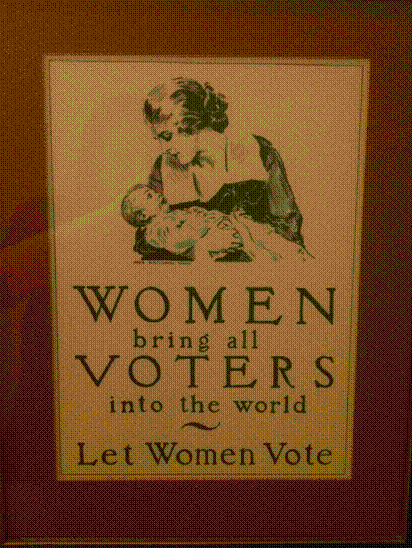
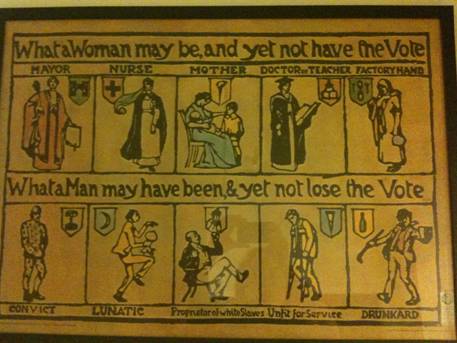
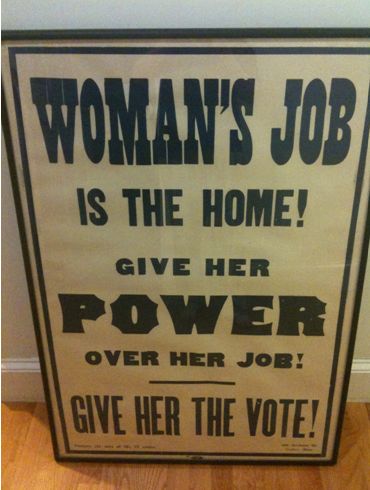
The décor in my childhood home was unusual. Interspersed with photographs of my sister and me were vintage political posters, inherited from my late grandparents. The most startling of these were the posters promoting women’s right to vote: as I grew up, I realized that the viewpoints they depicted contrasted starkly with the narrative of women’s suffrage that I had learned in my history classes.

This poster supports women’s right to vote not by asserting their equality with men, but by appealing to their ability to bear children:

By contrast, this poster actively highlights woman’s ability to contribute to society beyond stereotypically female roles: women were not only nurses and mothers, but doctors and mayors. Yet at the same time, the image disparages the mentally and physically ill by painting men with these conditions as inherently lesser.

Lastly, a picture that speaks for itself.  Women should have suffrage, says the poster, but they must always remember where they truly belong.

Although the right to vote politically empowered the women of Western society, many of the proponents of the women’s suffrage movement espoused ideologies that would not be considered feminist or politically correct today. My history classes dwelt only briefly on these unpalatable schools of rhetoric, but the images in my home allowed me to glimpse a debate that was just as complex and fragmented as the political disputes we face today.

———————————-

Alison Marqusee is a high school senior from Massachusetts.  In addition to sociology, her interests include linguistics, psychology, and physics.  She looks forward to attending Haverford College.

If you would like to write a post for Sociological Images, please see our Guidelines for Guest Bloggers.


We’ve posted previously on the tendency of the U.S. media to ignore the rest of the world (in favor of Britney Spears), even changing the cover of magazines sold in the U.S., but not elsewhere, in ways that coddle our ethnocentrism.

Given this phenomenon, this four-minute clip from a Russia Today news program (in English) is particularly striking.  The reporter notes that the U.S. media is covering the ongoing foreign political protests more thoroughly, and with more positive enthusiasm, than it has the protests in Wisconsin.

Thanks to Abby Kinchy, fellow UW-Madison alum and Assistant Professor of Science and Technology Studies at Rensselaer Polytechnic Institute, for the tip.

Lisa Wade, PhD is an Associate Professor at Tulane University. She is the author of American Hookup, a book about college sexual culture; a textbook about gender; and a forthcoming introductory text: Terrible Magnificent Sociology. You can follow her on Twitter and Instagram.

Last year I wrote about a series of billboards in Atlanta that re-framed the abortion debate as a race issue. The billboards featured a child’s face and read “Black Children are an Endangered Species.” A new billboard, in the same theme, has appeared in New York City and was sent in by Kristy H. and Kelly.  Featuring a young girl, it reads: “The most dangerous place for an African American is in the womb”:

Three points:

(1) People without economic resources —  including, disproportionately, black women — are more likely to end pregnancies in abortion. This is not a trivial matter; many women in the U.S. have abortions because they can’t afford (more) children.  It’s terribly saddening to think that some women abort children they want.  And some members of the Black community do argue that this is a form of genocide.

(2) This ad, however, doesn’t come across to me as sympathetic to Black women.  The language in the ad leaves the aborting woman unstated, but still culpable.  She is simultaneously reduced to a womb and accused of placing her child in danger (of being a murderer?).  As Michael Shaw at BagNewsNotes suggests, this ad appears to happily trigger our thoughts of Black people and Black spaces as violent.  Is this ad appealing to the Black community?  Or is it appealing to stereotypes about Black people as a strategic move in the anti-abortion debate?

(3) Finally, as I wrote in my previous post, and on a different note, the message illustrates something very interesting about social movements and framing.

The fact that abortion is highly politicized in the United States, deeply connected to feminism (but not race or class movements), and framed as a specifically-gendered contest between “life” and “choice” seems natural to most Americans. Indeed, it’s hard for many Americans to imagine a world in which the procedure is less politicized or debated differently.  But the politics of abortion in the U.S. is not the only kind of abortion politics that could exist… [see, for example, Shaping Abortion Discourse].  So, whether you agree or disagree with the claims in these billboards, they nicely jolt us out of our acceptance of abortion politics as is.  How might thinking about abortion as a race issue or a class issue change the debate?

Source: Gawker.

Lisa Wade, PhD is an Associate Professor at Tulane University. She is the author of American Hookup, a book about college sexual culture; a textbook about gender; and a forthcoming introductory text: Terrible Magnificent Sociology. You can follow her on Twitter and Instagram.

Melissa sent in a trailer for the video game, inFAMOUS2.  The game features a white male protagonist who is advised by a bad influence and a good influence.  Melissa notes that these are a black woman dressed skimpily and a white woman dressed (relatively) modestly, respectively.  So here we have, again, an affirmation that black is bad and white is good.

Screenshot:

Trailer (2 minutes):

Lisa Wade, PhD is an Associate Professor at Tulane University. She is the author of American Hookup, a book about college sexual culture; a textbook about gender; and a forthcoming introductory text: Terrible Magnificent Sociology. You can follow her on Twitter and Instagram.


Lester Andrist (of The Sociological Cinema) sent in a clip by Feminist Frequency’s Anita Sarkeesian. She looks at the way that the movies that are rewarded with Oscars tend to be highly centered around male characters and male-dominated plots. It seemed appropriate for Oscars day:

(Transcript after the jump below.)

Lester also pointed out The Girls on Film, a group that recreates male-centered scenes from movies with a female cast. They’re fun and also highlight the types of roles we do and don’t expect to see women in. Here’s Lester’s favorite, a recreation of a scene from J. J. Abrams’s Star Trek:


more...