Search results for The


In this four-minute video, Dwayne McDuffie describes what it’s like being a Black comic book writer:

Related, see Hennessey Youngman on being a black artist.

Via Racialicious.

Lisa Wade, PhD is an Associate Professor at Tulane University. She is the author of American Hookup, a book about college sexual culture; a textbook about gender; and a forthcoming introductory text: Terrible Magnificent Sociology. You can follow her on Twitter and Instagram.

Karma Japan and Ignorant and Online are new sites, featured at BoingBoing, dedicated to collecting tweets and Facebook status updates that suggest that the tsunami in Japan is karmic: pay-off for supposed Japanese sins.  The guilt ascribed to Japan ranges from their hunting and eating dolphins and whales and their bombing of Pearl Harbor especially, but also things like their rate of atheism and their politics.  But all have in common the notion that the Japanese deserve what has happened and that mother nature/God herself is against Japan and ensuring that the society is punished.  A fascinating peek into the minds of these Americans.


Trigger Warning: These comments are hateful and vulgar (and in pretty large font if you’re at work).


From Karma Japan:

The rest after the jump:

more...

We’ve posted before about the use of women’s bodies to sell real estate. But this Australian commercial for luxury housing, sent in by Nigel M., takes it to a whole new level. As Nigel said, “Even if I told you, you still wouldn’t believe me.” Let’s just say it includes a “lingerie model tied to a chair,” hot lesbians making out for male pleasure, and the phrase “speaking of broads.”

It’s a real gem:

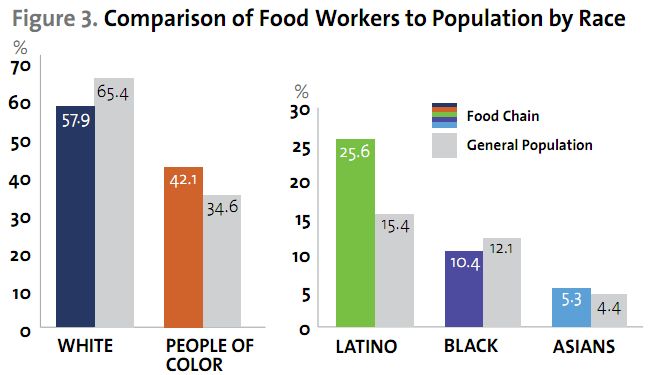
Via Colorlines I discovered an Applied Research Center report titled The Color of Food.  The report found that Blacks, Latinos, and Asians were overrepresented in food service work:

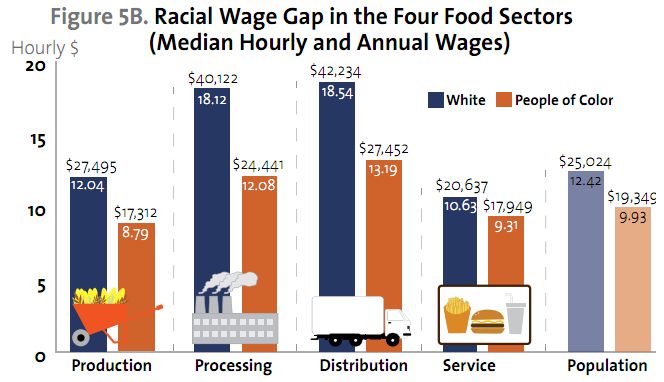
The report also discovered a wage gap between White workers and non-White workers at every level of food production:

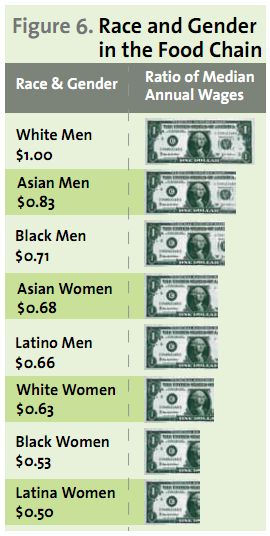
Race intersected with gender, such that women earned less than men of their same race for each group studied:

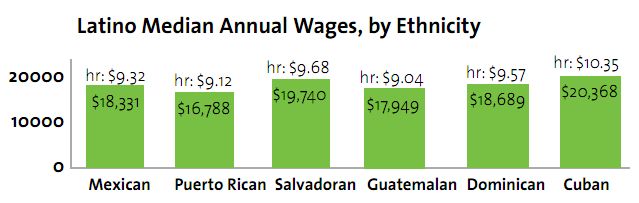
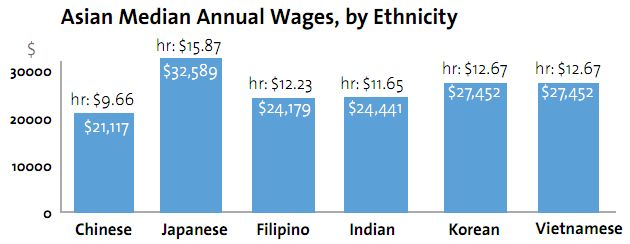
The authors go on to break down the data further by each part of the commodity food chain — production, processing, distribution and service — and by racial group.  For example, they show that the average wage of Latinos and Asians differs by ethnic background (always a good reminder that racial categories obscure variability):

Lots more at The Color of Food.

Lisa Wade, PhD is an Associate Professor at Tulane University. She is the author of American Hookup, a book about college sexual culture; a textbook about gender; and a forthcoming introductory text: Terrible Magnificent Sociology. You can follow her on Twitter and Instagram.

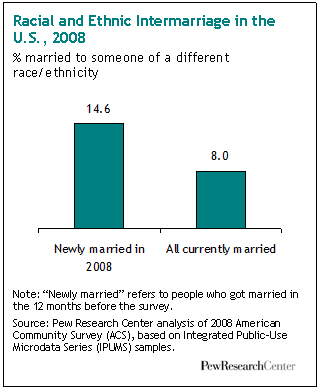
New-ish data from the Pew Research Center suggests that inter-racial and -ethnic marriages are on the rise due to cohort changes.  First, the report shows that people who were newly married in 2008 were more likely to be married to someone of a different racial or ethnic group:

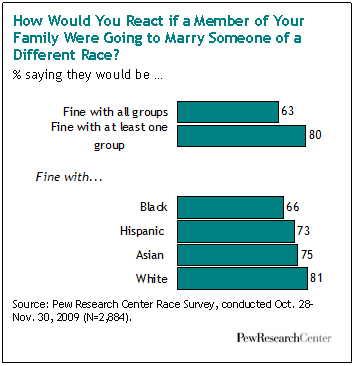
This trend is likely facilitated by greater acceptance of intermarriage.  According to the report, in 1987 less than half of Americans said it was okay for White and Black people to date each other, by 2009 that number had risen to 83%.  Among 18- to 32-year-olds, 93% approve.

Among Pew’s respondents, 63% said that they approved of inter-racial and -ethnic marriages without reservation and another 17% said that they approved of at least one type of intermarriage, but not others.  Still, overall acceptance of intermarriage still aligns with the familiar racial hierarchy in that Americans are more comfortable with outmarriages to Whites, than to Asians, Hispanics, and especially Blacks.

Acceptance of inter-racial and -ethnic marriage is on the rise, then, in part because younger people are more accepting of it than older people.  Acceptance, however, still reflects a color-based racial hierarchy.

Lisa Wade, PhD is an Associate Professor at Tulane University. She is the author of American Hookup, a book about college sexual culture; a textbook about gender; and a forthcoming introductory text: Terrible Magnificent Sociology. You can follow her on Twitter and Instagram.

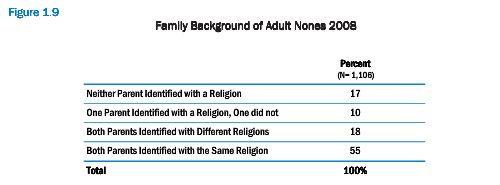
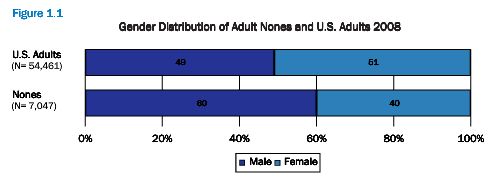
Data from the American Religious Identification Survey (collected in 2008) reveals some interesting things about the population of Americans that do not identify with organized religions: atheists, agnostics, and the “spiritual but not religious.”  Most of the non-religious grew up with religious parents.  Only 17% report that neither of their parents identified with a religion:

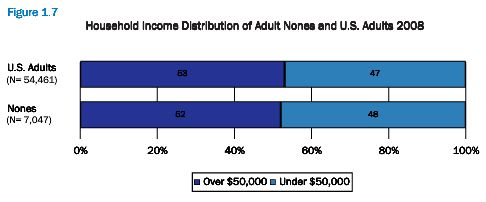
Being non-religious does not correlate with income or education:

Instead, it’s strongest correlation is with gender.  Women are more likely than men to believe in God, more likely to convert to a faith if raised as a non-believer, and less likely to leave a faith they are raised in.

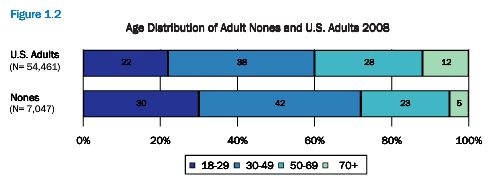
Younger people are also more likely to be non-religious:

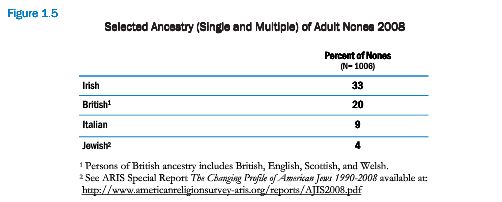
Americans with Irish ancestry make up a significant percentage of the non-religious. They account for about 12% of Americans, but about 1/3rd of all non-religious:

More details at American Nones.

Lisa Wade, PhD is an Associate Professor at Tulane University. She is the author of American Hookup, a book about college sexual culture; a textbook about gender; and a forthcoming introductory text: Terrible Magnificent Sociology. You can follow her on Twitter and Instagram.
Squee sent in this video on the complexities of the placebo effect. We most often hear about the placebo effect in terms of medicine (the famed “sugar pill” that makes people feel better despite having no known effect on a condition), but as the video points out, we use placebos in other aspects of social life as well, such as buttons at intersections that don’t affect the timing of the “walk” signal but make pedestrians feel better about their wait anyway. And since the placebo effect is based in part on cultural assumptions about what should make us feel better (i.e., an expensive drug must be better than a discounted one, right?), not surprisingly the effectiveness of specific placebos varies cross-culturally.

Fun!

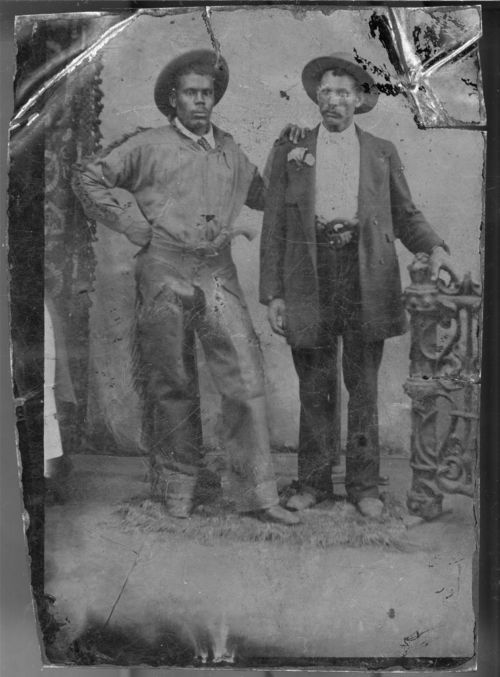
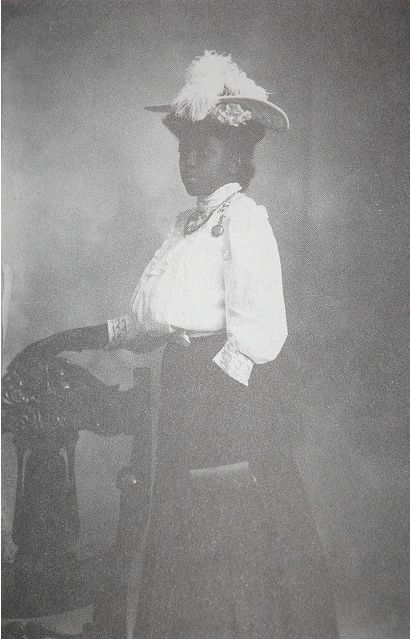
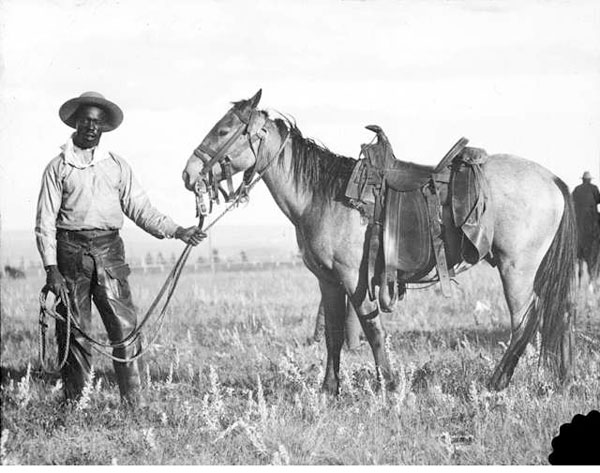
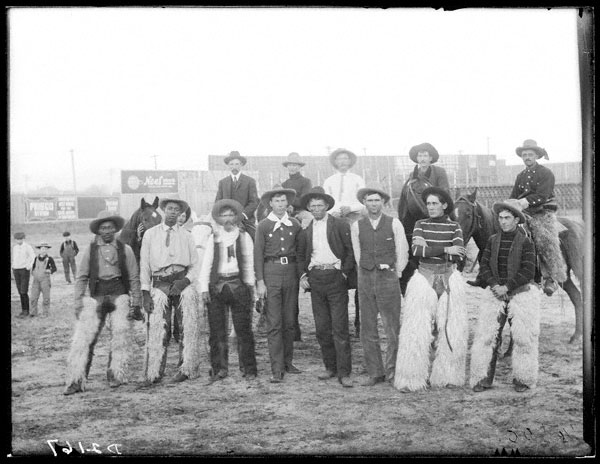
While the quintessential Old West “cowboy” is White in most imaginations, in fact there were Black pioneers in the west during the wild days (usually dated mid-1800s till the end of the century).  According to wikipedia, thousands of Black men and women lived in mostly segregated communities in the West, but participated in all parts of Western society.  They were traders, gold miners, soldiers, cowboys and farm hands, bartenders, cooks, and, of course, outlaws.   I enjoy how these photographs color American history:

Identity unknown, around 1865, Kansas (source):

Nona Marshall, late 1800s, Arizona territory (source):

Black cowboys (1890-1920):

Lisa Wade, PhD is an Associate Professor at Tulane University. She is the author of American Hookup, a book about college sexual culture; a textbook about gender; and a forthcoming introductory text: Terrible Magnificent Sociology. You can follow her on Twitter and Instagram.