Search results for The

Given our collection of toy make-overs, I was curious when I heard that Quaker Oats had re-vamped their mascot, Larry.  In the toys we’ve covered, the trend is towards greater feminization and sexualization.  Larry, though, is a dude.  And do we really need to sexualize our oatmeal?  (Well, you never know.)

It turns out what prompted the mascot make-over wasn’t an effort to make Larry sexier, but to make him look healthier.  According to the Wall Street Journal, the director of Quaker’s brand-design firm wanted to reinforce people’s association of oatmeal with “energy and healthy choices.”  And by “healthy,” they mean “thin.”   They reduced the roundness of his chin and cheeks.  They also gave him a hair cut in order to expose the sides of his neck.  Another representative of the brand redesign explains: “It’s the same neck,” but the haircut “makes him look thinner… We took about five pounds off him.”
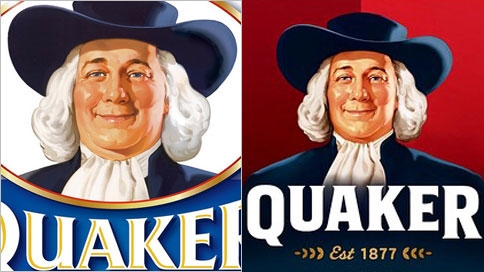
If it’s tough for you to tell the difference between the two, it’s by design.  Quaker wants the changes to work on a subconscious level.  A fascinating peak into the motives and tactics of brand management.

Lisa Wade, PhD is an Associate Professor at Tulane University. She is the author of American Hookup, a book about college sexual culture; a textbook about gender; and a forthcoming introductory text: Terrible Magnificent Sociology. You can follow her on Twitter and Instagram.
Cross-posted from cyborgology.

On February 26, 2012, Trayvon Martin, an unarmed Black high school student, was shot and killed by George Zimmerman, a White Hispanic neighborhood watch captain. The case has become a symbolic battleground. Artist Israel McCloud was inspired to paint a mural in his honor in Houston.

As Jessie Daniels points out at Racism Review, battles over racism have shifted into the realm of social media, where digital and physical race relations persist in an augmented relationship. We see this in both anti-racist discourses and the racial smear campaigns surrounding the Martin/Zimmerman case.

Although it is important to expose the overtly racist tactics utilized by some of Zimmerman’s defenders, I want to talk about a more subtle, and so perhaps more problematic, form of racial discourse. A prominent strategy of protest arising from the left may inadvertently perpetuate, rather than challenge, racial hierarchies in their most dehumanizing form.

This tactic has made the rounds on my own Facebook Newsfeed, and is one in which I, prior to more critical thought, actively participated:  the creation of images and texts that couple Black bodies with prestigious social positions and ask viewers to problematize racialized assumptions that often lead to faulty first impressions—which in turn lead to physical danger for the racialized subject. This tactic comes in two forms: political memes and case examples.

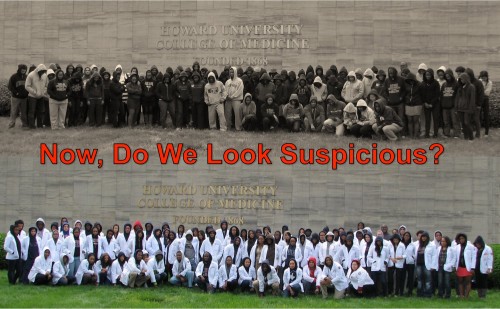
The memes, such as the one pictured below, are direct and general. They argue that Black bodies are assumed dangerous unless proven otherwise. This meme warns us that we might treat a doctor as a criminal purely based on skin color:

 I (regretfully) posted this meme to my own Facebook wall. Rather than delete the meme, I added this post to the comment thread as a public declaration of my error.

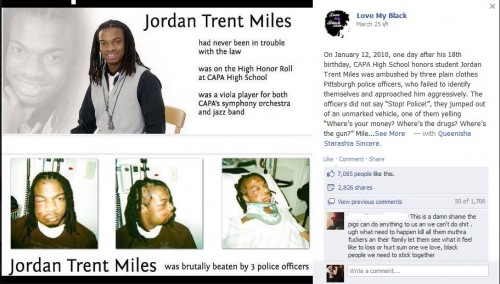
The case examples are more in depth, but accomplish a similar task. They picture a clean-cut, Black male body. They list his credentials, and then tell of his physical abuse at the hands of scared, racist White authority figures:

Copied from my Facebook Newsfeed.

 Activists strategically link these memes and cases to Trayvon Martin’s story, highlighting his clean record and child-like face. This protest tactic honors Martin (and other Black boys and men who have been hurt because of a racist culture) and spotlights the problematic racialized lens within which Americans largely operate.

Both forms of this protest tactic tell an empirically accurate story. Simultaneously, however, they are gross oversimplifications that perpetuate oppressive hierarchies that lie at the intersection of race and class. They work to differentiate the “good” from the “bad” kind of racial minority—and imply that the life of the former is more valuable.

We are warned that our racial assumptions may lead to the wrongful and tragic harm of a “good” racial minority—reinforcing the devaluation of poor, under-educated, over-policed and under-protected people of color. Indeed, as the left fights accusations that Trayvon Martin sold drugs, we forget to ask: “SO WHAT IF HE DID?!” Would he somehow be less human? Would his murder be less atrocious? As the left justifiably decries the accusative investigations into Trayvon’s life, some protest tactics effectively present the opposite side of the same coin.

The empirical reality of Blackness in America is that it often intersects with poverty, which in turn, intersects with crime. A poor Black man with a criminal record is an artifact of a deeply embedded racial system. The memes and case examples discussed above perpetuate the devaluation of the Poor Black subject, marginalizing him against those who are upwardly mobile. In utilizing this protest tactic we fail to address the grittier realities of race in America that led George Zimmerman to perceive an anonymous, unarmed Black boy as a threat. We not only ignore these realities, but become naively complicit in their reproduction.

—————

Jenny Davis is a doctoral candidate in the Department of Sociology at Texas A&M University. She studies self, identity, and human-technology interaction. She blogs for cyborgology.org. Follow Jenny on Twitter @Jup83

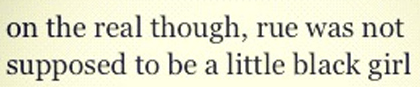
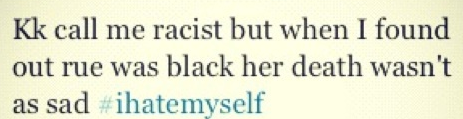
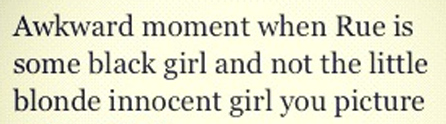
Last week Andrew, Michael S., Will S., Katrin, and Tom Megginson all brought our attention to some of the racist tweets that appeared after the premiere of The Hunger Games. Apparently some viewers were shocked to find that some of their favorite characters from the books were played by African American actors (and some critics seem to have felt that Jennifer Lawrence didn’t look starved enough for her role). Buzzfeed and Jezebel posted some examples of the response to the African American characters:

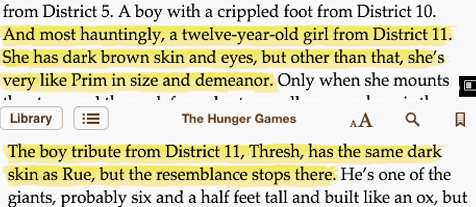
In fact, Suzanne Collins did include descriptions that would seem to clue a reader in that they’re not supposed to assume that every character in the book is Caucasian (cropped from Buzzfeed):

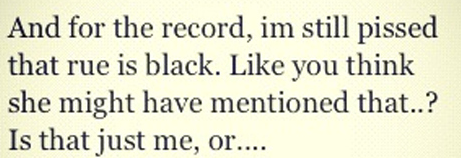
But of course, the apparent lack of reading comprehension of many fans of the book is rather beside the point by now. What these reactions indicate is the invisibility of non-White people in pop culture, and the sense of distress, disappointment, and even outrage some can feel when they are expected to accept non-Whites in what they see as “neutral” roles. And, more disturbingly, it illustrates the degree to which the humanity of non-Whites can be erased, and highlights racialized associations. “Some black girl” is, by definition, not an “innocent girl.” It’s funny to say that the death of a character that touched you in the book is less moving if you imagine the character as African American. We’ve seen this type of reaction before, such as when Idris Elba was cast in Thor. Or the equally negative response to the suggestion that Donald Glover, an African American actor, should audition for the starring role in the newest Spider-Man remake, as Lindy West points out at Jezebel: “…it’s a proprietary thing-if Spider-Man is black, then he isn’t ours anymore. He’s theirs.”

I think the best discussion of the implications of the Hunger Games tweets comes from Anna Holmes, whose take was posted by The New Yorker. I’ll leave you with a quote and strongly suggest you go check out the full article:

Hunger Games Tweets—there are now more than two hundred up on the blog—illuminated long-standing racial biases and anxieties. The a-hundred-and-forty-character-long outbursts were microcosms of the ways in which the humanity of minorities is often denied and thwarted, and they underscored how infuriatingly conditional empathy can be…If the stories we tell ourselves about the future, however disturbing, don’t include black people; if readers of “The Hunger Games” are so blind as to skip over the author’s specific details and themes of appearance, race, and class, then what does it say about the stories we tell ourselves regarding the present?

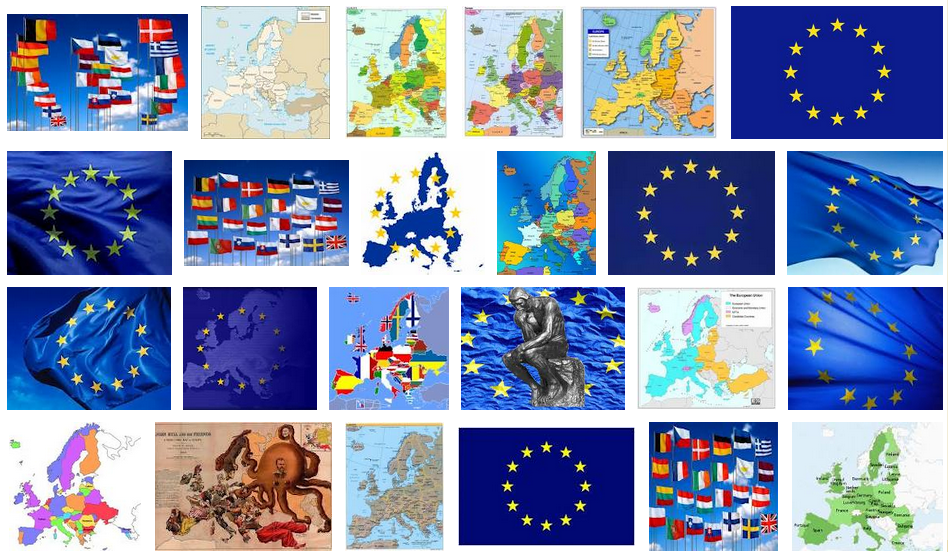
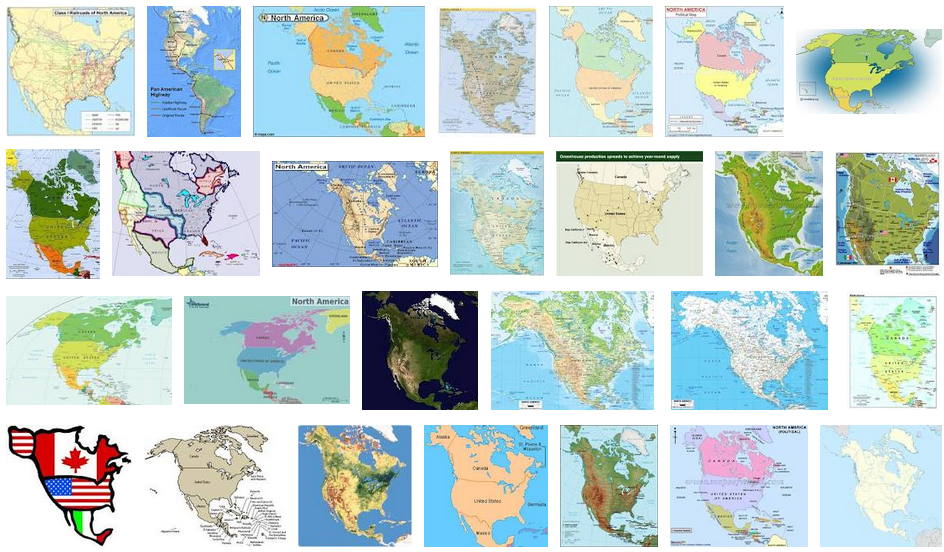
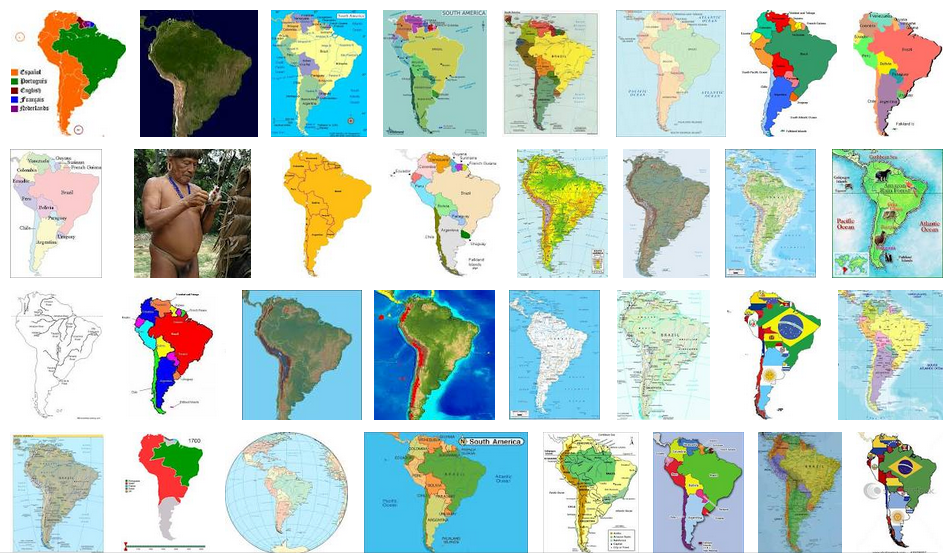
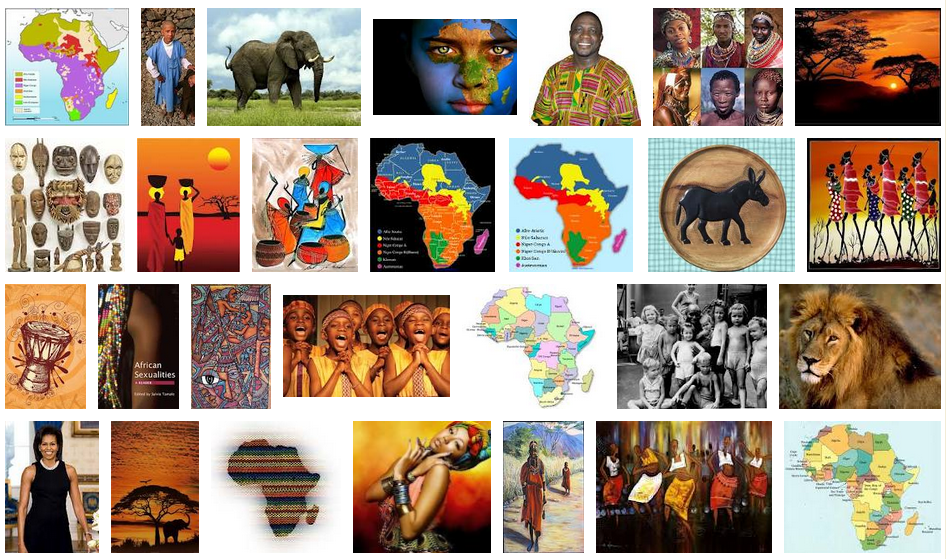
The people over at Sociological Cinema did an interesting experiment, searching Google images for the continents.  Tell us what you see:

“European”:

“North American”:

“South American”:

“African”:

“Asian”:

Lisa Wade, PhD is an Associate Professor at Tulane University. She is the author of American Hookup, a book about college sexual culture; a textbook about gender; and a forthcoming introductory text: Terrible Magnificent Sociology. You can follow her on Twitter and Instagram.
It is common around election time to hear politicians talk about how they are standing up for ”America,” as if we all had similar interests and were well served by the same policies.   Sounds nice.  The problem is that it is just not true.  

Want evidence?  Look at the distribution of gains from our current economic recovery.  According to a New York Times summary of a recent study of inequality: 

In 2010, as the nation continued to recover from the recession, a dizzying 93 percent of the additional income created in the country that year, compared to 2009 — $288 billion — went to the top 1 percent of taxpayers, those with at least $352,000 in income. That delivered an average single-year pay increase of 11.6 percent to each of these households.

Still more astonishing was the extent to which the super rich got rich faster than the merely rich. In 2010, 37 percent of these additional earnings went to just the top 0.01 percent, a teaspoon-size collection of about 15,000 households with average incomes of $23.8 million. These fortunate few saw their incomes rise by 21.5 percent.

The bottom 99 percent received a microscopic $80 increase in pay per person in 2010, after adjusting for inflation. The top 1 percent, whose average income is $1,019,089, had an 11.6 percent increase in income.

nyt.png

Moreover, ”the top 1 percent has done progressively better in each economic recovery of the past two decades. In the Clinton era expansion, 45 percent of the total income gains went to the top 1 percent; in the Bush recovery, the figure was 65 percent; now it is 93 percent.”

It is hard to celebrate economic expansion when we have an economy structured in such a way that the income generated by our collective efforts ends up in the pockets of a very few.   

Cross-posted at Global Policy TV.

Recent research has unearthed the interesting finding that most Americans dislike atheists.  In fact, they strongly dislike atheists. Surveys suggest that they’d rather share a beer with almost anyone, even members of historically-hated groups: homosexuals, African-Americans, or Muslims (yes, even after 9/11).  This phenomenon is new in American society, as I’ll discuss below, and reflects a significant change in our social alliances.

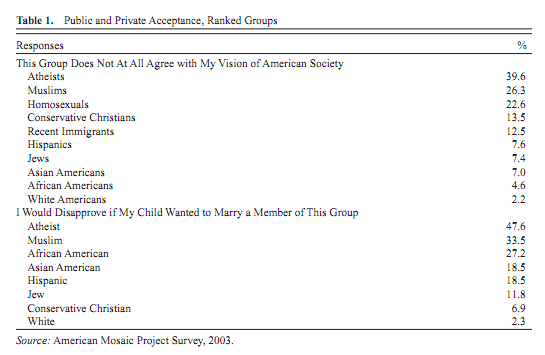
But first, consider this data published by Penny Edgell and her colleagues in the American Sociological Review (full text).  It reveals that Americans believe that atheists, more than many other groups, are not likely to agree with their “vision of American society.”  Atheists topped the list, beating out the second contender, Muslims, by 13 percentage points.  Likewise, among the types of people Americans would not want their children to marry, atheists come first, beating out Muslims (again) by 14 points and African Americans by a full 20.

This dislike for atheists, by the way, isn’t on the wane.  While dislike of gays and lesbians has been easing, racism has become increasingly unacceptable, and religious diversity has become less contentious, intolerance for non-believers has held steady.

An even more recent article revealed that the reason people dislike atheists so much has to do with trust (cite).  Many people are skeptical that someone who doesn’t believe in God would do the right thing, given that they don’t imagine that a higher power is watching them and keeping score.  Atheists were more distrusted than Muslims, Jews, gay men, and feminists.  The only group that was as strongly suspected of bad behavior as atheists?  Rapists.

What is interesting in all this – above and beyond a clear prejudice against atheists – is the change in how Americans think about religion.  Until recently, members of different religious saw each other as enemies, not friends.  American history is characterized by “long-standing divisions among Protestants, Catholics, and Jews” (Edgell et al.). Many of us can remember how significant it was to elect the first Catholic president (something we take for granted as unremarkable now) and we are on the precipice of nominating a Mormon to run on the Republican ticket.

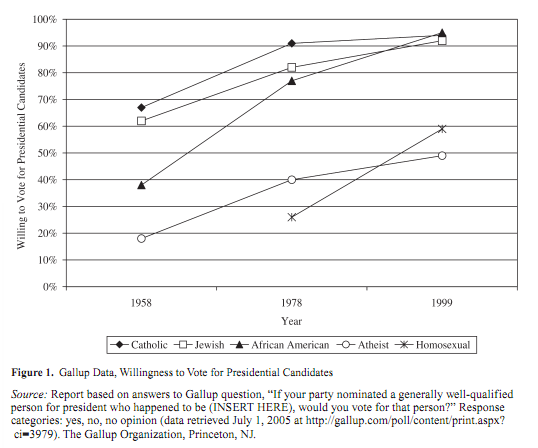
Indeed, historical data shows that Americans have been increasingly willing to vote for a Catholic or Jewish Presidential Candidate (as well as an African American and homosexual candidate), but their willingness to vote for an atheist is lagging behind:

The take home point has to do with shifting social alliances.  Now that most Americans have abandoned a strong dislike for members of other religions, it’s possible for The Religious to emerge as a socially-meaningful identity group.  In other words, once members of different religions begin to see each other as the same instead of different, they can begin to align together.  Suddenly atheists become an obvious foe.  Instead of one of many types of people who had lost their way (along with people of different faiths), atheists could emerge as uniquely problematic.  It is the building of cross-religious alliances, then, that undergirds the strong dislike for atheists specifically.

Lisa Wade, PhD is an Associate Professor at Tulane University. She is the author of American Hookup, a book about college sexual culture; a textbook about gender; and a forthcoming introductory text: Terrible Magnificent Sociology. You can follow her on Twitter and Instagram.
A while back I posted about a Pew study looking at long-term unemployment. About a third of those currently out of work have been unemployed for a year or longer.

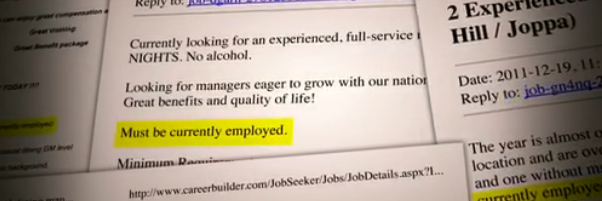
That makes a recent video released by 60 Minutes Overtime particularly striking. The reporters discuss evidence of discrimination against the long-term unemployed, with employers particularly unwilling to hire those who have been out of a job for two years or more. Given the length and severity of the current recession, this leaves large numbers of jobless people facing the frustrating paradox that you often need a job to get a job, leaving them trapped:

This morning NPR had a segment on the history of the U.S. income tax. A federal income tax was first introduced during the Civil War to make up for lost tariffs due to blocked ports and sunk ships. However, in 1895 the Supreme Court declared the income tax unconstitutional. In 1913, the states ratified the Sixteenth Amendment to the Constitution:

The Congress shall have power to lay and collect taxes on incomes, from whatever source derived, without apportionment among the several States, and without regard to any census or enumeration.

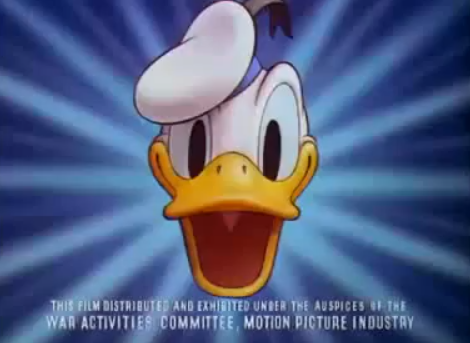
For a couple of decades, only the wealthy paid income tax. However, war — in this case, World War II — once again increased the need for taxes. The government had to convince a larger portion of the population to pay income tax. The Treasuring Department and Disney produced “The New Spirit,” a short film featuring Donald Duck. The film presented paying taxes as patriotic and essential to the war effort, and helped normalize the income tax for all workers:

For another example of World War II-era Disney propaganda in support of particular government policies, see our earlier post on Victory through Air Power, which justified bombing civilian targets.

Gwen Sharp is an associate professor of sociology at Nevada State College. You can follow her on Twitter at @gwensharpnv.