Search results for The

A resolution to the matter described below was announced yesterday.  In order to preserve the religious memorial without violating the separation of church and state, the Park Service has agree to give the land it sits on to two private citizens who take care of the monument.  Problem solved?

———————

The Supreme Court is in the process of deciding whether a cross erected 75 years ago as a memorial to war veterans violates the constitutional separation between church and state. The cross sits on the Mojave National Preserve and, therefore, is on public land. After lower court rulings, the cross was covered in plywood.

In deliberations, Justice Scalia tried to argue that the cross is a neutral and universal symbol. He said:

It’s erected as a war memorial. I assume it is erected in honor of all of the war dead… What would you have them erect?… Some conglomerate of a cross, a Star of David, and you know, a Muslim half moon and star?

Faced with an argument that the cross is distinctly Christian, he said:

I don’t think you can leap from that to the conclusion that the only war dead that that cross honors are the Christian war dead. I think that’s an outrageous conclusion.

Scalia’s comments reveal a common phenonemon that we’ve discussed in terms of race and gender, but not yet religion.  As Jay Livingston pointed out at MontClair SocioBlog, one can only think of Christian symbols as non-specific if one thinks of Christianity as somehow normal, neutral, and for everyone.  In the U.S., because Christianity is the dominant religion, many people simply see it as default.  You’re Christian unless you’re something else.  Something else that marks you as different and specific, Christianity does not.

This is one way that dominance works.  It makes itself invisible.

UPDATE! Dmitriy T.M. pointed out that Steven Colbert addressed this issue on The Colbert Report back in 2009:

See our other posts on how whiteness and maleness are the characteristics we attribute to “person,” unless there are reasons to do otherwise, herehere, here, and here.

Lisa Wade, PhD is an Associate Professor at Tulane University. She is the author of American Hookup, a book about college sexual culture; a textbook about gender; and a forthcoming introductory text: Terrible Magnificent Sociology. You can follow her on Twitter and Instagram.
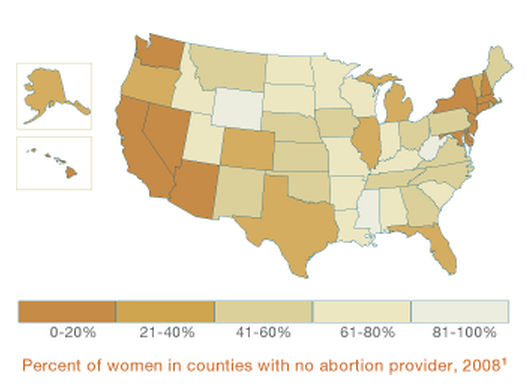
Abortion is highly politicized in the U.S. (more so than in many other countries) and the fight between those who are in favor of and against available abortion occurs on two fronts.  One is familiar to just about everyone: the effort to overturn Roe v. Wade, the legislation Supreme Court decision that established the legality of abortion in 1973.

The second front, though, is less familiar.  It involves reducing the ease of access to legal abortion. Efforts to increase barriers to accessing legal abortion include passing laws that require minors to notify their parents of an abortion or get their consent, requiring mandatory counseling for abortion-seekers, instituting waiting periods, and discouraging medical schools from teaching abortion procedures.  Some of the issues of diminishing access are non-movement related; others are the direct result of pro-life activism.

I bring this up in order to focus on an additional barrier to access: a reduction in the number of clinics and hospitals that provide abortions.  The map below, based on data from the Guttmacher Institute and compiled by ANSIRH, shows how availability varies by state.  In the darkest states, up to 20% of women live in a county with no abortion provider; in the lightest states, between 81 and 100% percent do.

Living far from the nearest abortion provider is a problem especially for low-income women.  Such women are less likely to have an employer who will give her a day off to travel to the clinic, less likely to get a paid sick day, and less likely to be able to afford to lose even a single day’s wages.  She is also less likely to have a car, making it more difficult to get to a distant location, and less likely to have reliable day care for any existing children.  If the state requires in-person counseling and has a waiting period, it means that the woman must take two days off, travel to and from the clinic twice, and arrange for child care on multiple days.

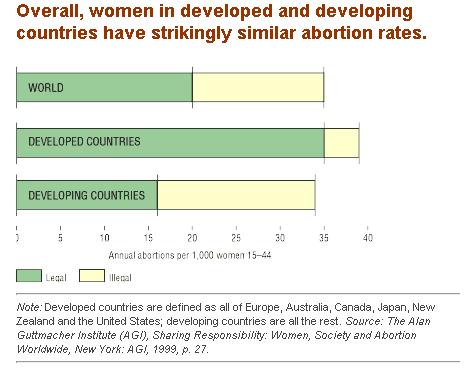
Reduction in the availability of abortion does not necessarily reduce the number of abortions.  We recently posted global data showing that less liberal abortion laws actually correlate with higher rates of abortion.  The data below, also from Guttmacher, show that were abortion laws are less liberal (largely in developing countries), the rate of abortion is 34/1,000 women oer year, compared to 39/1,000 in developed countries (the difference may look significant here, but imagine how trivial it would look if the horizontal axis went all the way to it’s true maximum of 1,000):

Guttmacher explains that the relevant variable isn’t availability of abortion, but the unintended pregnancy rate (which is surprisingly high in the U.S.).

Barriers to accessing abortion, then, don’t lower the abortion rate.  They do, however, increase the likelihood that an abortion procedure will occur later in pregnancy and guarantee a greater logistic burden on the pregnant woman.

Lisa Wade, PhD is an Associate Professor at Tulane University. She is the author of American Hookup, a book about college sexual culture; a textbook about gender; and a forthcoming introductory text: Terrible Magnificent Sociology. You can follow her on Twitter and Instagram.
Over the last couple of years, we’ve collected a number of awesome examples of kids illustrating socialization into particular types of interaction or performance. We had the toddlers expertly mimicking the cadences of a conversation; we had a 2-year-old rapping; there was the baby worshipper; and finally, the baby preacher, who has the gestures and rhythms of a certain type of preaching down pat.

Thanks to Stephanie V., now we’ve got another example. This 4-year-old has not only figured out how to rap using different cadences and tones, he accompanies himself on a keyboard and drum machine, and has a pretty excellent grasp of song construction. Enjoy!

[youtube]https://www.youtube.com/watch?v=nDtgyGwvUus[/youtube]

Gwen Sharp is an associate professor of sociology at Nevada State College. You can follow her on Twitter at @gwensharpnv.

Cross-posted at Montclair SocioBlog.

By now, you have heard about the killing of Trayvon Martin.  But when did you first hear about it?  If you’re a news junkie and were watching the national news channels,  the answer to that question might well depend on which one you watch.  ThinkProgress counted the number of stories about this killing on three cable news outlets in the week following the event.

Megan McCardle interprets the data as an example of “the Availability Heuristic, a rule of thumb that says the frequency of an event should correspond to how quickly you can think of examples of it.”  The Availability Heuristic makes us overestimate the risk of shark attacks.  The Availability Heuristic is probably behind my students’ writing confidently that teenage pregnancy has been steadily rising (thank you, MTV).

McCardle looks at the graph and sees a reason for different perceptions of racism as a problem:

…the disparity here may have something to do with whether one thinks institutional racism remains a serious problem in the United States. Conservatives often seem to think it isn’t, and that if anything, the real problem is how often spurious charges of white racism are deployed by their political opponents, while liberals more often tend toward the opposite view. Maybe both groups are drawing justified inferences from the data they’re seeing.

Do Fox viewers discount racism because of what they see?  Or is the network disparity more an example of another cognitive wiring problem – Confirmation Bias?  Confirmation bias is our tendency to seek out and to remember information that fits with our existing ideas.  Faced with information that clashes with that world view, we ignore, forget, distort, or misinterpret.

In Foxland — the world of both those who create Fox news and those who consume it — racism is not a real problem.  A story of a white Hispanic man armed with a 9mm chasing down and shooting a black teenager armed only with Skittles has no place in that world.  The Fox news producers don’t want to tell that story, and the viewers don’t want to hear it.  In the days since this graph appeared, the story has become too big for even Fox to ignore. I would imagine that Fox will instead interpret the events so as to fit with the view that McCardle suggests — that whites are the victims.  If you watch Fox, get ready to hear a lot about self-defense.

Technically yesterday was tax day, but since it fell on a weekend and today is a holiday in Washington, D.C. (Emancipation Day), Americans actually got two extra days to file. Whether you’re already done or are wildly rushing to finish up, you might enjoy this short video by political economist Robert Reich, explaining how the concentration of wealth, and the ability of the very wealthy to redesign the tax code to their advantage have affected the overall economy:

Via The Sociology Cinema.

Wired has posted a set of photos by Richard Ross highlighting the  harsh reality of life in juvenile detention centers  — locations where about 60,000 kids reside each night throughout the U.S. According to the article,

The U.S. locks up children at more than six times the rate of all other developed nations. The over 60,000 average daily juvenile lockups, a figure estimated by the Annie E. Casey Foundation (AECF), are also disproportionately young people of color. With an average cost of $80,000 per year to lock up a child, the U.S. spends more than $5 billion annually on youth detention.


The images are at Wired, and you can read more about the project, Juvenile-in-Justice, including a schedule of shows, at Ross’s website. His photos also appear in the Annie E. Casey Foundation report No Place for Kids.

You might also want to check out our previous posts on treatment of prisoners during Hurricane Katrina and overcrowding in California prisons.

And thanks to Karl for the tip about the article!

Gwen Sharp is an associate professor of sociology at Nevada State College. You can follow her on Twitter at @gwensharpnv.

Cross-posted at Reports from the Economic Front.

While the press cheers on every sign of private sector job creation, little attention is being paid to public sector job destruction.  As the Economic Policy Institute reports, while there has been an increase of some 2.8 million private sector jobs since June 2009, public sector employment (federal, state, and local governments combined) has actually fallen by approximately 600,000.  As the figure below reveals, this is a very unusual development .

wwwepiorg.png

According to the Economic Policy Institute, if the percentage growth of public sector employment in this recovery had followed past recovery trends, we would have an additional 1.2 million public sector jobs and some 500,000 additional private sector jobs. A separate reason for concern about this trend is that lost public sector jobs generally means a decline in the services that we need to sustain our communities.  The withering away of our public sector during a period of expansion should worry us all.

Cross-posted at Ms. and Caroline Heldman’s Blog.

The Hunger Games should serve as a wake-up call to Hollywood that women action-hero movies can be successful if the protagonist is portrayed as a complex subject — instead of a hyper-sexualized fighting fuck toy (FFT).

In its first weekend, The Hunger Games grossed $155 million, making it the third highest opener of all time (behind the last Harry Potter film and The Dark Knight), despite a marketing budget half the size of a typical big-studio, big-budget film. It seized the records for top opener released outside of July, top non-sequel opener and top opener with a woman protagonist. By the second weekend, The Hunger Games had made $251 million in the U.S. — the fastest non-sequel to break the quarter-billion-dollar mark.

While the movie arguably plays up the romance angle more than the books, The Hunger Games is still squarely an action thriller, set in a dystopic future world where teens fight to the death in a reality show.

Its success is largely based on the wide appeal of its teenage hero, Katniss Everdeen, who makes it through the movie without being sexually objectified once — a rarity in action films. Katniss is a believable, reluctant hero.

Katniss succeeds with audiences where other women heroes have failed because she isn’t an FFT. Fighting fuck toys are hyper-sexualized women protagonists who are able to “kick ass” (and kill) with the best of them — and look good doing it. The FFT appears empowered, but her very existence serves the pleasure of the heterosexual male viewer. In short, the FFT takes female agency and appropriates it for the male gaze.

From an ethical standpoint, Hollywood executives should be concerned about the damage girls and women sustain growing up in a society with ubiquitous images of sex objects. But it appears they are not. From a business standpoint, then, they should be concerned about the money they could be making with better women action heroes. But so far, they seem pretty clueless.

Hollywood rolls out FFTs every few years that generally don’t perform well at the box office (think ElektraCatwomanSucker Punch), leading executives to wrongly conclude that women action leads aren’t bankable. In fact, the problem isn’t their sex; the problem is their portrayal as sex objects. Objects aren’t convincing protagonists. Subjects act while objects are acted upon, so reducing a woman action hero to an object, even sporadically, diminishes her ability to believably carry a storyline. The FFT might have an enviable swagger and do cool stunts, but she’s ultimately a bit of a joke.

For a breakdown of why FFTS lack believability and appeal, check out the Escher Girls tumbler, a site that critiques the ridiculous physical contortions of FFTs that allow them to be both sex objects and action heroines.  Contortions like this:

As Mark Hughes from Forbes.com points out, movie studios artificially limit their profits when they target only male audiences (by, for instance, by portraying women only as FFTs). With the phenomenal success of The Hunger Games, Hollywood can no longer deny the bankability of believable women action leads. Forty percent of the audience for The Hunger Games is male, proving that a kick-ass woman lead who isn’t reduced to a sex object can appeal to all genders. That should put dollar signs in executives’ eyes.

Hollywood is now on a quest to find the next Katniss Everdeen. Whoever she is, the question will be: Do executives know better than to turn her into a fighting fuck toy?