Search results for The

I recently put together a Pinterest board featuring our examples of light-tan clothes and products described as “nude,” “skin-colored,” or “flesh-colored.”  The practice erases or marginalizes people with medium or dark-colored skin by presuming that everyone’s flesh is light tan… even Michelle Obama can be a victim of this kind of insensitivity.  Lil’ Kim, too!

Inspired by our older posts, I decided to check up on the Internets and see if the trend was still alive.  Indeed, and alas.  The first example I stumbled upon was Vera Wang’s 2012 wedding dress collection.  The collection isn’t up on Wang’s website at the time I’m writing, but media outlets are consistently describing the collection as featuring “nude” and “black” dresses.  The Huffington Post is one example.

I decided to go with the wedding theme. At Martha Stewart, she suggests a “powder blue and nude palette” for the ceremony and reception. Project Wedding had many examples of nude clothing and other items. Finally, Belle had a collection of “nude” wedding shoes.

To reiterate, calling this color “nude” reminds us all that light-skinned people are regular people and everyone else needs a modifying adjective.  In addition to the many other examples of this that we encounter everyday — like lotion for “normal to darker skin,” ornaments in “bride and groom” and “African-American bride and groom,” and dolls in “dolls” and “ethnic dolls” — these instances can be constant and exhausting examples of one’s marginality.

Lisa Wade, PhD is an Associate Professor at Tulane University. She is the author of American Hookup, a book about college sexual culture; a textbook about gender; and a forthcoming introductory text: Terrible Magnificent Sociology. You can follow her on Twitter and Instagram.

The foreclosure crisis that emerged in 2006 continues to displace families and change neighborhoods, creating holes in the social fabric of communities. Kathryn Clark, artist and former urban planner, has created a series of “foreclosure quilts” based on maps of urban areas, with holes representing foreclosed houses.  These unique visual representations call our attention to the holes that remain after foreclosure.

Clark writes on her blog:

The quilt is pieced together using patterns of neighborhood blocks taken from RealtyTrac maps.  Within these, foreclosed lots are shown as holes in the quilts.  The lot locations are completely random and they yield an unexpected beauty when laid out on fabric. These torn holes question the protective nature of a quilt. The situation is so dire that even a quilt can’t provide the security one needs.

Clark’s artistic rendering of these maps points to the size and spread of the foreclosure problem, but also evokes the conflicting experience of home and the reality of the housing market.  Homes, like quilts, promise warmth, comfort and continuity, a connection to family and a sense of protection.  The holes in the quilts powerfully evoke the false promise of security offered by home ownership in the contemporary U.S.

Public policy and real estate market professionals have actively worked to construct home as an owner-occupied, single family house (as opposed to rental, communal space, or other residential option).  The preference for ownership has become so strong that many forgo other forms of investment for a mortgage on a house, and those who rent are told that they are “throwing their money away.”  This normative belief that home ownership is the most desirable option for adults provided justification for consumers to risk their savings, even when offered poor subprime loans, because ownership is symbolically important.

The foreclosure quilts call our attention to the holes that have been produced by the collapse of the housing market.  The focus on neighborhoods and blocks rather than individual houses and families encourages us to think about the impact on communities as well as individuals.  These quilts offer little comfort, and hopefully provoke questions about the sustainability of our singular focus on home ownership.

For images of Clark’s quilts, check out her blog and website or an article on her work at The Atlantic Cities page.

Karen McCormack is an assistant professor of sociology at Wheaton College in Norton, Massachusetts.  She is currently studying the strategies that people employ to manage the risk of losing their homes to foreclosure.

Jay Smooth — always insightful and earnest — praises the movement for justice in the Trayvon Martin case, and points us forward to what’s next:

Lisa Wade, PhD is an Associate Professor at Tulane University. She is the author of American Hookup, a book about college sexual culture; a textbook about gender; and a forthcoming introductory text: Terrible Magnificent Sociology. You can follow her on Twitter and Instagram.

The first drug court started in Miami in 1989 as an effort to stop the cycle of drug addiction and crime.  The program brought together judges, prosecuting and defense attorneys, addiction counselors, and social workers to collaboratively build an individualized treatment program.  Rather than sending people to jail, the drug court program was designed to treat addiction while participants lived in the community.  Drug courts have become an increasingly common way for communities to engage with low-level drug offenders.

Seeking to raise awareness and support for drug courts, the National Association of Drug Court Professionals has released a series of PSAs entitled, “All Rise.”  Using a mix of celebrities and drug court judges, these commercials assert that 75% of drug court participants are never arrested again.

The promise is clear.  Drug courts not only treat addiction, they also treat a number of social problems (“no more families torn apart… no more neglect… no more overdoses”).

Are drug courts really this successful?

The truth is, we still don’t know.  The 75% success statistic comes from a study published in 2003.  The authors report that only 27.5% of drug court participants had been re-arrested and charged with a serious crime within two years.  So, we don’t know what re-arrest rates look like after that two-year period and the data doesn’t include arrests for minor crimes or arrests for serious crimes that did not result in a charge.  This is a far cry from the claim made in the video: that 75% of drug court participants are never arrested again.

The claims asserted in the “All Rise” campaign, then, should be treated with caution.  That said, drug courts are a significant move away from punitiveness for addicted offenders. Increasing the time to reoffending is a very positive step for the offender, for the community, and for the criminal justice system.  Additionally, most recidivism occurs within three years of release, so if the drug court program is helping participants to make it past this milestone it may indeed lead to some graduates leaving criminality altogether.

But before we turn to drug courts as “the” solution, we need more research on the effectiveness of drug courts.  Women and Caucasians fare better in the program than men and people of color.  And large courts tend to be more effective than small courts. Nevertheless, since the 1990s drug courts have spread across the nation to all major cities and many medium and small-sized cities, some of which have limited resources and less dedication.  All Rise’s enthusiasm should be tempered with a critical eye aimed at making these programs work well, and for as many people as possible.

————————

Kimberly Baker is an assistant professor of Sociology and Women’s Studies at Ithaca College.  She teaches classes in crime, deviance, and law.  Her research is on drugs, addiction, and U.S. drug policy, including drug courts.

Cross-posted at Montclair SocioBlog.

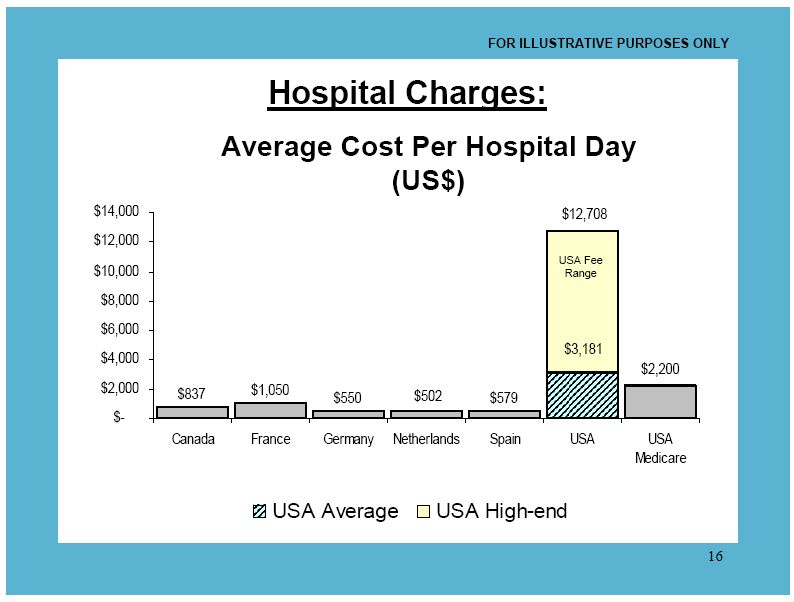
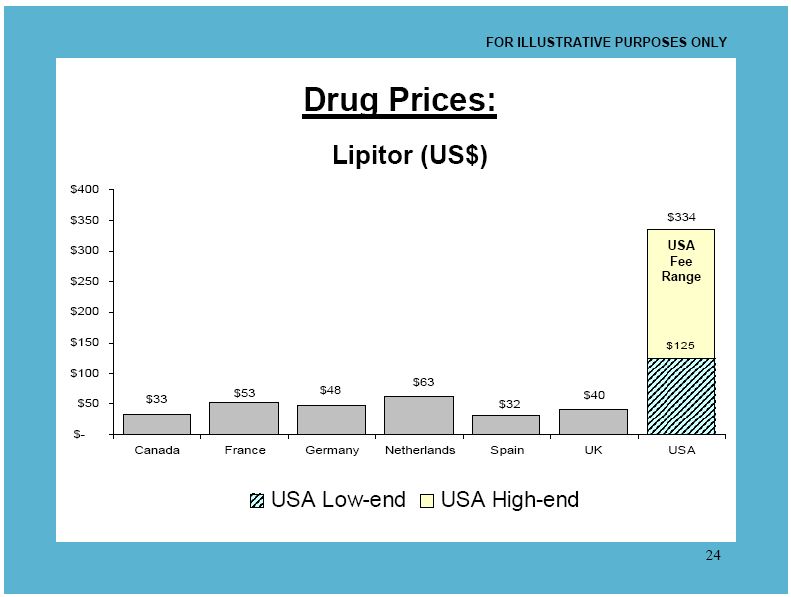
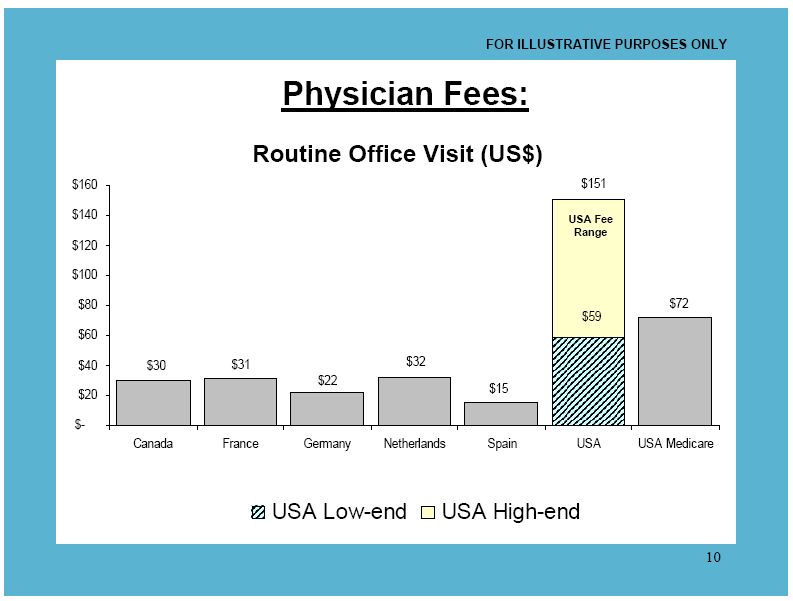
In case you wondered about what we in the U.S. pay for health care compared with those unfree unfortunates who suffer under various forms of socialized medicine, here are some graphs from 2009 showing the advantages of what is sometimes called “the best health care system in the world.”

The graphs are from the International Federation of Health Plans. I’ve selected only four — to show the relative costs* of

  • an office visit
  • a day in the hospital
  • a common procedure (childbirth without complications)
  • a widely used drug (Lipitor)

You can download all the charts here, but be warned: it gets boring. We’re number one in every chart, at least in this one category of how much we shell out.

Since we have the best health care in the world, this must mean that you get what you pay for. Our Lipitor must be four to ten times as good as the Lipitor that Canadians take.

Hat tip: Ezra Klein.

———————–

*These amounts are what providers are paid by governments or other insurers, not what the patient pays, which in many Eurpean countries is essentially nothing. See the footnotes for the tables in the original document. Or look at the comments on this at Boing Boing, a discussion which is remarkably civil (do they monitor comments?).

U.S. Senator Susan Collins (R, Maine) and Representative Carolyn Maloney (D, New York) have both gone on record claiming that having more women employed in the Secret Service would prevent scandals like the one involving Colombian prostitutes.

In classic Daily Show form, Jon Stewart and his “correspondents” respond (thanks to Dmitriy T.M. for the link!):

Lisa Wade, PhD is an Associate Professor at Tulane University. She is the author of American Hookup, a book about college sexual culture; a textbook about gender; and a forthcoming introductory text: Terrible Magnificent Sociology. You can follow her on Twitter and Instagram.
Cross-posted at Brad’s Blog.

Here are a few commercials for the new MilkBite™ from Kraft. They play on stereotypes about mixed-race individuals.

[youtube]https://youtu.be/ffkDRynWAMw[/youtube]

Here is a transcription:

You didn’t think, did you? You, uh, didn’t think what life was going to be like for me — mom, dad — for your son.

In another commercial, the characters have the following conversation:

I just have a question. Your profile said you were milk.
Uh huh, yep, I am.
You just look like granola.
Granola, yeah, I know. I get that a lot. This was a mistake.
No, wait. Please don’t go. I’m kinda into it.

There are other spots on Kraft’s YouTube page, most playing on these same themes. The problem with a marketing campaign like this is that it trivializes the experience of people with multiple racial/ethnic identities who are still often met with derision and confusion. The first ad above perpetuates the self-fulfilling prophecy about “confused” identities. As a child, I remember family members telling me that they didn’t have a problem with interracial couples but worried about how others might react to their children.

In my classroom earlier this year, a young white woman expressed overt anger when I told the class that the 2010 2000 Census, for the first time, allowed individuals to check more than one racial category. “How can they do that?!!” she demanded to know. Living in a country with a president who had a black father and an white mother complicates all of this. Beyond the standard “post-racial America” narrative, Pres. Obama’s racial identity — even though he identifies only as black — means that people feel entitled to be dismissive of the problems that come with our increasingly complex constructions of race.

Anita Sarkeesian at Feminist Frequency points out that the marketers are likely fully aware of the inappropriate nature of these types of campaigns, and in fact, that is precisely why they launch them. They are seen as ironic, over-the-top, cynical, and tongue-in-cheek. It’s “they know that I know that they know” that it’s racist. It’s a virtual “wink and a nod.” Lisa Wade at SocImages points out that it’s a “no-one-will-ever-believe-we’re-serious” mindset. Sadly, not all people are in on the joke and will find their bigotry and ignorance reinforced, but the rest of us should know better than to perpetuate racism, even under the guise of humor.

————————

Bradley Koch is a sociologist at Georgia College. He is currently the co-director of the study abroad program based in Athens, Greece.  His research interests include religion, sexuality, higher education, and teaching and learning. In his free time, Brad enjoys making music and riding his road bike around rural Georgia.

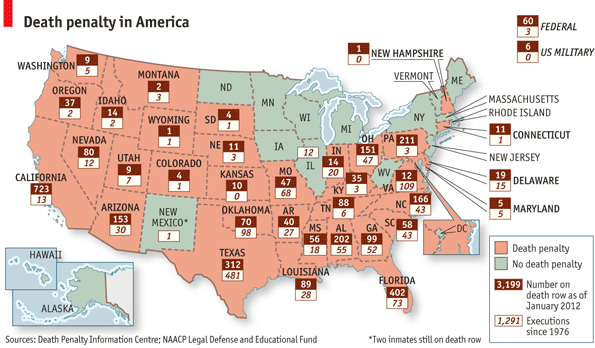
Capital punishment in the U.S. has gotten renewed attention recently, with Connecticut’s governor signing a bill repealing the death penalty this week and Californians set to vote on a ballot initiative in November that would get rid of capital punishment in the state.

Think Progress recently reposted a map showing the legality of the death penalty across the U.S. (now out of date since the change in Connecticut), as well as data on the number of people on death row per state (dark red boxes) and the number executed since 1976 (white boxes):

Talking about capital punishment in the U.S. hides a significant amount of variation. While the death penalty is technically available in most states, its use is very uneven. In many states where the death penalty is legal, prosecutors rarely push for it, and the vast majority of death penalty sentences are never actually carried out (for instance, notice that while over 700 people are currently on death row in California, the state has a much lower number of executions since 1976 than many other states). The exception is the South, which accounts for a disproportionate number of death penalty sentences and carries out such sentences at a much higher rate than other states.

In a podcast just posted at Office Hours, David Garland, author of Peculiar Institution: America’s Death Penalty in an Age of Abolition, discusses why capital punishment persists in the U.S. and also highlights the unevenness in its application. It’s a really great summary of the various factors that lead to the patterns we see in the map.