Over at the University of North Carolina at Chapel Hill, sociologist Neal Caren and a team of graduate students have worked up on image showing the locations of people signing secession petitions on the White House website in the wake of Obama’s reelection.

For context, here’s the text of one such petition, from Alaska:

ALLOW ALASKA TO SECEDE FROM A DYSFUNCTIONAL UNION.

As an American Veteran on behalf of the U.S. Constitution, the Republic, the Rule of Law, and equal justice for all freedom loving citizens of the United States of America hereby declare that the Federal Government allow Alaska to peacefully secede from a dysfunctional Union that is run by corrupt politicians who buy the votes of individuals who can no longer be seen as American citizens but rather, slaves to a tyrant. We who took the oath to protect and defend the Constitution of the United States of America against all enemies, foreign and domestic, now declare Washington D.C. to be the domestic enemy to the freedom and liberty of all Alaskans and indeed, 50% of the free citizens of the USA. Therefore, we declare our secession in support of the U.S. Constitution. LET MY PEOPLE GO!

Almost all states have an active petition now. Here’s the map of signers from around the country, shaded according to the proportion of each county’s residents who signed a secession petition. If you click on the image you go to the site, which allows you to hover over each county and see the counts:Neal Caren writes:
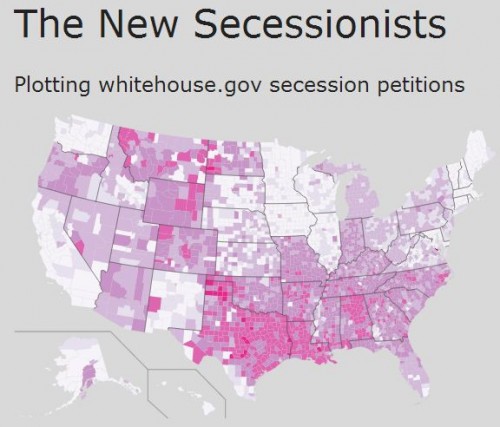
In total, we collected data on 702,092 signatures. Of these, we identified 248,936 unique combinations of names and places, suggesting that a large number of people were signing more than one petition. Approximately 90%, or 223,907, of these individuals provided valid city locations that we could locate with a U.S. county.

Using a first-name algorithm, they estimate that 62% of those signing are men.

Philip N. Cohen is a professor of sociology at the University of Maryland, College Park, and writes the blog Family Inequality. You can follow him on Twitter or Facebook.


 

Some Fun History:

Cigarette Advertising, on this Holiday:

Thanksgiving, Race, and Gender:


OLYMPUS DIGITAL CAMERA

Emile Durkheim, founding father of sociology and author of The Elementary Forms of Religious Life, would love  the Macy’s Thanksgiving Day Parade. Consider this excerpt from a British observer, Jonathan Raban, who watched the parade twenty years ago from a window on Central Park West. The parade, he said, was…

…the secular, American descendant of the European Catholic Easter procession in which all the icons and saints’ bones are removed from the churches and carried ceremonially around the town. The baseball hero, the gaseous, rubbery Mickey Mouse, the Mayflower pilgrims were the totems and treasure relics of a culture, as the New Orleans jazz and Sousa marches were its solemn music.

Had a serious-minded Martian been standing at the window, he would have learned a good deal by studying the parade’s idyllic version of American history. [guns, refugees, rebels]… The imaginative life of children was honored to a degree unknown on Mars — which was, perhaps, why matters of fact and matters of fiction were so confusingly jumbled up here, with Santa Claus and George Washington and Superman and Abraham Lincoln all stirred into the same pot.

He would be struck by the extraordinarily mythopoeic character of life in this strange country. People made myths and lived by them with an ease and fertility that would have been the envy of any tribe of Pacific islanders. Sometimes there were big myths that took possession of the whole society, sometimes little ones, casually manufactured, then trusted absolutely.

In my class, when we read about religion, Durkheim mostly, I have students write a paper about a secular ritual. One goal of the assignment is to get them to see that, from a functional perspective, a ritual is a way to generate and distribute the energy for binding the members of a society together.  It doesn’t really matter whether the ritual is officially secular or religious. In fact, if you’re a complete stranger to the culture, you probably couldn’t tell the difference.

potato1

No student has ever chosen the Macy’s parade. I wonder why not. Raban, who is from England, not Mars, senses the religious aura of the parade with its many gods. Had there been a Macy’s in ancient Greece, the parade would no doubt have had balloon representations of Demeter (god of the harvest), Poseidon (god of the sea), Aphrodite (god of beauty), Hermes (god of silk scarves), and of course in the U.S., Hebe (goddess of youth). And all the rest. We’re not Athenians. Instead, we throng the streets for icons like Snoopy and Spiderman, Pikachu, Bullwinkle, and Spongebob, but the idea is the same. They are our totems, our gods.

I imagine Durkheim on Central Park West, watching the children and grown-ups that have come together here to look up to these huge embodiments of our cultural ideals. Durkheim feels a frisson, a shiver of recognition. What better way to symbolize the idea about the binding power of ritual social energy?

Durkheim smiles.

Cross-posted at Montclair SocioBlog. Photographs by Kay West.

Jay Livingston is the chair of the Sociology Department at Montclair State University. You can follow him at Montclair SocioBlog or on Twitter.

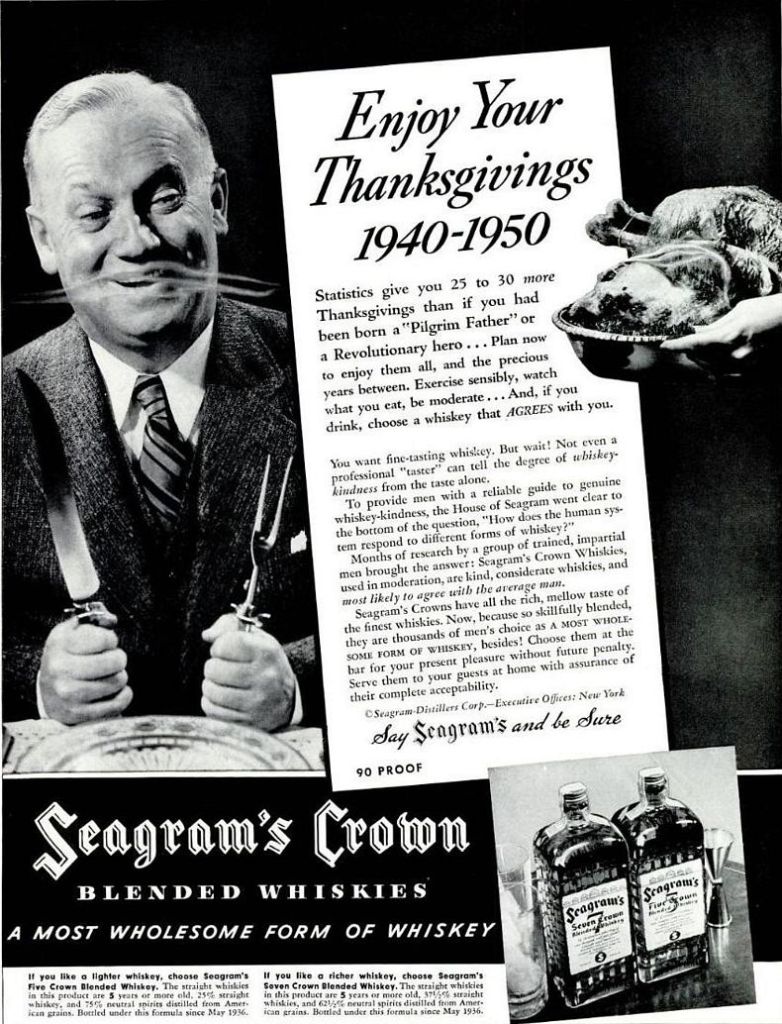
In a now-unfamiliar advertising strategy, this 1936 Thanksgiving-themed ad for whiskey suggests you make the scientifically “wholesome” choice: Seagram’s Crown.

Partial transcript:

Months of research by a group of trained, impartial men brought the answer: Seagram’s Crown Whiskies, used in moderation, are kind, considerate whiskies, and most likely to agree with the average man… they are thousands of men’s choice AS A MOST WHOLESOME FORM OF WHISKEY, besides!  Choose them at the bar for your present pleasure without future penalty.

I’d like to practice… er, review the research methods.

Found at Vintage Ads.  Just for fun, see also: Whiskey-flavored toothpaste.

—————————

Lisa Wade is a professor of sociology at Occidental College. You can follow her on Twitter and Facebook.

Cross-posted at Jezebel.

This holiday season, a dollhouse may be a feminist gift for a little girl.

A tweet from Natalie Novik inspired me to look into the toy.  She had discovered a gender-neutral dollhouse being sold at Etsy.  Following up on her lead, I went over the Toys R Us website to see what gender messages dollhouses were sending.  Some of the results surprised me.

Among the 22 best selling dollhouses at Toys R Us, four came without people, six came with a preponderance of females, ten came with a male, female, and children, and there were two I couldn’t categorize.  (All humans were white — some dollhouses included non-human creatures — and just about everyone appears to be wealthy.)

The majority of dollhouses, then, came in two types.  The first was an explicitly family-themed toy.  The message of these was heteronormative, for sure, and also pro-coupling and pro-reproduction.   The Fisher-Price Loving Family Home for the Holidays Dollhouse is an example:

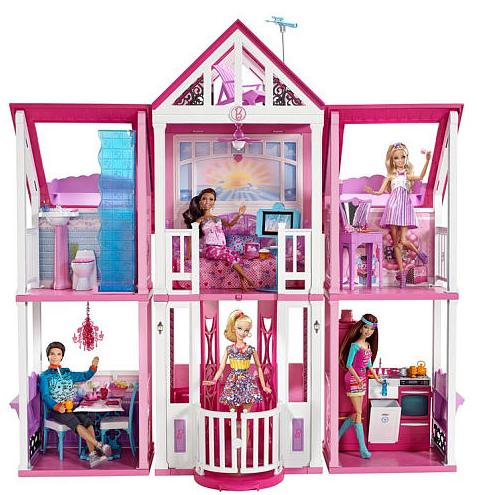
The second type of house, however, had themes of friendship and, dare I say, female-independence.  These houses had only women or, more often, a group of women and one man.  They gave the impression of female home-ownership and female-dominated social interaction.  The Exclusive Barbie Malibu Dreamhouse is an example:

Interestingly, most of the dollhouses that fell into this second type were Barbie affiliated.  People disagree as to whether Barbie is a good role model for young women.  She is roundly criticized for upholding a harmful standard of beauty, but she also tells women they can run for President and go to the moon.  In this case, Barbie is sending girls the message that they can have fulfilling lives and own homes without a husband.

As if to capture the paradox completely, the dollhouse featured above comes complete with a Barbie in a bikini doing astronomy:

Children, of course, play with toys both creatively and in resistance to the messages they send.  We’d be happy to hear your stories and observations in the comments.

Lisa Wade, PhD is an Associate Professor at Tulane University. She is the author of American Hookup, a book about college sexual culture; a textbook about gender; and a forthcoming introductory text: Terrible Magnificent Sociology. You can follow her on Twitter and Instagram.

***TRIGGER WARNING for racism and enslavement***

Last month I posted about the human zoo captives popular during the 1800s and early 1900s in Europe and America.  Today I discovered an archive documenting the capture and display of members of a Burmese ethnic minority, the Kayan (also called Padaung), who have historically practiced neck-lengthening.

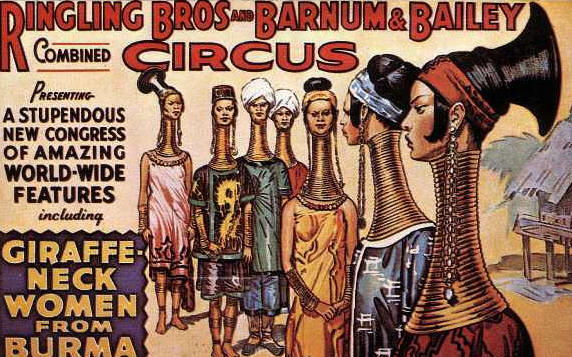
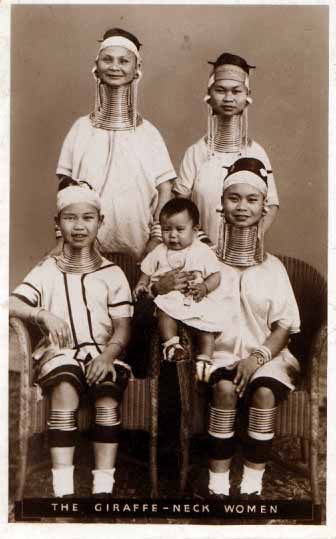
The archive, at Sideshow World, includes posters from the Hagenbeck-Wallace Circus and the Ringling Bros. and Barnum and Bailey Circus, as well as promotional photographs of the captives.  This material typically referred to the women as “giraffe-necked.”

Promotional posters:

Promotional photograph:
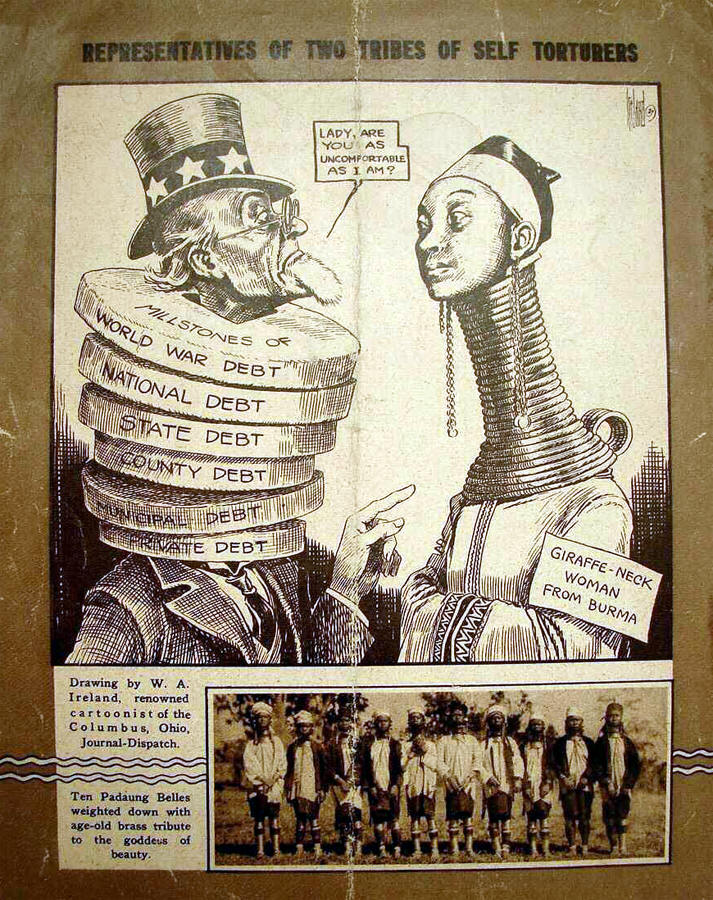
This political cartoon reveals the degree to which the “giraffe-necked woman” had become a well-known icon in the U.S.:

These women and the many others from various parts of the colonized world were typically kidnapped from their communities and put on display.  Many died young, exposed to diseases their bodies were not prepared to fight.  In some cases their remains — sometimes preserved as “freakish” samples — are still being repatriated.

Lisa Wade, PhD is an Associate Professor at Tulane University. She is the author of American Hookup, a book about college sexual culture; a textbook about gender; and a forthcoming introductory text: Terrible Magnificent Sociology. You can follow her on Twitter and Instagram.

In the five minute video below, U.C. Santa Barbara sociologist Richard Appelbaum discusses the global changes that are driving our uncertain economic future.  While economists have rightly focused on many proximate factors, he says, sociologists have emphasized “changing nature of the economy in the world today.”  He offers a quick history of economic transformations throughout human history and then focuses on the ongoing changes that we call “globalization.”  This includes lightning speed communication and extremely fast movement of goods from one part of the world to another.

Globalization, he goes on, has caused a migration of work out of wealthy and into poor countries.  Meanwhile, businesses that have no national boundaries are increasingly independent. Not beholden to any given country, it has become more difficult to regulate industries in ways that benefit any given state and its citizens.

Appelbaum finishes with a quick discussion of what all this means for young people who are educating themselves today with the hopes of a bright future tomorrow.

Video by Norton Sociology.

Lisa Wade, PhD is an Associate Professor at Tulane University. She is the author of American Hookup, a book about college sexual culture; a textbook about gender; and a forthcoming introductory text: Terrible Magnificent Sociology. You can follow her on Twitter and Instagram.