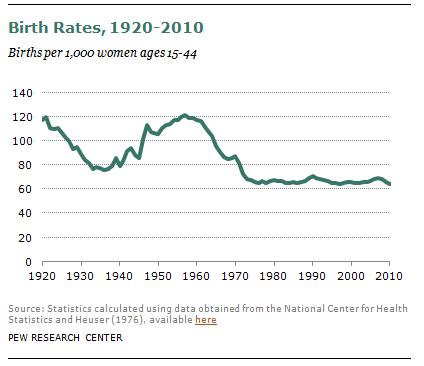
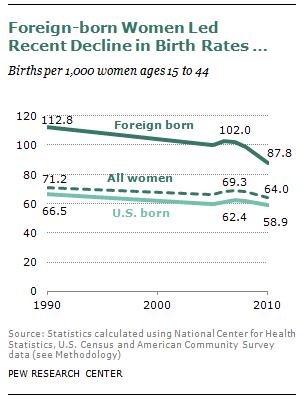
In 2011 the U.S. birth rate dropped to the lowest ever recorded, according to preliminary data released by the National Center for Health Statistics and reported by Pew Social Trends:
The decline was led by foreign-born women, who’s birthrate dropped 14% between 2007 and 2010, compared to a 6% drop for U.S.-born women.
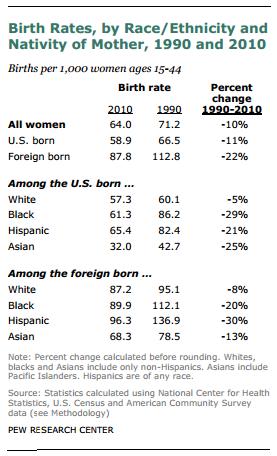
Considering the last two decades, birthrates for all racial/ethnic groups and both U.S.- and foreign-born women have been dropping, but the percent change is much larger among the foreign-born and all non-white groups. The drop in the birthrate of foreign-born women is double that of U.S.-born and the drop in the birthrate of white women is often a fraction that of women of color.
It’s easy to forget that effective, reversible birth control was invented only about 50 years ago. Birth control for married couples was illegal until 1965; legalization for single people would follow a few years later. In the meantime, the second wave of feminism would give women the opportunity to enter well-paying, highly-regarded jobs, essentially giving women something rewarding to do other than/in addition to raise children. The massive drop in the birthrate during the ’60s likely reflects these changes.
Many European countries are facing less than replacement levels of fertility and scrambling to figure out what to do about it (the health of most economies in the developed world is predicated on population growth), the U.S. is likely not far behind.
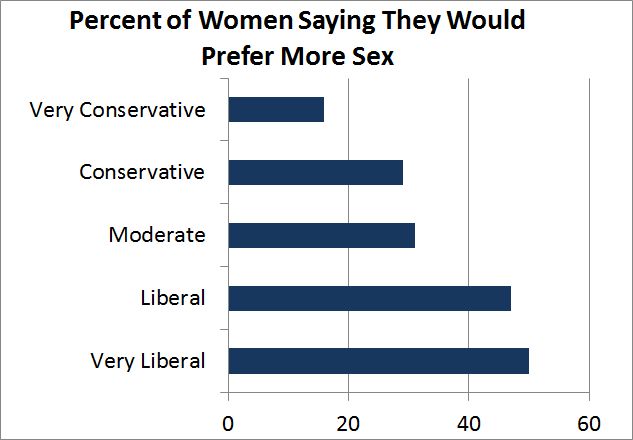
Controversial sociologist Mark Regnerus has been fooling around with the New Family Structures Survey. Back in June, Regnerus used the NFSS data to conclude that gay parents are bad for children. Now, he runs the regressions and finds that liberalism leaves women sexually dissatisfied.
Question:“Are you content with the amount of sex you’re having?”
The possible answers:
Yes
No, I’d prefer more
No, I’d prefer less
The differences were clear.
Those liberal women, they try and they try and they try; they can’t get no… satisfaction. Hey, hey, hey — that’s what they say.
The differences held even with controls for how much sex the woman had had recently. Nor did adding other possible explanatory variables dampen the effect:
[T]he measure of political liberalism remains significantly associated with the odds of wanting more sex even after controlling for the frequency of actual intercourse over the past two weeks, their age, marital status, education level, whether they’ve masturbated recently, their anxiety level, sexual orientation, race/ethnicity, depressive symptoms, and porn use.
Regnerus says he was puzzled and asked an economist friend for her explanation. She, like Regnerus, is a serious Christian, and saw it as a matter of seeking “transcendence.” Liberal women want to have more sex because they feel the lack of sufficient transcendence in life and seek it in sex. Conservative women find transcendence in the seemingly mundane — “sanctifying daily life” — so they do not need sex for transcendence. Or as Regnerus puts it, “Basically, liberal women substitute sex for religion.”
To test this idea, Regnerus controlled for religious attendance. When he did, “political liberalism finally went silent as a predictor.” Churchgoing liberals were no more insatiable than were their sexually content conservative co-worshipers.
So here’s the scenario. All women want transcendence. Since liberal women are not religious, they seek transcendence in sex and don’t find it. They’re dissatisfied, but they cling to the idea that sex will bring them transcendence if only they have more of it. So they keep looking for transcendence in all the wrong places. Conservative women seek transcendence in religion and in everyday activities. And that works.
Conclusion: Religion is deeply satisfying; sex, not so much.
This explanation, with its attribution of psychological-spiritual longing, makes some huge assumptions about what’s going on inside women’s heads.
I can offer a contrasting sociological explanation for Regnerus’ findings. It looks not to deep inner longings for transcendence but to social norms, beliefs, and values. It rests on the assumption that people’s desires are shaped by external forces, especially the culture of the social world they live in. In some groups, sex for women is good, so it’s OK for them to want more sex. In other social worlds, sex for women has a lower place on the scale of values. It is less of a “focal concern.”
These differences make for differences in who is content with what — a liberal, East Coast man and a WASP woman from the Midwest, for example:
Can we really say that the difference here is about spiritual transcendence?
In some social worlds, a woman can never be too thin or too rich. In those worlds, women diet and exercise in a way we might find obsessive. But that’s what their culture rewards. Some cultures hold that sex is a good thing — certainly more pleasurable than dieting and exercising — therefore, more is better. In some social worlds, that’s the way some people feel about money. Are these desires really about transcendence, or they about cultural values?
Oh, and on the sexual discontent matter, there are two other possibilities that may not to have occurred to Regnerus: (1) maybe conservative men are better lovers; they satisfy their conservative bedmates in ways liberals can only dream of. Or (2) conservative men are so bad at sex that when you ask their partners if they want more, the answer is, “No thanks.”
I’ve been thinking about Oldsmobile. I mentioned it in passing in the previous post, and since then I’ve been wondering about “Not Your Father’s Oldsmobile” – the brand’s swan song. Matthew Yglesias at Slate thinks that the campaign alienated the regular customers, the ones who bought a new Olds every few years, saying to them in effect, “You’re a geezer, an Oldster, and have been for a while – sans youth, sans sex, sans taste, sans everything except your crummy car.”
The tag that completed the famous set-up line was, “The new generation of Olds.”
The target of the campaign was to attract young car buyers, but it missed badly. Why? My guess is the futility of negation. Saying what something is not doesn’t give people a clear picture of what that something actually is. But that’s not the problem here. The message was clear, especially with that tag about generations.
The problem is that direct negation can reinforce the idea you are trying to deny – as in the paradoxical command to not think about an elephant. “I am not a crook,” said Richard Nixon in his televised address about Watergate. It’s his most remembered line, and when he spoke it, the TV screen might as well have had an overlay flashing the words “Game Over.”
If the denial contradicts general perceptions (i.e., the brand), people might not hear it at all, or worse, they might hear the opposite. Ever since fact-checking went public in a big way a few years ago, we’ve seen corrections to the lies that politicians have told about one another. But as Brendan Nyhan and Jason Reifler have shown, corrections can boomerang, especially when they clash with ideas the reader already has.
Can these false or unsubstantiated beliefs about politics be corrected? … Results indicate that corrections frequently fail to reduce misperceptions among the targeted ideological group. We also document several instances of a “backfire effect” in which corrections actually increase misperceptions among the group in question.
By insisting that they weren’t old after all, Oldsmobile might have done more harm than good.
Today we have an important public service announcement for you from Radi-Aid: Africa for Norway. The campaign has released a song and accompanying music video, imploring Africans to donate radiators to help Norwegians survive the difficult conditions in their country:
The real point of the video, of course, is to point out some of the problems with the images of Africa that are often presented in humanitarian fundraising drives by using a “We Are the World”-style song to turn the tables. The video’s creators argue that the constant depiction of Africa as a place of violence and misery is both counter-productive and generally obscures the actual cause of many of the problems, presenting the West as benevolent saviors while ignoring any role they might have in actually creating the conditions the fundraising campaigns are meant to address.
From the Radi-Aid website:
The pictures we usually see in fundraisers are of poor African children. Hunger and poverty is ugly, and it calls for action. But while these images can engage people in the short term, we are concerned that many people simply give up because it seems like nothing is getting better. Africa should not just be something that people either give to, or give up on…We need to change the simplistic explanations of problems in Africa. We need to educate ourselves on the complex issues and get more focus on how western countries have a negative impact on Africa’s development. If we want to address the problems the world is facing we need to do it based on knowledge and respect.
Erik Evans, one of the people behind the video, spoke to NPR about the video and the intent. You can listen to the segment here.
Thanks to Erin A., Amy H., Katrin, and Autumn S. for sending it in!
Anjan G. alerted us to an internet sensation, Liu Xianping. The 72-year-old man in China has risen to fame modeling for his granddaughter’s clothing store, Yuekou. The clothes are designed for teen girls:
Commenters are impressed about Xianping’s ability to “pull off” this look, but we shouldn’t be surprised. Masculinity and femininity are performances, and so is age.
While the idea that we “do” gender is no surprise to SocImages regulars, we also “do” age. In fact, we have a whole language of age-related chiding that serves to get people to act in ways that we deem suitable for their number of birthdays. Says sociologist Cheryl Laz:
“Act your age. You’re a big kid now,” we say to children to encourage independence (or obedience). “Act your age. Stop being so childish,” we say to other adults when we think they are being irresponsible. “Act your age; you’re not as young as you used to be,” we say to an old person pursuing “youthful” activities.
Accordingly, Xianping’s adoption of feminine poses and youthful fashions makes him appear younger and more girly than we think he should look. Importantly, though, he is no more an actor here than are actual teen girls. Each is playing a part, both with the help of just the right accessories.
Source: Laz, Cheryl. 1998. Act Your Age. Sociological Forum 13, 1: 85-113. (link)
There are six (progressive) tax brackets for income. The tax rate paid by earners is bumped up each time they reach a bracket threshold. The threshholds are determined by type of household. Here’s a handy chart for 2012 from Wikipedia:
U.S. politicians are now debating how these tax rates should change and they often focus on the “marginal” or “top” tax rate. That’s the one that applies to the highest tax bracket, right now at 35%.
Dylan Matthews at the WonkBlog notes that the squabbling has been mostly over a percentage point or two. Small beans, he asserts. To put this in perspective, he includes this graph of fluctuations in the top tax rates throughout history (click to enlarge):
The green line labeled “income” correlates to the chart above. You can see that especially income, but also corporate and capital gains top tax rates, have been shockingly variable since 1910. They were about 25% right before the Great Depression, raised to about 95% during World War II, dropped to about 70% in the ’60s, and have been on the decline ever since.
Matthews refers to a pair of economists, Nobel laureate Peter Diamond and Emmanuel Saez, who argue that the top tax rate should optimally be 73%. Sociologist Jose Marichal, however, at ThickCulture, observes that tax policy has rarely been about what is optimal for society. Instead, he writes:
What these wild shifts in tax policy suggest is that our determination of how much we should tax our wealthiest is not based on any pragmatic assessment of what would result in the best policy outcome, but is rather guided by foundational assumptions about what is fair.
Beliefs about what is fair are, of course, strongly influenced by cultural ideologies and group stereotypes. Politicians both fall victim to their own biases and strategically invoke and create ideas and resentments. We shouldn’t expect the current debate over how to change our tax code to be either rational or practical, then. The debate will be political, but you already knew that.
This is a serious situation with literal life and death implications. Much of this story has yet to play out. Right now, I want to take a moment to explore one aspect of what this all means. Namely, I want to explore the question: why did the internet shut off now? To do so, I turn to Derrick Bell’s interest convergence theory.
Derrick Bell’s theory of interest convergence is a canonical statement on race relations. Bell famously argues that whites promote racial justice only when doing so converges with their own interests. The key example is the 1954 Brown V. Board of Education case, in which racial integration in schools served the larger U.S. message within the Cold War of human rights, freedom, and equality.
Although many scholars critique the strong version of Bell’s argument for its failure to incorporate agency among blacks, the root of the argument is quite useful in explaining power relations. In short, interest convergence theory tells us that the will of the powerful wades towards the direction of self-interest. When these interests converge with those of the less powerful, the less powerful are better able to achieve their will.
To a degree, I think this framework helps us understand the decision of the Syrian government to shut down communication channels. Syrian rebels utilized digital communication channels to both organize among themselves, and share their experiences — often in real time — with the outside world. This was instrumental in their cause both on the ground and internationally. The real question then, is why did the government maintain these channels for so long? This question is particularly blaring in light of extreme government atrocities, including mass killings of innocent citizens — including children. Moreover, why did the government decide to cut off these channels now?
Internet and communication blackouts are not unique among the Arab uprisings. Egypt and Libyan governments both shut down communication during their respective battles. The Syrian government, however, is unique in its deft use of digital technologies to quash protests, locate dissidents, and suppress the movement. In short, the interests of the powerful (i.e. the government) converged with the less powerful (i.e. the rebels). In addition to appearing somehow less oppressive to the international community, we see here a possible reason for maintaining Internet capabilities despite their strategic importance in the rebel movement.
However, we may speculate that the costs got too high for the government. We may speculate that in light a persistent rebel force, culminating in massive protests in Damascus — so large that the major airport had to be shut down — it no longer served governmental interests to maintain digital connectivity. The interests of the powerful and the less powerful no longer converged.
Certainly, there are other factors in play. This is a minuscule fraction of the story. With that said, this framework suggests that perhaps today’s act by the Syrian government was one of desperation. They were forced to give up a key oppressive resource (digital communication capabilities). This resource was no longer adequately effective for keep the uprising at bay. Now, they must all battle in the dark.
—————————
Jenny Davis is a PhD candidate in the Department of Sociology at Texas A&M University, where she studies the intersection of culture and identity. You can follow her twitter feed at @Jup83.
About Sociological Images
Sociological Images encourages people to exercise and develop their sociological imaginations with discussions of compelling visuals that span the breadth of sociological inquiry. Read more…