Cross-posted at Reports from the Economic Front.
Market advocates have had their way for years now and one of the consequences has been the growing dominance of industry after industry by a select few powerful corporations. In short, unchecked competition can and does produce its opposite: monopoly.
As John Bellamy Foster, Robert W. McChesney, and R. Jamil Jonna explain:
This [development] is anything but an academic concern. The economic defense of capitalism is premised on the ubiquity of competitive markets, providing for the rational allocation of scarce resources and justifying the existing distribution of incomes. The political defense of capitalism is that economic power is diffuse and cannot be aggregated in such a manner as to have undue influence over the democratic state. Both of these core claims for capitalism are demolished if monopoly, rather than competition, is the rule.
The chart below highlights the rise, especially since the 1980s, in both the number and percentage of U.S. manufacturing industries in which four firms account for more than 50% of sales.
Number and Percentage of U.S. Manufacturing Industries in which Largest Four Companies Accounted for at Least 50 Percent of Shipment Value in Their Industries, 1947-2007:

As the table below shows, the concentration of market power is not confined to manufacturing.
Percentage of Sales for Four Largest Firms in Selected U.S. Retail Industries:
| Industry (NAICS code) | 1992 | 1997 | 2002 | 2007 |
| Food & beverage stores (445) | 15.4 | 18.3 | 28.2 | 27.7 |
| Health & personal care stores (446) | 24.7 | 39.1 | 45.7 | 54.4 |
| General merchandise stores (452) | 47.3 | 55.9 | 65.6 | 73.2 |
| Supermarkets (44511) | 18.0 | 20.8 | 32.5 | 32.0 |
| Book stores (451211) | 41.3 | 54.1 | 65.6 | 71.0 |
| Computer & software stores (443120) | 26.2 | 34.9 | 52.5 | 73.1 |
As impressive as these concentration trends may be, they actually understate the market power exercised by leading U.S. firms because many of these firms are conglomerates and active in more than one industry. The next chart provides some flavor for overall concentration trends by showing the growing share of total business revenue captured by the top two hundred U.S. corporations. Notice the sharp rise since the 1990s.
Revenue of Top 200 U.S. Corporations as Percentage of Total Business Revenue, U.S. Economy, 1950–2008:
These are general trends. Here, thanks to Zocalo (which draws on the work of Barry Lynn), we get a picture of the market dominance of just one corporation–Procter and Gamble. This corporation controls:
- More than 75 percent of men’s razors
- About 60 percent of laundry detergent
- Nearly 60 percent of dishwasher detergent
- More than 50 percent of feminine pads
- About 50 percent of toothbrushes
- Nearly 50 percent of batteries
- Nearly 45 percent of paper towels, just through the Bounty brand
- Nearly 40 percent of toothpaste
- Nearly 40 percent of over-the-counter heartburn medicines
- Nearly 40 percent of diapers.
- About 33 percent of shampoo, coffee, and toilet paper
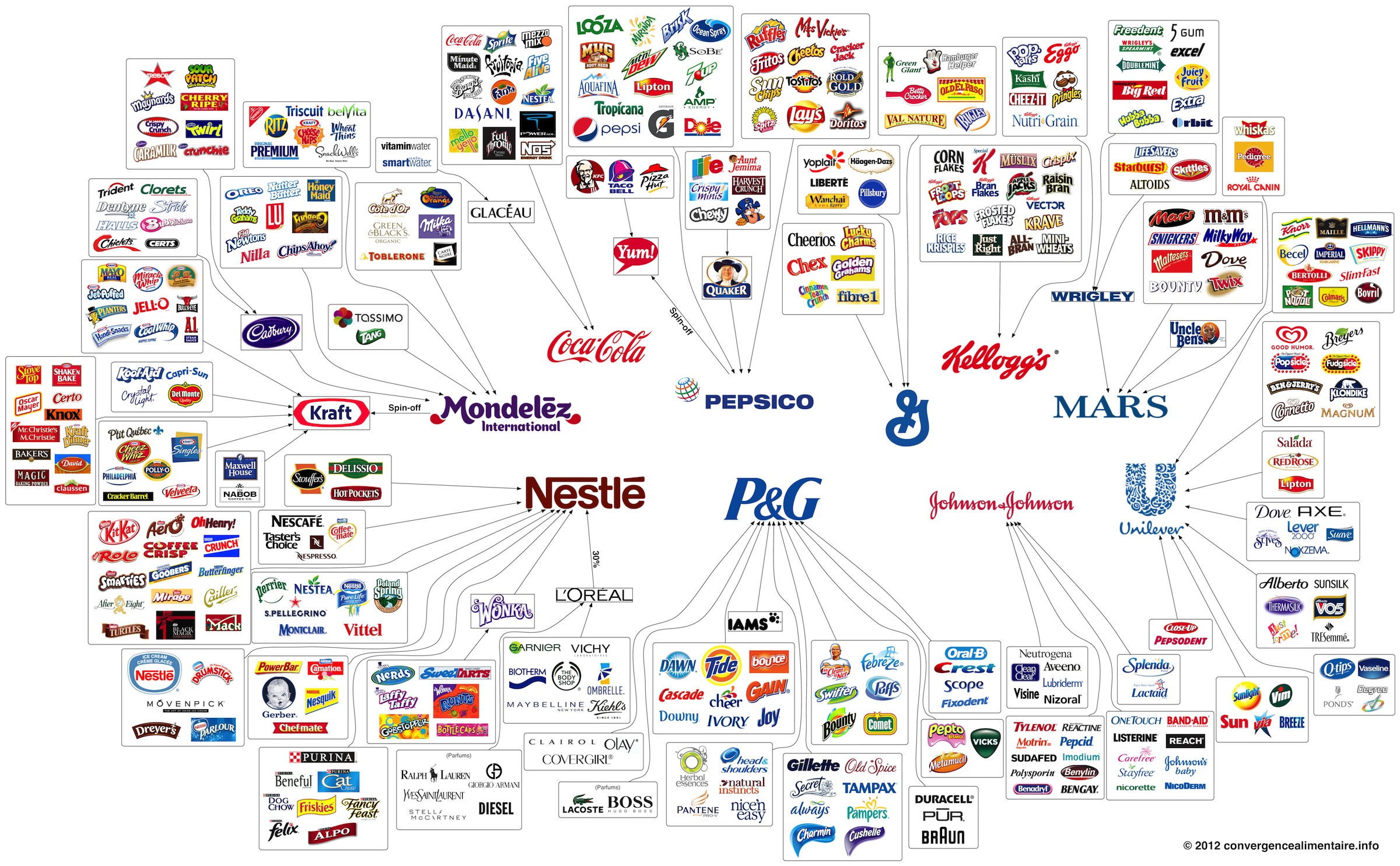
A recent Huffington Post blog post, which includes the following infographic from the French blog Convergence Alimentaire, makes clear that Procter and Gamble, as big as it is, is just one member of a small but powerful group of multinationals that dominate many consumer markets. The blog post states: “A ginormous number of brands are controlled by just 10 multinationals… Now we can see just how many products are owned by Kraft, Coca-Cola, General Mills, Kellogg’s, Mars, Unilever, Johnson & Johnson, P&G and Nestlé. ” See here for a bigger version of the infographic.

And, it is not just the consumer goods industry that’s highly concentrated. As the Huffington Post also noted: “Ninety percent of the media is now controlled by just six companies, down from 50 in 1983…. Likewise, 37 banks merged to become JPMorgan Chase, Bank of America, Wells Fargo and CitiGroup in a little over two decades, as seen in this 2010 graphic from Mother Jones.”
Not surprisingly, there are complex interactions and struggles between these dominant companies. Unfortunately, most end up strengthening monopoly power at the public expense. For example, as Zocalo reports, Wal-Mart, Target, and other major retailers have adopted a new control strategy in which:
…these retailers name a single supplier to serve as a category captain. This supplier is expected to manage all the shelving and marketing decisions for an entire family of products, such as dental care.
The retailer then requires all the other producers of this class of products — these days, usually no more than one or two other firms — to cooperate with the captain. The consciously intended result of this tight cartelization is a growing specialization of production and pricing among the few big suppliers who are still in business…
It’s not that Wal-Mart and category copycats like Target cede all control over shelving and hence production decisions to these captains. The trading firms use the process mainly to gain more insight into the operations of the manufacturers and hence more leverage over them, their suppliers, and even their other clients… Wal-Mart, for instance, has told Coca-Cola what artificial sweetener to use in a diet soda, it has told Disney what scenes to cut from a DVD, it has told Levi’s what grade of cotton to use in its jeans, and it has told lawn mower makers what grade of steel to buy.
And don’t think that such consolidation within the Wal-Mart system makes it easier for new small manufacturers and retailers to rise up and compete. The exact opposite tends to be true. . . . This [system] boils down to presenting the owners of midsized and smaller companies, like Oakley or Tom’s of Maine, with the “option” of selling their business to the monopolist in exchange for a “reasonable” sum determined by the monopolist.
This was the message delivered to many of the companies that in recent decades managed to develop big businesses seemingly outside the reach of the Procter & Gambles, Krafts, and Gillettes of the world. Consider the following:
- Ben & Jerry’s, the Vermont ice cream company that reshaped the industry, was swallowed by Unilever in 2000.
- Cascadian Farm, one of the most successful organic food companies, sold out to General Mills and was promptly transformed into what its founder calls a “PR farm.”
- Stonyfield Farm and Brown Cow, organic dairy companies from New Hampshire and California, respectively, separately sold con-trol to the French food giant Groupe Danone in February 2003 and were blended into a single operation.
- Glaceau, the company behind the brightly colored Vitamin Water and one of the last independent success stories, sold out to Coca-Cola in 2007.
The practical result is a hierarchy of power in which a few immense trading companies — in control of and to some degree in cahoots with a few dominant supply conglomerates — govern almost all the industrial activities on which we depend, and they back their efforts with what amounts to police power. This tiny confederation of private corporate governments determines who wins and who loses in this country, at least within our consumer economy.
Of course the growing concentration nationally is matched by a growing concentration of power globally, with large transnational corporations from different nations battling each other and, in many cases, uniting through mergers and acquisitions. We cannot hope to understand and overcome our current problems and the structural pressures limiting our responses to them without first acknowledging the extent of corporate dominance over our economic lives.
—————————
Martin Hart-Landsberg is a professor of Economics and Director of the Political Economy Program at Lewis and Clark College. You can follow him at Reports from the Economic Front.