Way back in 1978, Mark Fishman wrote an article titled “Crime Waves as Ideology.”  It referred to the way in which TV news gets organized thematically in ways that make non-trends appear to be trends.  Fishman pointed out that the news directors can unwittingly create media crime waves — sudden increases in the number of stories even as the the actual number of crimes remains unchanged.  Once the theme is established, it’s just a matter of combing the city or the entire country for incidents that fit.  Today we’re so used to it that when we watch the local news at eleven, we barely notice.

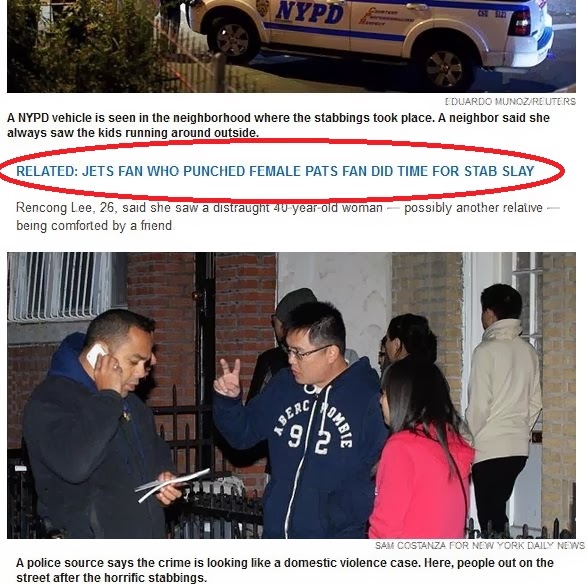
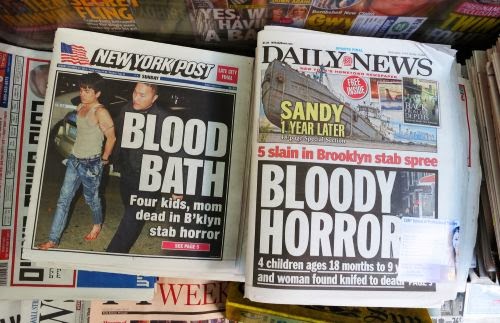
Now, thanks to hyperlinks, online news can do the same thematic grouping.  Consider: on a recent Sunday, both New York tabloids put the same story on page one — the stabbing death of a woman and four children in their apartment in Sunset Park, Brooklyn.
1

Early word from the police was that “it’s looking a domestic violence case.” Apparently the killer knew the victims and may have been a relative.

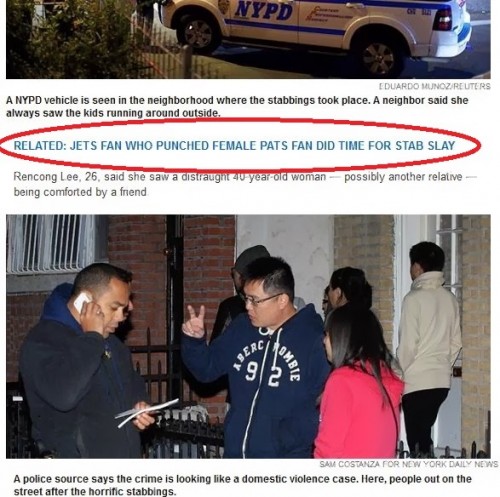
What caught my attention was the “related” story that the Daily News linked to on its website version of the story.  What kind of story might be related?  A story about the family?  About difficulties faced by Chinese immigrants or conflicts within an immigrant community?  About mental illness and violence?  About ethnic and demographic changes in Sunset Park?   No.  None of the above.  The related story is actually an entirely unrelated story.
2

The story the Daily News chose as “related” concerns the “Green Gang goon who was caught on video slugging a female New England Patriots fan in the face after the Jets’ upset victory” a week earlier. It turns out that in a fight twenty years ago, when he was 17, he fatally stabbed another kid.  He served three years.

How are these two stories related? There is no connection between the two killers or their victims. The incidents are separated by two decades.  The motives and circumstances are entirely different.  If the Jets fan had not been caught on camera punching the female Patriots fan, no journalist following the Sunday killing would have dug up information on this crime of twenty years ago in an attempt to elaborate on the Sunset Park killings.  Knowing about that “related” crime gives us no better understanding of Sunday’s stabbing.

Instead, the two stories are related by a common theme — they are both about killing where the weapon is a knife.  The Daily News seems to be taking a page from Amazon’s marketing strategy. “Readers who liked this story also liked . . .”  or Netflix recommendations. Television news often groups stories thematically. A story about a commercial arson in one part of town will be followed by a story about an accidental fire in a house in a distant neighborhood. The circumstances, location, and causes of the two fires are completely different, and if the big fire had not occurred, that house fire might not have been newsworthy.  But that night, it fit with the fire theme.

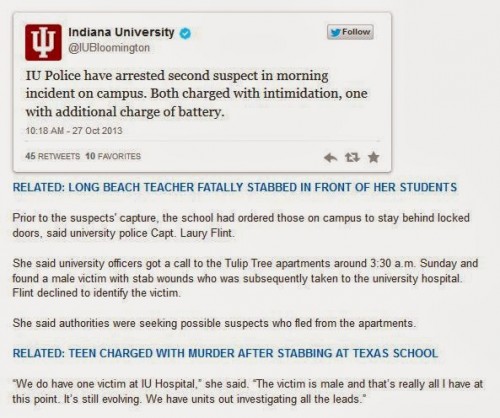
Here is another example in a screengrab from the Daily News website:
3

A stabbing at the University of Indiana. The related stories are a stabbing death of a teacher in Long Beach, California and of a teacher in a Texas high school.

So, students stabbing people at schools — is that a real trend? Probably not, but it is a news theme.

Cross-posted at Montclair Socioblog.

Jay Livingston is the chair of the Sociology Department at Montclair State University. You can follow him at Montclair SocioBlog or on Twitter.

According to an article at the Wall Street Journal,  the average income for the bottom 90% of families fell by over 10% from 2002 – 2012 while the average income for families in all the top income groups grew.  The top 0.01% of families actually saw their average yearly income grow from a bit over $12 million to over $21 million over the same period.  And that is adjusted for inflation and without including capital gains.

MI-BZ607_UNEQUA_G_20131110150005

What was most interesting about the article was its discussion of the dangers of this trend and the costs of reversing it.  In brief, the article noted that many financial analysts now worry that inequality has gotten big enough to threaten the future economic and political stability of the country.  At the same time, it also pointed out that doing anything about it will likely threaten profits.  As the article notes:

But if inequality has risen to a point in which investors need to be worried, any reversal might also hurt.

One reason U.S. corporate profit margins are at records is the share of revenue going to wages is so low. Another is companies are paying a smaller share of profits on taxes. An economy where income and wealth disparities are smaller might be healthier. It would also leave less money flowing to the bottom line, something that will grab fund managers’ attention.

Any bets how those in the financial community will evaluate future policy choices?

Martin Hart-Landsberg is a professor of economics at Lewis and Clark College. You can follow him at Reports from the Economic Front.

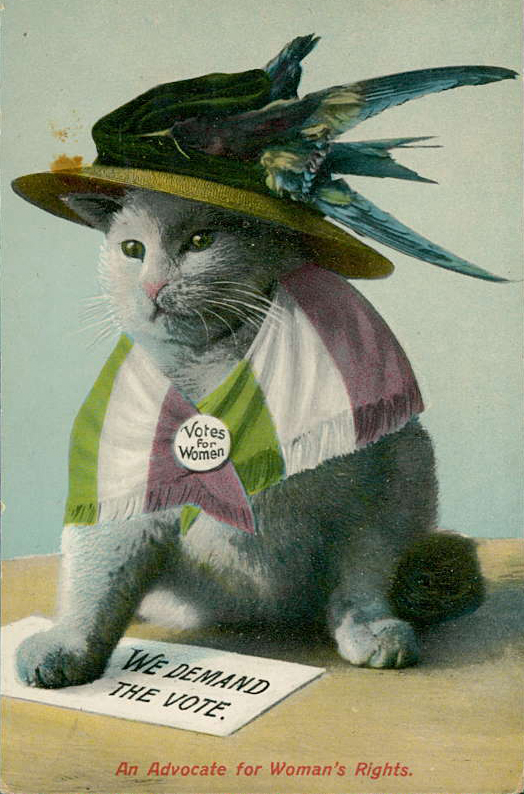
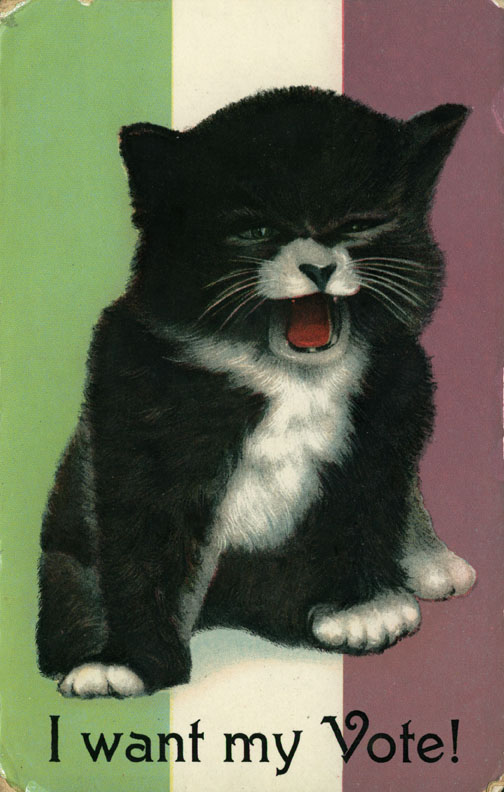
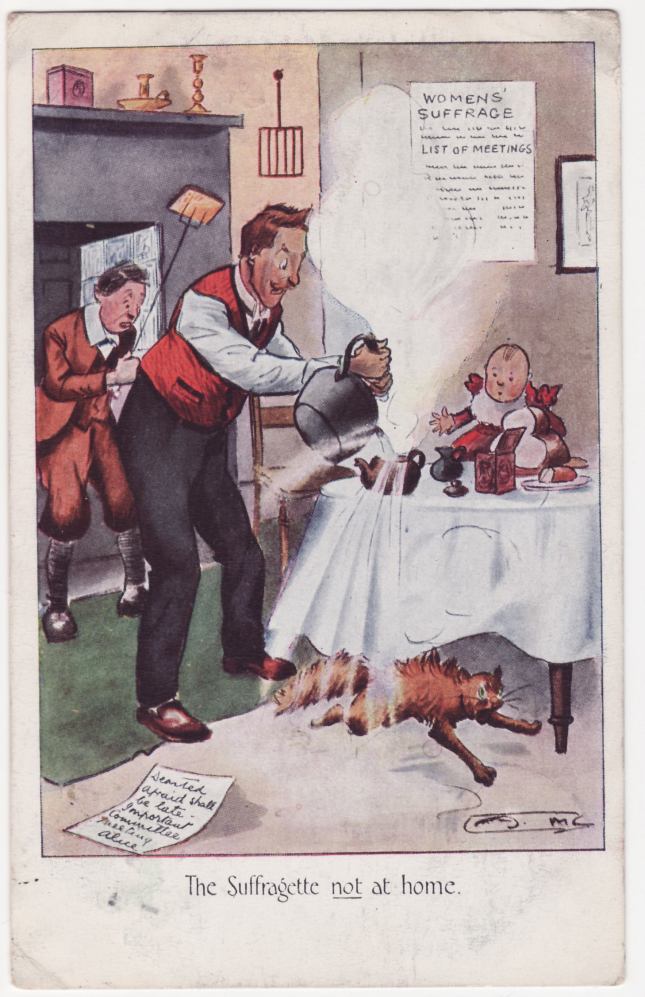
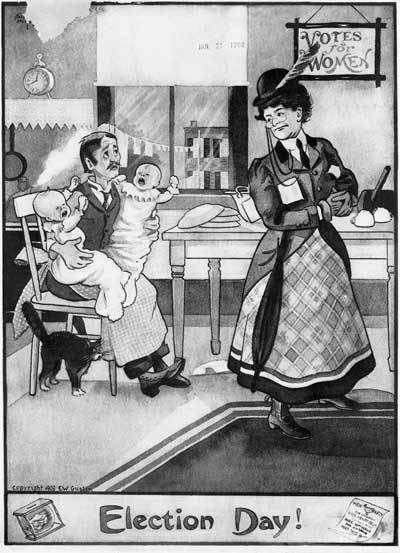
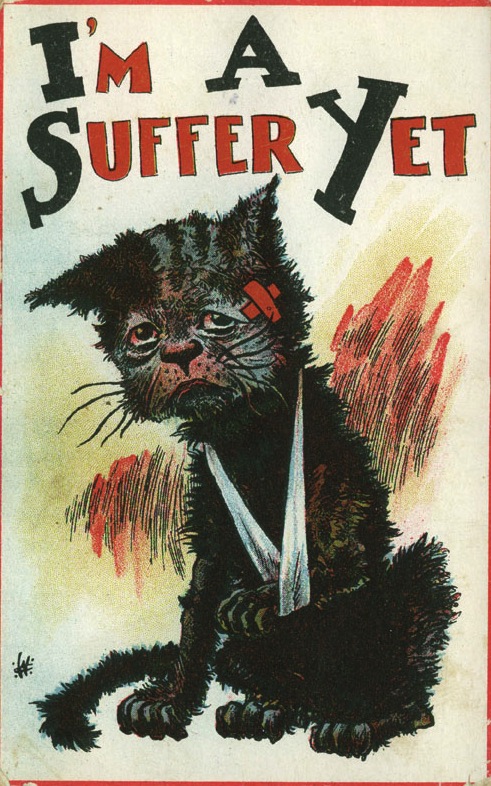
Cats and dogs are gendered in contemporary American culture, such that dogs are thought to be the proper pet for men and cats for women (especially lesbians).  This, it turns out, is an old stereotype.  In fact, cats were a common symbol in suffragette imagery.  Cats represented the domestic sphere, and anti-suffrage postcards often used them to reference female activists.  The intent was to portray suffragettes as silly, infantile, incompetent, and ill-suited to political engagement.

1

2

3

Cats were also used in anti-suffrage cartoons and postcards that featured the bumbling, emasculated father cruelly left behind to cover his wife’s shirked duties as she so ungracefully abandons the home for the political sphere.  Oftentimes, unhappy cats were portrayed in these scenes as symbols of a threatened traditional home in need of woman’s care and attention.

54

While opposition to the female vote was strong, public sentiment warmed to the suffragettes as police brutality began to push women into a more favorable, if victimized, light.

6

As suffragettes increasingly found themselves jailed, many resisted unfair or inhumane imprisonment with hunger strikes.  In response, jailers would often force-feed female prisoners with steel devices to pry open their mouths and long hoses inserted into their noses and down their throats.  This caused severe damage to the women’s faces, mouths, lungs, and stomachs, sometimes causing illness and death.

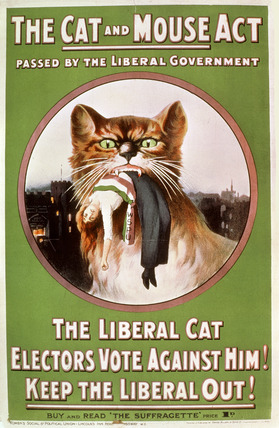
Not wanting to create a group of martyrs for the suffragist cause, the British government responded by enacting the Prisoner’s Act of 1913 which temporarily freed prisoners to recuperate (or die) at home and then rearrested them when they were well.  The intention was to free the government from responsibility of injury and death from force feeding prisoners.

This act became popularly known as the “Cat and Mouse Act,” as the government was seen as toying with their female prey as a cat would a mouse.  Suddenly, the cat takes on a decidedly more masculine, “tom cat” persona.  The cat now represented the violent realities of women’s struggle for political rights in the male public sphere.

7

The longevity of the stereotype of cats as feminine and domestic, along with the interesting way that the social constructions flipped, is a great example of how cultural associations are used to create meaning and facilitate or resist social change.

Cross-posted at Jezebel and Human-Animal Studies Images.

Ms. Wrenn is an instructor of Sociology with Colorado State University, where she is working on her PhD.  She is a council member of the American Sociological Association’s Animals & Society section and has published extensively on the non-human animal rights movement. 

What separates those with a criminal record from the rest of the population?  According to lawyer Emily Baxter, not a whole lot.  Baxter’s new project “We Are All Criminals” examines the illegal activities committed by people without a criminal record.  In Minnesota, 1 out of 4 residents has a criminal record, but Baxter’s project, she says on her website, is about the 75% that “got away, and how very different their lives may have been had they been caught.”

By emphasizing the crimes of the unconvicted, Baxter blurs the lines between criminal and noncriminal and draws attention to the detrimental effects that a criminal record has on the lives of those who are convicted.  Many of the undocumented and unpunished transgressions confessed through her project were committed when the perpetrators were juveniles, many of whom are now lawyers, doctors, and professionals.

Executive director of the Legal Rights Center in Minneapolis Michael Friedman is intrigued by the project, saying:

“I don’t think I’ve come across anybody who has not committed crimes as a juvenile,” Friedman said. “Allowing society to use juvenile criminal records as a marker for someone’s potential success, or risk for employment or opportunity, is not scientific. It’s dangerous and discriminatory.”

The most intriguing part of her project lies in its look at society as a whole.  Imagine if we had all been prosecuted for every crime we committed, even as a juvenile.  What would the crime rate look like then?

The author, Kat Albrecht, is an editorial assistant for The Society Pages. She is currently an undergraduate student in the department of sociology at the University of Minnesota. The artist, Emily Baxter, is the Director of Public Policy and Advocacy at the Council on Crime and Justice.  Cross-posted at Citings and Sightings.

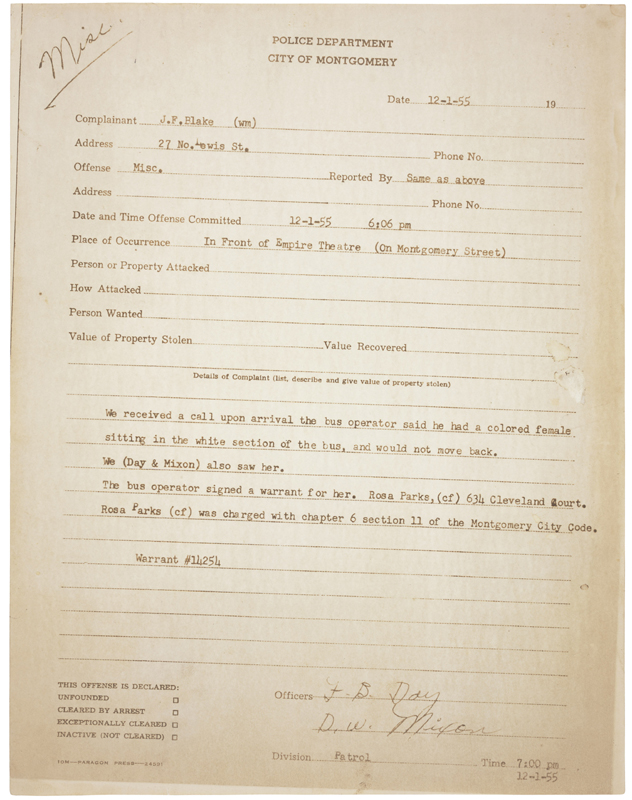
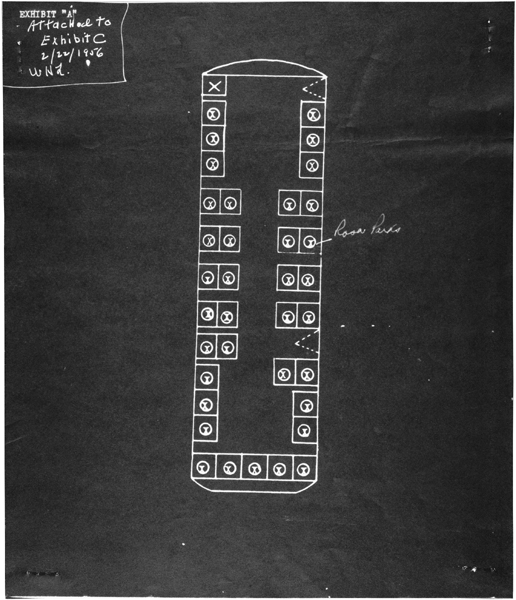
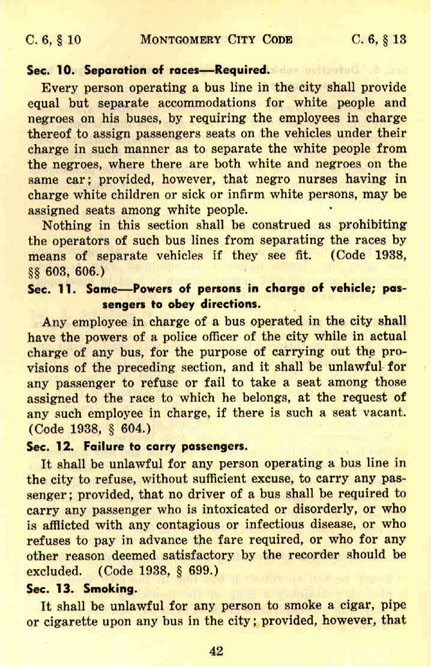
Fifty eight years ago today, Rosa Parks kicked off a plan to bring down Jim Crow segregation by refusing to move to the back of the bus.  @ShawneeSoc sent us a link to the Washington Post, where they featured her original arrest documents.  A very cool piece of history.

rosa-parks rosa-parks-busBonus, here’s the law that Parks was arrested for violating and an explanation (thanks to Martín A. for the link):

Montgomery-City-Code


Lisa Wade, PhD is an Associate Professor at Tulane University. She is the author of American Hookup, a book about college sexual culture; a textbook about gender; and a forthcoming introductory text: Terrible Magnificent Sociology. You can follow her on Twitter and Instagram.

Still from a 2013 Red Bull commercial:

Red Bull TV Commercial

The winter of 1620 was a devastating one for the colonists who had just arrived from England in New Plymouth.  They suffered from scurvy, exposure to the elements, and terrible living conditions.  Almost half (45 out of 102) died; only four of the remaining were women.

They made contact with the Wampanoag tribe in March.  The tribe taught them how to grow corn and donated food to the colony.  Thank to their help, the pilgrims were able to celebrate a harvest, or thanksgiving, that fall.  It was attended by the 53 remaining pilgrims and 90 indigenous Americans.

That’s why this Red Bull commercial is so annoying.  In the final 12 seconds, you see four pilgrims and two Indians, three women and three men. So, by pure numbers, reversed and heavily female.  The turkey is served by a pilgrim, sending the message that the pilgrims were feeding the Indians and not vice versa.  It’s a woman, of course, but likely most of the food preparation would have done by men, since they were 77% of the colonist population.

But, it nicely lines up with how we apparently think the world should be today: multicultural but majority white, with women cooking, and everyone paired up in same-race, heterosexual monogamy.

It’s the little things, you know.

Thanks to Jeff S. for the tip!

Lisa Wade, PhD is an Associate Professor at Tulane University. She is the author of American Hookup, a book about college sexual culture; a textbook about gender; and a forthcoming introductory text: Terrible Magnificent Sociology. You can follow her on Twitter and Instagram.

New Tumblr Page!

Our Tumblr is now one month old!   We think we’re getting the hang of it, including the daily SocImages posts, highlighting the best stuff from our archives, and adding compelling quotes and links.  Please feel free to join us there!  And thanks to our intern, Javier Quiroz, for doing the bulk of the work!

Five thousand posts!

We reached quite the milestone this month.  This is our 5,016th!  Thanks to Gwen Sharp, our contributors, and our many, many guest bloggers.

New Pinterest:

I put together a new Pinterest board featuring commercials and ads that co-opt the idea of women’s liberation for marketing purposes.   Peruse examples at Marketing Feminism. Here’s a sample:

mf

Your Favorite Posts this Month:

Plus, the most popular post on Tumblr this month:

Social Media ‘n’ Stuff:

Finally, this is your monthly reminder that SocImages is on TwitterFacebook, TumblrGoogle+, and Pinterest.  I’m on Facebook and most of the team is on Twitter: @lisawade@gwensharpnv@familyunequal, and @jaylivingston.

Finally…

Shout out to my dance team, choreographers Steve and Chanzie, photographer Kyle Ellison, and director Pascal de Maria.  We danced the lindy hop to Whole Lotta Shakin’ Going On all up and down that bowling alley!  Can’t wait to see the video!

1441537_507499416023932_737140849_n1467360_507412366032637_342510528_n

Lisa Wade, PhD is an Associate Professor at Tulane University. She is the author of American Hookup, a book about college sexual culture; a textbook about gender; and a forthcoming introductory text: Terrible Magnificent Sociology. You can follow her on Twitter and Instagram.

Lisa Wade, PhD is an Associate Professor at Tulane University. She is the author of American Hookup, a book about college sexual culture; a textbook about gender; and a forthcoming introductory text: Terrible Magnificent Sociology. You can follow her on Twitter and Instagram.