I once heard a transgender woman give a talk about the process of socially transitioning to being recognized as a woman. She discussed various decisions she made in taking some final critical steps toward the social identity of woman.  She talked at length about her hair. She asked, “What kind of woman am I and how is my haircut going to indicate that?”  She talked about being preoccupied with her hair for a long time as she attempted to figure out a cut and style that “felt right.” But what struck me the most was her discussion of carrying a purse.

She said that getting used to carrying a purse everywhere was one of the more challenging elements of the transition.  If asked what I thought would be a significant everyday challenge if I were a woman, I don’t think purse would have been high on my list.  But, it was high on hers.  She discussed remembering to bring it, how to carry it, norms surrounding purse protection in public, but also more intimate details like: what belongs in a purse?

Purses and wallets are gendered spaces.  There’s nothing inherent in men’s and women’s constitutions that naturally recommends carrying money and belongings in different containers.  Like the use of urinals in men’s restrooms, wallets and purses are a way of producing understandings of gender difference rather than as a natural consequence of differences.

I got the idea for this post after reading Christena Nippert-Eng’s book, Islands of Privacy — a sociological study of privacy in everyday life.  One chapter deals specifically with wallets and purses.  In it, Nippert-Eng discusses one way she interviewed her participants about privacy.  She used participants’ wallets and purses as a means of getting them to think more critically about privacy.  Participants were asked to empty the contents of their wallets and purses and to form two piles with the contents: “more private” and “more public.”  As they sifted through the contents of their wallets and purses, they talked about why they carried what they carried as well as how and why they thought about it as public or private.

After collecting responses, she documented all of the contents and created categories and distinctions between objects based on how people thought about them as public or private.  One question that was clearly related to privacy was whether the objects were personally meaningful to the participant.  Invariably, objects defined as more personally meaningful were also considered more private.

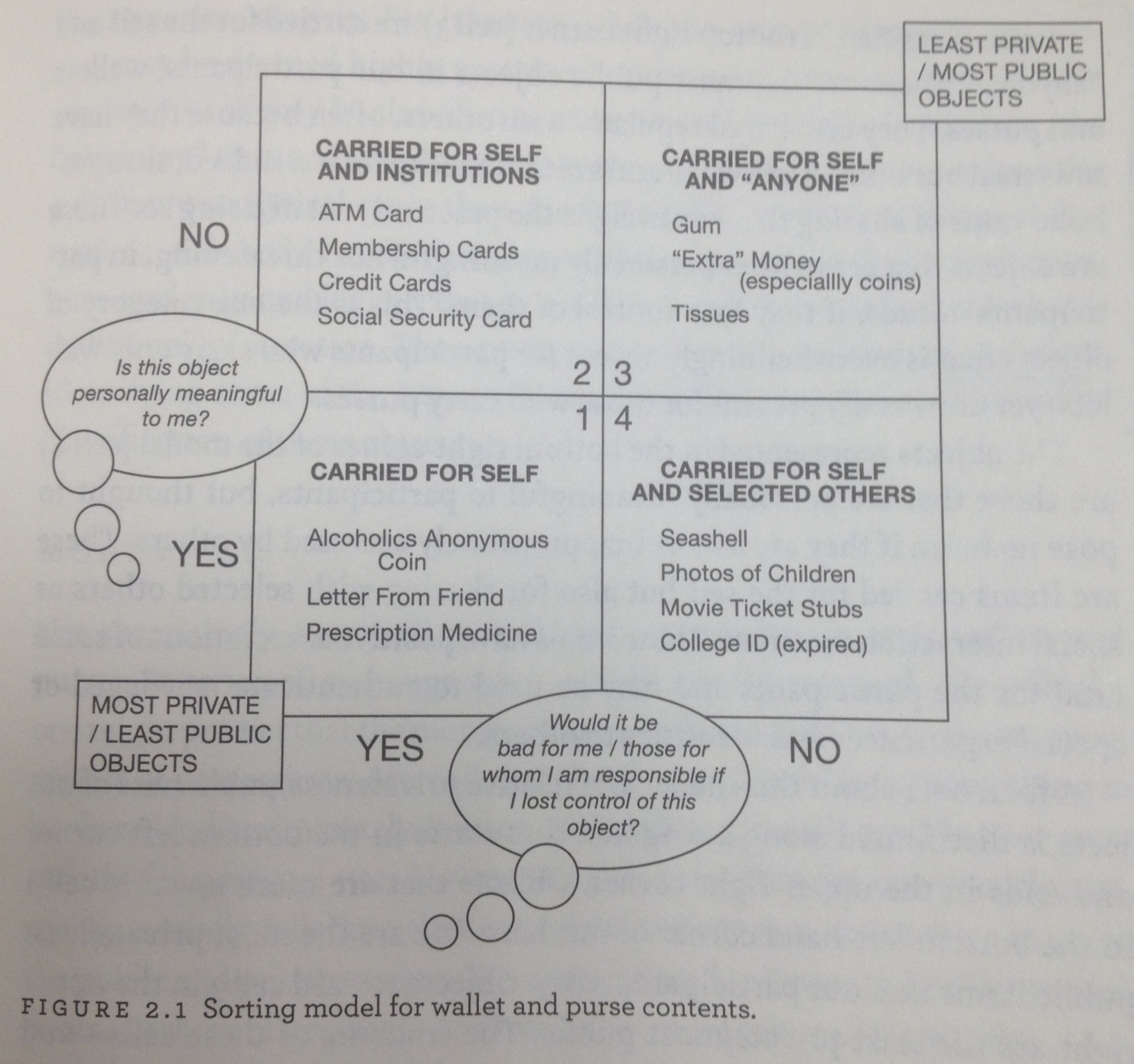
Another question that routinely arose as participants made sense of the objects they carry around everyday was how damaging it might be for participants if a specific object was taken.  Based on this findings, she creates a useful table delineating participants concerns surrounding and understandings of the objects they carry with them (see left).
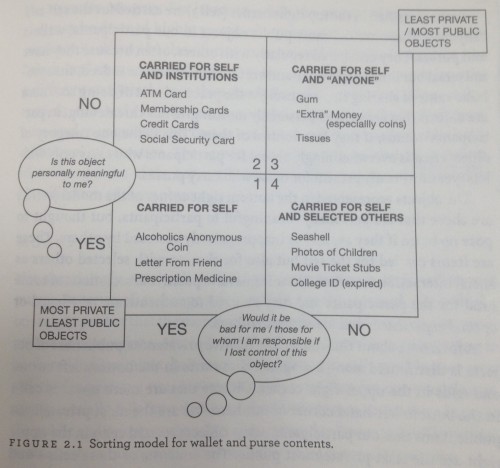
photo1

Just for clarification, there’s sort of a sliding scale of privacy going from most to least private as one proceeds from the bottom left cell to the top right cell.  Thus, items classified by participants in the lower left cell (1) are the most private objects.  Here, participants identified things like prescription medications, letters from friends, and a variety of personally meaningful objects that were thought of as completely private and carried only for the self.

Other items were still considered private, but “less private” than objects in cell 1 because they were shared selectively.  Consider cell 2.  While credit cards, bank cards, memberships, credit cards and money were all classified as “private,” individual’s also thought of them as “more public” than object in cell 1 because they were required to share these objects with institutions throughout their lives.

Similarly, some objects were thought of as “private,” but were also carried to share with certain others, such as photographs of children (cell 4).  Finally, items classified in the top right cell (3) are the most public objects in wallets and purses—carried for the self and, potentially, “anyone” else.  Items here include things like tissues, lip balm, money classified as “extra,” gum, breath mints, etc.

Objects from most of the cells exist in both wallets and purses, but not all of them.  The contents of cell 3 (containing the “most public” objects in wallets and purses) are inequitably distributed between wallets and purses.  As Nippert-Eng writes, “This is the one category of objects that is overwhelmingly absent for participants who carry only wallets, yet universally present for those who carry purses” (here: 130).  She also found that some of her participants only carried objects all fitting the same cell in the above table.  These participants — universally “wallet carriers” in her sample — carry only objects necessary for institutional transactions (cell 2).

This is, I believe, a wonderful analysis of one of the more subtle ways in which gender is accomplished in daily life. Certain objects are simply more likely to be carried in purses.  Interestingly, this class of “feminine” objects are also objects that play a critical role in social interactions.  Indeed, many of us are able to travel without these objects because we can “count on” purse-carriers as having them.  Things like packs of gum, tissues, breath mints and more might seem like inconsequential objects.  But, they play a crucial role in social interactions, and many of us count on purse-carriers to provide us with these objects when we are “in need.”  It’s an aspect of care work by which some (those carrying purses) care for others (those without purses).  And if they’re any good at it, the caring goes virtually unacknowledged, though potentially highly acknowledged when these objects are absent in purses.  Children routinely ask their mothers for objects they presume they’ll be carrying in their purses.  Indeed, these objects may be carried in anticipation of such requests.  It’s a small aspect of doing gender, but a significant element of social interactions and life.

When I was learning about interviewing and ethnography, I was told to always carry a pack of gum, a pack of cigarettes (something “lite”), and a lighter.  My professor told me, “It opens people up.  It’s a small gesture that comforts people–puts them at ease.”  These are the ways you might want people to feel if you’re asking them to “open up” for you.  I still remember my first foray into “the field.”  I bought my gum and cigarettes (objects I don’t typically carry) and the first thought I had was, “Where the heck am I going to keep these things?”  What I didn’t realize at the time was that I was asking an intensely gendered question.

Tristan Bridges is a sociologist of gender and sexuality at the College at Brockport (SUNY).  Dr. Bridges blogs about some of this research and more at Inequality by (Interior) Design.  You can follow him on twitter @tristanbphd.

We don’t prohibit all dangerous behavior, or even behavior that endangers others, including people’s own children.

Question: Is the limit of acceptable risks to which we may subject our own children determined by absolute risks or relative risks?

Case for consideration: Home birth.

Let’s say planning to have your birth at home doubles the risk of some serious complications. Does that mean no one should do it, or be allowed to do it? Other policy options: do nothing, discourage home birth, promote it, regulate it, or educate people about the risks and let them do what they want.

Here is the most recent result from a large study reported on the New York Times Well blog, which looks to me like it was done properly, from the American Journal of Obstetrics & Gynecology. Researchers analyzed about 2 million birth records of live, term (37-43 weeks), singleton, head-first births, including 12,000 planned home births.

The planned-home birth mothers were generally relatively privileged, more likely to be White and non-Hispanic, college-educated, married, and not having their first child. However, they were also more likely to be older than 34 and to have waited to see a doctor until their second trimester.

On three measures of birth outcomes, the home-birth infants were more likely to have bad results: low Apgar scores and neonatal seizures. Apgar is the standard for measuring an infant’s wellbeing within 5 minutes of birth, assessing breathing, heart rate, muscle tone, reflex irritability and circulation (blue skin). With up to 2 points on each indicator, the maximum score is 10, but 7 or more is considered normal and under 4 is serious trouble. Low scores are usually caused by some difficulty in the birth process, and babies with low scores usually require medical attention. The score is a good indicator of risk for infant mortality.

These are the unadjusted rates of middle- and low-Apgar scores and seizure rates:

homebirthoutcomesThese are big differences considering the home birth mothers are usually healthier. In the subsequent analysis, the researchers controlled for parity, maternal age, race/ethnicity, education, gestational age at delivery, number of prenatal care visits, cigarette smoking during pregnancy, and medical/obstetric conditions. With those controls, the odds ratios were 1.9 for Apgar<4, 2.4 for Apgar<7, and 3.1 for seizures. Pretty big effects.

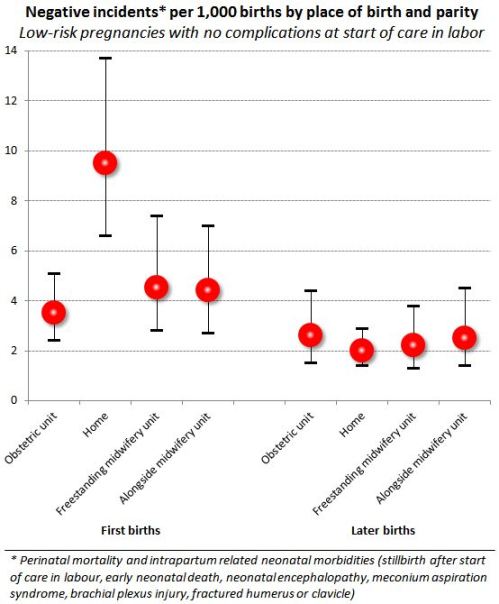
Two years  ago I wrote about a British study that found much higher rates of birth complications among home births when the mother was delivering her first child. This is my chart for their findings:

Again, those were the unadjusted rates, but the disparities held with a variety of important controls.

These birth complication rates are low by world historical standards. In New Delhi, India, in the 1980s 10% of 5-minute-olds had Apgar scores of 3 or less. So that’s many-times worse than American home births. On the other hand, a number of big European countries (Germany, France, Italy) have Apgar<7 rates of 1% or less, which is much better.

A large proportional increase on a low risk for a high-consequence event (like nuclear meltdown) can be very serious. A large absolute risk of a common low-consequence event (like having a hangover) can be completely acceptable. Birth complications are somewhere in between. But where?

Seems like a good topic for discussion, and having some real numbers helps. Let me know what you decide.

Cross-posted at Family Inequality.

Philip N. Cohen is a professor of sociology at the University of Maryland, College Park, and writes the blog Family Inequality. You can follow him on Twitter or Facebook.

A hundred thousand men and women identified as homosexuals were imprisoned during the Nazi regime. They were detained under a law known as “paragraph 175,” which made sodomy illegal.  Up to 15,000 were sent to concentration camps instead of prisons.  Nearly 2/3rds would die there.  The last surviving victim is believed to have died in 2011.

These men and women were not only victims of Nazi Germany, surviving torture in concentration camps, they were also denied validation as victims of the Third Reich.  They were classified as criminals upon release and included on lists of sex offenders.  Some were re-captured and imprisoned again.

The world went on to mourn the inhumanity of the Holocaust, but not for them.  Because they were designated as non-victims, and also because they were stigmatized sexual minorities, they were largely excluded from the official history of Hitler’s Germany.

Screenshot_1

Seeking to give these men and women a voice, historian Klaus Müller interviewed several gay men and one lesbian around the year 2000.  At the time, there were fewer than 10 left alive.  Not one of the men and women imprisoned for being homosexual — alive or dead — had ever been officially identified as a victim of the Nazi regime.

The documentary, titled Paragraph 175, is one of the most heart-wrenching I’ve ever seen.  For some, it sounds as if this is the first time anyone — even members of their own family — has ever asked them about what happened.  Re-telling the stories of death and torture is obviously incredibly painful, as it would be for any survivor.

On top of this, however, is anger at their extended invisibility and continued oppression.  Many seem opposed to talking about it at all, saying that it’s too painful to re-live, but it is as if they can’t help it; they are at the end of their lives and facing, perhaps, their first and last chance to do so.  In the interviews, the anger, pain, survivor guilt, and relief mix together. It’s excruciating.

I was riveted, even as I desperately wanted to look away so as to avoid the emotions it brought out in me.  I can’t recommend it strongly enough.

Cross-posted at Pacific Standard.

Lisa Wade, PhD is an Associate Professor at Tulane University. She is the author of American Hookup, a book about college sexual culture; a textbook about gender; and a forthcoming introductory text: Terrible Magnificent Sociology. You can follow her on Twitter and Instagram.

Screenshot_1In this powerful spoken word, poet Clint Smith, who is also a teacher in Washington D.C., tells the stories of some of his students. It puts names and details to the struggles of young people trying to thrive in an urban environment that is all too often indifferent to their survival.

Via Upworthy.

Lisa Wade, PhD is an Associate Professor at Tulane University. She is the author of American Hookup, a book about college sexual culture; a textbook about gender; and a forthcoming introductory text: Terrible Magnificent Sociology. You can follow her on Twitter and Instagram.

In my lecture about the sex lives of college students, I remind students that they didn’t invent casual sex.  This always prompts some snickers.  The fact that today’s students have about the same number of sexual partners as their parents did at their age evokes an even stronger response.   About 1/5th of college students will be virgins when they graduate college.

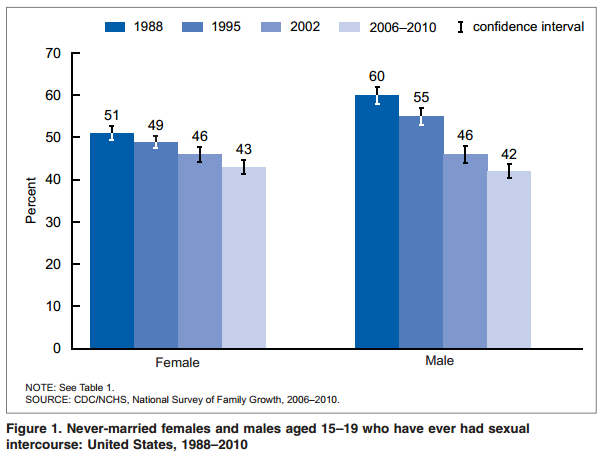
In fact, college students aren’t as sexually active as the moralizing makes it seem.  And neither, it turns out, are teenagers.  According to the Centers for Disease Control, 57% of girls and 58% of boys age 15 to 19 have never had penile-vaginal intercourse.  Moreover, the percent of teenagers that have had intercourse has been dropping consistently over the last 20 years.

Screenshot_1

So, despite the fact that young people are more likely than earlier generations to engage in oral sex before initiating penile-vaginal intercourse (especially fellatio), they continue to take intercourse very seriously.  This may be, in part, because men are becoming more like women in this regard.  Men’s numbers have dropped much more sharply. In addition, for the first time the CDC study found that boys’ #2 reason for not having engaged in intercourse was that they were waiting for the right person.  Men cited this reason 29% of the time, compared to 19% for girls.  For both boys and girls, the #1 reason is that it’s against their religion (41% of girls and 31% of boys).  Concerns about pregnancy come in third.

Cross-posted at Pacific Standard.

Lisa Wade, PhD is an Associate Professor at Tulane University. She is the author of American Hookup, a book about college sexual culture; a textbook about gender; and a forthcoming introductory text: Terrible Magnificent Sociology. You can follow her on Twitter and Instagram.

I have enjoyed Star Wars Angry Birds since I first discovered it almost a year ago, at the suggestion of my brother (a fellow Star Wars fan). While I never warmed to the original Angry Birds, I was tickled that I could clearly identify the Star Wars characters the birds represented in the themed version of the game. When Star Wars Angry Birds II released last month, I anxiously dove into the sequel.  On a whim, I decided to use the new store feature to look through the many characters that I might someday unlock.

When I finally scrolled through all of the characters in the game, I noticed something peculiar.

Han Solo (played by Harrison Ford, a white male, in the Star Wars films) is portrayed by a yellow bird. Luke Skywalker (played by Mark Hamill, a white male) is portrayed by a red bird. Qui-Gon Jinn (played by Liam Neeson, a white male) is portrayed by a tan bird. These birds all have costumes or props that identify them as the characters they are meant to represent, but their color is not related to the skin color of the characters/actors in the films.

This pattern held true for every (human) male character with two notable exceptions: Captain Panaka (played by Hugh Quarshie, a black male) and Mace Windu (played by Samuel Jackson, a black male) are both portrayed by brown birds.

Complete-Angry-Birds-Star-Wars-2-All-Characters-Guide-Featured-Image-640x478

So, what’s the message? Well, for white, male Star Wars characters, skin color is unimportant; white characters can be represented by a bird of any color. It is the costuming or props used by these birds that convey the essence of the character. But for black Star Wars characters, their skin color (brown) becomes the defining element conveying the essence of the character.

Likewise, gender is also a defining characteristic for the portrayal of female characters. Princess Leia (played by Carrie Fisher, a white female) and Padme (played by Natalie Portman, a white female) are both portrayed by pink birds. There are no other pink birds in the game.   Again, the color of the bird is unimportant, unless the bird is female, in which case the character’s gender (denoted by its pinkness) becomes the essential element of that character.

This same pattern also appears in the original Star Wars Angry Birds, in which Princess Leia is the only pink bird and Lando Calrissian (played by Billy Dee Williams, a black male) is the only brown bird.

White privilege and male privilege persist, in part, by framing the white, male experience as normal. Even in a game like Star Wars Angry Birds II we see the invisibility of whiteness and maleness and the foregrounding of race and gender for people of color and women.

Galen Ciscell is a visiting assistant professor of sociology at Pacific Lutheran University.  He is also the designer of the cooperative board game Atlantis Rising.

The dominant firms in the U.S. and other major capitalist counties are happily making profits, but they aren’t interested in investing them in new plants and equipment that increase productivity and create jobs.  Rather they prefer to use their earnings to acquire other firms, reward their managers and shareholders, or increase their holdings of cash and other financial assets.

The chart below, taken from a Michael Burke post in the Irish Left Review, shows trends in both U.S profits and investment .

1

As you can see the increase in profits (in orange) has swamped the increase in investment (in blue) over the relevant time period; in fact, investment in current dollars has actually been falling.

Looking at the ratio between these two variables helps us see even more clearly the growth in firm reluctance to channel profits into investment.  The investment ratio (investment/profits) was 62% in 1971, peaked at 69% in 1979, fell to 61% in 2000 and 56% in 2008, and dropped to an even lower 46% in 2012.

According to Burke,  if U.S. firms were simply to invest at the level they did in 1979, not even the peak, the increase in investment in the American economy would exceed $1.5 trillion, close to 10% of GDP.

The same dynamic is observable in the other main capitalist economies:

In 1995 the investment ratio in the Euro Area was 51.7% and by 2008 it was 53.2%. It fell to 47.1% in 2012. In Britain the investment ratio peaked at 76% in 1975 but by 2008 had fallen to 53%. In 2012 it was just 42.9% (OECD data).

So what are firms doing with their money? As Burke explains:

The uninvested portion of firms’ surplus essentially has only two destinations, either as a return to the holders of capital (both bondholders and shareholders), or is hoarded in the form of financial assets. In the case of the U.S. and other leading capitalist economies both phenomena have been observed. The nominal returns to capital have risen (even while the investment ratio has fallen) and financial assets including cash balances have also risen.

So, with firms seeing no privately profitable outlet for their funds, despite great societal needs, their owners appear content to reward themselves and sock away the rest in the financial system.  In many ways this turns out to be a self-reinforcing dynamic.  No wonder things are so bad for so many.

Cross-posted at Reports from the Economic Front.

Martin Hart-Landsberg is a professor of economics at Lewis and Clark College. You can follow him at Reports from the Economic Front.

Last week Kay Hymowitz (who sometimes works out of a PO Box rented by Brad Wilcox) wrote the following in the LA Times:

As far back as the 1970s, family researchers began noticing that… [b]oys from broken homes were more likely than their peers to get suspended and arrested… And justice experts have long known that juvenile facilities and adult jails overflow with sons from broken families. Liberals often assume that these kinds of social problems result from our stingy support system for single mothers and their children. But the link between criminality and fatherlessness holds even in countries with lavish social welfare systems.

Ah, the link between criminality and fatherlessness again. So ingrained is the assumption that crime rates always go up that conservatives making this argument do not even see the need to account for the incredible, world-historical drop in violence that has accompanied the collapse of the nuclear family. I know Kay Hymowitz knows this, because we’ve argued about it before. But if her editors and readers don’t, why should she make a big deal out of it?

In this graph I show the scales down to zero so you can see the proportional change in each trend: father-not-present boys ages 10-14 and male juvenile violent-crime arrest rates.

1

I’m not arguing about whether boys living without fathers are more likely to commit crimes. I’m just saying that this is very unlikely to be the major cause of male juvenile violent crime if the trends can move so drastically in opposite directions at the same time. These aren’t little fluctuations. Even if you leave out the late-80s-early-90s spike in crime, arrests fell about 40% from 1980 to 2010 while father-absent boys increased almost 50%.

If you are going to argue for a strong association — which Hymowitz does — and use words like “tide,” you should at least acknowledge that the problem you are trumpeting is getting better while the cause you are bemoaning is getting worse.

Cross-posted at Family Inequality.

Philip N. Cohen is a professor of sociology at the University of Maryland, College Park, and writes the blog Family Inequality. You can follow him on Twitter or Facebook.