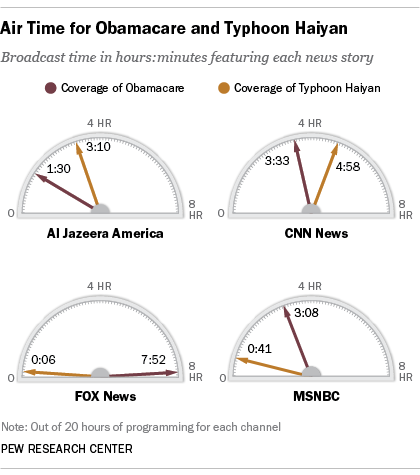
Yesterday the Pew Research Center released data on the news coverage of Typhoon Haiyan — a disaster that has killed at least 4,000 people — and the bungled Obamacare website roll-out. Comparing 20 hours of news coverage over four major U.S. channels, they found dramatic differences. The data below shows the hours and minutes spent on each topic at each channel (red = Obamacare, yellow = the typhoon).
First, the two partisan channels (Fox News and MSNBC) gave more time to Obamacare than the typhoon. On MSNBC, there was four times as much coverage of Obamacare. On Fox, there as a stunning 80 times as much coverage. Al Jazeera America and CNN spent significantly more time on the typhoon, likely reflecting their more global focus and less of an ideological mission.
The channels also differed in how much time they spent on facts/reporting versus opinion/commentary. Check it out:
While most all of us sometimes lazily refer to “the media” as if it’s a homogeneous thing, it’s important to remember that our perceptions of reality are strongly shaped by which media we consume.
On October 28th, Miami Dolphins offensive lineman Jonathan Martin left the National Football League citing emotional distress as a result of abuse at the hands of his teammate Richie Incognito. Incognito admits to having sent Martin racist, homophobic, and threatening text messages and voicemails but argues that rather than hazing or bullying, this was merely an instance of miscommunication between the two men.
While a great deal of media attention has questioned the behavior of Richie Incognito, a disproportionate amount of attention has also been given to Martin’s choice to report the abuse. Why has Martin’s choice to report the abuse received so much attention? What has been the main theme of those critiquing Martin’s choice? And, what does this discussion mean for our national discourse on bullying and hazing? The answers to these questions, I argue, are all linked to masculinity.
The media talks about Martin’s choice to report because his decision violated accepted cultural norms of masculinity. Some may call these norms, more colloquially, the “bro code,” “guy code,” or “man code.” Whatever we choose to call it, there are accepted ways in which men and boys are expected to conduct ourselves and our relationships to other men. Martin stands accused, especially within the athletic community, of having broken the code.
In a very telling interview, Channing Crowder, a former teammate of Incognito, made it clear that this conversation is really about masculinity. According to Crowder, Incognito tests his teammates. He “tests you to see if you have enough manhood or enough testosterone” (even though this type of bullying is just as much about the perpetrator’s masculinity as it is the victim’s).
In this case Martin’s masculinity is under attack on two fronts. First, it is under attack because he failed Incognito’s “test” of his manhood. Second, he is under attack because his solution to Incognito’s bullying violated guy code. According to the code, real men solve their problems with one another through violence.
Sports Illustratedreported that many NFL personnel consider Martin to be a coward or a wimp for reporting the abuse. One NFL informant was even quoted saying “I think Jonathan Martin is a weak person. If Incognito did offend him racially, that’s something you have to handle as a man.” Others said it would have been preferable for Martin to “go down swinging” or to “fight.” Even NPR ran a piece in which a regular guest argued:
Martin should have taken that dude outside and put his lights out. I do not – I absolutely do not believe in a society where we run to the principal’s office every time these petty tyrants make a threat… Only power dispatches bullies… Jonathan Martin is a grown man and you can’t bully a grown man.
To be fair, in that same NPR piece, another interviewee stated that “not everybody resorts to violence in response to bullying and I applaud him for that.”
Nevertheless, by reporting the abuse rather than physically confronting Incognito, Jonathan Martin has been publicly stripped of his “mancard.”
But, so what? Why should we care about how grown men address bullying? We should care because just as Jonathan Martin is being told to “man up,” so are young boys all over the country when they are bullied. Boys are told that when they cannot physically confront a bully they are inadequate and unworthy. They are taught to remain silent in the face of insurmountable violence because speaking out is a sign of weakness, or worse, femininity. Too many boys are left with nowhere to turn when bullying makes trauma a daily experience. In this sort of environment can we really be surprised that boys are committing suicide, developing depression, and lashing out violently at incredibly high rates?
The current economic recovery officially began June 2009 and is one of the weakest in the post-World War II period. This is true by almost every indicator, except growth in profits.
One reason it has offered working people so little is the contraction of government spending and employment. This may sound strange given the steady drumbeat of articles and speeches demanding a further retrenchment of government involvement in the economy, but the fact is that this drumbeat is masking the reality of the situation.
The figure shows the growth in real spending by federal, state, and local governments in the years before and after recessions. The black line shows the average change in public spending over the six business cycles between 1948 and 1980. Each blue line shows government spending for a different recent business cycle and the red line does the same for our current cycle. As you can see, this expansionary period stands out for having the slowest growth in public spending. In fact, in contrast to other recovery periods, public spending is actually declining.
…public spending following the Great Recession is the slowest on record, and as of the second quarter of 2013 stood roughly 15 percent below what it would have been had it simply matched historical averages… if public spending since 2009 had matched typical business cycles, this spending would be roughly $550 billion higher today, and more than 5 million additional people would have jobs (and most of these would be in the private sector).
The basic stagnation in government spending has actually translated into a significant contraction in public employment. This figure highlights just how serious the trend is by comparing public sector job growth in the current recovery to the three prior recovery periods.
…the public sector has shed 737,000 jobs since June 2009. However, this raw job-loss figure radically understates the drag of public-sector employment relative to how this sector has normally performed during economic recoveries… [P]ublic-sector employment should naturally grow as the overall population grows. Between 1989 and 2007, for example, the ratio of public employment to overall population was remarkably stable at roughly 7.3 public sector workers for each 100 members of the population. Today’s ratio is 6.9, and if it stood at the historic average of 7.3 instead, we would have 1.3 million more public sector jobs today.
In short, the challenge we face is not deciding between alternative ways to further shrink the public sector but rather of designing and building support for well financed public programs to restructure our economy and generate living wage jobs.
Sociologists like to say that gender identities are socially constructed. That just means that what it is, and what it means, to be male or female is at least partly the outcome of social interaction between people – visible through the rules, attitudes, media, or ideals in the social world.
And that process sometimes involves constructing people’s bodies physically as well. And in today’s high-intensity parenting, in which gender plays a big part, this includes constructing – or at least tinkering with – the bodies of children.
Today’s example: braces. In my Google image search for “child with braces,” the first 100 images yielded about 75 girls.
Why so many girls braced for beauty? More girls than boys want braces, and more parents of girls want their kids to have them, even though girls’ teeth are no more crooked or misplaced than boys’. This is just one manifestation of the greater tendency to value appearance for girls and women more than for boys and men. But because braces are expensive, this is also tied up with social class, so that richer people are more likely to get their kids’ teeth straightened, and as a result richer girls are more likely to meet (and set) beauty standards.
Hard numbers on how many kids get braces are surprisingly hard to come by. However, the government’s medical expenditure survey shows that 17 percent of children ages 11-17 saw an orthodontist in the last year, which means the number getting braces at some point in their lives is higher than that. The numbers are rising, and girls are wearing most of hardware.
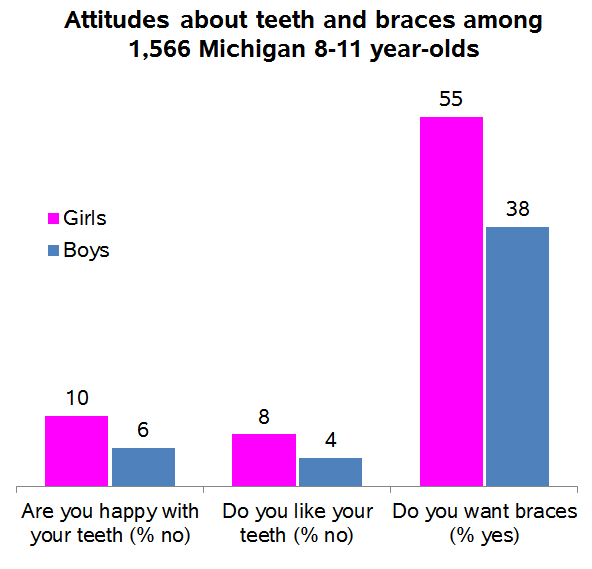
A study of Michigan public school students showed that although boys and girls had equal treatment needs (orthodontists have developed sophisticated tools for measuring this need, which everyone agrees is usually aesthetic), girls’ attitudes about their own teeth were quite different:
Clearly, braces are popular among American kids, with about half in this study saying they want them, but that sentiment is more common among girls, who are twice as likely as boys to say they don’t like their teeth.
The same pattern is found in Germany, where 38 percent of girls versus 30 percent of boys ages 11-14 have braces, and in Britain – both countries where braces are covered by state health insurance if they are needed, but parents can pay for them if they aren’t.
Among American adults, women are also more likely to get braces, leading the way in the adult orthodontic trend. (Google “mother daughter braces” and you get mothers and daughters getting braces together; “father son braces” brings you to orthodontic practices run by father-son teams.)
Teeth and consequences
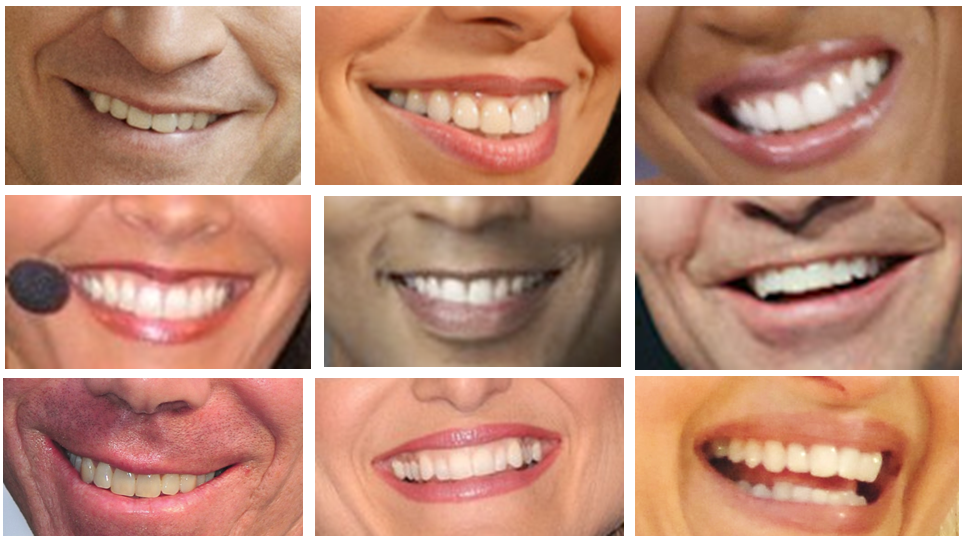
Caption: The teeth of TV anchors Anderson Cooper, Soledad O’Brien, Robin Roberts, Suzanne Malveaux, Don Lemon, George Stephanopolous, David Gregory, Ashley Banfield, and Diane Sawyer.
.
Today’s rich and famous people – at least the one whose faces we see a lot – usually have straight white teeth, and most people don’t get that way without some intervention. And lots of people get that.
Girls are held to a higher beauty standard and feel the pressure – from media, peers or parents – to get their teeth straightened. They want braces, and for good reason. Unfortunately, this subjects them to needless medical procedures and reinforces the over-valuing of appearance. However, it also shows one way that parents invest more in their girls, perhaps thinking they need to prepare them for successful careers and relationships by spending more on their looks.
When they’re grown up, of course, women get a lot more cosmetic surgery than men do – 87 percent of all surgical procedures, and 94% of Botox-type procedures – and that gap is growing over time.
As is the case with lots of cosmetic procedures, people from wealthier families generally are less likely to need braces but more likely to get them. But add this to the gender pattern, and what emerges is a system in which richer girls (voluntarily or not) and their parents set the standard for beauty – and then reap the rewards (as well as harms) of reaching it.
Philip N. Cohen is a professor of sociology at the University of Maryland, College Park, and writes the blog Family Inequality. You can follow him on Twitter or Facebook.
olden days a glimpse of stocking Was looked on as something shocking, But now lord knows — Anything goes.
— Cole Porter, 1934
Poor Richard Cohen, columnist for the Washington Post. He’s being raked over the liberal coals for this recent observation:
Today’s GOP is not racist, as Harry Belafonte alleged about the tea party, but it is deeply troubled – about the expansion of government, about immigration, about secularism, about the mainstreaming of what used to be the avant-garde. People with conventional views must repress a gag reflex when considering the mayor-elect of New York – a white man married to a black woman and with two biracial children. (Should I mention that Bill de Blasio’s wife, Chirlane McCray, used to be a lesbian?) This family represents the cultural changes that have enveloped parts – but not all – of America. To cultural conservatives, this doesn’t look like their country at all.
As Ta-Nehisi Coates points out, gagging at a Black-White couple and their biracial children is, in fact, racist. So let’s focus on the word that Cohen uses to avoid that obvious conclusion – conventional.
Conventional: conforming or adhering to accepted standards; ordinary rather than different or original.
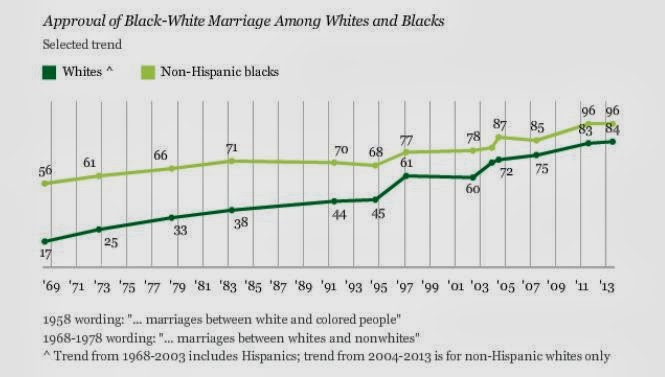
Matthew Yglesias at Slate seizes on that word and those “people with conventional views.” Yglesias too calls Cohen’s column “racist,” but more to the point, he provides some Gallup-poll evidence that interracial marriage is the new conventional.
Or as Cole Porter put it in a 1935 production:
When ladies fair who seek affection Prefer gents of dark complexion As Romeos — Anything goes
Porter was bemused; Cohen is troubled. My spider sense tells me that if he’s not actually one of those people with conventional views repressing a gag reflex, he at least feels some strong sympathy for them. But they are on the wrong side of 21st century history, and not only on interracial marriage. Consider that parenthetical comment:
(Should I mention that Bill de Blasio’s wife, Chirlane McCray, used to be a lesbian?)
First, this is a pretty good example of one of my favorite rhetorical devices, paralipsis (or is it apophasis?) – saying something while saying that you’re not saying it. “To keep this discussion one of principle and not personalities, I won’t even mention that my opponent was arrested for wife-beating and has been linked to the Gambino crime family.”
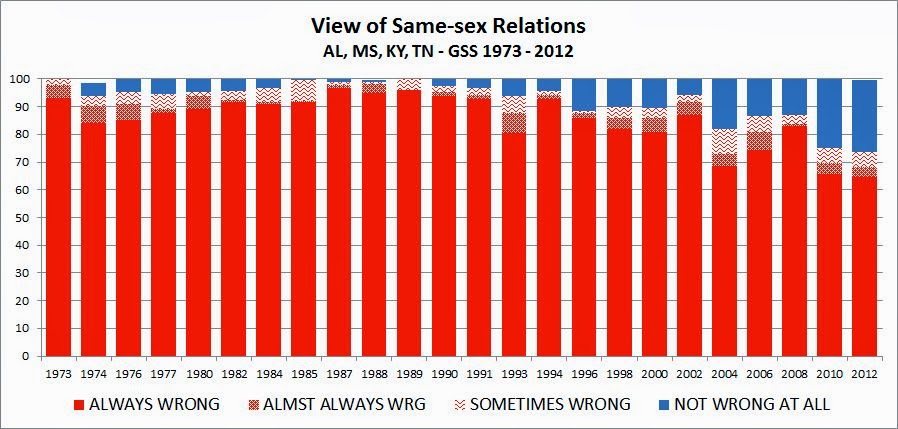
Second, as with interracial marriage, opinion on homosexuality has shifted considerably. Here’s the GSS data.
In less than twenty years, the Always Wrong delegation has shrunk from more than three-fourths to less than half. As Cohen says, this change has “enveloped” only parts of America. The gag reflex is still strong in the East South Central, which comprises Alabama, Mississippi, Tennessee, and Kentucky – the most unenveloped (unreconstructed?) of the GSS regions.
Despite the recent liberalizing trend, the Always Wrongs outnumber the Never Wrongs by more than two to one.
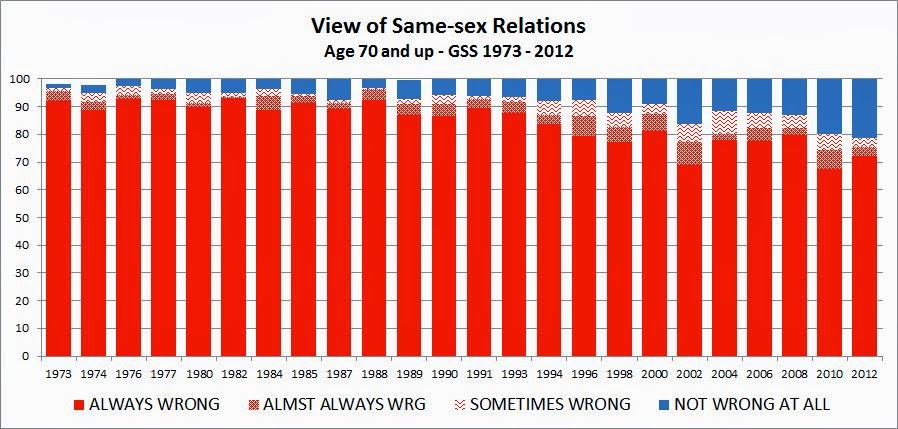
But wait, Cohen is not from the South or Appalachia. Like Bill deBlasio, he’s a New Yorker born and bred. (DeBlasio is from Manhattan, Cohen from Far Rockaway, Queens.) But there might be one other demographic source of that gag reflex – age. Cohen is 72. Here’s how his peers feel about people who share Cole Porter’s sexual orientation.
Among septuagenarians and their elders, those gagging at gays have a large 3½-to-1 edge.
Cohen is probably making the mistake that many of us make – projecting our own views as more widely held than they actually are. Journalists may be especially prone to this kind of projection, preferring to write about what “the public” or “the voters” want or think, when simple first-person statements would be more accurate. So when Cohen says, “to cultural conservatives, this doesn’t look like their country at all,” he may be talking about himself and the country he grew up in — Far Rockaway in the forties and fifties. But in 2013, that Far Rockaway is far away.
I absolutely love this comic from Robot Hugs! Yes, people are people! Or, as Kathryn Dindia once said, “Men are from North Dakota, women are from South Dakota.”
“It’s worth recalling that Loving v. Virginia, the Supreme Court case that struck down laws prohibiting interracial marriage, centered on the union of a white man and a black woman. These laws ended at least in part because, in an ironic twist, racism had interfered with a white man’s right to choose.”
I read an article today about whether visible, viable female candidates for elected office make adolescent girls more interested in politics. They do. But what made my jaw drop was the data on adolescents’ interest in politics overall. It’s been falling for decades.
The graph below was included as part of the description of their data. The measure of “political engagement” is a combination of responses to questions about whether they plan to participate in political activities when they get older, imagine they’ll ever write to a public official, think they’d like to work on a political campaign. Remember, they’re just kids, so it’s all prospective.
They’ve been asking this question of about 2,500 kids since 1979. In that year, adolescents scored about 0.75, with possible scores ranging from zero to three. So, the average kid said yes to fewer than one of the questions. The likelihood of adolescents saying yes to even one, however, has been dropping. In 2001, the average score was closer to 0.5. That’s equivalent to every other kid saying yes to just one of the questions.
Click to enlarge:
The drop isn’t as dramatic as it looks because the graph only goes from 0.4 to 0.9, while the scale is from zero to three. The pattern of decreasing interest in politics, however, seems real. I’m outside of my range of expertise here, otherwise I’d be able to offer some hypotheses for why. But I’d love to hear your ideas and any guesses about what’s happened to adolescents’ interest in politics since 2001.
Sociological Images encourages people to exercise and develop their sociological imaginations with discussions of compelling visuals that span the breadth of sociological inquiry. Read more…