stoplight

Three in the morning, Dad, good citizen
stopped, waited, looked left, right.
He had been driving nine hundred miles,
had nearly a hundred more to go,
but if there was any impatience
it was only the steady growl of the engine
which could just as easily be called a purr.I chided him for stopping;
he told me our civilization is founded
on people stopping for lights at three in the morning.

— from a poem by Bruce Hawkins.

I read these lines and I thought of Murray Davis.

One December long ago, I got a ride home from Boston to Pittsburgh with Murray in his black VW Beetle. He was a graduate student, I was an undergrad, and in those days the trip took twelve hours.  We got into Pittsburgh some time after 2 a.m.  The streets were deserted

In Shadyside on Fifth Avenue, not far from my parents’ condo, we came to a red light. Murray paused, then drove on through.

“Sociology allowed me to do that,” he said.

I can’t remember his explanation, but I think it had something to do with “rules in use” and the negotiability of norms. That’s interesting, I thought.  Maybe it was even convincing, though I still turned in my seat to see if there were any cops behind us. There weren’t.

Murray was right. At that hour of empty streets, waiting for the green serves no rational purpose. When there is no traffic, traffic safety is not an issue. But Bruce Hawkins’s dad is also right.  He takes a more Durkheimian view: rationality is not the basis of society. What makes society possible is people’s attachment to the group and its ideas – its values, its beliefs, and its stoplights.I wonder what Murray would have said now about this poem.

Photo by David Allan Rueter.  Cross-posted at Montclair SocioBlog.

Jay Livingston is the chair of the Sociology Department at Montclair State University. You can follow him at Montclair SocioBlog or on Twitter.

In this 4 1/2 minute video, Harvard business professor Michael Norton describes a study testing people’s willingness to talk about race.  He made volunteers play a simple game.  One picked a face from a field of 12 and the other asked yes/no questions in order to guess who they had in mind.  Among the field of faces, six were white and six were black.

Screenshot_4

Even though asking if a person was black or white would eliminate half of the contenders, 43% of people did not mention race.  If the other volunteer was African American, they were even less likely to mention it.  In that scenario, 79% didn’t ask if the face they had in mind was white or black.

They reproduced the experiment with children and found that, while little kids would ask about race, by nine or ten, they’d stopped.  The little kids often beat the older kids at the game, given that race was a pretty good way to eliminate faces.

Interestingly, the people who didn’t mention race were probably trying to appear not racist, but their decision had the opposite effect.  The partners of people who didn’t mention race rated them as more racist than the partners of people who did.  Bringing up race was, in fact, a way to signal comfort with racial difference.

For the whole story, here’s the video:

Lisa Wade, PhD is an Associate Professor at Tulane University. She is the author of American Hookup, a book about college sexual culture; a textbook about gender; and a forthcoming introductory text: Terrible Magnificent Sociology. You can follow her on Twitter and Instagram.

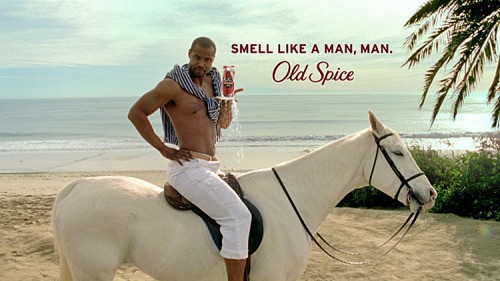
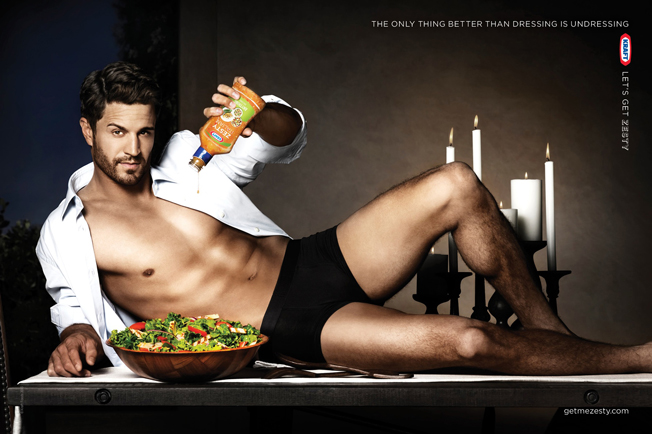
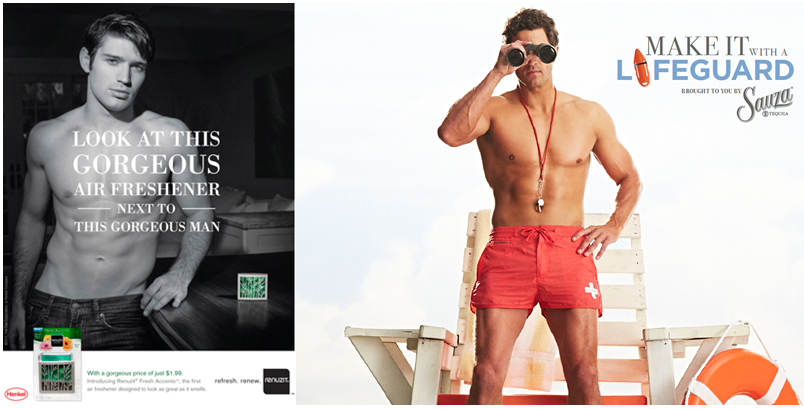
Recently David Gianatasio at AdWeek wrote an analysis of the sudden rise in the sexual objectification of men in advertising.  It seems to have been spurred by the wild popularity of the Old Spice character introduced in 2010, The Man Your Man Could Smell Like.  Gianatasio calls it “hunkvertising.”  Indeed, rippling abdominal muscles suddenly seem to be everywhere.

53Screenshot_3

Gianatasio interviewed me for the piece and I had two thoughts.  First, because the ads are so tongue-in-cheek, they didn’t seem to be acknowledging and validating women’s sexual desire, so much as mocking it.  “It’s funny to us to think of women being lustful,” I told Gianatasio, “because we don’t really take women’s sexuality very seriously.”  In this way, the joke affirms the gender order because the humor depends on us knowing that we don’t really objectify men this way and we don’t really believe that women are the way we imagine men to be.

Second, objectifying men alongside women certainly isn’t progress.  There’s the old critique that, if it is equality, it’s not the kind we want.  But, more importantly, the forces behind this so-called equality have nothing to do with justice.  Gianatasio generously gave me the last word:

I wouldn’t call it equality — I’d call it marketing, and maybe capitalism. Market forces under capitalism exploit whatever fertile ground is available. Justice and sexual equality aren’t driving increasing rates of male objectification — money is.

Lisa Wade, PhD is an Associate Professor at Tulane University. She is the author of American Hookup, a book about college sexual culture; a textbook about gender; and a forthcoming introductory text: Terrible Magnificent Sociology. You can follow her on Twitter and Instagram.

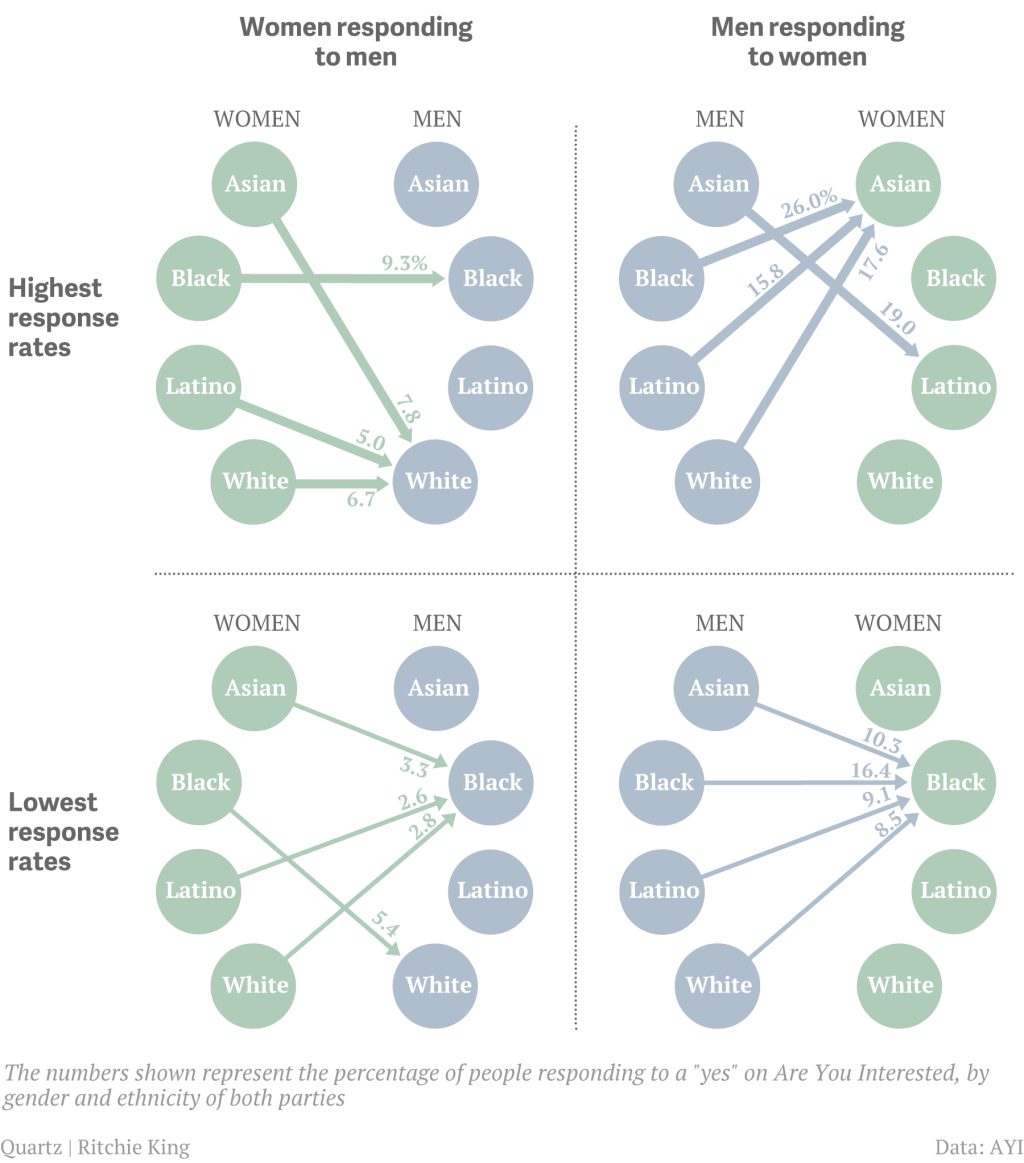
Quartz, a business and marketing website, recently released data on the Facebook dating app Are You Interested, which connects single people with others within the confines of their Facebook networks. Quartz’ data are based on a series of yes-or-no questions about who users are interested in, as well as response rates between users, once notified of a potential suitor. The data show that white men and Asian women receive the most interest, whereas black men and women receive the least amount of interest. The writers at Quartz summarize the findings as follows:

Unfortunately the data reveal winners and losers. All men except Asians preferred Asian women, while all except black women preferred white men. And both black men and black women got the lowest response rates for their respective genders.

Here’s what the data looks like:

1

As a sociologist, I am entirely unsurprised that race matters, especially in such a personal process like dating/mating. However, these findings may come as a surprise to the (quite significant) segments of the population who identify as color-blind; those who label contemporary society post-racial.

And this is why dating sites are so cool. Social psychologists know that what people say and what they do have little empirical connection. Dating sites capture what we do, and play it back for us. They expose who we are, who we want, and of course, who we don’t want. As shown by Quartz, “we” fetishize Asian women while devaluing blacks.

With a schism between what people say and what they do; between what they say and what the unconsciously think,  surveys of racial attitudes are always already quite limited.  People can say whatever they want — that race doesn’t matter, that they don’t see color — but when it comes to selecting a partner, and the selection criteria are formalized through profiles and response decisions, we, as individuals and a society, can no longer hide from ourselves. The numbers blare back at us, forcing us to prosume uncomfortable cultural and identity meanings both personally and collectively.

Indeed, before anyone has answered anything, the architecture of online dating sites say a lot.  Namely, by defining what can be preferences at all, they tell us which characteristics are the ones about which we are likely to care; about which we should care.

Both the user data and the presence of racial identification and preference in the first place are revealing, demolishing arguments about colorblindness and post-racial culture.

Jenny L. Davis, PhD, is in the department of sociology at James Madison University. She studies social psychology, experimental research methods, and new and social media. She is also a contributing author and editor at Cyborgology.  You can follow her at @Jenny_L_Davis.

Cross-posted at Cyborgology.

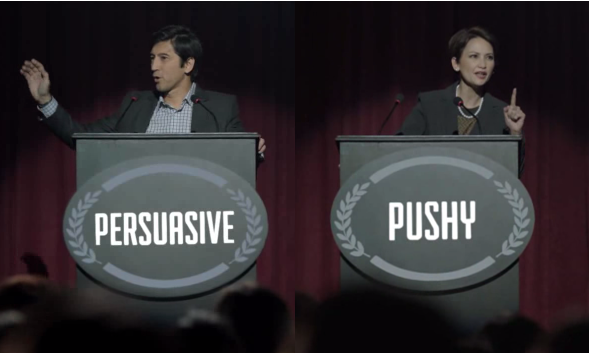
This 1 minute commercial for Pantene, running in the Philippines, is getting a lot of praise.  It does a powerful job of pointing out the way that women are disadvantaged in corporate contexts.  The men and women in the ad are portrayed similarly, but the women are judged for the behavior while the men are praised.

32

1Pretty neat.

But then the end.  Oh Pantene.  The answer to this systemic double bind that damns women if they do and damns them if they don’t is, apparently, to “be strong and shine.”

1

I suppose we shouldn’t expect much more from a shampoo ad, but I lament the ending anyway.  It resonates with a wider cultural trend in which feminist empowerment has been conflated with individual gain within a patriarchal system, not a collective effort to end patriarchy once and for all.

This is the lesson of Sheryl Sandberg’s Lean In: the system’s all set up to fuck you over, she acknowledges, but then she whispers: I will try to help you get to the top anyway.  No matter if you have to step all over lots of other women on the way.  That’s not feminism, that’s self-interest.  And it’s certainly not progressive change.

Thanks to @yassmin_a at Redefining the Narrative, Keely W., and Jacob R. for the link!  Cross-posted at the Huffington Post.

Lisa Wade, PhD is an Associate Professor at Tulane University. She is the author of American Hookup, a book about college sexual culture; a textbook about gender; and a forthcoming introductory text: Terrible Magnificent Sociology. You can follow her on Twitter and Instagram.

1Sociologists observe that cultures are centered around some people and  not others such that members of some groups just seem like people and others are perceived as deviations from that presumed norm.

Names are part of how we divide the world into the normals and the deviants.  Illustrating this, the sketch comedy duo Key and Peele are super creative in this 3 minute skit.  They reverse the white-teacher-goes-into-the-inner-city trope and put a non-white teacher into a suburban school.  As he calls roll, the skit center HIS reality instead of that of the white, middle class kids.  He pronounces their names like stereotypically black names, confusing the heck out of the kids, and never considering the possibility that the names he’s familiar with isn’t how all names really are.

It’s not a safe skit — it potentially reinforces the conflation of non-white and urban and the stereotypes of inner city students and the names low-income black parents give their kids — but it does a great job of playing with what life might be like if we shifted the center of the world.

Lisa Wade, PhD is an Associate Professor at Tulane University. She is the author of American Hookup, a book about college sexual culture; a textbook about gender; and a forthcoming introductory text: Terrible Magnificent Sociology. You can follow her on Twitter and Instagram.

“The United States is one of few advanced nations where schools serving better-off children usually have more educational resources than those serving poor students,” writes Eduardo Porter for the New York Times.  This is because a large percentage of funding for public education comes not from the federal government, but from the property taxes collected in each school district.  Rich kids, then, get more lavish educations.

This means differences in how much we spend per student both across and within states.  New York, for example, spends about $19,000 per student.  In Tennessee they spend $8,200 and in Utah $5,321.  Money within New York, is also unequally distributed: $25,505 was spent per student in the richest neighborhoods, compared to $12,861 in the poorest.

Screenshot_1 Screenshot_2

This makes us one of the three countries in the OECD — with Israel and Turkey — in which the student/teacher ratio is less favorable in poor neighborhoods compared to rich ones.  The other 31 nations in the survey invest equally in each student or disproportionately in poor students.  This is not meritocracy and it is certainly not equal opportunity.

Lisa Wade, PhD is an Associate Professor at Tulane University. She is the author of American Hookup, a book about college sexual culture; a textbook about gender; and a forthcoming introductory text: Terrible Magnificent Sociology. You can follow her on Twitter and Instagram.

Screenshot_1The joke about the woman who sued McDonald’s after spilling hot coffee in her lap has become a cultural lightening rod, mocked in sitcoms and used to argue in favor of reforming the law that guides civil lawsuits.  In fact, the coffee was served 30 degrees higher than coffee made at home. When it spilled between 79-year-old  Stella Liebeck’s legs and pooled in her seat, she went into shock.  She was burned over 16% of her body, 6% of the burns were 3rd degree.  She spent a week in the hospital and had to have skin grafts.  When she asked McDonald’s to pay her hospital bills, they refused.  Later it came out that the restaurant had gotten many complaints about the temperature of their coffee.

This New York Times video reviews the case, described as the “most widely misunderstood story in America.”  From a sociological perspective, it’s a great example of how stories can bounce around in the media echo chamber, constrained by the need for sound bites, and become a cultural touchstone.

Lisa Wade, PhD is an Associate Professor at Tulane University. She is the author of American Hookup, a book about college sexual culture; a textbook about gender; and a forthcoming introductory text: Terrible Magnificent Sociology. You can follow her on Twitter and Instagram.