We’re celebrating the end of the year with our most popular posts from 2013, plus a few of our favorites tossed in.  Enjoy!

Oddly, three high profile female musicians find themselves in a public debate about what it means to be a feminist.  We can thank Miley Cyrus for the occasion.  After claiming that the video for Wrecking Ball was inspired by Sinead O’Connor’s Nothing Compares to You, O’Connor wrote an open letter to the performer.  No doubt informed by Cyrus’ performance at the VMAs, she argued that the music industry would inevitably exploit Cyrus’ body and leave her a shell of a human being.  Amanda Palmer, another strong-minded female musician, responded to O’Connor.  She countered with the idea that all efforts to control women’s choices, no matter how benevolent, were anti-feminist.

I keep receiving requests to add my two cents.  So, here goes: I think they’re both right, but only half right.  And, when you put the two sides together, the conclusion isn’t as simple as either of them makes it out to be.  Both letters are kind, compelling, and smart, but neither capture the deep contradictions that Cyrus – indeed all women in the U.S. – face every day.

Cyrus in Wrecking Ball:

Screenshot_7

O’Connor warns Cyrus that the music industry is patriarchal and capitalist.  In so many words, she explains that the capitalists will never pay Cyrus what she’s worth because doing so leaves nothing to skim off the top.  The whole point is to exploit her.  Meanwhile, her exploitation will be distinctly gendered because sexism is part of the very fabric of the industry.  O’Connor writes:

The music business doesn’t give a shit about you, or any of us. They will prostitute you for all you are worth… and when you end up in rehab as a result of being prostituted, “they” will be sunning themselves on their yachts in Antigua, which they bought by selling your body…

Whether Cyrus ends up in rehab remains to be seen but O’Connor is, of course, right about the music industry. This is not something that requires argumentation, but is simply true in a patriarchal, capitalist society.  For-profit industries are for profit.  You may think that’s good or bad, but it is, by definition, about finding ways to extract money from goods and services and one does that by selling it for more than you paid for it.  And media companies of all kinds are dominated at almost all levels by (rich, white) men. These are the facts.

Disagreeing, Palmer claims that O’Connor herself is contributing to an oppressive environment for women.  All women’s choices, Palmer argues, should be considered fair game.

I want to live in a world where WE as women determine what we wear and look like and play the game as our fancy leads us, army pants one minute and killer gown the next, where WE decide whether or not we’re going to play games with the male gaze…

In Palmer’s utopia, no one gets to decide what’s best for women.  The whole point is to have all options on the table, without censure, so women can pick and choose and change their mind as they so desire.

This is intuitively pleasing and seems to mesh pretty well with a decent definition of “freedom.”  And women do have more choices – many, many more choices – than recent generations of women. They are now free to vote in elections, wear pants, smoke in public, have their own bank accounts, play sports, go into men’s occupations and, yes, be unabashedly sexual.  Hell they can even run for President.  And they get to still do all the feminine stuff too!  Women have it pretty great right now and Palmer is right that we should defend these options.

So, both are making a feminist argument.  What, then, is the source of the disagreement?

O’Connor and Palmer are using different levels of analysis.  Palmer’s is straightforwardly individualistic: each individual woman should be able to choose what she wants to do.  O’Connor’s is strongly institutional: we are all operating within a system – the music industry, in this case, or even “society” – and that system is powerfully deterministic.

The truth is that both are right and, because of that, neither sees the whole picture.  On the one hand, women are making individual choices. They are not complete dupes of the system.  They are architects of their own lives.   On the other hand, those individual choices are being made within a system.  The system sets up the pros and cons, the rewards and punishments, the paths to success and the pitfalls that lead to failure.  No amount of wishing it were different will make it so.  No individual choices change that reality.

So, Cyrus may indeed be “in charge of her own show,” as Palmer puts it.  She may have chosen to be a “raging, naked, twerking sexpot” all of her own volition.  But why?  Because that’s what the system rewards.  That’s not freedom, that’s a strategy.

In sociological terms, we call this a patriarchal bargain.  Both men and women make them and they come in many different forms. Generally, however, they involve a choice to manipulate the system to one’s best advantage without challenging the system itself.  This may maximize the benefits that accrue to any individual woman, but it harms women as a whole.  Cyrus’ particular bargain – accepting the sexual objectification of women in exchange for money, fame, and power – is a common one.  Serena Williams, Tila Tequila, Kim Kardashian, and Lady Gaga do it too.

We are all Miley, though.  We all make patriarchal bargains, large and small.  Housewives do when they support husbands’ careers on the agreement that he share the dividends.  Many high-achieving women do when they go into masculinized occupations to reap the benefits, but don’t challenge the idea that occupations associated with men are of greater value.  None of us have the moral high ground here.

So, is Miley Cyrus a pawn of industry patriarchs?  No.  Can her choices be fairly described as good for women?  No.

That’s how power works. It makes it so that essentially all choices can be absorbed into and mobilized on behalf of the system.  Fighting the system on behalf of the disadvantaged – in this case, women – requires individual sacrifices that are extraordinarily costly.  In Cyrus’ case, perhaps being replaced by another artist who is willing to capitulate to patriarchy with more gusto.  Accepting the rules of the system translates into individual gain, but doesn’t exactly make the world a better place.  In Cyrus’ case, her success is also an affirmation that a woman’s worth is strongly correlated with her willingness to commodify her sexuality.

Americans want their stories to have happy endings.  I’m sorry I don’t have a more optimistic read.  If the way out of this conundrum were easy, we’d have fixed it already.  But one thing’s for sure: it’s going to take collective sacrifice to bring about a world in which women’s humanity is so taken-for-granted that no individual woman’s choices can undermine it.  To get there, we’re going to need to acknowledge the power of the system, recognize each other as conscious actors, and have empathy for the difficult choices we all make as we try to navigate a difficult world.

Cross-posted at Pacific Standard.

Lisa Wade, PhD is an Associate Professor at Tulane University. She is the author of American Hookup, a book about college sexual culture; a textbook about gender; and a forthcoming introductory text: Terrible Magnificent Sociology. You can follow her on Twitter and Instagram.
We’re celebrating the end of the year with our most popular posts from 2013, plus a few of our favorites tossed in.  Enjoy!

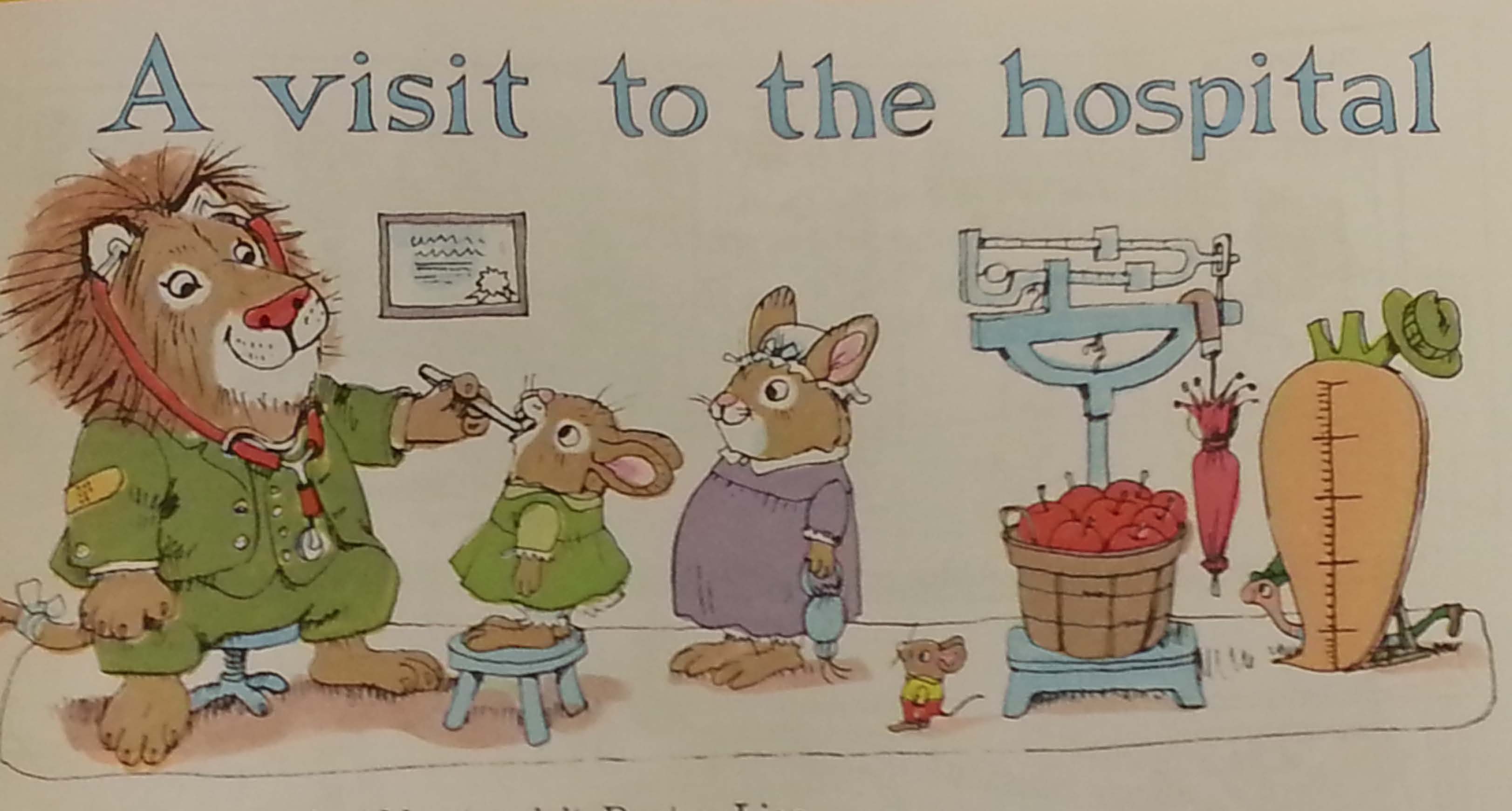
As children, many of us encountered Richard Scarry’s book, What Do People Do all Day?  A classic kid’s book, it uses animals to represent the division of labor that exists in “Busytown.”  The book is an example of a brilliant piece of analysis by sociologist John Levi Martin.

To oversimplify greatly: Martin analyzes nearly 300 children’s books and finds that there is a marked tendency for these texts to represent certain animals in particular kinds of jobs. Jobs that allow the occupant to exercise authority over others tend to be held by predatory animals (especially foxes), but never by “lower” animals (mice or pigs).

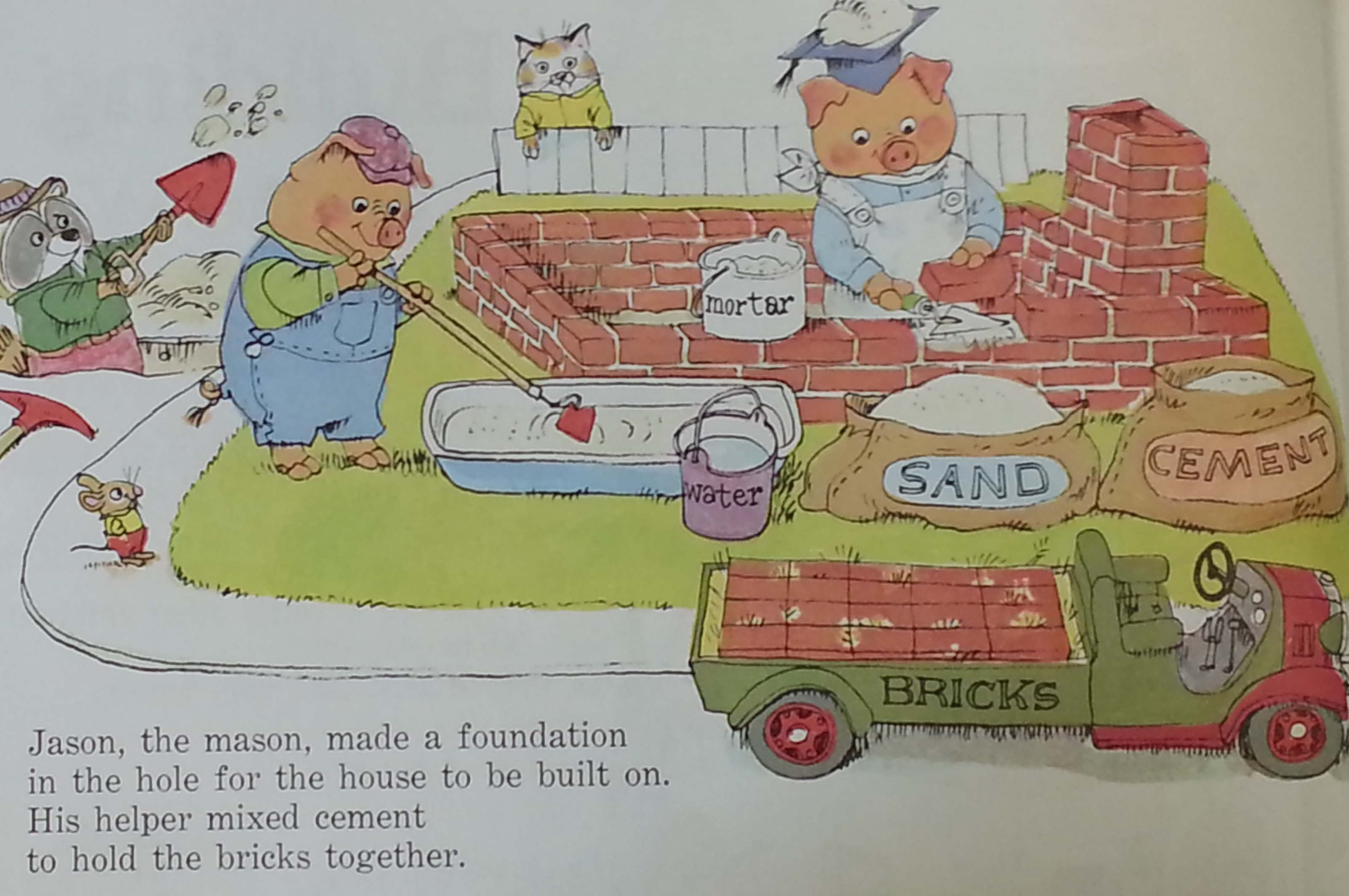
Pigs in particular are substantially over-represented in subordinate jobs (those with low skill and no authority), where their overweight bodies and (judging from the plots of these books) congenital stupidity seems to “naturally” equip them for subservient jobs. Here, see this additional image from Scarry’s book, showing construction work being performed by the above-mentioned swine.

In effect, Martin’s point is that there is a hidden language or code inscribed in children’s books, which teaches kids to view inequalities within the division of labor as a “natural” fact of life  — that is, as a reflection of the inherent characteristics of the workers themselves.  Young readers learn (without realizing it, of course) that some species-beings are simply better equipped to hold manual or service jobs, while other creatures ought to be professionals. Once this code is acquired by pre-school children, he suggests, it becomes exceedingly difficult to unlearn.  As adults, then, we are already predisposed to accept the hierarchical, caste-based system of labor that characterizes the American workplace.

Steven Vallas is a professor of sociology at Northeastern University.  He specializes in the sociology of work and employment.  His most recent book, Work: A Critique, offers an overview and discussion of the sociological literatures on the topic.  You can follow Steven at the blog Work in Progress.

Cross-posted at Work in Progress.

We’re celebrating the end of the year with our most popular posts from 2013, plus a few of our favorites tossed in.  Enjoy!

What’s the big deal about uptalk? In The College of William & Mary’s Tom Linneman took a look at how women and men both use uptalk in his new study, “Gender in Jeopardy! Intonation Variation on a Television Game Show” in Gender & Society.

The punchline? Women use uptalk more frequently, but men use it as well. For men, however, uptalk signals something completely different.

1

What is uptalk?

“Uptalk is the use of a rising, questioning intonation when making a statement, which has become quite prevalent in contemporary American speech,” explains Linneman. Uptalk in the U.S. is reported to have emerged in the 1980s among adolescent women in California, aka “Valley Girls,” and it has become more widely used by men and women since then. Uptalk has been associated with a way of talking that makes women sound less confident.

Jeopardy! was Linneman’s clever setting for observing how women and men use the speech pattern. The associate professor of sociology analyzed the use of uptalk by carefully coding 5,500 responses from 300 contestants in 100 episodes of the popular game show. He looked at what happened to speech patterns when contestants — from a variety of backgrounds — gave their answers to host Alex Trebek.  Although the contestants were asked to phrase their response in the form of a question, they used uptalk just over a third of the time.

How do men use uptalk? 

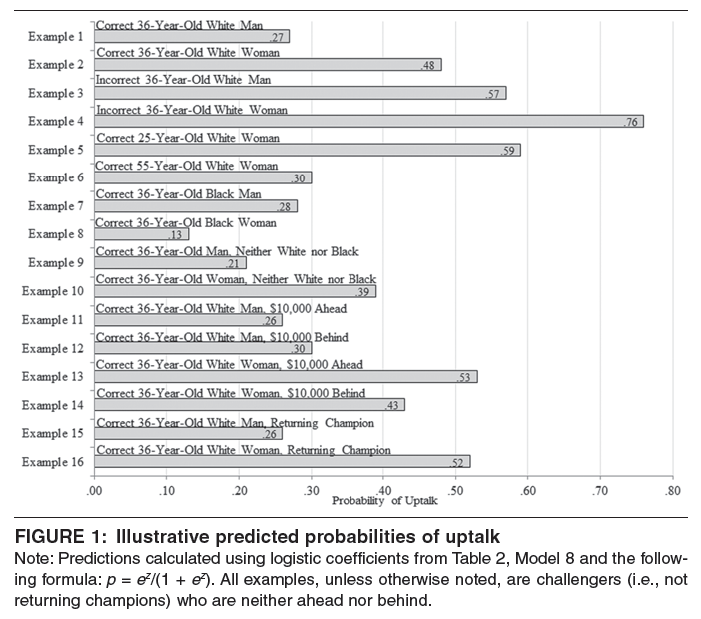
Linneman found that men use uptalk as a way to signal uncertainty.   Linneman explained, “On average, women used uptalk nearly twice as often as men. However, if men responded incorrectly, their intonation betrayed their uncertainty: Their use of uptalk shot up dramatically.”  On average, men who answered correctly used uptalk only 27% of the time. Among incorrect responses, men used uptalk 57% of the time.  In contrast, a woman who answered correctly used uptalk 48% of the time, nearly as often as an incorrect man.

Men’s uptalk increased when they were less confident, and also when they were correcting women — but not men. When a man corrected another man — that is, following a man’s incorrect answer with a correct one — he used uptalk 22% of the time. When a man corrected another woman, though, he used uptalk 53% of the time. Linneman speculates that men are engaging in a kind of chivalry: men can be blunt with another man in public, but feel obliged to use a softer edge with a woman.

How do women use uptalk?

As Linneman explains, “One of the most interesting findings coming out of the project is that success has an opposite effect on men and women on the show.”  Linneman measured success in two ways: He compared challengers to returning champions, and he tracked how far ahead or behind contestants were when they responded.  Linneman found that, “The more successful a man is on the show, the less he uses uptalk. The opposite is true for women… the more successful a woman is on the show, the more she uses uptalk.” Linneman suspects that this is “because women continue to feel they must apologize for their success.”

Probabilities of Uptalk by Certainty, Age, Race, and Gender

Screenshot_17

Virginia Rutter is a professor of sociology at Framingham State University.  She is the author, with Pepper Schwartz, of The Gender of Sexuality and The Love Test.  You can follow her on Twitter and at Girl w/Pen.


We’re celebrating the end of the year with our most popular posts from 2013, plus a few of our favorites tossed in.  Enjoy!

Philosopher Sandra Lee Bartky once observed that being feminine often means using one’s body to portray powerlessness.  Consider: A feminine person keeps her body small and contained; she makes sure that it doesn’t take up to much space or impose itself.  She walks and sits in tightly packaged ways.  She doesn’t cover the breadth of the sidewalk or expand herself beyond the chair she occupies. This comic from Chaos Life illustrates the point well..

Likewise, burping and farting, raising one’s voice in an argument, and even laughing loudly are considered distinctly unfeminine.  A feminine person doesn’t use her body to forcefully interact with the world, she lets others do for her when possible.  “Massiveness, power, or abundance in a woman’s body is met with distaste,” Bartky wrote.

Stunningly, when you think about it, these features of feminine body comportment are, in fact, not uniquely feminine, but associated with deference more generally.  Bartky again:

In groups of men, those with higher status typically assume looser and more relaxed postures; the boss lounges comfortably behind the desk while the applicant sits tense and rigid on the edge of his seat.  Higher-status individuals may touch their subordinates more than they themselves get touched; they initiate more eye contact and are smiled at by their inferiors more than they are observed to smile in return.  What is announced in the comportment of superiors is confidence and ease…

Acting feminine, then, overlaps with performances of submissiveness.  Both men and women use their bodies in more feminine ways when their interacting with a superior, whether it be their boss, their commander, a police officer, or their professor.

New evidence suggests that this is not pure theory.  Psychologist Andy Yap and his colleagues tested whether “expansive body postures” like the ones associated with masculinity increase people’s sense of powerfulness and entitlement.  They did.  In laboratory experiments, people who were prompted to take up more space were more likely to steal, cheat, and violate traffic laws in a simulation.  A sense of powerfulness, reported by the subjects, mediated the effect (a robust finding that others have documented as well).

In a real world test of the theory, they found that large automobiles with greater internal space were more likely than small ones to be illegally parked in New York City.

Research, then, has shown that expansive body postures that take up room instill a psychological sense of power and entitlement.  The fact that this behavior is gendered may go some way towards explaining the persistence of gender inequality and, more pointedly, some men’s belief that they have earned their unearned privileges.

Cross-posted at Jezebel and Pacific Standard.

Lisa Wade, PhD is an Associate Professor at Tulane University. She is the author of American Hookup, a book about college sexual culture; a textbook about gender; and a forthcoming introductory text: Terrible Magnificent Sociology. You can follow her on Twitter and Instagram.
We’re celebrating the end of the year with our most popular posts from 2013, plus a few of our favorites tossed in.  Enjoy!

Studying up on the literature on gun marketing for a recent interview with the New York Times, I found a 2004 article on the topic with some really interesting findings.

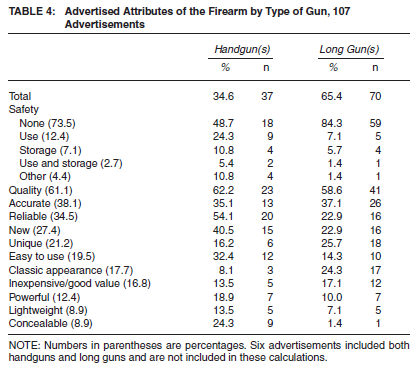
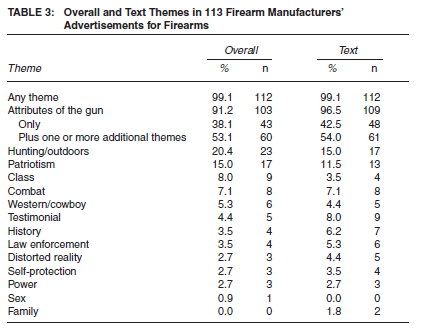
The study — by public health scholar Elizabeth Saylor and two colleagues — asked what tactics marketers use to sell guns in a single month of advertising.  In contrast to what you might imagine, only a small minority of gun ads emphasized self-protection (3%) or a Western cowboy lifestyle (5%). Zero percent mentioned protecting one’s family. Only 15% of gun ads linked ownership to patriotism.  The most common substantive theme was hunting, but even that was a theme in only 20% of ads.

So what are gun advertisers highlighting in their ads?  Technical attributes.  The majority of gun ads (91%) emphasize the things that make one gun different from the next.  For example, they discuss the quality of the gun (61%), its accuracy (38%) and reliability (35%), and its innovative features (27%) and uniqueness (21%).

Why are gun manufacturers using this marketing strategy?

Here’s where the statistics get really interesting.  At the time of the study, 44 million Americans owned firearms.  Three-quarters of these owned more than one gun. In fact, 20% of gun owners are in possession of 55% of all guns (excluding law enforcement and military).

In other words, guns are not evenly distributed across the U.S. population, they are concentrated in the hands of a minority.  Most people that don’t own a gun are never going to buy one, so the best strategy for gun manufacturers is to convince people that they need lots of guns.  Differentiating the technical attributes of one from another is their way of telling the buyer that any given gun will do something different for them than the guns they already have, enticing the gun owner to own a range of guns instead of just one.

Cross-posted at iVoter.

Lisa Wade, PhD is an Associate Professor at Tulane University. She is the author of American Hookup, a book about college sexual culture; a textbook about gender; and a forthcoming introductory text: Terrible Magnificent Sociology. You can follow her on Twitter and Instagram.

We’re celebrating the end of the year with our most popular posts from 2013, plus a few of our favorites tossed in.  Enjoy!

We’ve seen a real shift in support for the issue and acceptance of homosexuality in general.  Since 2011, the majority of Americans are in favor of extending marriage to same-sex couples and the trend has continued.

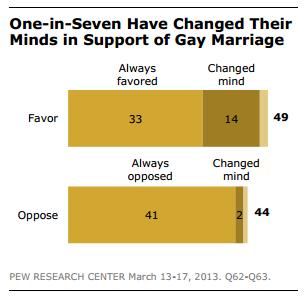
What is behind that change?  The Pew Research Center asked 1,501 respondents whether they’d changed their minds about same-sex marriage and why.  Here’s what they found.

The overall trend towards increasing support is clear in the data.  Fourteen percent of Americans say that they used to oppose same-sex marriage, but they now support it.  Only 2% changed their mind in the other direction.

2

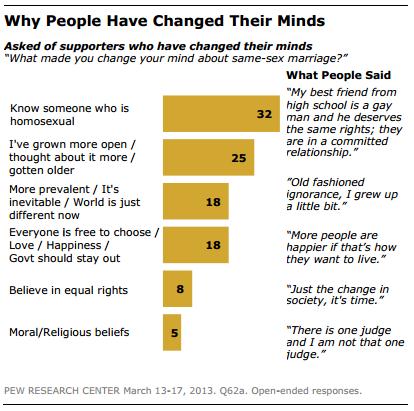
People offered a range of reasons for why they changed their minds.  The most common response involved coming into contact with someone that they learned was homosexual.  A third of respondents said that knowing a gay, lesbian, or bisexual person was influential in making them rethink their position on gay marriage.  This is consistent with the Contact Hypothesis, the idea that (positive) experiences with someone we fear or dislike will result in changes of opinion.

3

As you can see, lots of other reasons were common too.  A quarter of people said that they, well, “evolved”:  they grew up, thought about it more, or more clearly.  Nearly as many said that they were simply changing with the times or that a belief that everyone should be free to do what they want was more important than restricting the right to marry.

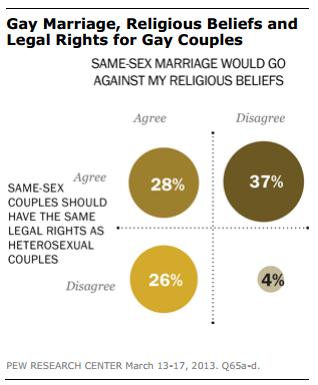
I thought that the 5% that said they’d changed their minds for religious reasons were especially interesting.  Support for same-sex marriage is rising in every demographic, even among the religious.  Following up on this, Pew offers an additional peek into the minds of believers.  The table below shows that 37% of the religious  both believe that same-sex marriage is compatible with their belief and support it, but an additional 28% who think marriage rights would violate their religious belief are in favor of extending those rights nonetheless.

1


While we’ve been following the trend lines for several years, it’s really interesting to learn what’s behind the change in opinion about same-sex marriage.  Contact with actual gay people — and probably lovable gay and lesbian celebrities like Ellen and Neil Patrick Harris — appears to be changing minds. But the overall trend reflects real shifts in American values about being “open,” valuing “freedom” and “choice,” extending “rights,” and accepting that this is the way it is, even if one personally doesn’t like it.

Cross-posted at BlogHer and Pacific Standard.

Lisa Wade, PhD is an Associate Professor at Tulane University. She is the author of American Hookup, a book about college sexual culture; a textbook about gender; and a forthcoming introductory text: Terrible Magnificent Sociology. You can follow her on Twitter and Instagram.
We’re celebrating the end of the year with our most popular posts from 2013, plus a few of our favorites tossed in.  Enjoy!

Like many people, I’ve been following news about the crash landing in San Francisco. It’s a frightening reminder of the risks that come with air travel, but an uplifting one thanks to the small number of casualties.  The Mayor of San Francisco was quoted saying: “We’re lucky we have this many survivors.”  And the Chief of the San Francisco Fire Department said that it was “nothing short of a miracle…”  At CNN, after mentioning the two confirmed fatalities, the reporter writes, “Somehow, 305 others survived.” Sheryl Sandberg, COO of Facebook, wrote that it was a “serious moment to give thanks.”  But to whom?

Screenshot_1

There’s a kind of person who is trained to maximize survival in the case of a plane crash: the flight attendant.  Airlines don’t advertise the intense training their flight attendants receive because it reminds potential passengers that air travel is risky.  As a result, most people seriously underestimate the skills flight attendants bring on board and the dedication they have to the safety of their passengers.

Flight attendants have to learn hundreds of regulations and know the safety features of all of the aircraft in their airline’s fleet. They must know how to evacuate the plane on land or sea within 90 seconds; fight fires 35,000 feet in the air; keep a heart attack or stroke victim alive; calm an anxious, aggressive, or mentally ill passenger; respond to hijackings and terrorist attacks; and ensure group survival in the jungle, sea, desert, or arctic.

It isn’t just book learning; they train in “live fire pits” and “ditching pools.”As one flight attendant once said:

I don’t think of myself as a sex symbol or a servant. I think of myself as somebody who knows how to open the door of a 747 in the dark, upside down and in the water (source).

This is why I’m surprised to see almost no discussion of the flight attendants’ role in this “miracle.” Consider the top five news stories on Google at the time I’m writing: CNN, Fox, CBS, the Chicago Tribune, and USA Today.  These articles use passive language to describe the evacuation: “slides had deployed”; all passengers “managed to get off.”  When the cabin crew are mentioned, they appear alongside and equivalent to the passengers: the crash forced “dozens of frightened passengers and crew to scamper from the heavily damaged aircraft”; “passengers and crew were being treated” at local hospitals.

Only one of these five stories, at Fox, acknowledges that the 16 cabin crew members worked through the crash and its aftermath.  The story mentions that, while passengers who could were fleeing the plane, crew remained behind to help people who were trapped, slashing seat belts with knives supplied by police officers on the ground.  The plane was going up in flames; they risked their lives to save others.

I don’t know what the flight attendants on this plane did or didn’t do to minimize injuries or save lives, but I would like to know.  Instead, they are invisible in these news stories as workers, allowing readers and future passengers to remain ignorant of the skills and dedication they bring to their work.

Cross-posted at Jezebel, PolicyMic, Huffington Post, and BlogHer.

Lisa Wade, PhD is an Associate Professor at Tulane University. She is the author of American Hookup, a book about college sexual culture; a textbook about gender; and a forthcoming introductory text: Terrible Magnificent Sociology. You can follow her on Twitter and Instagram.
We’re celebrating the end of the year with our most popular posts from 2013, plus a few of our favorites tossed in.  Enjoy!

 You know all those badass ladies out there that are inexplicably single? Well, maybe it’s not so inexplicable.

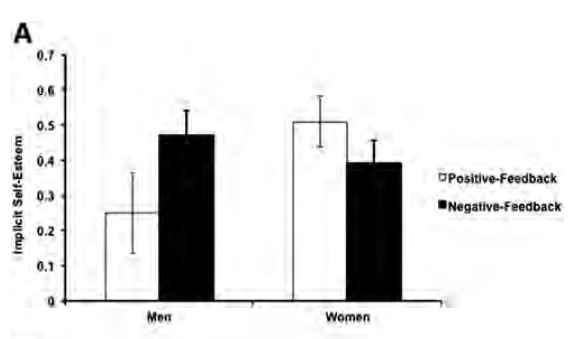
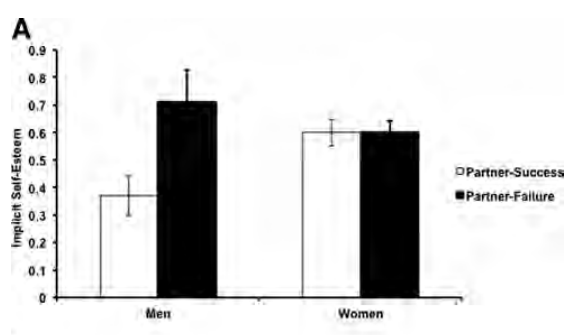
In a study contending for most-depressing-research-of-the-year, psychologists Kate Ratliff and Shigehiro Oishi tested how a romantic partner’s success or failure affects the self-esteem of people in heterosexual relationships.  The short story: men feel bad about themselves when good things happen to their female partners.  Women’s self-esteem is unaffected.  Here’s some of the data.

The vertical axis represents self-esteem. In this experiment, respondents were told that their partner scored high on a test of intelligence (“positive feedback”) or low (“negative feedback”).  The leftmost bars show that men who were told that their partners were smart reported significantly lower self-esteem than those who heard that their partners weren’t so smart.

Screenshot_1

In the second condition, respondents were asked to imagine a partner’s success or failure.  Doing so had no effect on women’s self-esteem (rightmost bars).  For men, however, imagining their partners’ success made them feel bad about themselves, whereas imagining their failure made them feel good.Screenshot_2

The various experiments were conducted with American and Dutch college students as well as a diverse Internet sample.  The findings were consistent across populations and were particularly surprising in the context of the Netherlands, which is generally believed to be more gender egalitarian.

We’ve got a long way to go.

Cross-posted at The Huffington Post and Pacific Standard.

Lisa Wade, PhD is an Associate Professor at Tulane University. She is the author of American Hookup, a book about college sexual culture; a textbook about gender; and a forthcoming introductory text: Terrible Magnificent Sociology. You can follow her on Twitter and Instagram.