We’re celebrating the end of the year with our most popular posts from 2013, plus a few of our favorites tossed in.  Enjoy!

Last year Lynne Grumet set the internet a-flutter when she appeared on the cover of TIME magazine breastfeeding her toddler. Reactions were largely negative, often reflecting unease at the open display of a sexualized body part being used to feed a child older than the age we generally find acceptable. Others objected to what they saw as the sensationalism of the photo. Grumet later posed on the cover of another magazine in a pose that focused on bonding and intimacy, commonly cited as benefits by breastfeeding advocates. The entire episode tapped into larger cultural anxieties about appropriate mothering.

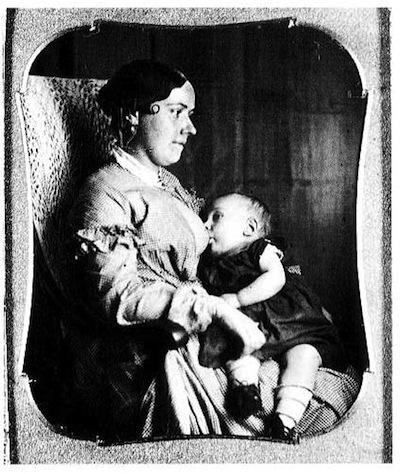
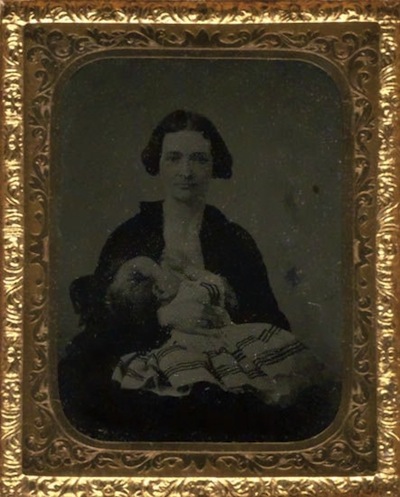
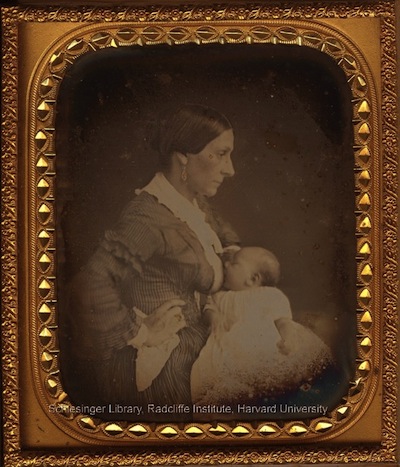
And as Jill Lepore explains in The Mansion of Happiness, it’s just the latest round in the changing discourse about breastfeeding; in the mid-1800s, images of breastfeeding mothers became a fad in the U.S. The use of wet nurses had never been as common in the U.S. as in Europe, and it became even less popular by the early 1800s; breastfeeding your own child became a central measure of your worth as a mother.  Cultural constructions of femininity became highly centered on motherhood and the special bond between a mother and her children in the Victorian era.

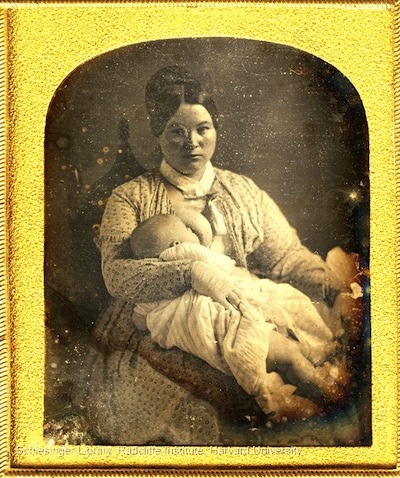
As daguerreotypes became available, women began to pose breastfeeding their infants, capturing them in this most essential of maternal roles:
daguerreotype5

daguerreotype6

daguerreotype2

M24278-1 001

2051237_1_l

Cosetra has created a Pinterest board of vintage photos and paintings of breastfeeding that has more examples.

Within decades, American women suddenly seemed to lose the ability to adequately feed their babies, just as infant formula hit the market. Doctors continued to push breastfeeding, but cultural perceptions changed, and with them the social construction of femininity. Rather than being a symbol of maternalism, breastfeeding seemed incompatible with femininity — or, specifically, with white upper-class femininity. Breastfeeding didn’t mesh well with ideas of delicate, refined white women; it was too animal-like, too uncivilized. As Lepore relates, by the early 1900s, a study in Boston found that 9 out of 10 poor mothers breastfed, but only 17% of wealthy mothers did.

By the 1950s, only 20% of mothers nursed their children. Then, ideas about motherhood changed once again; suddenly comparatively privileged, white women were drawn to movements that advocated breastfeeding. Formula came under increased scrutiny. And so continued the ongoing cultural debate over breastfeeding, motherhood, and proper femininity.

Cross-posted at The Huffington Post.  Sources: Schlesinger Library, Radcliffe Institute, Harvard University (direct link to daguerreotypes here); Marvelous Kiddo; liveauctioneers.

Gwen Sharp is an associate professor of sociology at Nevada State College. You can follow her on Twitter at @gwensharpnv.

We’re celebrating the end of the year with our most popular posts from 2013, plus a few of our favorites tossed in.  Enjoy!

The philosopher Susan Sontag has written achingly about the way in which men are allowed to age and women are not.

The great advantage men have is that our culture allows two standards of male beauty: the boy and the man. The beauty of a boy resembles the beauty of a girl. In both sexes it is a fragile kind of beauty and flourishes naturally only in the early part of the life-cycle. Happily, men are able to accept themselves under another standard of good looks — heavier, rougher, more thickly built…

There is no equivalent of this second standard for women. The single standard of beauty for women dictates that they must go on having clear skin. Every wrinkle, every line, every gray hair, is a defeat.

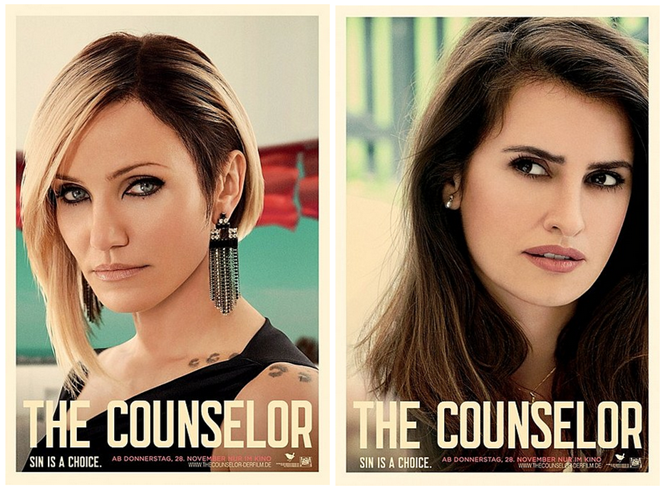
Perhaps nowhere is this more plain than in the movies, where men’s love interests stay the same age as they get older, and @sphericalfruit sent in a fantastic example.  The four posters below are part of a new marketing plan for the forthcoming movie, The Counselor.

Notice anything?

Screenshot_1 Screenshot_2

What a stunning example of Sontag’s observation.  The men are not considered unattractive by virtue of the fact that you can tell they have skin.  The women, in contrast, have faces that are so smooth that they look inhuman; their images are halfway between photograph and cartoon.  Amazingly, this treatment of images of men and women is so ubiquitous that it now looks more or less normal to us.

Cross-posted at Business Insider and VitaminW.

Lisa Wade, PhD is an Associate Professor at Tulane University. She is the author of American Hookup, a book about college sexual culture; a textbook about gender; and a forthcoming introductory text: Terrible Magnificent Sociology. You can follow her on Twitter and Instagram.

We’re celebrating the end of the year with our most popular posts from 2013, plus a few of our favorites tossed in.  Enjoy!

Flight attendants are not only friendly with their passengers, they’re also often super friendly with each other.  This may be because especially gregarious people go into the profession, but it’s also an adaptation to a surprising structural feature of their job. It turns out that, on any given flight anywhere in the world, most flight attendants are meeting their co-workers for the very first time.

There are about 100,000 flight attendants in the U.S. alone and they get their flights through a process of bidding, one month at a time, one month ahead.  Most really do “see the world,” as the old glamorized image of the intrepid stewardess suggests, instead of working the same route over and over again.  As a result, explains Drew Whitelegg in Working the Skies, they rarely run into the same flight attendant twice.

This means that flight attendants must get to know one another quickly once they get on board.  They need to do so to make food and beverage service efficient, to coordinate their actions in the tight galleys in which they work and, most importantly, so that they will trust one another if they are called upon to do what they are really there for: acting in an emergency, one that could theoretically happen within seconds of take-off.  There’s no time to lose. “[F]rom the moment they board the plane,” writes Whitelegg, “these workers — even if complete strangers — begin constructing bonds.”

Screenshot_1
Image credit: National Library of Australia


Their instant bonding is facilitated by their shared experiences and their “peculiar identity,” Whitelegg explains — few people understand their job and the airline industry deliberately misportays it — and also by a culture of confession.  The galley has its own rules to which new flight attendants are socialized.  So, even though the workers are always new, the workplace is predictable.  Whitlegg describes how galley conversations during downtime tend to be extremely, sometimes excruciatingly personal.  “The things you hear,” laughs Clare, a flight attendant for Continental, “I could write a book. The things you hear at 30,000 feet.”  It’s the odd combination of a habit of bonding and the anonymity of strangers.

So, if you have the pleasure of taking a flight, spend a few minutes watching the surprising coordination of strangers who seem like old friends, and take a moment to appreciate the amazing way these workers have adapted to their very peculiar position.

Cross-posted at The Huffington Post, Pacific Standard, and Work in Progress.

Lisa Wade, PhD is an Associate Professor at Tulane University. She is the author of American Hookup, a book about college sexual culture; a textbook about gender; and a forthcoming introductory text: Terrible Magnificent Sociology. You can follow her on Twitter and Instagram.

We’re celebrating the end of the year with our most read posts from 2013.

Today a jury found George Zimmerman not guilty of second-degree murder. It is widely argued that Florida’s stand your ground statute, which was considered by the defense, and which Zimmerman previously studied in a criminal litigation course, was at play. The statute allows people to use proportionate force in the face of an attack without first trying to retreat or escape. More than 20 other states have such laws.

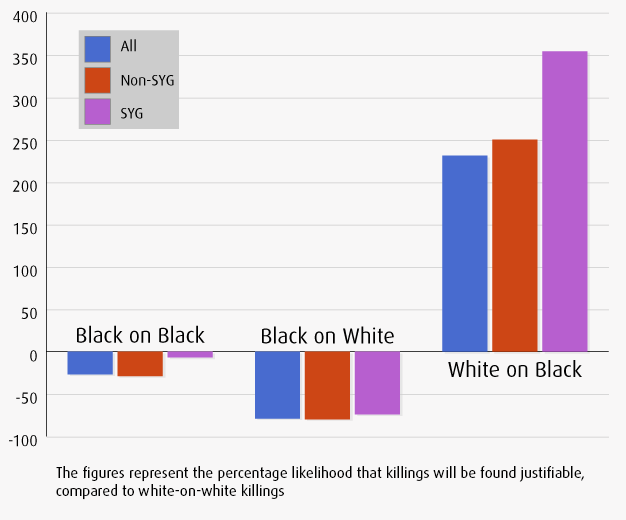
At MetroTrends, John Roman and Mitchell Downey report their analysis of 4,650 FBI records of homicides in which a person killed a stranger with a handgun. They conclude that stand your ground “tilts the odds in favor of the shooter.”  In SYG states, 13.6% of homicides were ruled justifiable; in non-SYG states, only 7.2% were deemed such.  This is strong evidence that rulings of justifiable homicide are more likely under stand your ground.

But which homicides?

Ones similar to the one decided in favor of George Zimmerman today.  A finding of “justifiable homicide” is much more common in the case of a white-on-black killing than any other kind including a white and a black person.  At PBS’s request, Roman compared the likelihood of a favorable finding for the defendant in SYG and non SYG cases, consider the races of the people involved.  The data is clear, compared to white-on-white crimes, stand your ground increases the likelihood of a not-guilty finding, but only when a person is accused of killing a black person.

1

Notice, however, that white people who kill black people are far more likely to be found not-guilty even in states without SYG and black people who kill whites are less likely to be found not-guilty regardless of state law.

It’s simple: We are already biased in favor of the white defendant and against the black victim. Stand your ground laws give jurors more leeway to give defendants the benefit of the doubt.  This increase even further the chances that a white-on-black homicide will be considered justifiable because jurors will likely give that benefit of the doubt to certain kinds of defendants and not others. Stand your ground may or may not be a good law in theory but, in practice, it increases racial bias in legal outcomes.

It is contested whether stand your ground played a role in this case, Media Matters offers strong evidence to suggest that it did. Cross-posted at Ms., PolicyMic, Pacific Standard, and Global Policy TV.

Lisa Wade, PhD is an Associate Professor at Tulane University. She is the author of American Hookup, a book about college sexual culture; a textbook about gender; and a forthcoming introductory text: Terrible Magnificent Sociology. You can follow her on Twitter and Instagram.

We’re celebrating the end of the year with our most popular posts from 2013, plus a few of our favorites tossed in.  Enjoy!

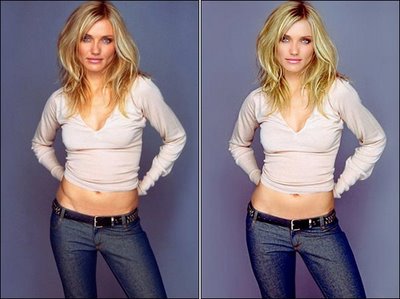
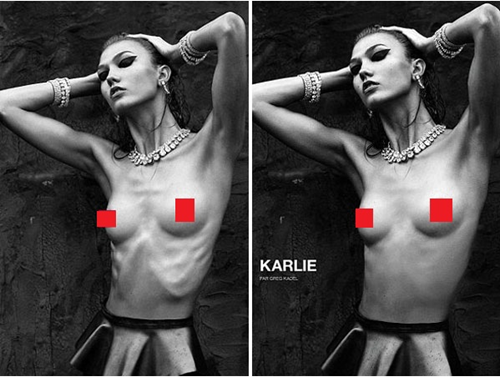
A former editor at Cosmopolitan, Leah Hardy, recently wrote an exposé about the practice of photoshopping models to hide the health and aesthetic costs of extreme thinness. Below is an example featuring Cameron Diaz:


The story about Diaz, in The Telegraph, includes the following description of the image’s manipulation:

  • Face: Cheeks appear filled out
  • Bust: Levelled
  • Thighs: Wider in the picture on the right
  • Hip: The bony definition has been smoothed away
  • Stomach: A fuller, more natural look
  • Arms: A bit more bulk in the arms and shoulders

Another example was posted at The Daily What. Notice that her prominent ribcage has been photoshopped out of the photograph on the right, which ran in the October 2012 issue of  Numéro.

Hardy, the editor at Cosmo, explains that she frequently re-touched models who were “frighteningly thin.”  Others have reported similar practices:

Jane Druker, the editor of Healthy magazine — which is sold in health food stores — admitted retouching a cover girl who pitched up at a shoot looking “really thin and unwell”…

The editor of the top-selling health and fitness magazine in the U.S., Self, has admitted: “We retouch to make the models look bigger and healthier”…

And the editor of British Vogue, Alexandra Shulman, has quietly confessed to being appalled by some of the models on shoots for her own magazine, saying: “I have found myself saying to the photographers, ‘Can you not make them look too thin?'”

Robin Derrick, creative director of Vogue, has admitted: “I spent the first ten years of my career making girls look thinner — and the last ten making them look larger.”

Hardy described her position as a “dilemma” between offering healthy images and reproducing the mythology that extreme thinness is healthy:

At the time, when we pored over the raw images, creating the appearance of smooth flesh over protruding ribs, softening the look of collarbones that stuck out like coat hangers, adding curves to flat bottoms and cleavage to pigeon chests, we felt we were doing the right thing… We knew our readers would be repelled by these grotesquely skinny women, and we also felt they were bad role models and it would be irresponsible to show them as they really were.

But now, I wonder. Because for all our retouching, it was still clear to the reader that these women were very, very thin. But, hey, they still looked great!

They had 22-inch waists (those were never made bigger), but they also had breasts and great skin. They had teeny tiny ankles and thin thighs, but they still had luscious hair and full cheeks.

Thanks to retouching, our readers… never saw the horrible, hungry downside of skinny. That these underweight girls didn’t look glamorous in the flesh. Their skeletal bodies, dull, thinning hair, spots and dark circles under their eyes were magicked away by technology, leaving only the allure of coltish limbs and Bambi eyes.

Insightfully, Hardy describes this as a “vision of perfection that simply didn’t exist” and concludes, “[n]o wonder women yearn to be super-thin when they never see how ugly [super-]thin can be.”

UPDATE:  A comment has brought up the point that it’s bad to police people’s bodies, no matter whether they’re thin or fat.  And this is an important point (made well here) and, while I agree that some of the language is harsh, that’s not what’s going on here.  The vast majority of the models who need reverse photoshopping aren’t women who just happen to have that body type.  They are part of an social institution that demands extreme thinness and they’re working hard on their bodies to be able to deliver it.  This isn’t, then, about shaming naturally thin women, it’s about (1) calling out an industry that requires women to be unhealthy and then hides the harmful consequences and (2) acknowledging that even people who are a part of that industry don’t necessarily have the power to change it.

Cross-posted at Business Insider and The Huffington Post in Spanish, French, and German.

Lisa Wade, PhD is an Associate Professor at Tulane University. She is the author of American Hookup, a book about college sexual culture; a textbook about gender; and a forthcoming introductory text: Terrible Magnificent Sociology. You can follow her on Twitter and Instagram.

We’re celebrating the end of the year with our most popular posts from 2013, plus a few of our favorites tossed in.  Enjoy!

Hip-hop music is frequently described as violent and anti-law enforcement, with the implication that its artists glorify criminality.  A new content analysis subtitled “Hip-Hop Artists’ Perceptions of Criminal Justice“, by criminologists Kevin Steinmetz and Howard Henderson, challenge this conclusion.

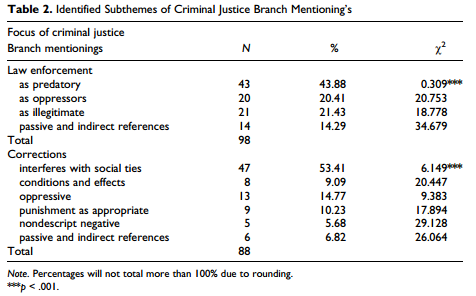
After an analysis of a random sample of hip-hop songs released on platinum-selling albums between 2000 and 2010, Steinmetz and Henderson concluded that the main law enforcement-related themes in hip-hop are not pleasure and pride in aggressive and criminal acts, but the unfairness of the criminal justice system and the powerlessness felt by those targeted by it.

Lyrics about law enforcement, for example, frequently portrayed cops as predators exercising an illegitimate power.  Imprisonment, likewise, was blamed for weakening familial and community relationships and described a modern method of oppression.

Their analysis refutes the idea that hip-hop performers are embracing negative stereotypes of African American men in order to sell albums.  Instead, it suggests that the genre retains the politicized messages that it was born with.

Steinmetz and Henderson offer Tupac’s “Crooked Nigga Too” (2004) as an example of a rap that emphasizes how urban Black men are treated unfairly by police.

Yo, why I got beef with police?
Ain’t that a bitch that motherfuckers got a beef with me
They make it hard for me to sleep
I wake up at the slightest peep, and my sheets are three feet deep.

The authors explain:

Police action perceived as hostile and unfair engenders an equally hostile and indignant response from Tupac, indicating a tremendous amount of disrespect for the police.

Likewise, Jay-Z, in “Pray” (2007), raps about cops who keep drugs confiscated from a dealer, emphasizing a “power dynamic in which the dealer was unfairly taken advantage of but was unable to seek redress”:

The same BM [‘‘big mover’’—a drug dealer] is pulled over by the boys dressed blue
they had their guns drawn screaming, “just move or is there something else you suggest we can do?”
He made his way to the trunk
opened it like, “huh?”
A treasure chest was removed
cops said he’ll be back next monthwhat we call corrupt, he calls payin’ dues

Henderson offers Jay-Z’s “Minority Report” as a great overall example.

Of course, the rappers — in their collective wisdom — are absolutely correct to suspect that the treatment that their communities receive from the police, corrections, and courts are unfair.  People of African descent are routinely targeted by police (see the examples of New York City and Toronto), even though racial profiling doesn’t work; Blacks are are more likely to be arrested and sentenced than Whites, regardless of actual crime rates; schools and juvenile detention systems are increasingly intertwined in inner cities; imprisonment tears families apart, disproportionately harming families of color; and even Black children don’t trust the police.

Steinmetz and Henderson conclude:

We actually found that the overwhelming message in hip-hop wasn’t that the rappers disliked the idea of justice, but they disliked the way it was being implemented.

These communities, then, have a strong sense of justice… rooted in the sense that they’re not getting any.

Cross-posted at Racialicious and PolicyMic.

Lisa Wade, PhD is an Associate Professor at Tulane University. She is the author of American Hookup, a book about college sexual culture; a textbook about gender; and a forthcoming introductory text: Terrible Magnificent Sociology. You can follow her on Twitter and Instagram.

We’re celebrating the end of the year with our most popular posts from 2013, plus a few of our favorites tossed in.  Enjoy!

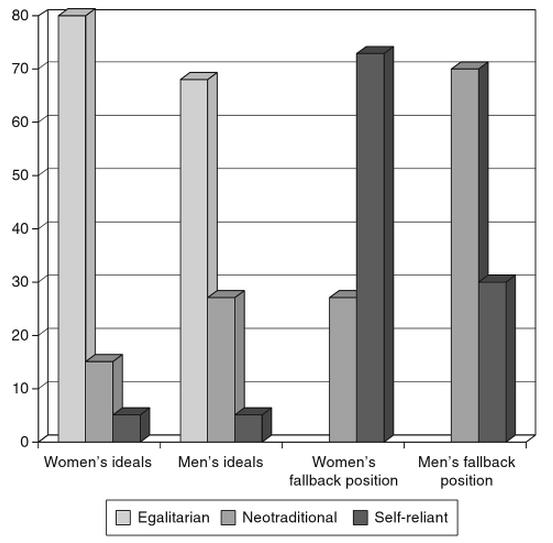
Here’s some great news.  The vast majority of young people — about 80% of women and 70% of men across all races, classes, and family backgrounds — desire an egalitarian marriage in which both partners share breadwinning, housekeeping, and child rearing.  The data come from Kathleen Gerson‘s fabulous 2010 book, The Unfinished Revolution.

In practice, however, egalitarian relationships are difficult to establish.  Both work and family are “greedy institutions,” ones that take up lots of time and energy.  Many couples find that, once children arrive, it’s impossible for both to do both with equal gusto.

With this in mind, Gerson asked her respondents what type of family they would like if, for whatever reason, they couldn’t sustain an equal partnership.  She discovered that, while men’s and women’s ideals are very similar, their fallback positions deviate dramatically.

Men’s most common fallback position is to establish a neotraditional division of labor: 70% hope to convince their wives to de-prioritize their careers and focus on homemaking and raising children.  Women?  Faced with a husband who wants them to be a housewife or work part-time, almost three-quarters of women say they would choose divorce and raise their kids alone.  In fact, despite men’s insistence on being breadwinners, women are more likely than men to say they value success in a high-paying career.

Look at this absolutely stunning data (matching ideals on the left; clashing fallback positions on the right):

One of Gerson’s interviewees, Matthew, exemplifies the egalitarian willing to fallback on a neotraditional family form:

If I could have the ideal world, I’d like to have a partner who’s making as much as I am—someone who’s ambitious and likes to achieve.  [But] if it can’t be equal, I would be the breadwinner and be there for helping with homework at night.

And this is what women think of that:

My mother’s such a leftover from the fifties and did everything for my father. I’m not planning to fall into that trap. I’m really not willing to take that from any guy at all.

Alas, what appears to be a happy convergence between men’s and women’s ideals — both are egalitarians — can turn into an intractable situation: a man who won’t give up his role as the breadwinner and a woman who would rather do anything than be a housewife.

Cross-posted at Ms., PolicyMic, Footnote, and The Huffington Post.

Lisa Wade, PhD is an Associate Professor at Tulane University. She is the author of American Hookup, a book about college sexual culture; a textbook about gender; and a forthcoming introductory text: Terrible Magnificent Sociology. You can follow her on Twitter and Instagram.

We’re celebrating the end of the year with our most popular posts from 2013, plus a few of our favorites tossed in.  Enjoy!

Over at his blog, The Ethical Adman, Tom Megginson asks us to consider the “power symbolism of fellatio.”  His post was prompted by this sign for an Android store (next door to an Apple store) in China:

Get it? Apple is fellating Android, so Apple is inferior. <sarcasm> Obvious right? </sarcasm>

The variations on the insult “you suck” — “suck it,” “suck my balls,” “suck my dick,” “cocksucker,” and Tom’s colorful addition, “this sucks donkey balls!” — are so commonplace that it’s easy to forget where it comes from.  Like the sign implies, and the more elaborate insults make clear, “you suck” works as an insult by positioning the male or female receiver in a position in which they are sexually servicing a man.

This cultural association of power and sex is pervasive throughout our insult vocabulary.  “Fuck you” is an excellent example, as is “fuck off,” “motherfucker,” and “go fuck yourself.”  Sexualized body parts used as insults are part of this too: “cunt,” “pussy,” “dick,” and “prick.”  “Scumbag” is a word that originally meant condom and suggests that sperm is somehow contaminating; sexual partners who receive or are covered with sperm can be seen as exposed to a disgusting or filthy substance.  Even “douchbag” may fall into this category (think about it).

People get pretty creative (or not) with this stuff.  Here’s one of my very favorite pieces of hate mail (in response to this post):

Just a tipoff, to let you filthy feminazi CUNTS know that we are exposing you, you fucking pieces of shit… see [name and organization redacted], a leading men’s rights magazine site, and boy does it expose you and your fucking feminazi cunt blog for what you are…. nothing but awful screaming feminazi harpy cunts who need to suck a dick and calm down… you evil twats…

Aside from this tipoff, all I will say to such feminazi CUNTS like you is, suck my fucking dick you awful feminazi cunts. FUCK I HATE YOU, AND EVERYTHING YOU STAND FOR!!!!! DOWN WITH FEMINAZI COCKSUCKING CUNTS WHO I HOPE GET BREAST CANCER.

So it’s interesting, right, to notice how often attempts to hurt other people come in the language of sexuality.  This reveals why sex can be scary, especially for women who are so often positioned as the one who “gets fucked.”  And this, of course, is what rape is all-too-often about.  It’s also part of how we demean and marginalize gay and bisexual men.  In the language of sex/power, they’ve voluntarily made themselves into lesser human beings, making homophobes feel justified in denigrating or assaulting them.

For my part, I try to avoid all of this language and I encourage you to do so too.

Lisa Wade, PhD is an Associate Professor at Tulane University. She is the author of American Hookup, a book about college sexual culture; a textbook about gender; and a forthcoming introductory text: Terrible Magnificent Sociology. You can follow her on Twitter and Instagram.