Holocaust Archaeologies: Approaches and Future Directions
Caroline Sturdy Colls
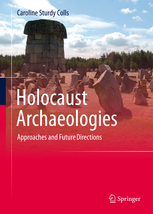 Holocaust Archaeologies: Approaches and Future Directions aims to move archaeological research concerning the Holocaust forward through a discussion of the variety of the political, social, ethical and religious issues that surround investigations of this period and by considering how to address them. It considers the various reasons why archaeological investigations may take place and what issues will be brought to bear when fieldwork is suggested. It presents an interdisciplinary methodology in order to demonstrate how archaeology can (uniquely) contribute to the history of this period. Case examples are used throughout the book in order to contextualize prevalent themes and a variety of geographically and typologically diverse sites throughout Europe are discussed. This book challenges many of the widely held perceptions concerning the Holocaust, including the idea that it was solely an Eastern European phenomena centered on Auschwitz and the belief that other sites connected to it were largely destroyed or are well-known. The typologically, temporally and spatial diverse body of physical evidence pertaining to this period is presented and future possibilities for investigation of it are discussed. Finally, the volume concludes by discussing issues relating to the “re-presentation” of the Holocaust and the impact of this on commemoration, heritage management and education. This discussion is a timely one as we enter an age without survivors and questions are raised about how to educate future generations about these events in their absence.
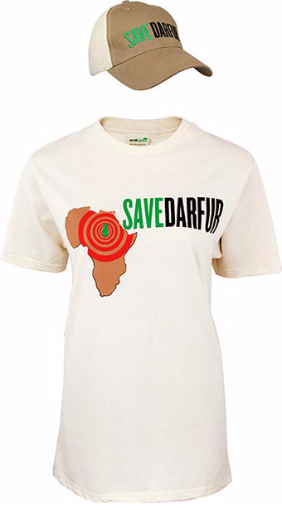 with ‘Save Darfur’ emblazoned on them. Syria, Iraq, Liberia, South Sudan, and Central Africa Republic have overtaken Darfur in the attention sweepstakes in the news. In previous posts I have talked about Compassion Fatigue and the four horsemen of the apocalypse whenever atrocities were covered in the media. However, when is it ok to say enough is enough? When do we, as global citizens, stop shaking our heads and going “tsk tsk, it is so sad what is happening in that country”? These are questions I have asked myself over the past few years. As a graduate student, I have often wondered if my keeping an eye on Darfur is influenced by the fact that my research is in the region. Would it matter as much if my research was on, say, farming practices in Africa? I would like to think it would, if for no reason other than the fact that my country (Kenya) shares a border with South Sudan. I would like to think that whenever I opened the local daily at a coffee shop, or on my way to work in the morning, I would read the news about Darfur and seek out like-minded individuals to try and help in some way, shape or form. What form of help this would be I’m not sure as of yet. So to the question, what have I done for Darfur lately? My honest answer is not as much as I would have liked to do. As Darfur has morphed into a conflict occurring in the shadows (a dreadful prospect) my sense of hopelessness has also increased. What will your answer be?