crime

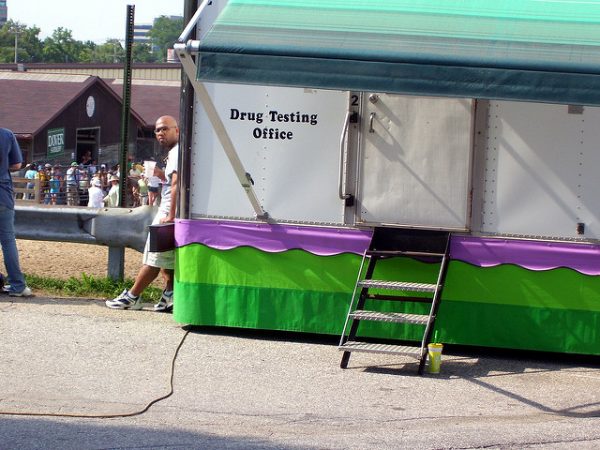
Photo of a portable structure labeled, “drug testing office.” Photo by Phil! Gold, Flickr CC

Originally published November 1, 2018.

For a long time, individuals and organizations have drawn stark lines between the “deserving” and the “undeserving” poor. Over the past 40 years, these distinctions have been used to justify cutting or limiting social safety net programs, leading to a decline in cash welfare programs and other parts of social assistance programs that working-age, able-bodied, poor adults are eligible for. Furthermore, researchers have shown that welfare recipients are subject to a growing list of limits, conditions, and expectations. In a recent study, Eric Bjorklund, Andrew P. Davis, and Jessica Pfaffendorf continue such research by examining states’ efforts to implement drug testing for applicants to “Temporary Aid to Needy Families” (TANF), a flagship national welfare program.

In the tense racial and economic climate following Obama’s 2008 election, Arizona became the first state to introduce a policy restricting access to cash welfare for applicants based on drug test results. Since then, 15 states followed by passing drug test policies for recipients of TANF. To understand how the states that passed welfare drug testing policies potentially differ from states that did not, Bjorklund and colleagues looked for patterns in the years leading up to the implementation of the policy. They examined factors such as states’ government ideology, whether a Republican governor ousted a Democrat, the proportion of nonwhites in the population, and the white employment rate. 

Both decreases in white labor force participation and having a Republican governor were associated with a state’s implementation of a drug testing policy. The authors rely on social context to explain this finding — specifically, these policies were implemented during the economic recession following Obama’s 2008 election as the first African American President of the United States. Given the importance of the white employment rate, the authors speculate that whites may have held a zero-sum belief that economic gains by people of color would entail losses for whites. Whites’ racialized economic fears may have led them to support restrictive policies framed as “correcting” the behavior of certain “morally compromised” groups, thus prompting politicians and legislators to tighten access to welfare programs by excluding those who failed a drug test. In short, this research highlights the ways social assistance programs can be shaped by public perceptions about who deserves assistance and who doesn’t.
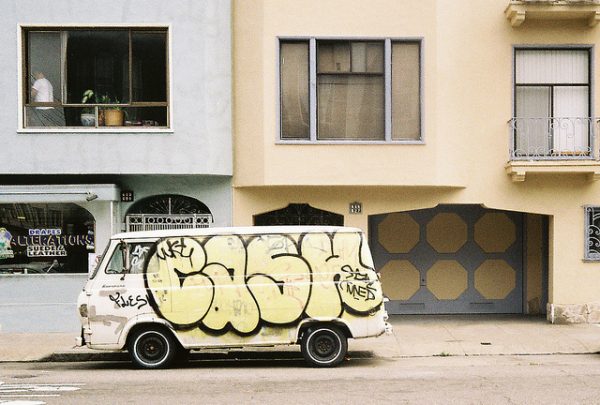
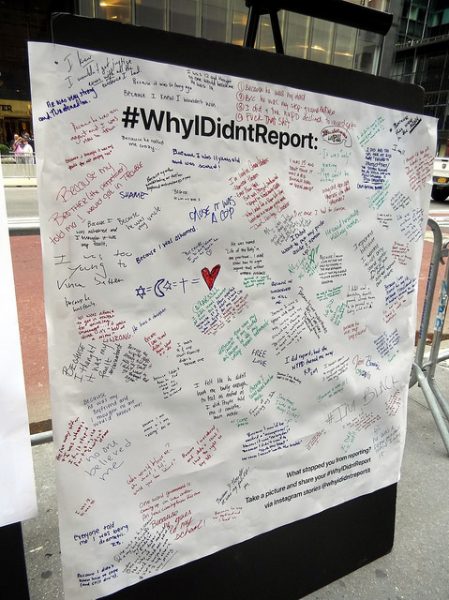
Photo of a white van with the word, “cash” written on it in graffiti. Photo by Dustin Ground, Flickr CC

They say opportunity makes the thief, and cash provides opportunity for crime. Cash is untraceable, provides anonymity, constitutes a universal and efficient method of exchange, and, unlike credit cards, has durable value and cannot be ‘cancelled,’ which makes it the ideal target for street crime. Because of this, countries around the world have begun to promote the use of digital payment systems, such as debit or credit cards, to reduce opportunities for robbery. But how strong is the connection between cash use and crime? William Pridemore, Sean Roche and Meghan L. Rogers compared rates of ‘cashlessness’ across countries and found out societies that don’t use cash as much as others also have lower levels of street crime.

The research team used the Global Financial Inclusion Database to compare countries’ cashlessness by looking at the percentage of adults in a country that received a direct deposit or payment from the government into a bank account. Unlike commercial digital transactions, government-based deposits directly benefit poor people who are at a greater risk of street crime. These public payments also signal the effort of state-level policies to reduce cash among the poor. The United Nations Office on Drugs and Crime provided the data on robberies.

Despite the importance of other factors like poverty, education, and unemployment in crime rates, cashlessness is significantly associated with lower robbery rates. These findings suggest that the medium of our financial transactions contributes to the forms of typical criminal activity. As social and digital forms of monetary exchange evolve, a new generation of digital crimes have emerged as well, creating challenging questions for those concerned with crime and justice. 

Photo of sign with handwritten messages of “why I didn’t report.” Photo by The All-Nite Images, Flickr CC

Emotions ran high across the nation as many of us tuned in to watch Dr. Christine Blasey Ford’s testimony of sexual assault by Judge Brett Kavanugh in front of the Senate Judiciary Committee. Dr. Ford’s public testimony has produced important dialogues regarding why most victims do not report, as seen in the social media hashtag #WhyIDidntReport. New research by Shamus Khan, Jennifer Hirsch, Alexander Wamboldt, and Claude A. Mellins contributes to this growing conversation by exploring the social risks students face in reporting.  

Khan and colleagues draw upon the Sexual Health Initiative to Foster Transformation (SHIFT) study, which includes 151 interviews, 17 focus groups, 18 months of participant observation, and a random-sample survey of 1,671 college students at Columbia University and Barnard College (a women’s only institution). This study mostly draws from the interviews with college students. Researchers defined incidents of sexual victimization based on legal definitions of sexual assault, rather than incidents that students explicitly labeled as such. According to the authors’ definition, interviews revealed that 66 students recounted 89 incidents of sexual victimization.

For many victims, naming their experiences as sexual assault and telling authorities came with a variety of social risks. For one, students feared association with a stigmatized identity such as “victim” or “survivor.” They often viewed these labels as disempowering and told interviewers they didn’t want to be seen as “that girl” or “that guy.” Some students attempted to claim alternative identities as compassionate students willing to provide second chances to their perpetrators by not reporting.

Second, reporting means students encounter risks to their social networks. For example, students considered how labeling and reporting might hinder their ability to develop or preserve interpersonal relationships, which for some, include relationships with their perpetrator. Lastly, students worried they might lose access to college activities like sports, sororities, fraternities, and other student organizations, which would affect their long-term career goals. Several students discussed how reporting would add stress and take time away from their activities. Men who were intoxicated and Black men in particular expressed concern that they would be the ones accused of assault due to their alcohol intake or lack of racial privilege.

As we continue to address sexual violence in the Me Too era, this work encourages us to look beyond formal reporting policies and work to transform the social and cultural conditions that shape perceptions of risk among sexual assault victims.

Click here for more sociological research and expert insight on sexual violence!

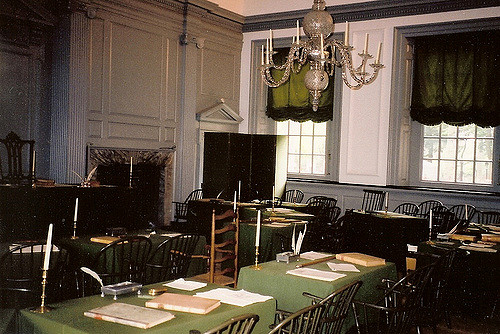
Photo of the Assembly room in Independence Hall where the U.S. Constitution was signed. Photo by Ken Lund, Flickr CC

Research on racial attitudes finds that a more modern form of racism has emerged since the civil rights movement — people are less likely to assert biological differences between racial groups, but often utter statements that covertly reinforce racial inequality (“I’m not racist, but…” ). A recent study by Kasey Henricks suggests that such covert forms of racism were actually present in the speeches and debates about slavery during the framing of the U.S. Constitution.

Henricks and his research assistants examined over 1,000 pages of an archival collection at the Library of Congress called, A Century of Lawmaking for a New Nation, one of the largest and oldest collections of congressional records. They focus on the three-fifths clause debate, the clause that codified slavery into law, between Northern and Southern framers about how to “properly tax” the human bondage that the United States was built upon, as well as how to count slaves for state representation in Congress.

In these discussions, Henricks finds parallels to many of the same expressions and contradictions we see today. For instance, while many framers lamented that slavery continued to exist, they simultaneously refused to extend the same humanity and rights to slaves as they did to “freepersons.”  Many framers stated their opposition to slavery, but nonetheless provided colorblind justifications for its continued existence. One of these justifications was the idea that slavery should be left up to local governance instead of federal intervention. Slaveholders also tried to distance themselves from any culpability by discussing themselves as “victims of circumstance” to a costly form of labor that made them more deserving of tax breaks. According to Henricks, these findings highlight how core American values were used to justify the continuation of slavery without ever having to explicitly discuss race.

These historical underpinnings of colorblindness illustrate that both our present and past are defined by forms of racism, overt and covert. In our current era, characterized by the reemergence of white supremacist groups and violence at Charlottesville, research must continue to demonstrate the multiple ways racism manifests itself and thus supports persistent inequalities, injustices, and violence.

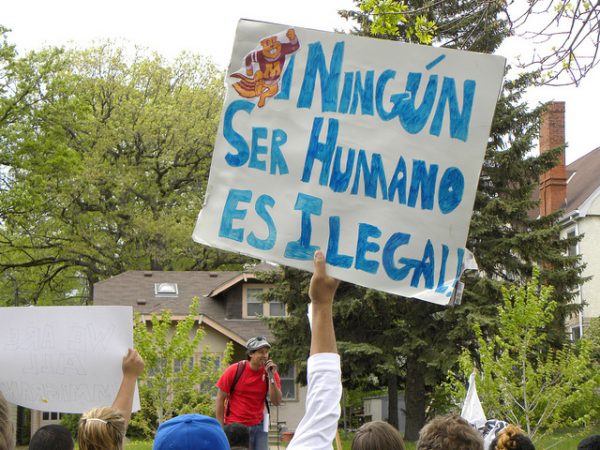
Photo of a protest sign that reads, “ningún ser humano es ilegal” or no human being is illegal. Photo by Fibonacci Blue, Flickr CC

Recent politics on immigration reflect understandings of citizenship and ideas of what types of groups “belong” in American society. Even if immigrants have legal residency status, they may still be perceived as “illegal.” These perceptions of illegality are shaped by an individual’s ethnicity, language, economic status, and a number of cultural factors. Recent research by René D. Flores and Ariela Schachter identifies factors affecting perceptions of illegal status.

The study used survey data from 1,515 non-Hispanic white respondents across the nation. They reviewed hypothetical profiles of immigrants that included traits such as the region or length of time in a country, type of employment, national origin, education level, criminal history, language abilities, and use of government services. Respondents then rated whether the profiles were of documented or undocumented immigrants. Some of the most salient traits that influenced perceptions of legality/illegality included:

  • National Origin. In comparison to 16 other national groups, Mexicans, Salvadorans, and Syrians were most likely to be perceived as illegal; Europeans and Asians drew the least amount of suspicion.
  • Criminal Background. Individuals with criminal backgrounds were more likely to be perceived as illegal, especially in cases of violent crime like murder or sexual assault.
  • Locality. The localities of the immigrants in different scenarios — such as if they were applying to a respondent’s place of work or walking in her/his neighborhood — affected the likelihood a respondent would report an immigrant to the police to investigate their legal status.
  • Receiving Government Benefits. Whether or not respondents perceived a profile including “receiving government benefits” as undocumented varied by political party. For Republican respondents, suspicions grew when the individuals in question were receiving benefits, whereas with Democrats this had the opposite effect.

This study links current political debates and discourse to perceptions of illegality. Some of its findings echo current Republican rhetoric that labels undocumented immigrants as heinous criminals or abusers of federal government benefits. How we perceive immigrants in different social spaces affects our treatment of them, and the likelihood of branding them as criminal, cultural, economic, or social threats. For immigrants, in other words, these perceptions have real consequences and outcomes.

Photo of a police SUV. Photo by Raymond Wambsgans, Flickr CC

Researchers have documented racial inequality in a variety of social spaces, finding that blacks and whites face different experiences in domains such as education, employment, and the criminal justice system. Such research often sorts people into uniform racial categories such as “black” and “white.” New directions in this research, however, consider the spectrum of skin color alongside racial identity, assessing whether and how skin shade impacts life chances and social inequalities. A recent study by Ellis Monk describes how skin color relates to policing and punishment, demonstrating there are penalties associated with darker skin.

Monk draws on data from the National Survey of American Life, a nationally representative in-person survey that asks participants about their lives. During this process, interviewers noted participants’ racial identity and the darkness of their skin. Monk then used these variables to determine whether skin color or racial identity predicts participants’ arrests or incarceration. He also considered a variety of other factors, such as participants’ age, education, marital status, poverty, employment, region, history of drug use, and hometown characteristics, to better test whether skin color relates to contact with the criminal justice system.

For black Americans, darker skin color is strongly associated with being incarcerated and/or arrested, even considering all of the factors above. In fact, the penalties that darker-skinned blacks face in comparison to light-skinned blacks are comparable to the penalties that blacks as a whole face in comparison to whites. This research highlights how traditional approaches to studying racial inequality can benefit from considering how variations in skin color affect life chances in education, employment, and the criminal justice system.

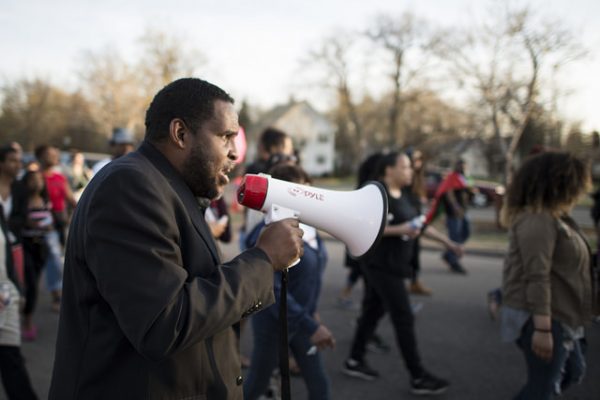
Black Lives Matter march for Tania Harris. Photo by Fibonacci Blue, Flickr CC

Research shows that poor communities of color are policed more extensively than other areas, and heavy policing  can substantially alter people’s behavior and identities. Some research indicates that individuals avoid formal institutions (e.g., schools, hospitals), while other research suggests that individuals interpret the increased criminal justice contact as racialized injustice and become more involved in activism. Using data from the National Longitudinal Survey of Adolescent to Adult Heath, Brianna Remster and Rory Kramer investigate community members’ varied responses to police contact.

Remster and Kramer found support for both avoidance of formal institutions and increased activism. People with more contact with the criminal justice system were more likely to avoid institutions — contact decreased the likelihood of receiving medical care and banking for members of all racial groups. Although the avoidance response applied to all races across contexts, avoidance tended to be stronger in predominantly minority communities. The researchers also found support for the activism hypothesis — individuals who had been stopped by police were more likely to take an activist role, which was measured by political rally attendance and whether individuals contacted government officials. In other words, after police contact individuals may withdraw for fear of further criminal justice contact, but they may also be inspired to protest unequal policing practices. 

This research also reveals the far-reaching presence and effects of modern surveillance across many contexts. Although the impacts of aggressive policing may be stronger in some neighborhoods, the impacts were not limited to poor minority communities. People across a variety of contexts respond to increases in criminal justice contact through avoidance and activism. Overall, the findings show that criminal justice contact can alter social life in more than one way beyond the moment of arrest.

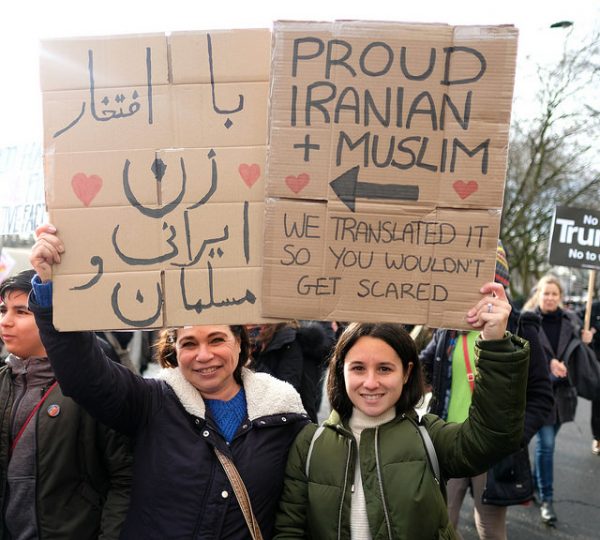
Photo of protesters holding a sign that says, “Proud Iranian + Muslim.” Photo by Alisdare Hickson, Flickr CC

Social scientists have long considered how negative stereotypes about racial and ethnic minorities relate to Americans’ opinions about state policies, such as social spending, education, and the criminal justice system. Recent research by Joseph Baker, David Cañarte, and L. Edward Day in The Sociological Quarterly examines a similar but distinct set of attitudes: “xenophobia” — a fear of outsiders or people from different places. This study indicates that xenophobia may be a strong predictor of whether whites support punitiveness in the criminal justice system.

Using data from the Chapman Survey of American Fears, a nationally representative dataset, Baker and colleagues study the relationship between racial attitudes, xenophobia, and attitudes towards punitiveness in the criminal justice system. They measure what participants think of members of specific racial minority groups, as well as several dimensions of anti-immigrant attitudes. In addition, they consider a number of control variables that could affect this relationship, including sociodemographic, political, ideological, and religious characteristics.

Baker and colleagues find that whites’ xenophobic attitudes more strongly predict their punitive attitudes than whites’ attitudes towards blacks or Hispanics. In fact, their analysis suggests that xenophobia is one of the strongest predictors of whites’ punitive attitudes — it even helped explain whites’ punitiveness within categories like political ideology. Furthermore, Baker and colleagues find that the association between xenophobic attitudes and punitiveness is stronger among whites than it is for blacks and Hispanics. Baker and colleagues describe how their results speak to the salience of immigration, anti-immigrant-attitudes, and political ideology in the 2016 presidential election, thus illustrating that a general fear of the “other” affects support for political policies.

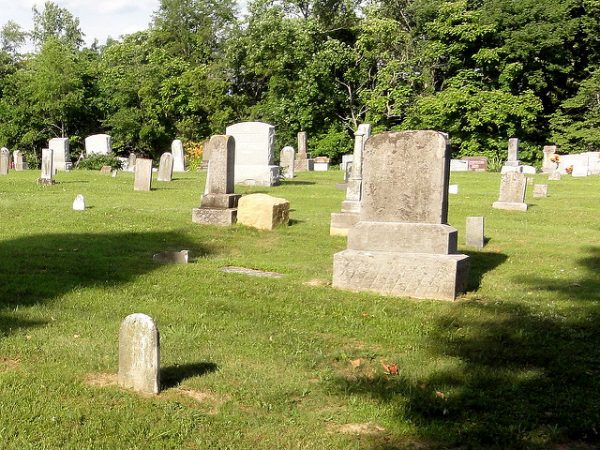
Headstones in a Cemetery. Photo by Bart Everson, Flickr CC

The expansion of the U.S. criminal justice system is often justified in the name of public safety. While incarceration does have crime-reducing capabilities, it also has numerous negative effects, such as decreased likelihood of employment and other “collateral consequences” for those incarcerated. Thus, it’s hard to say whether incarceration does more good than harm. This is a tricky question to answer, as the outcomes of incarceration are often hard to compare. However, Michael Light and Joey Marshall use a bevy of administrative panel data to compare whether incarceration saves more lives through reducing homicides than it costs lives through increases in infant mortality.

Overall, they find that the incarceration rate both decreases the homicide rate and also increases the infant mortality rate. The authors estimate that the “net benefit” of incarceration is much smaller when the mortality costs are taken into account. In other words, there seems to be a very weak or even non-existent return on incarceration when considering mortality. Thus, while it appears that incarceration does indeed “save lives,” incarceration also causes deaths, muddying the picture of the benefits of imprisonment. This research challenges claims that increased imprisonment will greatly enhance public safety and human well-being, and gives a glimpse into the varying effects the criminal justice system can have.

Graffiti on a dumpster in Minneapolis, MN. Photo by De Andre’ T. Beadle

Graffiti is common in urban spaces. Some city residents view it as art, many are apathetic, and others think it as a major nuisance that must be dealt with. Researchers often frame graffiti as either a form of vandalism that facilitates more disorder and crime or as acts of resistance. In recent research, however, Theo Kindynis argues that graffiti is a much more complex subculture, and graffiti creation is a social and symbolic practice that both shapes and is shaped by urban spaces.

Kindynis draws from three years of ethnographic research among graffiti writers in London. Most of his participants identified as “bombers,” and many were well known to local authorities as “serious graffiti vandals.” Some had even served jail time for graffiti writing. Graffiti writers’ main goal is to achieve subcultural status by “getting their name up” throughout the city, by placing their graffiti in every district and public transit line in the metro. The most important form of graffiti to writers is the “tag” or the bombers’ personal signature of letters, often alongside other embellishments like arrows, crowns, or RIP in remembrance of a deceased writer. The bombers in Kindynis’ research see their work as much more than simply “scribbles and scrawls.” According to one participant, writing often has “energy” or “presence” that is representative of each writer’s personal style and background. In other words, tags and other forms of graffiti are important subcultural symbols.

Tracks, and especially subway cars, are the most prized canvas for bombers in London, and the British Transport Police (BTP) respond by cracking down on graffiti crews there. Kindynis argues that this tough approach had some unintended consequences, and actually led to more destructive practices when graffiti writers retaliated with practices like etching, scratching, and using paint thinner. So on one hand, graffiti offers bombers a new way of envisioning their social surroundings — including their own language and alternative histories of urban space development and transformation, while on the other hand, graffiti tends to be at odds with social control in urban spaces and thus faces constant threat.