culture

Photo by Courtney Carmody via flickr.com

Many parents worry that college will introduce their kids to a realm of unmediated romps between the sheets, but for all the very public discussions about “hooking up,” the trend of unceremonious sex didn’t start with this generation. Despite common portrayals of unchecked, excessive sexuality on university campuses, the Millennial generation isn’t having more casual sex than the Baby Boomers did in their time. In an online article for Cosmopolitan Magazine, Charlotte Lieberman turns to sociology to explain why modern college romance (or the lack thereof) is “so screwed up.”

Lieberman draws from Michael Kimmel’s Guyland, which argues that our society rewards those who follow the “rules” of masculinity and show “no fears, no doubts, and no vulnerabilities.” This type of emotional detachment has become a common defense mechanism in the dating world, says Lieberman, as women are often applauded for taking on attitudes typical of men.

Most of my peers would say ‘You go, girl’ to a young woman who is career-focused, athletically competitive, or interested in casual sex.

Some feminists have viewed casual sex as an example of women’s liberation, as the freedom to break gender norms and act more masculine. However, according to sociologist Lisa Wade, this “freedom” doesn’t go both ways.

[No one says] “You go, boy!” when a guy feels liberated enough to learn to knit, decide to be a stay-at-home dad, or learn ballet.

According to both Kimmel and Wade, our culture celebrates “thick skin” and emotional detachment in sexuality, rather than the transgression of gender norms. Hookup culture has created a dating field with a “whoever-cares-less-wins” attitude.

With emoticons and emojis replacing emotions, another complication of modern-day dating, according to Lieberman, is modern-day technology. Text messaging has become a main form of communication, and Millennials have developed self-screening skills that model Kimmel’s rules of emotional distance.

[When responding to a guy’s text,] it can’t be 10 minutes on the dot, because then it is obvious you were waiting. It should be longer than 15 minutes to show you’re not desperate but within the 45-minute window if you are trying to lay groundwork for that evening.

What is “screwed up” about dating, according to Lieberman and sociologists, is not that this generation has become emotionally desensitized by casual sex, but that Millennials are looking for love in the midst of a culture that views emotional apathy as empowering and possesses the digital means to censor any emotions they may experience.


Picture 2


Picture 2


Pledge Photo by Jeffery Turner via flickr.com
Photo by Jeffery Turner via flickr.com

“I pledge allegiance to the flag of the United States of America….”  Many of us can remember standing and reciting this each morning at school.  But how many of you have thought about its origins?

NPR’s Shirish V. Dáte raised this question last week in reaction to Mitt Romney’s use of the Pledge of Allegiance in his campaign.

When Mitt Romney uses the Pledge of Allegiance as a metaphor for all that’s good and right with America, how many in his audience know that the two-sentence loyalty oath was penned not by the Founding Fathers in 1776, but a fascist preacher more than 100 years later?

Or that the original recommended posture was with a straightened arm raised upward and outward? Or that it was changed to the hand over the heart during World War II after the Nazis adopted the original as their salute?

Though Dáte makes several points about the use of the pledge in politics, the sociological point is that its use becomes so institutionalized that we (regardless of our political affiliation) don’t even question its origins.

And what are the precise origins of this custom?  Well, Francis Bellamy (the “fascist preacher” noted above) and his friends asked President Benjamin Harrison to incorporate the pledge, which he wrote, into the 400th anniversary celebration of Columbus’s arrival in America. It has been used ever since, with one change.  In 1954, President Eisenhower added “under God.”

For more on the use of the pledge in politics, see the rest of the blog post here.

Photo by Robert Schrader via flickr

While many turn up their noses at the thought, a recent article in the Star Tribune profiles a growing group of people who don headlamps and explore dumpsters for discarded edibles.

Some, calling themselves “freegans,” have a philosophy that shuns spending money and capitalism, and do it to protest waste.

Others just want to take advantage of free food.

The practice is rife with detractors, however, including food safety experts and most of the expiration date-abiding public. Taking food from dumpsters in public areas is not exactly against the law (at least no one has been prosecuted for it). Some cities, however, do have ordinances against dumpster diving, so most divers keep a low profile about their escapades.

Geographer Valentine Cadieux explains why such habits of food procurement might offend some:

 “Food is such a huge part of our lives, wrapped up in our identities and cultures and habits, not to mention survival — so we experience tremendous resistance to questioning the way we get this food,” Cadieux wrote in an e-mail.

While some dumpster divers may do it for practical reasons, like survival or cutting down on food costs, others might be looking to make a bigger statement.

“Dumpster divers are demonstrating a way to call into question something that seems really legitimate and scientific [expiration dates or the convenience of throwing away food],” Cadieux said. “The general guilt that we feel about how many people are hungry is exactly the kind of thing that adds additional meaning to what may not be intended as a part of a social movement — but dumpster diving ends up being legible to people as a critique of throwing away too much food.”

Though perhaps not looking to start a broader social movement, dumpster divers certainly make an impression. And, apparently, their exploits can make for a well-stocked fridge.

“All the produce, just tons of green peppers and red peppers; they looked perfect,” Graham recalled with not a small bit of awe. “This was the first time I was diving, and I couldn’t believe it.”

The Occupy Wall Street protests are in full swing across the nation, and reporters are doing their best to navigate and explain the growing, and sometimes ambiguous, movement. Not surprisingly, sociologists are helping journalists make sense of the phenomenon for viewers and readers. To help shed light on the Occupy Boston protests, FOX 25 Boston turned to Tufts University sociology professor Sarah Sobieraj. In a relatively short TV interview, Sobieraj was asked to cover a lot of territory, including explaining reasons for the movement’s popularity, addressing the breadth of its message, and identifying connections to other famous American protests.

These are all topics Sobieraj should feel pretty comfortable speaking on—after all, she wrote the book on media and protest (Soundbitten: The Perils of Media-Centered Political Activism). However, she isn’t the only academic with something to say about the Occupy protests. For instance, CUNY professor Héctor Cordero-Guzmán was asked by OWS itself to analyze the characteristics of occupywallst.org visitors and saw his results picked up by The New Yorker’s Rational Irrationality blog, while Columbia’s Todd Gitlin wrote about the difference between Tea Party and OWS protests in the New York Times and discussed the movement with National Public Radio’s Marketplace. These scholars are working as ambassadors for the discipline and proving to the broader public that sociological research can be timely and relevant for parsing current events. Let us know if you spot any particularly edifying articles in your daily news review.

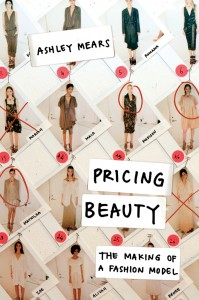
If you’d spent some time in the New York fashion scene and looked closely among the high heels, you might have spotted one model taking scrupulous field notes as seriously as she took the runway. Ashley Mears, assistant professor of sociology at Boston University and author of the book Pricing Beauty, immersed herself into the world of modeling by actually becoming a model. A recent New York Times’ T Magazine Blog interview with Mears got into what the world of fashion looks like through the eyes of and insider and the eyes of a sociologist.

Mears didn’t specifically set out to study fashion models, she claims: “Rather, I study questions of how cultural value gets translated into economic values.” In fact, she had only some limited teenaged experience in the field, and so it was a surprise when a “career” in modeling more or less fell into her lap—she was approached as she puzzled over her dissertation topic at a Starbucks.

From her life backstage, Mears was able to draw several conclusions on a lingering disconnect between traditional beauty and the type of look often revered on the catwalk. First and foremost, she says, fashion makes a distinction between mass appeal and cultural prestige:

The commercial end… [does the] kinds of jobs that are intended to sell things, to move merchandise. They have to resonate with a mass audience. The editorial end is the elite end, it’s by far the more prestigious end … And they look really strange. They don’t resonate with a mass audience, and that’s the point. They’re not intended to. That’s kind of a general principle that we take from the art world. The more people a specific piece of art is intended to make sense to, the less valuable on the whole it is.

And why do the elite modeling specifications require an extraordinarily tall, extraordinarily thin, white woman? For Mears, it all stems from class:

If you look at a historical trajectory of what, in Western society, elite culture values, it’s this prized aesthetic for women with extremely thin, taut, controlled bodies. A corpulent body, a body with rolls and with flesh, is a body that signals looseness, sexual availability, and is antithetical to a kind of “elite” body. You can see this in strip clubs as well. There’s some ethnographic work that shows that strip clubs that cater to higher-class audiences have thinner women, and whiter women. You see it reproduce in all kinds of different settings.

Whether in boxing clubs or factories or catwalks, sociologists have a rich history of this kind of embedded ethnography. To read more about Mears’s research, visit her Boston University website here or pick up a copy of her book.


Bart's BlackboardIn a recent opinion column in the Star Tribune, John Rash points to the absence of religion as a major theme in shows on the national television networks.

The absence is all the more surprising considering that 80% of Americans reported to Gallup that religion plays a ‘very’ or ‘fairly’ important role in their lives.

And as Rash reminds readers, religion continues to maintain a very visible presence in other popular culture:

Topping the bestseller list is “Heaven is for Real,” about a boy witnessing the afterlife following a near-death experience.
The hottest Broadway show is “The Book of Mormon,” a satire (and grudging admiration) of the faith from the creators of “South Park.”
The highest-grossing R-rated film ever isn’t a gross-out comedy, Quentin Tarantino-style nihilistic violence, or even a sexual coming-of-age story, but “The Passion of the Christ.”

To help understand the absence, Rash turns to academia. Professor Jeanne Halgren Kilde, director of religious studies at the University of Minnesota, explains that even though network television rarely features explicitly religious themes, it is engaging in many of the same debates.

“Questions about good and evil, justice, personal destiny, love, about relationships — these are the narratives we see on TV that are the same questions religion has been asking, and answering, forever. So TV becomes in some senses a kind of superseding of what had been the religious context of discussing, to a more secular context of answering these questions.”

And, while the major religions are rarely a central theme in popular television, there has been a dramatic increase in the number of shows with spiritual and paranormal themes.

Hitting its peak around 2006, this trend inverted media maven Marshall McLuhan’s famous dictum: This time, the message was the mediums — as well as the psychics, ghost hunters and clairvoyant crimefighters who populated prime-time in shows like “Medium,” “Supernatural” and “Ghost Whisperer.”

Penny Edgell, professor of sociology at the University of Minnesota provides context to the rise.

“Network prime time is responding to a trend,” said Penny Edgell “And thus it’s perpetuating and popularizing that trend of people thinking about spiritual things, but drawing on a different kind of repertoire that’s more about relationships and flexible personal contacts that might shape your own life that don’t have anything to do with a doctrine or a church. There’s a lot of the supernatural on TV, but not a lot of organized religion. And that mirrors trends in how people are thinking about their spirituality; it mirrors a rise of a discourse that emphasized spirituality of something that’s distinct from, but not always in opposition to, organized religion.”

Rash does make note of one of the few shows where religion is discussed – America’s longest running cartoon, The Simpsons.

Even the Catholic Church’s official newspaper, Osservatore Ramono, honed in on Homer, saying he “finds in God his last refuge, even though he sometimes gets His name sensationally wrong.”

Whether or not the misadventures of America’s favorite animated family is the appropriate venue for a national discussion of religion remains up for debate.

y2.d108 | tug of war.Judging by the popularity of cat and dog videos on the Internet, it seems safe to say that pets have assumed an important role in our society.

However, as Benedict Carey explores in a recent NY Times article, the pet’s position within the family can be a contentious topic.

“The big bone of contention was that my mom and my sister thought that he was too smart to be treated like a dog; they thought he was a person and should be treated as such — well, spoiled,” said Danielle, a Florida woman who asked that her last name not be published to avoid more family pet strife. “The dog remains to this day, 10 years later, a source of contention and anger.”

To understand human pet relationships, Carey turns to the field of sociology. David Blouin, a sociologist at Indiana University, explains that there are three basic categories of belief concerning pets.  “Dominionists” who see pets as a useful, and beloved, but ranked below humans and replaceable. “Humanists,” who cherish their pets and raise them to the same status as a favored child. And, “protectionists,” who base their views on what they think is “best” for the animal.

“These are ideologies, and so protectionists are very critical of humanists, who are very critical of dominionists, and so on,” Dr. Blouin said. “You can see where this can create problems if people in a family have different orientations. Every little decision about the pet is loaded.”

And, whether you believe Fido should be in the yard or snuggling under the down comforter at night may not simply be a matter of personal preference. Rather, as sociologist Elizabeth Terrien helps us understand, views vary by class, ethnicity and geographic location.

One clear trend that has emerged is that people from rural backgrounds tend to see their dogs as guardians to be kept outside, whereas middle-class couples typically treat their hounds as children, often having them sleep in the master bedroom, or a special bed.

Terrien explains, the cultural and class-based differences in understanding how a pet should be treated can lead to groups judging each other negatively.

In neighborhoods with a larger Latino immigrant population, owners were more likely to say “protector,” or even “toy for the children,” she found. “In those neighborhoods you’ll sometimes see kids yanking around a dog on the leash, pushing and playing, the sort of behavior that some middle-class owners would think of as abuse” she said.

Carey’s article provides an important reminder that sometimes even the most personal – for instance, family arguments over whether the dog is included in the will – is linked to larger social forces. Also, Carey confirms yet again that class matters, even for dogs and cats.


male's eye  (mental masturbation)In February’s issue of Wired (now available online), Columbia sociologist Sudhir Venkatesh helps us understand the life of a prostitute in New York City and how the trade has been transformed by advances in technology.

While Venkatesh’s initial goal was to examine how the gentrification of Times Square and other areas of New York City would impact the sex trade, he quickly found himself documenting the rise of a new type of sex worker.

The economies of big cities have been reshaped by a demand for high-end entertainment, cuisine, and “wellness” goods. In the process, “dating,” “massage,” “escort,” and “dancing” have replaced hustling and streetwalking. A luxury brand has been born.

The shift has resulted in an increase in both the price of, and level of respect for, prostitutes. Technology has played a large part in this as it allows clients to find companionship without resorting to driving the streets.

The Internet and the rise of mobile phones have enabled some sex workers to professionalize their trade. Today they can control their image, set their prices, and sidestep some of the pimps, madams, and other intermediaries who once took a share of the revenue.

Most exciting about this short piece was the amount of information conveyed in about ½ a page of writing through the use of a wide array of supplemental graphics. A map is used to show the movement of sex workers to trendier, more upscale districts in Manhattan. And a compilation of images, statistics, and well-chosen quotes demonstrate the divide between types of sex work, as well as the infusion of technology into the escort services. For instance, Facebook is quickly becoming a medium for advertising adult-services and a BlackBerry phone has come to symbolize a professional (and disease-free) status.

Montréal-Nord

Patricia Cohen’s recent article in the NY Times, “‘Culture of Poverty’ Makes a Comeback,” documents culture once again being used by social scientists as an explanation in discussing poverty.

Cohen begins by setting the historical context.

The reticence was a legacy of the ugly battles that erupted after Daniel Patrick Moynihan, then an assistant labor secretary in the Johnson administration, introduced the idea of a “culture of poverty” to the public in a startling 1965 report. Although Moynihan didn’t coin the phrase (that distinction belongs to the anthropologist Oscar Lewis), his description of the urban black family as caught in an inescapable “tangle of pathology” of unmarried mothers and welfare dependency was seen as attributing self-perpetuating moral deficiencies to black people, as if blaming them for their own misfortune.

The idea was soon central to many of the conservative critiques of government aid for the needy. Within the generally liberal fields of sociology and anthropology the argument was generally treated as being in poor taste and avoided. This time of silence seems to be drawing to a close.

“We’ve finally reached the stage where people aren’t afraid of being politically incorrect,” said Douglas S. Massey, a sociologist at Princeton who has argued that Moynihan was unfairly maligned.

The new wave of culture-oriented discussions is not a direct replica of the studies of the 1960s.

Today, social scientists are rejecting the notion of a monolithic and unchanging culture of poverty. And they attribute destructive attitudes and behavior not to inherent moral character but to sustained racism and isolation.

Cohen continues by providing examples of how culture is now being examined. To do so she turns to Harvard sociologist, Robert J. Sampson. According to Sampson culture should be understood as “shared understandings.”

The shared perception of a neighborhood — is it on the rise or stagnant? — does a better job of predicting a community’s future than the actual level of poverty, he said.

William Julius Wilson, a fellow Harvard sociologist who achieved notoriety through studies of persistent poverty defines culture as the way

“individuals in a community develop an understanding of how the world works and make decisions based on that understanding.”

For some young black men, Professor Wilson said, the world works like this: “If you don’t develop a tough demeanor, you won’t survive. If you have access to weapons, you get them, and if you get into a fight, you have to use them.”

As a result of this new direction in the study of poverty, a number of assumptions about people in poverty have been challenged. One of these is idea marriage is not valued by poor, urban single mothers.

In Philadelphia, for example, low-income mothers told the sociologists Kathryn Edin and Maria Kefalas that they thought marriage was profoundly important, even sacred, but doubted that their partners were “marriage material.” Their results have prompted some lawmakers and poverty experts to conclude that programs that promote marriage without changing economic and social conditions are unlikely to work.

The question remains, why are social scientists suddenly willing to deal with this once taboo approach?

Younger academics like Professor Small, 35, attributed the upswing in cultural explanations to a “new generation of scholars without the baggage of that debate.”

Scholars like Professor Wilson, 74, who have tilled the field much longer, mentioned the development of more sophisticated data and analytical tools. He said he felt compelled to look more closely at culture after the publication of Charles Murray and Richard Herrnstein’s controversial 1994 book, “The Bell Curve,” which attributed African-Americans’ lower I.Q. scores to genetics.

The authors claimed to have taken family background into account, Professor Wilson said, but “they had not captured the cumulative effects of living in poor, racially segregated neighborhoods.”

He added, “I realized we needed a comprehensive measure of the environment, that we must consider structural and cultural forces.”

This surge of interest is particularly timely as poverty in the United States has hit a fifteen-year high. And the debate is by no means confined to the ‘Ivory Tower’.

The topic has generated interest on Capitol Hill because so much of the research intersects with policy debates. Views of the cultural roots of poverty “play important roles in shaping how lawmakers choose to address poverty issues,” Representative Lynn Woolsey, Democrat of California, noted at the briefing.

Morningside Heights/HarlemSince the 1960s, sociologists have shied away from explaining the persistence of poverty in terms of cultural factors, instead emphasizing the social structures that create and perpetuate poverty. Now, the New York Times reports, there seems to be a resurgence of analysis linking culture and persistent poverty.

The old debate has shaped the new. Last month Princeton and the Brookings Institution released a collection of papers on unmarried parents, a subject, it noted, that became off-limits after the Moynihan report. At the recent annual meeting of the American Sociological Association, attendees discussed the resurgence of scholarship on culture. And in Washington last spring, social scientists participated in a Congressional briefing on culture and poverty linked to a special issue of The Annals, the journal of the American Academy of Political and Social Science.

This, however, is not a reproduction of ‘culture of poverty’ scholarship; current work is significantly different:

With these studies come many new and varied definitions of culture, but they all differ from the ’60s-era model in these crucial respects: Today, social scientists are rejecting the notion of a monolithic and unchanging culture of poverty. And they attribute destructive attitudes and behavior not to inherent moral character but to sustained racism and isolation.

Harvard sociologist Robert J. Sampson says that how people collectively view their community matters.

The shared perception of a neighborhood — is it on the rise or stagnant? — does a better job of predicting a community’s future than the actual level of poverty, he said.

Sociologists try to unpack what this means:

Seeking to recapture the topic from economists, sociologists have ventured into poor neighborhoods to delve deeper into the attitudes of residents. Their results have challenged some common assumptions, like the belief that poor mothers remain single because they don’t value marriage.

In Philadelphia, for example, low-income mothers told the sociologists Kathryn Edin and Maria Kefalas that they thought marriage was profoundly important, even sacred, but doubted that their partners were “marriage material.” Their results have prompted some lawmakers and poverty experts to conclude that programs that promote marriage without changing economic and social conditions are unlikely to work.

The article speculates about several reasons why a cultural approach to studying poverty is reemerging, including a new generation of scholars, advancements in data collection and analysis, and shifts in broader discourse and attitudes outside the university, as well.

Take a look at the full article.