
culture

12200621_740d218a53_m.jpgIn a new editorial from the Freakonomics bloggers at the New York Times asks, “Do Hamburgers Cause Crime?” A new paper from Jennifer Dillard of the Georgetown Law School investigates the effects of lengthy employment on the ‘kill floor’ of slaughterhouses to a dramatic increase in the risk of psychological problems, like post traumatic stress disorder. Dillard argues that from a legal standpoint, these workers should be compensated under O.S.H.A.

In their discussion of Dillard’s new work, the Freakonomics blog authors also highlight sociologist Amy Fitzgerald’s paper which concludes that communities with slaughterhouses experience a ‘spill-over’ effect from this type of work, resulting in much higher rates of violent crime than other communities with similar demographic characteristics.

24815360_18174dee30_m.jpgCBS news recently reprinted a quotation from Hillary Clinton’s discussion with reporters after jokingly challenging Barack Obama to a ‘bowl off.’ Clinton references Robert Putnam’s work on ‘bowling alone’ as a way of expressing our highly isolated social interactions.

“Bowling alone you know, this is a big sociological phenomenon, bowling alone is a sign of our times, we could bring it back we could like transform the entire society. People would start joining leagues again they would feel a sense of community a sense of togetherness, exactly, bowling alleys everywhere on every corner, people setting pins again. End the automation, get the pin boy, there is no telling what could happen!”

via Brayden King at orgtheory:

It turns out Tom Wolfe, the realist American novelist most famous for his Bonfire of the Vanities, is a bit of an amateur sociologist. Check out this interview with the New York Times’s Sam Tanenhaus in which Tom admits to falling in love with sociology.   (You can begin listening about 1/4 of the way into the interview.) During graduate school Tom became attracted to Weber’s theorizing of status, a concept that later figured prominently in many of Wolfe’s novels, especially in Bonfire.  In the last half of the interview Wolfe describes how he carefully builds status markers into his novels.

sleeping.jpgA new study from University of Maryland sociologists John P. Robinson and Steven Martin suggests that Americans are getting as much, if not more, sleep than they did 40 years ago. This study also made use of time diaries to determine how long Americans were sleeping, as opposed to previous studies that just asked respondents outright.

Key findings from the report:

“Sleep Patterns 1965-1995: There was little change in sleep averages during this period, particularly in comparison to the far larger shifts in time spent on housework, child care and watching TV. ‘The proverbial figure of eight hours per day (56 hours per week) has remained close to the diary norm for those aged 18 to 64 in each national study between 1965 and 1995,’ the report says.”

“Sleep Patterns 2003-2005: The time diaries collected by the federal government on an annual basis between 2003 and 2005 showed rising sleep averages – 8.2 hours on weeknights, 8.9 on Saturday and 9.5 on Sunday, a total increase of about three hours per week.”

“‘While these recent increases are statistically significant, we’re approaching them with some caution,’ says Maryland sociologist Steven Martin, the co-author of Not So Deprived. ‘The numbers didn’t change for more than 30 years. We want to see if these increases hold up in the long-run.'”

Discussions about inequality and access to the internet are one thing, but if you look only at people who already have access, are there differences in online behavior? Eszter Hargittai found that race, ethnicity and education level predict whether young people are more likely to use the social networking site MySpace or its competitor Facebook.

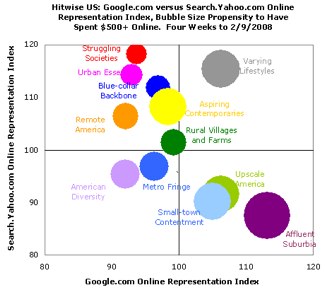
TechCrunch points to a study by Hitwise (a marketing company that tracks internet usage) that suggests class, geography and other factors shape whether people use Google or Yahoo! as their search engine of choice:

hitwise1.jpg

They include “lifestyle” indicators like “Urban Essence,” “American Diversity” and “Small-town Contentment” that I’m not sure how to react to, and of course, as a private consulting company, it’s not like they’re giving their data away here for social scientists to scrutinize. (Though I admittedly have no idea what it would take to get the data…I got impatient with their website very quickly!) Nonetheless, pretty interesting.