
culture

Ever wonder where weird Thanksgiving traditions come from? Photo by Musicwala via Flickr.
The Macy’s Thanksgiving Day parade has been held annually since 1924. Turns out some families’ holiday “rituals” are more common than you might think. Photo by Musicwala via Flickr.

Sociology loves making the familiar strange, and few events blend the familiar and the strange as artfully as holiday family gatherings. The Week recaps a classic sociological study of Thanksgiving celebrations by Melanie Wallendorf and Eric J. Arnould, which sheds light on just how common our “quirky” family rituals can be. A particularly juicy conclusion was that interview respondents didn’t realize their party quirks were actually ‘traditions’ happening year after year at gatherings across the U.S. According to the article:

…a society is not always the best judge of its own customs…The data analysis revealed some common events in the fieldnotes that people rarely remarked on in the interviews.

Common practices included “The Giving of The Job Advice,” “The Telling of Disaster Stories of Thanksgivings Past,” and the ever-popular “After-Dinner Stroll around the Neighborhood.” These customs remind us just how much we share at this time of year. Who knows? The next awkward family gathering just might be a new field site!

war inkJason Deitch, a UC-Berkeley PhD in sociology, has long been fascinated with the cultural effects of war. A veteran, Deitch has served as an advisor and activist in many capacities, but his newest project, produced in his capacity as an advisor to the California State Library, is gaining national recognition. Along with Chris Brown of the Contra Costa County Library system, the StoryCorps Military Voices Initiative, filmmaker Rebecca Murga, and photographer Johann Wolf, Deitch set out to interview as many of California’s estimated two million veterans as he could.

Well, at least the ones with tattoos. As Deitch told PBS’s NewsHour:

These tattoos are an expression from a community that doesn’t openly discuss or express emotion…. We understood these tattoos to be uniquely valuable, as veterans largely return home to a community that doesn’t know their story and how war changed them… That can be an incredibly isolating experience…

He went on to say that it was tough recruiting vets willing to show off their ink and talk about their experiences on the frontlines, but he hoped the resulting exhibit, “War Ink,” would help “bring veterans out of isolation by helping people back home understand them.”

Participants described the process of being photographed and recounting their stories as a way to educate others about a struggle that doesn’t end with their tour of duty.

first step to success
Photo by CJ via Flickr CC.

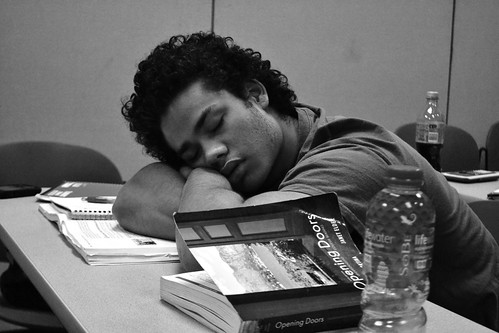
College students are tired of sleeping, according to a BBC interview with Catherine M. Coveney. She’s a British sociologist who recently explored the sleeping practices and subjective sleep experiences of two notoriously sleep-deprived groups: shift workers and college students. After conducting 25 semi-structured interviews with individuals dispossessed of rest, she concludes that our social context impacts how we understand the meaning of sleep and how we manage our sleeping schedules as a result.

The hospital-based doctors, nurses, police officers, call center employees, and other shift workers Coveney interviewed describe actively managing their sleep schedules around work patterns, finding childcare, and spending time with their partner. It is something that is constantly at the back of their mind. To illustrate why they view “broken sleep” as part and parcel of the job, Coveney explains how sleeplessness is built-in to the work structure:

There are some occupations where nothing is sanctioned…. The two nurses that I spoke to, they had to work waking nights. So even on their break, they weren’t allowed to go to sleep during the night. That’s not to say it didn’t occasionally happen, but that it was not a sanctioned practice. That was something that was seen as going against the rules of their profession.

On the surface, the sleep patterns of the college students look identical to the shift workers: “They did describe a kind of similar pattern; they did describe taking naps during the day, having a shorter sleep at night, having a two hour nap the next day.” Yet because they see sleep as an  “expendable luxury,” they don’t view their own erratic sleep as “broken.” According to Coveney, for the college students,

…it was more flexible, it was more their choice, so in a sense they were customizing their sleep patterns to fit around their social activities…. I suppose it was seen as disposable in a sense, they could cut back on sleep if they chose to, they could indulge in sleep if they chose to.

Although both groups thought of sleep in functional terms—the necessary amount determined by what was needed to get them through what they had to do the next day—Coveney reports, “None of the students I spoke to said they would prioritize a night in bed because they thought they hadn’t had enough sleep. If there was something else they wanted to do, they‘d do that. And they’d catch up later, they’d sleep longer the next day, they’d take a nap…. Some of them did go as far as to say if they could get rid of their need for sleep, it would give them much more time to do other things.” Even the value of sleep depends on supply and demand.

To learn who else is getting more sleep than you are, check out these TSP classics on the gender sleep gap and on segmented sleep.

m_350_oc_1sht_V1.inddThe comedy Obvious Child hit theaters last Friday, and it’s been praised as “the most honest” abortion movie Slate‘s Amanda Hess has ever seen. Honest, in that the film’s protagonist Jenny Slate decides to have an abortion and goes through with it. Her relationship does not implode, she does not suffer crippling guilt, and she survives. Her life goes on. It turns out that this kind of straightforward portrayal is a rarity in American film and television, though millions of women have abortions every year (the Guttmacher Institute pegs the number of worldwide procedures at about 42 million per year). In a recent Contraception article, a pair of sociologists report that pre-Roe v. Wade era plotlines disproportionately featured the death of women characters who even thought about abortion. After abortion’s legalization, portrayals came to suffer from a different distortion: “These movies tell us that it was wrong [before Roe] for laws to dictate what a woman ought to do with her body, but now that she has the choice, she should choose to give birth except under the most extenuating of circumstances,” Hess writes. Obvious Child rejects, well, the obvious.

Watch the trailer for the film here.

Courtesy the Boston Public Library.

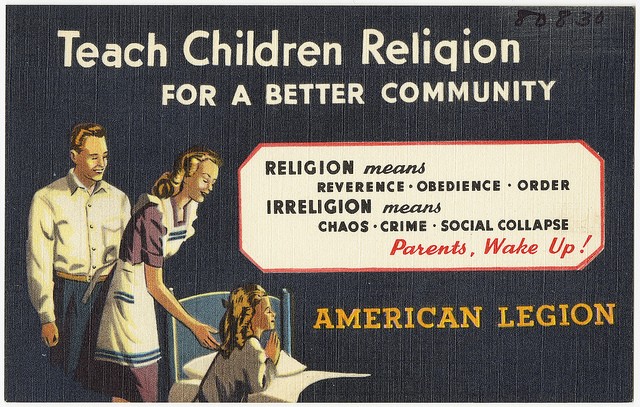
It’s been a busy time for social facts on religion in American life. First, The Washington Post reported new data from the Pew Forum suggesting that more Americans would be willing to vote for an atheist president. While the original report noted that atheism is still a “top negative” for voters—with more respondents saying it would make them less likely to vote for a candidate than drug use, political inexperience, or an extramarital affair—there is still some optimism in the fact that this number has declined by 10% since 2007.

Second, a new report from the Public Religion Research Institute found that Americans are still over-reporting their church attendance, moreso in phone than in online surveys. The Huffington Posthosted a roundtable on the issue, and a take in The Atlantic emphasized the political implications of this data—liberals are more likely to inflate their church attendance than conservatives, and this may be because of negative stereotypes that liberals are “anti-religion.”

In a journalistic trifecta, all three stories noted research from Minnesota sociologists Penny Edgell, Joseph Gerteis, and TSP’s own Doug Hartmann on the continued stigma faced by atheists in American culture. From The Atlantic:

When three University of Minnesota sociologists surveyed American religious attitudes in 2006, they found “not only that atheists are less accepted than other marginalized groups but also that attitudes toward them have not exhibited the marked increase in acceptance that has characterized views of other racial and religious minorities over the past forty years.” Americans are today more likely to say they would vote for a Muslim or a gay or lesbian for president than an atheist.

Edgell also discussed current trends in church attendance on The Huffington Post and updated her 2006 research in The Washington Post:

A 2006 study by University of Minnesota sociologist Penny Edgell found atheists were the most mistrusted minority in the U.S. Edgell said Tuesday that an updated study based on a 2014 online survey would be released soon. Preliminary results show the mistrust meter hasn’t budged.

Despite an inclusive trend in what Americans say they look for in a candidate, religious identities are still an important marker of who can lead the flock(s).

For more on the cultural factors that may be driving these trends, check out this classic TSP feature: The Social Functions of Religion in American Political Culture.

Photo by Eduardo Hulshof, Flickr CC.

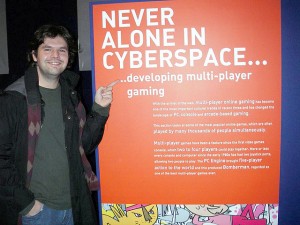
Ubisoft has been trying to find out what makes its gamers tick. Nick Yee, a researcher fronting the company’s internal “Daedalus Project,” now has a new book, The Proteus Paradox, bringing together some of the major findings from the years of interviewing and observing gamers. Perhaps most interesting, as Bryan Alexander points out in Reason, is that, no matter how otherworldly the games might be, players tend to import their offline behavior and attitudes.

For instance, Yee explains in a chapter called “The Labor of Fun,” many gamers come to see gaming as a second job, demanding hours of boring drudgery contributing to fleeting achievements. Some even exploit other gamers to do the “grinding” work of leveling-up and repay it with racism toward those willing to do the work.

Gender figures interestingly, too:

Proteus outlines how male players denigrate, harass, and drive off female players. But Yee offers two twists to this sadly familiar story. First, women report wanting to play for the same reasons men do—achievement, social interaction, and immersion—going against essentialist expectations of gender behavior difference. And second, MMOs [massively multiplayer online games] offer a pedagogical benefit of sorts to male gamers who play under female avatars.

Males do this switching with some frequency… mostly to enjoy the eye candy of an attractive female avatar displayed in a game’s third-person perspective. That gaze is then reversed, as it were, as other players ogle the same avatar from their avatar’s perspectives. It’s a surprising opportunity to experience the kinds of sexual harassment that real-world women know to well.

Love, death, and helping others all come into play. “For all the criticisms that can be made of gamers’ behavior,” Alexander writes after reading Yee’s book, “these worlds are not bleak places entirely devoid of pleasure and fellow-feeling.” Between levels, it seems, some Putnam, Goffman, and Addams have snuck into the online realm.

For more in the Reason series on gaming, click here. For more on race in gaming, check out “The Whiteness of Warcraft,” here on TSP.

Picturing the War on Drugs in Pittsburgh. Photo by Christopher "Rice" via flickr CC.
Picturing the War on Drugs in Pittsburgh. Photo by Christopher “Rice” via flickr CC.

As far as the London School of Economics is concerned, it is time to end the global War on Drugs. According to LSE’s new report, the “War” is a “billion-dollar failure.” The report was signed by five Nobel-Prize winning economists (Kenneth Arrow, Christopher Pissarides, Thomas Schelling, Vernon Smith, and Oliver Williamson), as well as former U.S. Secretary of State George Schultz, British Prime Minister Nick Clegg, and former NATO and EU foreign policy chief Javier Solana. Al Jazeera explains:

“The pursuit of a militarised and enforcement-led global ‘war on drugs’ strategy has produced enormous negative outcomes and collateral damage.” Citing mass drug-related incarceration in the US, corruption and violence in developing countries and an HIV epidemic in Russia, the group urged the UN to drop its “repressive, one-size-fits-all approach” to tackling drugs, which, according to the report, has created a $300bn black market.”

The LSE report urges a shift toward evidence-based approaches to illicit drug use: the tremendous resources devoted to the drug war could be diverted to more rigorous analysis and effective policy with “a focus on public health, minimising the impact of the illegal drug trade.”

"Soliciting," by Rachel's Secret via Flickr Creative Commons.
“Soliciting,” by Rachel’s Secret via Flickr Creative Commons.

It’s been a few weeks since CNN highlighted a new report by the Urban Institute’s Justice Policy Center on the income from underground commercial sex economies. Perhaps it was the pain of doing my taxes this week (down to the wire, I know) that jogged my memory. But the report estimates that this underground economy in Atlanta alone nets those working in the sex trade—from pimps to erotic massage providers—$290 million per year, with pimps making an average of $33,000 a week.

Until now, there has been little information about the size and scale of the sex economy. Though this report examines only eight cities across the U.S. (notably omitting Las Vegas), is one of the first forays into quantification. Meredith Dank from the Urban Institute told Time magazine,

With knowing the size of the economy, you get better a sense of what you’re dealing with and how big this market is. Law enforcement now knows they can potentially seize $290 million in Atlanta that can be used toward providing services and education.

Beyond what police asset seizures might do for city infrastructure, the studies also point out the enormous numbers of people working in the sex trade. Due to the secretive nature of their work, they may live outside the social systems of taxes, safety net benefits, and healthcare.


Photo by Travis Barfield, Flickr Creative Commons.

Forbes Magazine recently highlighted some shocking numbers. According to the USDA,

A child born in 2012 will cost his parents $241,080 in 2012 dollars, on average [in the first 17 years of life]… And children of higher-earning families drain the bank account more: Families earning more than $105,000 annually can expect to spend $399,780 per child.

That works out to about $14,000 a year on the low end. Now that, as author Laura Shin points out, is a big investment—especially when kids used to be contributors to the household economy, not drains on it. Today, NYU professor Dalton Conley calls on research from colleague Viviana Zelizer who says “kids are emotionally priceless and economically worthless.” And yet, “We think of them as our most important life project.”

In a hard economy in a country with high inequality, parental investment in children is truly important, Conley goes on. “We know… that investments at home in time, energy and from birth and before are what actually develop kids that are successful in terms of this knowledge economy.” And those successful kids will get into better schools, have better jobs, and maybe even be able to support their parents into old age. But how do can parents get the best return on this investment?

That question, Shin writes, is at least partially answered with Conley’s new book Parentology: Everything You Wanted to Know about the Science of Raising Children But Were Too Exhausted to Ask. Along with Conley, she goes on to boil down the how-to for investing in your child to ten easy (well, depending on means, time, and commitment) steps. Be sure to click on over for all the good stuff on number, timing, names, parental work decisions, public v. private school, bribes, ADD, and whether to “stay together for the kids.” In the meantime, Shin concludes, “The most important guideline is to make your actions speak louder than you words.” Parenting the Warren Buffett way!

—–

*Edited to better contextualize the USDA’s numbers and why parents’ investment might have an ROI at all (someone’s got to foot the bill for all those Golden Years we’ve heard so much about… particularly if we blew all our cash on soccer lessons). Another reader points out that it’s worth looking at all the sociology on how to maximize returns by minimizing investment (that is, not having children at all).

 
Picture 2


Photo by Tim Olson via flickr.com

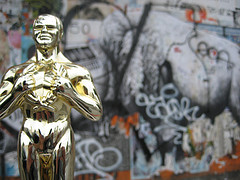
Every year when I watch the Oscars, I wonder about this elusive “Academy” that each winner thanks. It wields such power over which movies become classics and which ones fade away into obscurity. In the build-up to the awards, there’s always much speculation about winning strategies for getting the attention, and votes, of the Academy. UCLA sociologist Gabriel Rossman and colleagues have researched films that have won Oscars over the years and identified a number of predictors of award success, which Rossman recently shared with The Atlantic.

They find that serious roles and “meaty” dramas that are released towards the end of the year (during awards season) are more likely to get nominations. Furthermore, the sociological concept of “cumulative advantage” can be applied to the Oscars, in that talented actors who work with other talented actors are more likely to get an award, rather than one particularly talented actor within an otherwise mediocre film.

These predictors for getting a nomination may seem obvious and even formulaic, but Rossman argues that films must meet these criteria while avoiding the impression of trying too hard. He says, “It turns out that audiences dislike movies that are ‘trying’ to get Oscar nominations but really like movies that actually ‘get’ Oscar nomination.”


Picture 2