
politics

Photo by The Great 8, Flickr CC.

Income inequality is a hot topic this election, and the Panama Papers have added fuel to the fire. Indeed, it seems that there’s no end to the data that shows the discrepancy between the 1% and the rest of us. What will it to start seeking solutions to extreme income disparities?

New research by TSP contributor Kevin Leicht of Urbana Champaign (available in an article in The Sociological Quarterly) points us in the right direction. As he explains in an interview with The Atlantic’s Gillian B. White, the way social scientists and others conceptualize inequality is too tied to trying to increase diversity at the top rather than studying the economy as a whole. Furthermore, while we’ve been very interested in inequality by race, we don’t do enough to consider gender inequalities, particularly as they exist within racial groups. The popular narrative is that hard work can jettison anyone to the top, but research like Leicht’s shows how outdated this notion is.

To read more of Leicht’s work, see his TSP papers, “Has Borrowing Replaced Earning?”, “Economic Decline and the American Dream,” and “Old Narratives and New Realities,” or check out our volume on the new sociology of debt, Owned.
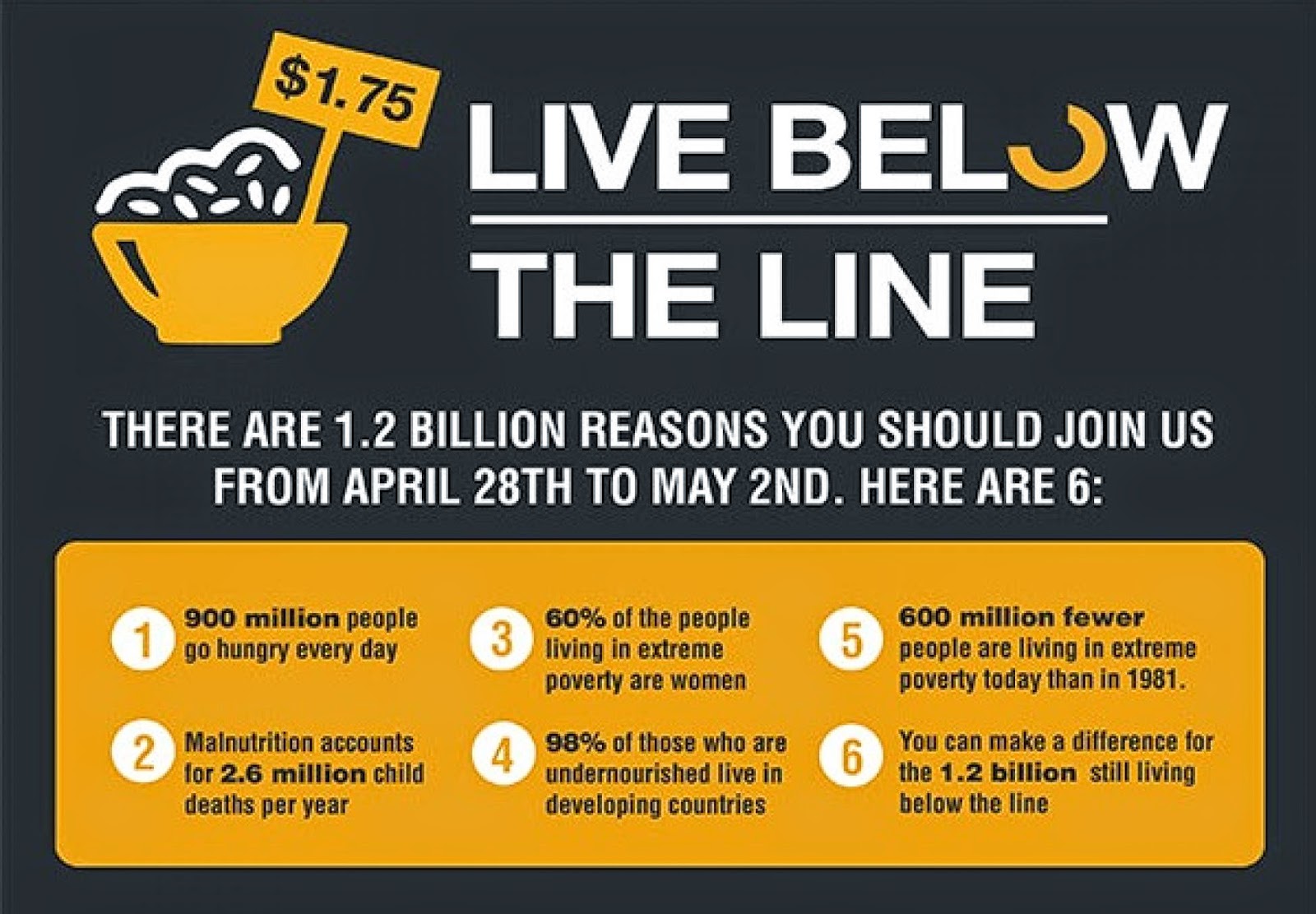
The Live Below the Line campaign helped people in many countries express solidarity with fellow citizens working to make ends meet.
The 2015 Live Below the Line campaign helped people in many countries express solidarity with fellow citizens working to make ends meet.

The U.S. presidential election is beginning to take on issues of poverty and class. Such conversations often look at “the poor” from a careful remove, but work by Thomas Hirschl of Cornell and Mark Rank of Washington University says that outsider angle is a comfortable farce. As explained by an article in Salon, the unpleasant fact is that over fifty percent of Americans will experience poverty during our lifetimes. Impoverishment and “the poor”—and the politics and policies that affect them—are actually very close to home.

Of course, demographic factors are a big part of predicting one’s likelihood of experiencing poverty. (If you’re interested in calculating your own odds, check out Hirschl and Rank’s poverty calculator!) Education is one big factor, as is race: white people are half as likely as non-white people to fall into poverty. And married people are less likely to become poor than singles. Still, as candidates and voters debate nature of class and poverty in America, we would do well to remember that they affect us all. To pretend like anyone’s above poverty would be a poor show.

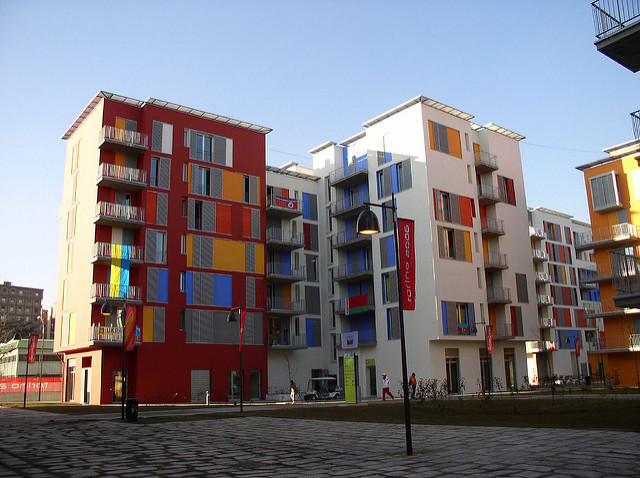
Turin's Olympic Village in 2005, before the athletes arrived. Marco Scala, Flickr CC. https://flic.kr/p/aiymh
Turin’s Olympic Village in 2005, before the athletes arrived. Marco Scala, Flickr CC.

Ever wonder what happens to Olympic villages once the athletes and spectators leave? Some thrive, and some end up as ghost towns.

Turin, Italy’s village has taken an interesting turn. The city tried to make an international name for itself with the 2006 Olympic Winter Games. Sociologist Sergio Scamuzzi, a member of an academic Games-monitoring group called the Olympics and Mega Events Research Observatory, told the Guardian that the Olympics “gave an opportunity to the inhabitants to be proud of the city, of its capacity for innovation, its capacity to organise such a big event.” Soon after the games ended, however, the area was almost abandoned.

Today, Turin’s Olympic village hosts more than 1,000 refugees from over 30 countries. Many of these occupiers were migrant workers from African countries who found themselves out on the streets in 2013, when Italy’s Emergency North African program ended abruptly, and some still survive on seasonal labor farm jobs. The village now features a weekly pop-up medical clinic, common spaces for office and legal advice drop-ins, language classes, barber shops, restaurants, and stores. However, many of the buildings are overcrowded and falling apart. Plans to redevelop the area have been made, and eviction orders have been issued by the government.

The actual eviction of so many seems almost impossible, and residents continue their daily lives despite the threat. According to a resident formerly from Senegal, “For now it’s just words, no one knows what will happen.” In the meantime, an international community lives on in the dormitories and cafeterias that once hosted international athletics’ elite.

The poster for "global warning" film "An Inconvenient Truth."
The poster for “global warning” film “An Inconvenient Truth.”

Beliefs about climate change are not so much about social demographics, but about what else you believe in–your values, worldviews, and political affiliations. The Washington Post recently featured a new analysis reviewing all existing literature on climate change beliefs. They found that people who vote for more liberal political parties are more likely to believe in climate change. In addition, those who are more concerned with the environment–measured by something called the New Ecological Paradigm (NEP)–were also more likely to believe in global warming. Finally, the trustworthiness of scientists was also a strong predictor in individuals’ beliefs in climate change.

Beliefs, though, do not always translate into action. The researchers found that even those who believe in climate change sometimes do not support policies to remedy it. This occurs more as the policies asked about get more specific. According to sociologist Aaron McCright, this disconnect may simply reflect how people feels about those policies regardless of how they help the environment. He says, “even people who are pretty environmental don’t like taxes still.”

So how do these findings help fight climate change? Sociologist Riley Dunlap suggests that since it may not be possible to change people’s minds, activists should focus their resources on mobilizing voter support for politicians who recognize the importance of climate change. Additionally, McCright suggests that conservative leaders who believe in climate change should be more outspoken about their positions. Psychology professor Matthew Hornsey add that the key, to his mind, is making messages about climate change fit with the worldviews of people who generally do not support climate change. Painting environmentalism as patriotic, for instance, may spur support for mitigation policies.

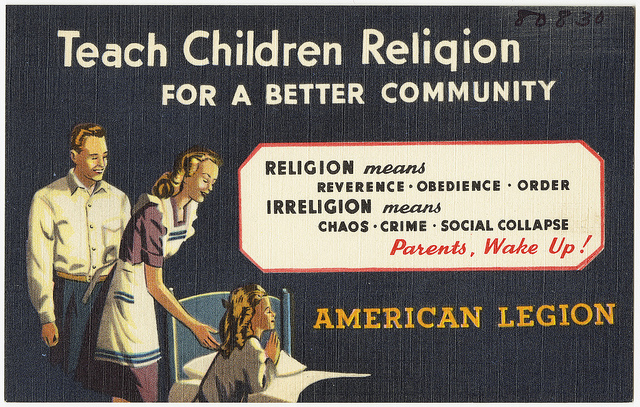
Courtesy the Boston Public Library.

Primary season already feels interminable, and it looks like, among Republicans, Donald Trump is pulling ahead with wins in Nevada, South Carolina, and New Hampshire. The results are perplexing for our typical narratives about conservative politics for a number of reasons, but one of the most striking is that he appears to be doing pretty well with evangelical Christian voters, despite being not terribly religious himself (including a recent flub over “two Corinthians”).

Ted Cruz is a much more committed evangelical candidate. A recent piece in New Republic looks at “How Ted Cruz Lost the Evangelical Vote,” and draws on research from sociologist Lydia Bean on how a simple narrative about conservative religion and conservative politics doesn’t quite fit the reality of contemporary evangelicalism. According to the article:

Bean points out that evangelicals differ not only in their politics—with some identifying as more conservative and others as more moderate—but in their religiosity.

“Evangelicals who don’t go to church very much but identify as Christian, with Christian nationalistic rhetoric, but aren’t very well formed or advised by Christian community leaders—they’re going for Trump,” Bean says. “I think Ted Cruz is picking up the older, more observant people who are theologically and politically conservative, the people who actually go to church every week.” Rubio, meanwhile, “is picking up the younger, more cosmopolitan evangelicals…”

The relationship between religion and politics is complicated, just like any other ideological system. The most interesting sociological point in Bean’s research, though, is how different styles of practice within similar religious communities can teach people to look at politics and their choices in different ways.

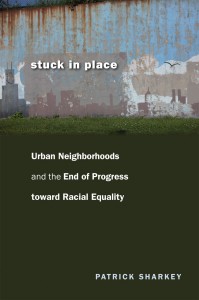
Patrick Sharkey's 2013 book traces generational reproduction of wealth and poverty.
Patrick Sharkey’s 2013 book traces generational reproduction of wealth and poverty.

Democratic presidential candidate Bernie Sanders stated that he is against reparations for African Americans, and the declaration has spurred a fair number of back-and-forth pieces between authors on the political left. One notable article by writer and recent MacArthur “Genius” Grant winner Ta-Nehisi Coates responds to an open letter by Cedric Johnson, a professor of African American studies and political science who critiqued Coates’ call for reparations. Johnson tries to make the case that those who call for reparations are missing the main point: if broad class inequality is addressed, the economic and other inequalities faced by blacks will fall away. Further, Johnson characterizes liberals who disagree with him as uninterested in promoting solidarity. As Coates explains, however, race is far more complex. Whiteness and white identity still confer privilege, and that enduring system is another form of “solidarity,” a historical collection of forces that reinscribe inequality.

Using research from, among others, sociologists Patrick Sharkey of NYU and Robert Sampson of Harvard, Coates shows that white and black poverty are distinct. First of all, blacks are more likely to live in poor neighborhoods in which structural issues such as limited access to healthy groceries and banking are more heavily felt. After all, living in a poor neighborhood can have independent effects on poverty, effects which disproportionately affect African Americans. For example, Sampson’s research shows that incarceration rates in poor black neighborhoods can be forty times higher than in poor white neighborhoods, and incarceration rates are tied to further poverty in many ways. Trying to reduce issues of race to issues of class is, Coates explains, a disservice to both dynamics. Race and class intersect and overlap in ways left untouched by Johnson’s black-and-white characterization of poverty, reparations, and inequality.

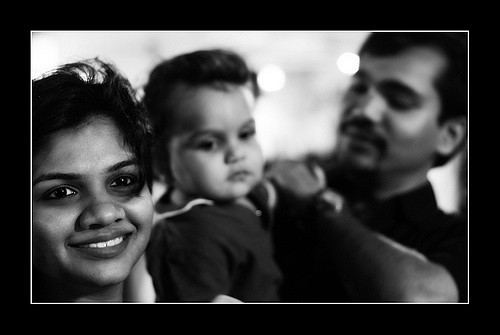
Photo by Abhisek Sarda via Flickr.

For years, legislators and employers have framed guaranteed parental leave as a “women’s issue.” Women serve as the primary advocates for policies that allow more flexibility between work and family life, while fighting stereotypes that paint them as less committed to their jobs than men. In a recent article for Fast Company, sociologist Michael Kimmel discusses how the U.S. lags behind every other industrialized country in policies that guarantee parental leave and how he believes this contradicts “family first” ideals. “Supporting families is the very definition of family values,” writes Kimmel. “How can we possibly lecture others about loving and supporting families when we value our own so little?”

One key to the gradual change that’s come to cities including New York, Washington D.C., and Chicago may be a shift in male perspectives of household work. Recent surveys suggest many men want to be more involved in household duties. Despite that willingness, however, women still bear much of the burden. Consequently, fathers are often praised for more public acts of parenting, like taking children to soccer practice, while mothers are more likely to take care of unsung housework, struggling to also meet the demands of their careers. Further, researchers note that demanding careers cause increased risks of physical and mental illnesses such as heart disease, diabetes, and stress for everyone, not just fathers or mothers.

As legislators craft a new wave of parental leave policies, many question how employers can provide a working environment to support parents and families. In a recent study, Phyllis Moen and Erin Kelly studied the Star Initiative program that allowed for increased flexibility for 700 employees at a Fortune 500 company. The aim was to provide employees with more flexibility in attending meetings, working from home, and communicating via instant messenger. After one year, those involved in the initiative reported greater job satisfaction and lower rates of poor mental health. According to Kelly, “One important implication of this research is that workplaces can change to bring some relief to stressed out workers. It’s not up to an individual to figure out how to balance everything. Challenges come up with work, but organizations can change to bring some relief.”

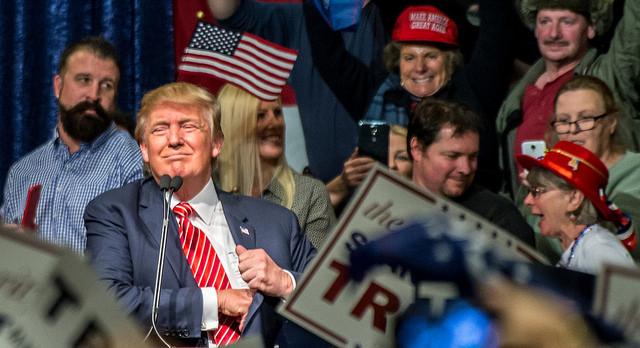
Trump at a Nevada campaign stop, 2016. Photo by Darron Birgenheier via Flickr.

Tonight, we’ll see the 7th GOP Presidential Debate, but how will the public parse truth from fiction? Recently The Conversation asked four scholars to choose and fact-check one statement from the 6th GOP debate. Stealing the show was tonight’s ostensible no-show, The Donald, conflating refugees with immigrants, and both with crime.

To be fair, nearly all the candidates conflate immigrants and refugees, and, in the 6th Debate, they reduced the topics to one: national security. According to sociologist David Cook Martin, refugees are a legal category defined by United Nations, and they undergo an extensive screening process, while immigrant status is determined by U.S. law. The emphasis on immigrants and refugees as a security threat thus leaves no room for acknowledging the ways  migration has helped the U.S.:

To reduce immigration and refugee policy to a matter of national security overlooks the considerable extent to which the cultural, social and economic success of the United States has been linked to migration, including that of the families of five of [the GOP] debate participants. Immigration policy is a complex weighing of security matters, but also of geopolitical interests, economics and the diversity of people and perspectives that have informed U.S. success.

Trump also claimed that migrants coming to the U.S. are primarily “strong, powerful men,” again drawing on stereotypes of immigrants and refugees as threats (previously, he had notoriously said that Mexican immgirants, in particular, were rapists and drug dealers). Hadar Aviram, professor of law, points out that this is plain old wrong. First, of the 1,682 Syrian refugees entering the U.S. last year, 77% were women. And while immigrants are often associated in the popular imagination with criminality, scholars agree—and sociologist Ruben Rumbaut has shown time and time again—that immigrants actually commit less crime than native-born Americans. Aviram argues that Trump is distracting the public from other issues, like the tax breaks for the wealthy he plans to make and that might actually harm middle-class and working-class Americans, by drawing attention to a “demonized ‘other.’”

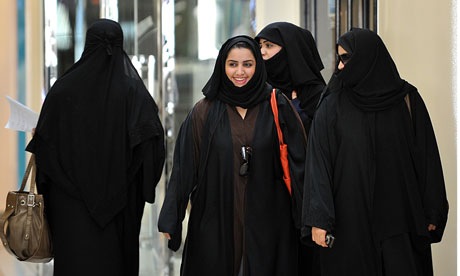
In Riyadh. Tribes of the World, Flickr CC.

Saudi women have just achieved the right to vote. Sociologist Mona Salahuddin Al-Munajjed showcases the power and roles of such Saudi women through her books and her work with on social issues with the United Nations.

Al-Manajjed told Arab News,

There is a huge misconception and misunderstanding in the rest of the world about the status of women in Saudi Arabia, which I realized while pursuing my higher studies in the United States and traveling abroad subsequently.

In the book, Saudi Women: A Celebration of Success, Al-Manajjed interviews those who “have made a difference in society with their education, professionalism, socioeconomic impact and contributions to the Kingdom, becoming a role model and an inspiration for the younger generations.”

Throughout, she introduces readers to educators, businesswomen, bankers, doctors, scientists, philanthropists, writers, actors, and decision makers, giving a glimpse into their lives and achievements. Consider another major advancement for Saudi women’s rights: new entrée into the Shoura Council. That change was driven by driven women.

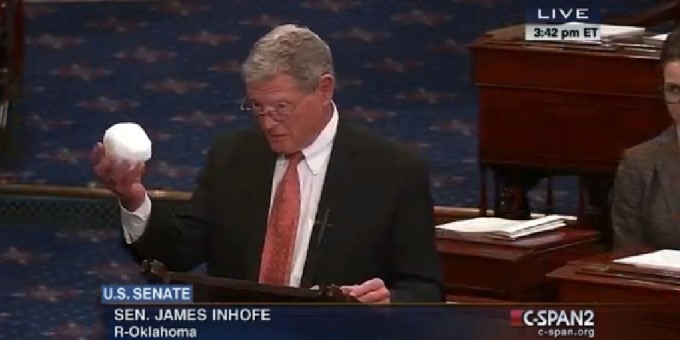
CSPAN screenshot via Washington Post.

Alongside the U.N. Framework Convention on Climate Change, the media and presidential candidates have been making a lot of small talk about weather. Though there’s nothing new about the issue “climate change,” and the preceding term “global warming,” not everybody is on board. Republican candidates including Donald Trump, Chris Christie, and Ben Carson continue to deny climate change, even as the evidence mounts. Often, these candidates state they don’t place much stock in “science.”

An article on Huffington Post discusses this dynamic with help from environmental sociologists Riley Dunlap from OSU and Aaron McCright of MSU. They describe how, particularly among conservative voter bases, people are more likely to seek out information that they agree with while, ignoring what challenges their preexisting ideas. In addition, high-profile skeptics such as political figures can generate an “echo chamber.” In essence, people hear their beliefs reinforced within their social networks; groups can normalize and strengthen particular beliefs or ideologies by simply listening to each other instead of finding new information. As the article describes, even in the face of increasing scientific evidence of climate change, some will remain cold to the idea.