
politics

Pollution at the Great Wall of China. Photo by Thomas Galvez via flickr.com.
Smog hangs over the Great Wall in China. Photo by Thomas Galvez via flickr.com.

China is suffering an environmental crisis, and it’s become a health hazard. Using social media, young activists are now disseminating shocking photos and information. Through their lenses, we see Beijing’s air, thick with smog, and rivers lined with hundreds of rotting animal carcasses. For Chinese and world citizens, it seems clear these environmental problems can’t be ignored, and protests have sprung up across China, especially on its Eastern seaboard. In an interview in Dissent Magazine, Jeffery Wasserstrom asks Duke anthropologist Ralph Litzinger to discuss China’s new environmental movement.

One of Litzinger’s most interesting research findings is that there is a major class discrepancy in reacting to the environmental issues:

Much of the publicity about deteriorating air conditions came from a new kind of middle-class activist citizen who took to the streets to monitor the air, posting findings and images on weibo (the Chinese version of Twitter) and other social networking platforms. […]But head out into the outer rings roads of Beijing, where the poorest of Beijing’s migrants and residents live and work, and you experience a very different situation. You see fewer people wearing masks, and hear much less complaining about the air. It is not that migrant and urban fringe communities in Beijing don’t care about health and environmental issues; it is just that they haven’t received the same kind of attention that the middle-class urban resident has received.

In China, the middle and upper classes are able to assess their environmental situation and adapt. They may shop for organic foods, build protection from the poisonous air, stay home from work or school on bad air days, or even leave the country. The poor are merely left to brave their new, toxic environment—at least until their richer countrymen make major changes.


NBP Gold by Giorgio Monteforti via flickr
NBP Gold by Giorgio Monteforti via flickr.com

Much of Switzerland’s wealth is built upon its powerful and secretive financial sector.  While it has long been a safe haven for wealthy individuals seeking to stash their cash, sociologist Jean Ziegler (no relation) argues that it is time for the famously neutral nation to reform its banking sector. In an interview with German newspaper Der Spiegel, he asserts that the country has enriched itself through stolen goods:

Money comes to Switzerland through three illegal sources: tax evasion in other developed countries, the blood money of dictators and other rulers in the Third World and organized crime.

Ziegler, who served on the Swiss National Council for 18 years and also acted as the U.N. Special Rapporteur on the Right to Food for another 8, is lukewarm about the prospects for change. On the one hand, he sees popular pressure from neighboring Germany and data leaks that could reveal the origins of deposits in his country’s banks.  That said, he notes that much inertia must be overcome before real change can happen.

The structure of the Swiss ruling class is rock-hard, and unchanged since the time of Napoleon. They sit on their mountains and lecture the world on democracy.

Photo by boltron- via Flickr.com
Photo by Nate Bolt via Flickr.com

If you’ve ever taken a survey, you know what it’s like to feel limited in giving an opinion: a simple “agree” or “disagree” doesn’t always capture the complexity of opinions; a few blank lines may leave too much room for you to be clear in your response; or maybe you don’t have an instant opinion when probed about a given subject, but you heard your mom talking about it, you feel forced to pick a side, and you quickly regurgitate her opinion.

These are only a few reasons sociologist Herbert Gans warns that “public opinion polls” can’t live up to the name. As he points out in an article from the Nieman Journalism Lab:

If poll results can be interpreted as opinion, they are pollster-evoked or passive opinions. They are not the active opinions of citizens who feel strongly about, or participate in some way in the debates about forthcoming legislation or a presidential decision.

Gans explains the differences between “answers” and “opinions,” and suggests that the media start informing its audiences on this subject. He also believes that the media should start offering more context around public opinion poll results to illustrate what the public is actually thinking. As it stands, communications to elected officials or involvement in town-hall meetings and demonstrations may be far more representative of a given community’s “opinion” than poll results.

Just gotta find the gold one… Photo by takingthemoney via flickr.com

It’s been decided! The winner of the March 2013 TSP Media Award for Measured Social Science goes to:

Anthropology Inc.,” Graeme Wood, The Atlantic.

Wood explains that corporations are seeking the help of social scientists to understand the qualitative dynamics of consumer behavior. To illustrate, Wood delves into one strategy consulting company’s struggle to understand consumers’ needs in China:

“We find that these objects have meanings, not just facts,” Madsbjerg says, “and that the meaning is often what matters.” So to sell a personal computer in China, for example, what matters is the whole concept of a “personal” computer, which is culturally wrong from the start. “Household objects don’t have the same personal attachment [in China as they do in America]. It has to be a shared thing.” So if the device isn’t designed and marketed as a shared household object, but instead as one customized for a single user, it probably won’t sell, no matter how many gigahertz it has.

TSP author Andrew Wiebe wrote a citing on this article which outlines the problem-solving Absolut Vodka did with the help of anthropologists. To see more examples of how social scientists are helping unearth consumer insights, check out Wood’s article—a lengthy, but fascinating read.

As we say often, the choice of each month’s TSP Media Award is neither scientific nor exhaustive, but we do work hard to winnow our favorite nominees. And, while we don’t have the deep pocketbooks to offer enormous trophies or cash prizes, we hope our informal award offers cheer and encouragement for journalists and social scientists to keep up the important (if not always rewarding) work of bringing academic knowledge to the broader public.

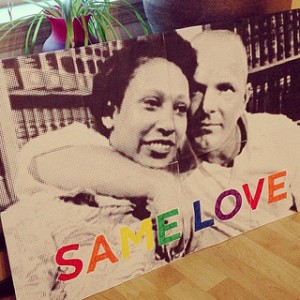
One sign, made to be displayed outside the Supreme Court as it hears arguments on DOMA and Prop 8, hearkens back to the days of arguments about interracial marriage, using a photo of Mildred and Richard Loving, who famously won their case, Loving v. Virginia, before the Supreme Court. Photo by Reed Probus via flickr.com.

Last week, the Supreme Court began hearing arguments regarding California’s Proposition 8, a ballot initiative that became a constitutional amendment legally defining marriage as an institution solely for the benefit of one man and one woman. On March 26, Justice Anthony Kennedy suggested the Court might simply dismiss the case, Hollingsworth v. Perry, without a ruling, so as not to dive into “uncharted waters,” particularly when the Court is considering another, related case.

Minnesota Public Radio invited Kathleen Hull, a sociologist at the University of Minnesota, to discuss the Court’s apparent willingness to side-step the case. She cited the results of a new PEW study showing that the younger generation was about 75% in favor of legalizing same sex marriage. She confessed:

Increasingly I find it difficult to engage the 18-22 year-olds on the same-sex issue. They are bored by it… They don’t know what there is to talk about.

Hull told MPR that California’s law not only lags behind public attitudes, but also behind the business and entertainment worlds. She also refutes claims that there isn’t enough data to rule on the subject if it’s considered through the lens of child-rearing:

I was a little stunned when one of the justices said something to the effect of “yeah, we don’t have any information on this.” […] We have decades of research now on the effects of same-sex parenting on children and it is all kind of in the same direction: That there is no difference from being raised by heterosexuals.

In fact, there is such a great deal of research in this area that the American Sociological Association went on to file an amicus curiae (that is, a “Friend of the Court”) brief outlining the social scientific consensus around the quality of parenting across different family forms. Interestingly, Justice Scalia then went on the record stating that there is no such consensus; he appears to have taken his cue from another amicus brief coauthored by Mark Regenerus, who has stirred up controversy with his own findings that children of homosexual parents do not fare as well as those raised by heterosexual couples. Clearly, this fight isn’t over.