politics

Screen Shot 2014-06-23 at 10.25.19 AMWhat do you get when you cross professor Carolyn Liebler from the University of Minnesota Sociology Department, Census data, and issues of identity? An immigration reform segment on the Colbert Report.

Recently, the Comedy Central satirist pulled a quote from Liebler’s research saying:

 2.5 million Americans who said they were Hispanic and “some other race” in 2000… a decade later, told the census they were Hispanic and white.

Of course, Colbert went on to explain his version of these findings: that Hispanics were voluntarily becoming white. Colbert points out that white people live in the best neighborhoods and get the best jobs, among other things. With that logic, why not “choose” to be white?

From a sociological perspective, he might have something there. Issues of identity are fluid. Looking at such a large change in the Census data provokes questions as to why this variation in identity exists. In an interview with NPR, Liebler drew a parallel to her work studying Native American identity:

Between 1960 and 1970, nearly a half-million more Americans identified themselves as Native American—a number that was too large to be explained by mere population growth, she said. Something else had to explain it.

In Colbert’s telling, ethno-racial identification shifts will be key in Republican victories in upcoming elections—the more people who identify as “white,” the more votes the GOP will garner.

Check out the clip here! For more on race and ethnicity among Hispanic Americans, see Wendy Roth’s “Creating a ‘Latino’ Race.”

m_350_oc_1sht_V1.inddThe comedy Obvious Child hit theaters last Friday, and it’s been praised as “the most honest” abortion movie Slate‘s Amanda Hess has ever seen. Honest, in that the film’s protagonist Jenny Slate decides to have an abortion and goes through with it. Her relationship does not implode, she does not suffer crippling guilt, and she survives. Her life goes on. It turns out that this kind of straightforward portrayal is a rarity in American film and television, though millions of women have abortions every year (the Guttmacher Institute pegs the number of worldwide procedures at about 42 million per year). In a recent Contraception article, a pair of sociologists report that pre-Roe v. Wade era plotlines disproportionately featured the death of women characters who even thought about abortion. After abortion’s legalization, portrayals came to suffer from a different distortion: “These movies tell us that it was wrong [before Roe] for laws to dictate what a woman ought to do with her body, but now that she has the choice, she should choose to give birth except under the most extenuating of circumstances,” Hess writes. Obvious Child rejects, well, the obvious.

Watch the trailer for the film here.

A Guardian UK graphic from 2011 draws on execution data from Amnesty International.

In societies that allow for the death penalty in criminal punishment, there has been a shift toward ever more “humane” methods of execution. The rhetoric surrounding these changes generally involves not violating the rights of the prisoner by applying a cruel or unusual punishment—that is, just death, not torture.

In an interview with The Voice of Russia, University of Colorado professor Michael Radelet explains that the real motivations for a turn toward the medicalized execution may have more to do with minimizing the suffering of the audience than the condemned. When asked if there was a humane way to kill someone, Radelet points out that shooting and guillotining have no history of failure, unlike generally bloodless lethal injection (recently pegged at 7% in the U.S. by Amherst College’s Austin D. Sarat).

“Most state authorities in the US couldn’t care less whether or not the inmate suffers, what they care about is the suffering by the audience. This all has to do with the spectators.” Apparently, modern sorts want their vengeance deadly, but not grisly.

Radelet says that the death penalty is mainly political, allowing the public to be convinced their society is tough on crime. If the obvious question in the death penalty debate is: Do you support the death penalty? Data Radelet cites points to a more thorough question: Do you support the death penalty, given the alternative of life without parole? When the question is rephrased, support for the death penalty actually goes up a bit. It seems that, when the respondents consider a lifetime of suffering against death, their views on the suffering of others shift yet again.

Courtesy the Boston Public Library.

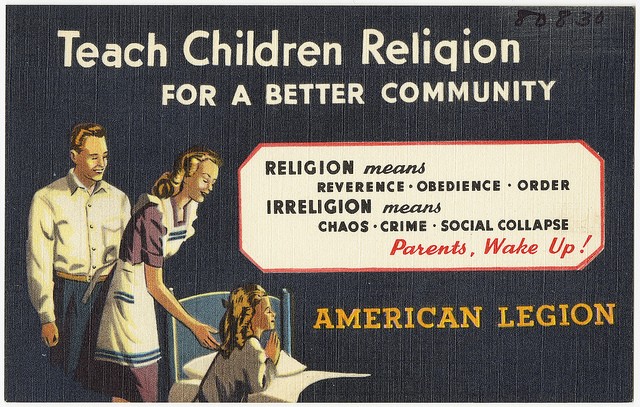
It’s been a busy time for social facts on religion in American life. First, The Washington Post reported new data from the Pew Forum suggesting that more Americans would be willing to vote for an atheist president. While the original report noted that atheism is still a “top negative” for voters—with more respondents saying it would make them less likely to vote for a candidate than drug use, political inexperience, or an extramarital affair—there is still some optimism in the fact that this number has declined by 10% since 2007.

Second, a new report from the Public Religion Research Institute found that Americans are still over-reporting their church attendance, moreso in phone than in online surveys. The Huffington Posthosted a roundtable on the issue, and a take in The Atlantic emphasized the political implications of this data—liberals are more likely to inflate their church attendance than conservatives, and this may be because of negative stereotypes that liberals are “anti-religion.”

In a journalistic trifecta, all three stories noted research from Minnesota sociologists Penny Edgell, Joseph Gerteis, and TSP’s own Doug Hartmann on the continued stigma faced by atheists in American culture. From The Atlantic:

When three University of Minnesota sociologists surveyed American religious attitudes in 2006, they found “not only that atheists are less accepted than other marginalized groups but also that attitudes toward them have not exhibited the marked increase in acceptance that has characterized views of other racial and religious minorities over the past forty years.” Americans are today more likely to say they would vote for a Muslim or a gay or lesbian for president than an atheist.

Edgell also discussed current trends in church attendance on The Huffington Post and updated her 2006 research in The Washington Post:

A 2006 study by University of Minnesota sociologist Penny Edgell found atheists were the most mistrusted minority in the U.S. Edgell said Tuesday that an updated study based on a 2014 online survey would be released soon. Preliminary results show the mistrust meter hasn’t budged.

Despite an inclusive trend in what Americans say they look for in a candidate, religious identities are still an important marker of who can lead the flock(s).

For more on the cultural factors that may be driving these trends, check out this classic TSP feature: The Social Functions of Religion in American Political Culture.

In the U.S., it’s enough to cause concern, Amherst College’s Austin D. Sarat tells “All Things Considered.” After a botched execution—that is, one that did not follow protocol, did not kill the prisoner, or did not kill the prisoner in a way that prevented suffering—in Oklahoma, the co-author of the forthcoming Gruesome Spectacles: Botched Executions and America’s Death Penalty (with Katherine Blumstein), said that the country has seen a 3% rate in botched executions overall. And though legislators have favored scientific progress in the death chamber, choosing hanging, then electrocution, lethal injection, and finally, today’s three-step injection process, the record of by-the-book executions is getting worse.

The rate of botched executions by lethal injection is now up to 7%, according to Sarat’s studies.

Lethal injection by the current process is meant to be more humane in that it is more scientific. It also removes any one person in the execution chamber from personal responsibility for the prisoner’s death, as each injection is delivered by a different person. But when it fails 7 out of 100 times, the experience is likely to be a “gruesome spectacle” for prison staff, prisoner, and viewers alike.

For more on the death penalty in the U.S., listen to our podcast with David Garland, author of Peculiar Institution: America’s Death Penalty in an Age of Abolition.

Photo by Nicolas Raymond via flickr.com

Is economic development compatible with environmental sustainability? Are “green jobs” the way of the future? Those questions are at the center of sociologist Andrew Jorgenson‘s research on the economic activity and carbon emissions of 106 countries.

Analyzing data from 1970 to 2009, Jorgenson calculated a ratio of carbon emissions to life expectancy at birth, and then compared it with each country’s gross domestic product. The results are not encouraging. Jorgenson found that in all regions of the world except for Africa, development is linked with an increase in carbon emissions. Africa may be the exception that proves the rule. Jorgenson noted that, since 1995, African nations have experienced much more carbon-intensive development in exchange for increasing life expectancies of their populations.

Achieving the three-legged stool of economic growth, reduced harm to the environment, and improved human health will not be easy, and Jorgenson is skeptical that technological advancements alone are likely to accomplish the task. “We need to start seriously thinking differently about solutions to these sustainability challenges and recognizing that hoping for technology and engineering solutions … is probably not the way to go,” Jorgenson said.

Picture 2


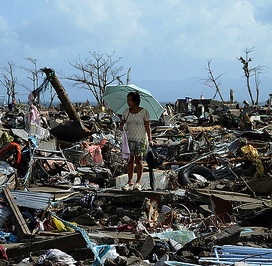
The aftermath of Typhoon Haiyan in the Philippines. Photo by Jordi Bernabeu
The aftermath of Typhoon Haiyan in the Philippines. Photo by Jordi Bernabeu via flickr.com

With death toll rising from the devastating typhoon in the Philippines this week, it seems that we’re constantly being reminded of the destruction of natural disasters, especially for rural and poor areas. Rural communities can be difficult to reach in times of environmental chaos, and poorer regions don’t always have the resources to cope with a crisis. When city services shut down or relief aid doesn’t come through immediately, community members band together to manage the aftermath of the disaster as best they can.

Sociologist Eric Klinenberg believes that community resources including “public places from libraries to mom-and-pop shops and coffee shops” can influence the outcomes of a crisis by providing the community the familiarity and support they need. In researching one such disaster, the 1995 Chicago heat wave, Klinenberg found that the residents of neighborhoods with more social infrastructure—like libraries and coffee shops—fared much better during the heat.

Those resources so dramatically improve the quality of our life on a regular day, but when there’s a heat wave or a hurricane or some other disaster, they can make the difference between life and death. In the Chicago heat wave, they did.

These types of social infrastructure benefit communities beyond times of crisis, according to Klinenberg who argues,

The nice thing about investing in climate security through social infrastructure is that the residual benefit is that we could dramatically improve the quality of life in these places all the time regardless of the weather. And it’s that kind of intelligent design that we desperately need at this moment.

Picture 2


Photo by Jeff Kubina via flickr.com

With Illinois poised to become the fifteenth state to legalize gay marriage (when Governor Pat Quinn signs the bill into law on November 20), the tide of public opinion about legal rights for same-sex couples seems to be changing at a rapid rate. In a recent NY Times article, Ross Douthat argues that this trend is also evident in other cultural debates, including attitudes toward the legalization of gambling and marijuana.

Since 1990 when casinos were isolated to Nevada and Atlantic City, almost half of states have legalized and developed commercial casinos. Rather than a Hangover-style bachelor weekend in Las Vegas, for many people, casino-going is a much more mundane experience, a regular weekend excursion.

Additionally, the public opinion ratings about marijuana legalization have grown at the same rate as approval for gay marriage. Indeed, in addition to the recreational legalization of pot in Washington and Colorado, twenty other states have already legalized medical marijuana.

Douthat uses late sociologist Robert Bellah’s concept of “expressive individualism” to explain these attitudinal and  legislative changes. Expressive individualism refers to the notion of being free to express oneself through rich experiences and feelings without restrictions. For Douthat, expressive individualism highlights “the rise of a live-and-let-live social libertarianism, the weakening influence of both religious conservatism and liberal communitarianism, the growing suspicion of moralism in public policy.”

However, in the midst of this growing support for individual choice and freedom, Douthat cautions against the social consequences of some of these new policies. He argues,

Previous societies made distinction between liberty and license that we have become loath to draw—because what seems like a harmless pleasure to the comfortable can devastate the poor and weak.


Picture 2


Credit to Michael Whitney via Flickr.com

Sociologist Frances Fox Piven is one the most dangerous people in the world (at least, Glenn Beck thinks so). So why would Salon sit down with her? She’s also an expert in social movements. Reporter Josh Eidelson goes in depth with Fox Piven on the continued power of the Tea Party, the Occupy Movement, and the power of youth.

One of Piven’s most interesting points regards the power of disruptive movements. She discusses the Occupy Wall Street Movement and its offshoots, asserting that two of its most successful strategies were flamboyance and the ability to disrupt business. These strategies have yielded success for Occupy, but also for a larger ambition for social change. Indeed, as Piven points out, Occupy influenced the rhetoric of American politics and helped show that the grassroots power of other decades is far from gone. She even believes working outside the system is now the most effective path to progress:

“Going to Washington is largely a waste of time. But causing trouble is not.”

Does the "wrong" come in creating the secret or telling it? Photo by John Perivolaris via flickr.com. Click for original.
Does the “wrong” come in creating the secret or telling it? Photo by John Perivolaris via flickr.com. Click for original.

Philosopher Peter Ludlow, a faculty member at Northwestern University, writes in a recent post for “The Stone” blog on NYTimes.com that, instead of undermining systems and generally acting immorally, people like Chelsea Manning and Edward Snowden took real risks to expose what Hannah Arendt famously called “the banality of systemic evil.” In a lengthy dissection, Ludlow looks at the leaks that so many have condemned and, noting that one of Aaron Swartz’s self-professed favorite books was the sociology text Moral Mazes, and finds an emerging extra-institutional morality across the cases. Ludlow concludes:

…if there are psychological motivations for whistleblowing, leaking and hacktivism, there are likewise psychological motivations for closing ranks with the power structure within a system — in this case a system in which corporate media plays an important role. Similarly it is possible that the system itself is sick, even though the actors within the organization are behaving in accord with organizational etiquette and respecting the internal bonds of trust.

Just as Hannah Arendt saw that the combined action of loyal managers can give rise to unspeakable systemic evil, so too generation W has seen that complicity within the surveillance state can give rise to evil as well — not the horrific evil that Eichmann’s bureaucratic efficiency brought us, but still an Orwellian future that must be avoided at all costs.

For more on weighing the costs and benefits of surveillance, be sure to check out “A Social Welfare Critique of Contemporary Crime Control” and pretty much all of the Community Page Cyborgology here on TSP. For more on moral ambiguity, consider Moral Mazes by Robert Jackall (updated and released in paperback by Oxford University Press in 2009) and Teaching TSP’s piece on the “Obedience to Authority” and the Milgram experiments.