Tag Archives: gender: education

In Defiance of Title IX: Colleges Report Male Athletes as Women

For the last week of December, we’re re-posting some of our favorite posts from 2011. Originally cross-posted at Ms.

————————

The New York Times has a fascinating 3-minute video on “roster management”, sent in by Emma M.H.  The term refers to manipulating Title IX rules in order to appear like you’re following them when you’re not.  Title IX is an amendment to the U.S. Civil Rights Act that requires that all schools allocate their resources to men and women in proportion to their interest and enrollment.  It is most famous for what it required of college athletics, and this is what this story is about.

As the article explains, schools demonstrate compliance with Title IX:

…by showing that the number of female athletes is in proportion to overall female enrollment, by demonstrating a history of expanding opportunities for women, or by proving that they are meeting the athletic interests and abilities of their female students.

Once implemented, women responded enthusiastically to the new opportunities.  But spectators and donors are less interested in women’s sports, it turns out.  And so colleges have found various ways to resist Title IX rules, including simple non-compliance.

In this case, the strategy is  to put men on women’s teams and then report them as female athletes.

Case in point: This is Cornell’s women’s fencing team:

It turns out, 15 of the 34 team members are men:

The men don’t actually compete, they are simply “practice players” (helping the women improve due to their greater speed and strength, says the coach).

The basketball team has a similar strategy.  A number of males practice with the team and then are reported to the authorities as female players.

Revealing that this is an attempt to manipulate Title IX rules and not a simple weird way of accounting for athletes, the five female coxswain’s on the men’s rowing team is reported not as male, but as female.

So there you have it.  Despite Title IX, these schools are finding ways to continue to spend a disproportionate amount of money on male athletes.  According to the Department of Education, this is well within the law.

Other sneaky moves documented in the article:

Quinnipiac University in Connecticut had violated Title IX by engaging in several questionable practices, including requiring that women cross-country runners join the indoor and outdoor track teams so they could be counted three times. The judge found earlier that Quinnipiac had been padding women’s rosters by counting players, then cutting them a few weeks later.

At the University of South Florida, more than half of the 71 women on the cross-country roster failed to run a race in 2009. Asked about it, a few laughed and said they did not know they were on the team.

Sarah Till, who graduated from South Florida in 2009, was a more extreme case. She said that she quit and returned her track scholarship in her sophomore year, but her name was listed on the rosters of all three squads through her junior year.

The University of California, Irvine, is among at least five California universities that sponsor women’s indoor track teams despite a mild climate and a dearth of indoor facilities. Those universities do not offer men’s indoor track.

Last year, an investigation by the Office for Civil Rights concluded that Irvine was not complying with Title IX because its indoor track team was essentially a ruse. It competed in just one meet per year and several women on the roster “vigorously stated” that they were not on the team.

Read the article and watch the video here.

Education and Earnings Potential

The Census Bureau posted some information about the economic payoff of a college degree on their blog, Random Samplings. A recent report indicated that educational level had a bigger impact than any other demographic factor on lifetime earnings. More education leads to both higher incomes not just because those with more education receive higher salaries, but also because they are more likely to be in full-time jobs. The x-axis here shows the % of people in full-time, year-round jobs:

Not surprisingly, the gap in earnings widens over time, especially for those with a bachelor’s or higher degree compared to those with less:

The report also estimated lifetime earnings by race/ethnicity for men and women separately. As they point out, except for a couple of cases at the very highest educational levels, men from even the most economically disadvantaged racial/ethnic groups out-earn women from the most economically advantaged ones:

Of course, not all college degrees are equal. Dolores R. sent in a link to an interactive table from the Wall Street Journal that lets you look at earnings and the unemployment rate for various majors. I sorted them by median earnings; here are the ten with the lowest median earnings:


And the ten with the highest:

The highest unemployment rate? Clinical psychology, at 19.5%.

You can also search by area (art, engineering, etc.), though it looks like the categorization may be a little sketchy — for instance, “geology and earth science” and “liberal arts” show up under the arts.

For more on college majors, earnings, and future career opportunities, see the report College Clusters: Forecasting Demand for High School through College Jobs, 2008-2018, from the Georgetown University Center on Education and the Workforce.

Boys, Social Control, and School Dress Codes

Two additional cases of a boy being subject to schools rules that don’t apply to girls prompts a re-post. I’ve added the new instances to the end.

Tara C. sent us a link to a story about a 4-year-old boy who has been given in-school suspension (and was threatened with expulsion) for having hair that breaks the dress code for the Dallas, TX, school system:

Dmitriy T.M. sent in another story, this one featuring a 6-year-old named Gareth who was being placed into in-school suspension (i.e., spending all day each day in the principal’s office) because of his long hair and earring.

So, this still you see of him below… that’s what counts as long hair. And, can you spot the earring in his left ear? It’s there.

In another case, 16-year-old Kasey Landrum was suspended for wearing eye-liner on school grounds (after classes were out):

Of course, these aren’t just about enforcing a dress code. It’s a gendered code; girls aren’t required to have short hair cuts, because on girls, longer hair isn’t “distracting,” it’s “normal.”  As is make-up and earrings.  Implicit in the idea of what counts as an appropriate appearance, then, is the gender of the person wearing it.  These cases reveal, further, that girls are allowed more choices than boys because we are more accepting of girls acting boyish than boys acting girlish (in what sociologists call “androcentrism“).

The final case also reveals the importance of intersectionality, or the way that different identities come together in complicated ways. Landrum claims that an ostensibly heterosexual boy was allowed to wear punk-style make-up to school on the same day.  So breaking gender rules is apparently okay if you affirm that you’re heterosexual, and maybe being gay is okay if you don’t break any gender rules, but doing both is going too far.

Gender Gap in Science and Tech Jobs

Cross-posted at Scientopia.

The U.S. Department of Commerce just released a report on the continuing gender gap in STEM jobs – that is, science, technology, engineering, and math. While women make up roughly half of the total paid workforce, they still held only a quarter of STEM jobs as of 2009:

In fact, we saw no change in the gender make-up of STEM fields between 2000 and 2009.

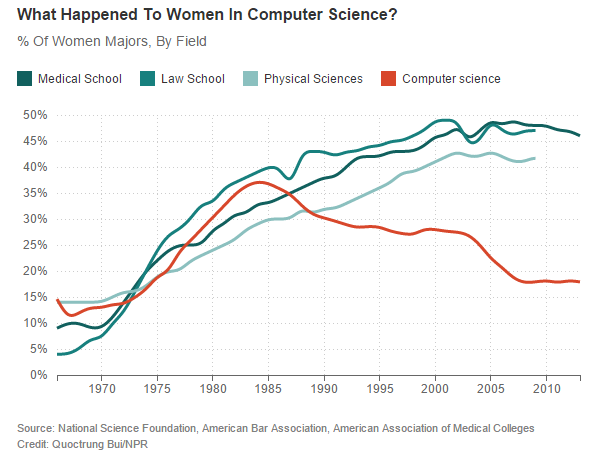
There is significant variation in the gender composition within the STEM category, however. At the high end, women hold 40% of jobs in the physical and life sciences; the low point is engineering, where only 14% of employees are women. And the proportion of women in computer science and math jobs actually fell between 2000 and 2009, from 30% to 27% of workers.

This isn’t simply because of differences in education, either. Here we see the proportion of both men and women in STEM jobs at various educational levels; while increased education correlates with a higher likelihood of having a STEM job for both groups, women are significantly less likely than men at every educational level to have a STEM job:

The gender disparity in STEM jobs is especially noteworthy because, on average, STEM occupations pay significantly more than other private-sector jobs, and the gender gap in pay is actually lower than in non-STEM sectors:

If we look only at women with bachelor’s degrees, women who earn STEM degrees and work in STEM jobs earn, on average, 29% more than other women.

So the underrepresentation of women in STEM jobs means that women are missing out on some of the best-paying occupations in the U.S.; in fact, this type of gender-segregation of jobs is one of the leading causes of gender gap in yearly and lifetime earnings.

The authors of the report don’t go into detail about potential causes of the gender gap in STEM careers, though they note that among those earning STEM degrees in college, women are significantly less likely than men to hold jobs in related STEM fields. They suggest this might be because STEM jobs are relatively unaccommodating to those who take time off for family obligations (disproportionately women), because of a lack of female role models in STEM fields (including as college professors), or because of gender stereotyping about math or science aptitude (like this, or this if you prefer a t-shirt) that pushes women away from STEM degrees and careers. [UPDATE: Broken links fixed!]

The complex interplay of factors that lead to a gender gap in who holds STEM-sector jobs provides significant challenges to increasing the proportion of women in these occupations — as indicated by the lack of change over the past decade. But particularly as we see increasing economic divergence between well-paid tech and information sector and low-paid service sector jobs, addressing the underrepresentation of women in STEM jobs will be essential as part of any effort to improve women’s lifetime earnings potential and overall economic outlook.

Post-High-School Pathways of Men of Color

The College Board has released data from an initiative with the aim of better understanding the educational pathways of men of color.  Their site includes testimonials from many of these men, in addition to the data below.  And they included Native American men, a group almost always left out of quantitative data analysis because they are such a small percent of total Americans (in a profound and tragic irony).  Here’s the data on what each group of men are doing after high school.

About 1/3 of African American and Hispanic men are enrolling in some sort of college, another 34 and 47%, respectively, face unemployment.  A significant proportion go straight into work.  The 5% incarceration rate for Hispanics, and the 10% rate for Blacks, is a sad testimony to the over-policing of poor, urban neighborhoods, racial profiling, and emphasis on prosecuting the crimes of the poor.

Native American men are significantly less likely than Black men to go to college or vocational school.  They are most likely to straight into a job or be unemployed.  While not all all Native American men live on reservations — not by a long shot, those that do are more likely to be unemployed because of the dismal economic profiles of many of these regions.

Asian men are more likely to enter postsecondary education than either Native American or Black men, but the 61% is balanced by a good 30% ending up unemployed.  This reflects the diversity of the Asian community.  Some Asian groups do very well in the U.S. — e.g., Japanese and Asian Indians — others are still struggling — e.g., Hmong and the Vietnamese.

The charts below compare men and women in each group.  Each, with the exception of Native Americans, reveals the feminization of postsecondary education and the relative advantage women see in the market (mostly because we’ve got a strong service economy that hires women disproportionately).

Hat tip to Sociology Lens.

The Promise and Perils of Hook-Up “Culture”

(view the slideshow)

Back in the spring, Lisa gave a talk at Franklin and Marshall College about data about the newness, prevalence, and content of “hook ups” on American campuses. Surprise, today’s college students didn’t invent casual sex and there’s no need for their parents to worry about a “bacchanalian orgy” in one dorm after another.  Concluding that the problem isn’t “too much” sex, she argues that the problem is too much bad sex.

In her own research, Lisa has found that students want sex to be pleasurable, empowering, or meaningful.  But, alas, they seem to have difficulty achieving any one of those things in great measure.  The culprit, she concludes, isn’t hooking up, it’s hook up culture.  When a hook up culture dominates, all other ways of being sexual are repressed, and that leaves many students involuntarily celibate or having sex they don’t really want. The solution: an opening up of sexual options that allow students to truly, genuinely explore their own sexualities safely.

Franklin and Marshall College arranged to have the lecture filmed, but Lisa was too shy to post it on Soc Images. But she sent me the link to the talk, and I have no such misgivings. Unfortunately, the camera was set up at an angle where you can’t see the PowerPoint presentation that went along with the lecture, so you’ll have to look through it separately if you’re interested (slideshow and transcript if you’d rather read).  Lisa’s got other talks too, if you’re interested, and I know she loves giving them.

Common Hour: The Promise and Perils of Hook-Up Culture from Franklin & Marshall College on Vimeo.

Common Hour: The Promise and Perils of Hook-Up Culture from Franklin & Marshall College on Vimeo.

Funeral Divas: Creating Space for Women in the Funeral Industry

I have posted before about the ways those who handle the dead may try to humanize themselves so as to avoid the stigmas often associated with their jobs. Individuals who have jobs that require them to touch or be around dead bodies often find they are negatively stereotyped as creepy, gross, or as taking advantage of families in times of pain. They engage in various strategies to try to resist those stereotypes, including redefining the job and attempting to present it as something valuable and respectable (a “funeral director,” after all, sounds much nicer and more professional that “undertaker” or “mortician”).

In my previous post I discussed the Men of Mortuaries calendar, which presented shirtless male funeral directors in hunky poses. Now we have an example of women doing something similar. Christie W. sent in a link to the Funeral Divas website, which clearly tries to present women working in the funeral industry in a positive light:

From the site’s homepage:

A Funeral Diva is a strong, confident and successful woman who works in the funeral industry. She is not ashamed of her career! She is proud to serve hurting families!

So here, women who work in the funeral industry are hip, fun, successful career women — not creepy people who like being around dead bodies, and not individuals who profit from families’ grief.

Of course, in addition to presenting female funeral directors positively, the site also attempts to support women working in a field that has been male-dominated since preparing and burying our dead moved from an informal family activity to a formal business. However, women’s presence in this industry is growing. In 2008, the New York Times reported that women made up 35% of mortuary school students in 1995, while in 2007 60% were female; at some schools women make up nearly 75% of the student body. Interestingly, the article focuses on how the funeral industry has changed to include more concern for handling grieving individuals and, thus, the increased need for “the caring factor” — which presumably makes women seem like a better fit for the job, as they are assumed to be for other types of jobs that require lots of nurturing and emotional work.

Despite this, an article in the Christian Science Monitor discusses the barriers women in the industry continue to face. This year, New York’s Attorney General filed a lawsuit against one mortuary school, the Simmons Institute of Funeral Services, and its CEO, alleging repeated sexual harassment of female student and discrimination against pregnant women, a violation of Title IX.

So women in the funeral industry have to contend with the general negative stigma associated with their job, as well as the usual issues faced by women entering a previously male-dominated field. Funeral Divas is an interesting attempt to address both of these sets of problems at once.

Explaining Gender Income Gaps by Education and Age

Philip Cohen posted some interesting data at his blog, Family Inequality, that I think will look at first blush, counterintuitive to many.  The figure below shows the percent of men’s income that women bring home, organized by age bracket and level of education.  The top bar, for example, tell us that, among 45-50 year olds with advanced degrees, women make 68% of what men do.

Two observations:

First, notice that women with more education (the lighter bars in each age bracket) do worse compared to men than women with less education.  That is, the gender inequity is worse in the upper classes than it is in the lower classes.   Why?  Well, people tend to marry other with similar class and education backgrounds.  Accordingly, women with more education may be married to men with higher earning potential than women with less education. Those women are more able to make work-related choices that don’t foreground economics, since their income is less central to the financial health of the couple.  They are also more likely to take substantial amounts of time out of the workforce when they have kids (working class women can’t afford to do so as easily), and we know that doing so makes a real dent in career advancement.  So, perhaps ironically, women who are “richer” educationally may marry economically richer men who then allow them to deprioritize their careers.

Second, notice that the most equal incomes (where women make 85% of men’s salaries) occurs among the youngest and least educated group: 25-34 year old high school drop outs.  Why would younger women do better relative to men than older women?  Some of this may be due to a decrease in gender-based discrimination.  But it also likely has something to do with the devaluation and disappearance of traditionally working-class men’s work.  Most of the narrowing of the gender wage gap, in fact, has to do with the lowering of men’s earning power to meet women’s, not vice versa.  As the industrial base in the U.S. has been collapsing, the number of historically-male blue collar jobs have been shrinking.  Meanwhile, our industrial economy has been replaced by one split between (well compensated) information/technology and (poorly compensated) service jobs.  Those service jobs are going disproportionately to women.  So, while men still dominate (especially the most well-regarded and well-compensated) upper class professions, their dominance in the lower rungs of the economic ladder is waning.

Thanks again to Philip Cohen for the data!