
culture

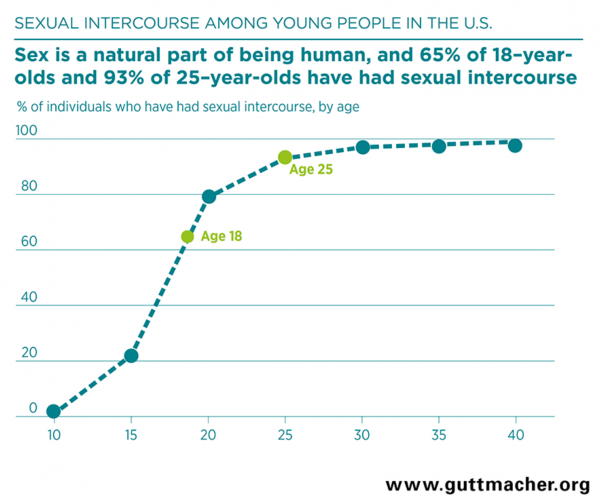
Research shows that by age 18, 65% of people in the US have had sexual intercourse. Graph via Guttmacher Institute.

Recently, the American rapper T.I. acknowledged that he attends gynecological examinations with his daughter to “check her hymen is still intact.” While shocking to many, T.I.’s boasting and the public debates it has provoked reveal deeply rooted cultural norms and beliefs about  virginity that young women encounter on a daily basis. Sociological research provides a closer look at how virginity is both socially constructed and discriminatory against girls and women.

People understand virginity and its subsequent “loss” through several frames. Traditionally, most people view virginity as a sexual transition from childhood to adulthood through vaginal-penile intercourse, though people often recognize virginity loss among same-sex couples who engage in other forms of genital sex. For some, virginity is viewed as a gift that may be given to another sexual partner; for others, virginity functions as a stigma that prevents them from progressing in their social life. Still, others see the loss of virginity as one step in the process of growing up and developing healthy relationships with romantic partners. Research has also shown that views and interpretations often change over time, especially in response to new experiences. Overall, these variations demonstrate that virginity is far from a simple biological truth. 
The different meanings and interpretations of virginity and loss can have significant social consequences as well. Virginity pledges — promises to remain abstinent until marriage–are one very well researched example. Under this view, pledgers perceive sex as sacred, solely for marriage, and heterosexual. About 12 percent of young people pledge abstinence, though most break that pledge before marriage. Those who break their pledges face negative consequences, including higher possibility for pregnancies and contracting HPV. Social context — including religiosity and the identities of others — contributes to who keeps their pledges.
Photo is shows a child covering their ears while watching tv
Photo by Miles Bannan, Flickr CC

This post was created in collaboration with the Minnesota Journalism Center

Obstruction, quid pro quo, impeachment. The tweets, the news alerts, the endless headlines. This political landscape, and the overall media news landscape, can be exhausting, and news consumers are showing they are tired of it all. A June 2019 Digital News Report explained that this news fatigue has turned into news avoidance: 41 percent of respondents in the United States (and 32 percent worldwide) said they “often or sometimes” avoid the news. 

Scholars are exploring the reasons for news avoidance, with some readers finding news “too negative,” “frustrating” or “annoying.” Other research shows that women are more likely than men to avoid the news, a gap explained by structural inequalities, like family commitments and household responsibilities.
One of the first journalism studies on this topic found that participants avoided the news but counted on the news finding them. The study from Stephanie Edgerly identified participants who did not follow any news accounts or journalists on social media but relied on Facebook to notify them of significant news and events.
These news avoiders are less inclined to vote, a troubling fact to University of Minnesota researcher Benjamin Toff:

“I do have concerns about whether our news environment is all that conducive to creating an electorate of people who actually hear the other side, can think through complicated political debates and issues, and understand a variety of different perspectives.”

Women’s news avoidance is intertwined with a lack of political engagement. This can lead to women facing difficulty advocating for themselves in the political sphere and fewer women involved in the political process or even running for office.
One way to decrease the number of news avoiders is to improve the quality of news itself and make news consumption more appealing. “Solutions journalism” explores sociological problematic issues in communities (homelessness, childhood obesity, etc) and critically examines problem-solving efforts. This goes beyond more straight-forward traditional reporting of the facts and, instead, offers ideas on how to resolve issues important to community members. Research demonstrates that readers are more likely to engage with (share, like, etc) solutions-oriented content than traditional news content. In addition, findings reveal readers report more favorable attitudes towards the news story and news organization when news discussed solutions.

Another important avenue in combating this news avoidance issue is media literacy. For more on media literacy, click here.

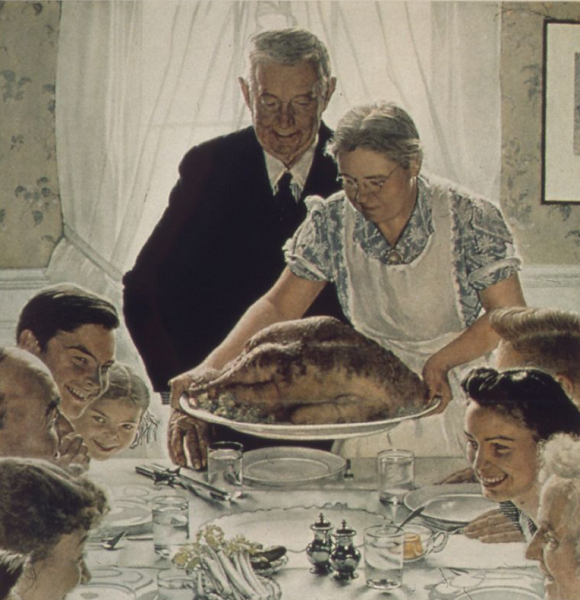
Peaceful holiday meals may still be the ideal, but they are not the norm. The image shows part of a World War II propaganda poster by Norman Rockwell, proclaiming, “OURS… to fight for: Freedom from want,” via Wikimedia Commons.

As we prepare for Thanksgiving, many people look forward to sharing a warm meal with their family and friends. Others dread the holiday, gearing up to argue with their relatives or answer nosey questions. TSP has written about the political minefield that holiday meals can be in the past. This year we want to point out that the roots of difficult dinners actually run deep in everyday family mealtime. Thanksgiving, like any family mealtime, has the potential for conflict. 

Scholars have documented how important meal time can be for families in terms of cultivating relationships and family intimacy. However, they also show that despite widespread belief that families should share “happy meals” together, meals can be emotionally painful and difficult for some families and family members.
Disagreements between parents and children arise at mealtime, in part, because of the meal itself. Some caregivers go to battle with “picky eaters.” Migrant parents struggle to pass cultural food traditions to children born in the United States. Low income parents worry that their children will not like or eat the food they can afford.
Family meals also reproduce conflict between heterosexual partners. Buying, preparing, and serving food are important ways that women fulfill gendered expectations. At family meal-times men continue to do less work but hold more power about how and when dinner is served.
Thanksgiving, or any big holiday meal, can involve disagreements. However, that is not altogether surprising considering that everyday family meals are full of conflicts and tension.
A woman walks alone in a dark alley. Photo by renee_mcgurk via Flickr.
While opinions of particular environments, situations, or objects may appear to be objectively dangerous or safe, sociologists argue otherwise. Instead, they find that opinions about safety are subjective. While there is a physical reality of harm and fear, beliefs about safety and danger spread through socialization, rather than direct observation. For example, Simpson notes that snakes and turtles can both cause illness and death through the transmission of venom or bacteria, yet snakes are seen as dangerous and turtles as benign. In other words, danger and safety do not exist on their own; they are contextual.
Socialized beliefs about safety and danger are also raced, classed, and gendered. While statistics indicate that men are predominantly the victims of violent crime, women express greater fear of crime. This fear often acts as a form of social control by limiting women’s daily activities, like when they leave the house and what they wear. Furthermore, the construction of fear and crime is often tied to racist legacies. In the United States, white women express prejudicial fear about areas marked as “dangerous” or “sketchy,” due to the occupation of this space by men of color.
Safety and danger are also constructed at the international level, as national security is politicized. For example, instances of large-scale political violence, such as genocide, war, and acts of terrorism revolve around the social construction of an enemy. More generally, national enemies are constructed as dangerous and a threat to the safety of a nation’s people. This construction of the enemy and perception of fear can move people to join terrorist organizations, participate in genocidal regimes, and enlist in state militaries.
A man reads a newspaper by the wall, by Garry Knight, via Flickr CC.

This post was created in collaboration with the Minnesota Journalism Center

According to Gallup, 45% of Americans polled trusted the mass media in 2018. Reuters Institute’s 2019 Digital News Report found similar trends among citizens in 37 countries around the globe: the average level of trust in the news is at 42%, and only 23% say they trust news they find on social media. Further, Edelman’s 2019 Trust Barometer found that, globally, people trust their employers, NGOs, and businesses before the media “to do what is right.”

Media literacy goes hand in hand with trust in the media, especially for younger generations. But studies show that news media has become neglected in media literacy education systems worldwide. To help young people in school better understand how to cultivate a sense of literacy about news consumption, educators could provide examples of what positive engagement with social media and news looks like. Studies show that recommending what young people shouldn’t do on social media — something scholars call “protectionist discourse” — isn’t very helpful.
Scholars argue that it is also useful to distinguish news literacy from concepts such as media literacy and digital literacy. According to Melissa Tully and colleagues, news literacy is defined as: “Knowledge of the personal and social processes by which news is produced, distributed, and consumed, and skills that allow users some control over these processes.” In this model, news literacy includes: “Context,” “Consumption,” “Circulation,” “Creation,” and “Content.”
These 5 “C’s” contribute to how media literacy is part of a healthy, functioning democracy: in a polarized era of partisanship and distrust (learn more about political polarization here), literacy can help consumers embrace differences and facilitate connections for the common good. However, some citizens avoid the news altogether. These “news avoiders” contribute to a culture that evades the need for literacy altogether in a post-fact and post-truth society.
1894 newspaper illustration by Frederick Burr Opper, Library of Congress via Wikimeida commons

The election of President Donald Trump in the United States in 2016 ushered in an era of attacks on the media and accusations that outlets such as The New York Times and The Washington Post are publishing “fake news.” But what exactly is “fake news”? And why are claims about information, misinformation, and disinformation in American journalism so troubling?

TSP has previously published articles summarizing scholarly concerns about fake news–in particular, its role in the political polarization phenomenon. Media scholars also now see these trends as part of a larger, longer-term crisis of democracy itself, beginning sometime in the final decades of the 20th century.

In spite of all of these questions and controversies, one thing is clear: there is no consensus on what exactly fake news is. The definition of fake news is unclear to many Americans. According to a 2018 study from The Media Insight Project, there are several understandings of what “fake news” really means to Americans nationwide:  

  • 71% of Americans think fake news is “made-up stories from news outlets that don’t exist”
  • 63% think fake news refers to “media outlets that pass on conspiracy theories and unsubstantiated rumors”
  • 62% think it means “journalists from real news organizations making stuff up” 
  • 43% think fake news refers to news organizations making sloppy mistakes
  • 25% call satire or comedy about current events fake news
Audiences play a key role in interpreting the news and acting on it — or not. Pew Research Center data shows 68 percent of American adults say that they get their news on social media even though 57 percent of them expect the news they see on social media to be “largely inaccurate.” Academic studies also find that “fake news” is often used by social media users to insult information shared by members of opposing political parties.  
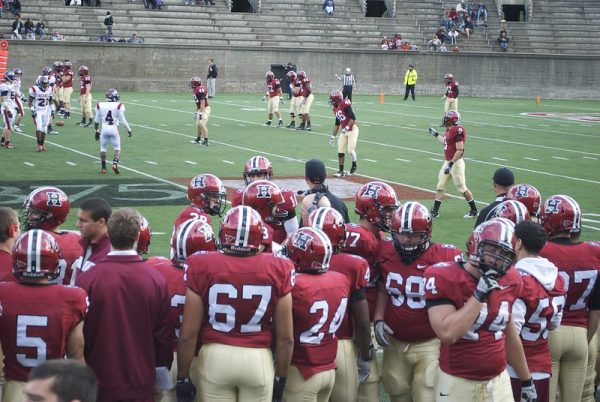
Harvard vs. Bucknell football game. Photo by Yzukerman, Flickr CC

There is no shortage of writing on the history of college sports, especially its history of scandal. There is also plenty of writing on how big-time college sports harm both the colleges and their athletes. Books as varied as Pay for Play: A History of Big-Time College Athletic Reform, College Sports Inc.: The Athletic Department vs. The University and College Athletes for Hire: The Evolution and Legacy of the NCAA’s Amateur Myth highlight the rise of the NCAA through and because of scandal, the enormous amounts of money flowing through college athletic departments (but not to players), and the contortions of universities to fit big-time athletics.

But athletics matter even in schools defined by their academics rather than their sports. Documents from the recent Harvard affirmative action legal case confirm prior research: even at the Ivies and at coed liberal arts colleges, athletes receive a substantial admissions bump. Articles from The Atlantic and Slate detail this bump and how it especially benefits upper-class white students. At Ivies and elite liberal arts colleges, the potential financial gain from athletics (as suspect as that might be at other schools) doesn’t make sense as the primary reason to keep sports in these schools. So what are some other reasons that American higher education institutions prioritize athletics? Here are three that sociological thinking and research can help us understand.

1.Status Networks and Peer Institutions

First, athletics helps schools signal who their peers are, both academically and athletically. Higher education in the United States didn’t develop from a master plan. It is, instead, a network and market of schools that jockey for position, carving out niches and constantly battling for status. Athletic conferences are one way that institutions establish networks, and research has found that schools within conferences come to share similar status, both athletically and academically. The Ivy League is the prime example of this phenomenon. Although “the Ivies” have come to mean a set of elite schools, the league began as simply a commitment to compete against each other on the athletic playing field. 

2. Competing for Students

Another way that colleges signal prestige is through established ranking systems, and a key part of those rankings come from measures of selectivity and the quality undergraduate students. So all colleges are competing for students — either to solidify rankings or to simply matriculate enough students for small, tuition-dependent institutions to be able to pay the bills. In Creating a Class, Mitchell Stevens points out how important athletics are to recruiting students within the competitive, small liberal arts space. He writes,

“Students choose schools for multiple reasons, and the ability to participate in a particular sport at a competitive level of play is often an important one. Because so many talented students also are serious athletes, colleges eager to admit students with top academic credentials are obliged to maintain at least passable teams and to support them with competitive facilities.”

3. Non-academic Signals in Admissions

Histories of Ivy League admissions have revealed how including athletic markers was part of establishing who belonged at the school. On the most obvious level, prominent alumni who were athletes or the parents of prospective students publicly pushed for admissions policies that would be beneficial to others like them. But more subtly, and more insidiously, having an affinity for athletics was viewed as a mark of the “Yale man,” the upper-class, Christian, future leader of the world who had the presence of mind and body to pick up new ideas and manage others. 

Athletics in colleges isn’t just a money-maker or something to keep students happy. It’s a way for colleges to recruit students, fight for status, and signal what types of students they value.

Illustration of Game of Thrones characters who are unimpressed while watching the show. By Silueta Production House via Vimeo.

Let’s face it: lots of fans despised the final season of Game of Thrones. Earlier this year, Scientific American suggested that’s because the storytelling style changed from sociological to psychological. When the storytelling was sociological, the characters evolved often in dramatic, unpredictable ways in response to the broader institutional settings, and the countervailing incentives and norms that surrounded them. When the style switched to psychological, viewers had to identify with the characters on a personal level and become invested in them for the story to work. Within this individualistic framing, characters’ unexpectedly evil actions and untimely deaths stopped making sense. As it happens, not only is sociological storytelling an important driver in keeping audiences devoted, it can also be a powerful tool in crafting a persuasive research article.

Research suggests that storytelling is powerful precisely because it gives human faces to abstract social forces, emplotting them as combatants over the very problems which social theory endeavors to understand — conflict, inequality, and modernization, to name but a few. Andrew Abbott thus argues for a lyrical sociology that recreates the experience of social discovery in the reader. Sara Lawrence-Lightfoot and Jessica Hoffmann Davis similarly suggest that to capture the complexity, dynamics, and subtlety of human experience and organizational life, one must document the voices and visions of the people they are studying.
Is it enough to fashion stories that enthrall readers with captivating narrative arcs, or must scholarship also advance theoretical arguments? In a recent Twitter thread, Jeff Guhin invites discussion of the tension in qualitative work between telling stories about social problems and making arguments. Some sociologists argue that description alone makes a valuable contribution. Scholars doing qualitative work should strive to publish descriptively rich, findings-driven papers that are so grounded and concrete that the reader intuitively grasps the “so what.” Though ethnography may share some characteristics with imaginative writing, Hammersley points out that it is more than that. Ethnographers must grapple with a number of issues as they analyze data and write up their work, just as they do when they choose where and how to collect it.
Using our sociological imagination in storytelling doesn’t mean discounting characters’ personal or psychological motivations. Instead, it means showing characters in ongoing and complex interaction with the economic and political forces of broader society and illustrating the consequences that emerge. This can be a powerful tool for learning social theory.

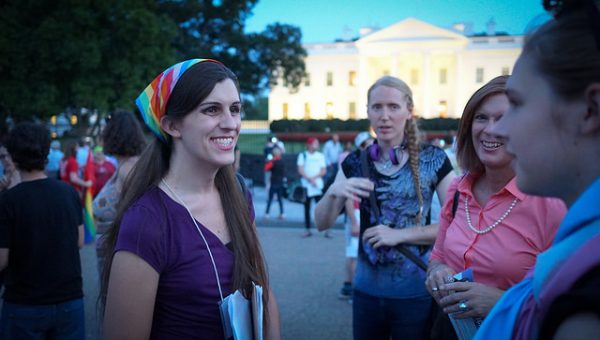
Candidate for Virginia Delegate (elected November 7) Danica Roem, at Protest Trans Military Ban. Photo by Ted Eytan, Flickr CC

Originally posted November 28, 2017.

American attitudes towards transgender and gender nonconforming persons might be changing. Earlier this month, voters elected six transgender officials to public office in the United States, and poll data from earlier this year suggests the majority of Americans oppose transgender bathroom restrictions and support LGBT nondiscrimination laws. Yet, data on attitudes toward transgender folks is extremely limited, and with the Trump administration’s assault on transgender protections in the military and workplace, the future for the trans community is unclear. Despite this uncertainty, a close examination of the social science research on past shifts in attitudes towards same-sex relationships can provide us insight for what the future may hold for the LGBTQ community in the coming decades.

Attitudes about homosexuality vary globally. While gay marriage is currently legal in more than twenty countries, many nations still criminalize same-sex relationships. Differences in attitudes about homosexuality between countries can be explained by a variety of factors, including religious context, the strength of democratic institutions, and the country’s level of economic development.
In the United States, the late 1980s witnessed little acceptance of same-sex marriage, except for small groups of people who tended to be highly educated, from urban backgrounds, or non-religious. By 2010, support for same-sex marriage increased dramatically, though older Americans, Republicans, and evangelicals were significantly more likely to remain opposed to same-sex marriage. Such a dramatic shift in a relatively short period of time indicates changing attitudes rather than generational differences.
Americans have also become more inclusive in their definition of family. In 2003, nearly half of Americans emphasized heterosexual marriage in their definition of family, while only about a quarter adopted a definition that included same-sex couples. By 2010, nearly one third of Americans ascribed to a more inclusive understanding of family structures. Evidence suggests that these shifts in attitudes were partially the result of broader societal shifts in the United States, including increased educational attainment and changing cultural norms.
Despite this progress for same-sex couples, many challenges remain. Members of the LGBTQ community still experience prejudice, discrimination, and hate crimes — especially for trans women of color. Even with support for formal rights for same-sex couples from the majority of Americans, the same people are often uncomfortable with informal privileges, like showing physical affection in public. Past debates within LGBTQ communities about the importance of fighting for marriage rights indicates that the future for the LGBTQ folks in the United States is uncertain. While the future can seem harrowing, the recent victories in the United States and Australia for same-sex couples and transgender individuals would have been unheard of only a few decades ago, which offers a beacon of hope to LGBTQ communities.

Want to read more?

Check out these posts on TSP:

Review historical trends in public opinion on gay and lesbian rights (Gallup)

Check out research showing that bisexual adults are less likely to be “out” (Pew Research Center)

Ben Ostrowsky//Flickr CC

Originally posted October 13, 2015.

October brings cozy sweaters, Pumpkin Spice Lattes, and lots of pink for Breast Cancer Awareness Month. It’s a worthy campaign: approximately 1 in 8 women will receive a breast cancer diagnosis in her lifetime. But how has breast cancer gained such visibility when others—even other forms of cancer—plague the population at even higher numbers?

Breast cancer awareness campaigns have branded breast cancer through pink ribbons and other merchandise, making the disease not only highly visible, but also a commodity. The signature pink color connects breast cancer to traditional ideas of femininity, beauty, and morality, and allows family and friends to show support.  Color aside, merchandise and freebies like cosmetics and small home appliances reinforce breast cancer’s symbolic ties to beautiful, domestic, heterosexual women as the primary sufferers. This is breast cancer’s “disease regime,” a system of institutional practices and styles of speech that shapes how patients experience it (Klawiter 2004, 851).  
Large-scale organizations like the Susan G. Komen foundation raise awareness, but often leave out marginalized identities that don’t fit a traditional feminine image. Groups like the Women & Cancer Walk provide spaces for those who don’t fit the mainstream definition of a “breast cancer patient.”
The specific image of the breast cancer patient affects who participates in activism and how they view their work for the cause. Many women volunteer for organizations like Komen as a way to connect with other survivors. Often this means that much of their work goes unnoticed, in part because they downplay their activism as trivial volunteering or “just being fair,” further reinforcing the gendered construction of the disease.

For more on breast cancer awareness, check out posts at Feminist Reflections, Sociological Images, and two of our recent Discoveries.