culture

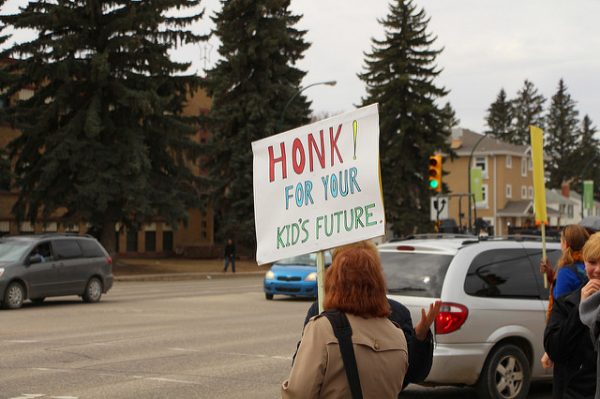
Image of a sign that reads, "honk for your kid's future"
Photo by Kyla Duhamel, Flickr CC

The FBI recently announced charges in a wide-spread college admission scandal involving fake test scores and fabricated athletic resumes. In the wake of the scandal, sociologists are weighing in and reminding us that college admissions is as much about legitimating privilege as improving life prospects. Sociologists have long been skeptical of the term meritocracy, which was in fact first coined as satire by Michael Young. The research below shows how constructed measures of merit in college admissions play a key part in reproducing inequality.

Mitchell Stevens spent a year in the admissions department at a selective liberal arts school. His book describes “the aristocracy of merit” — especially how the review process rewards the activities and presentation styles most common for privileged students. And while admissions officers are mostly the ones judging merit, the book also highlights how staff from other departments, such as coaches or fundraising officers, can advocate for a student’s admission. Shamus Khan’s ethnographic work similarly notes how elite prep schools set up their students to be competitive in elite college admission through skills, activities, and awards. Prep school staff even occasionally call admissions offices of Ivy League schools for students.
Other work on college admissions highlights that the idea of “merit” has always been socially constructed because those with race and class privilege can set the rules. For instance, colleges instituted  “holistic admission” in the early twentieth century because contemporary elites worried that their children would be shut out of attending their alma mater because of high-achieving Jewish students. They rewrote admissions criteria to devalue standardized test scores in favor of a review process that gave students credit for the experiences, skills, and habits that students from the upper-class were more likely to have.
So, if upper-class kids already have advantages, why is there a college cheating scandal? Jessica Calarco points out in NPR that the students affected by this scandal would likely do well no matter what school they attended, but parents are anxious about rising inequality, a bifurcating labor market, and afraid that children will have a harder time than their parents did. From teaching children how to advocate for themselves in school to paying thousands of dollars for out-of-school activities, middle and upper-class parents do whatever they can to help their children get ahead. American higher education is a decentralized marketplace that runs on prestige, which makes credentials from a big-name school potentially even more important in today’s changing labor market — both for students looking for social mobility and those looking to legitimate their privilege.

As Anthony Jack told CNN, the admission scandal flips the usual script — usually when we are discussing merit in college admissions it is around insinuations that minority students don’t deserve to get in. For more on race-based affirmative action, check out other TSP work below!

Affirmative Action, College Admissions, and the Debunked “Mismatch” Hypothesis

The Supreme Court’s Impacts on Race and Admissions in America

Merit and the Admissions Debates at Harvard University and Stuyvesant High School

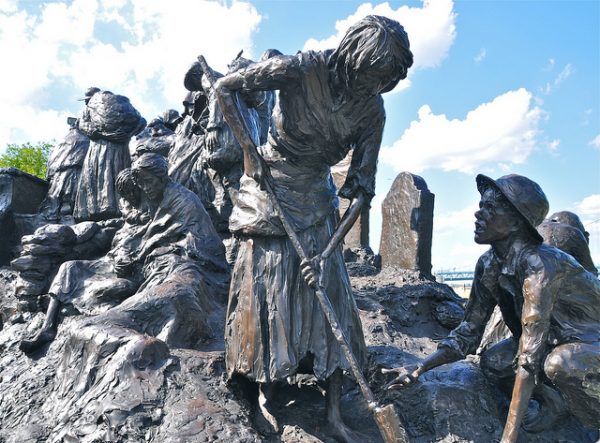
Photo of the Irish Immigrant Memorial in Pennsylvania by Kevin Burkett, Flickr CC

Happy St. Patrick’s Day! As you top one off down at the pub, here’s a round on the house about how the Irish became white in the United States.    

Irish presence in America greatly expanded following increased emigration in the mid-to-late 19th century. The journey from Ireland was arduous and dangerous, but their welcome on arrival was worse. Various political and social organizations espoused prejudiced, bigoted views towards Irish immigrants their families; frequent metaphors included comparing the Irish to animals or vermin. Scholars have described how Irish groups in America resisted hatred and discrimination and took steps to combat discrimination both in the job market and everyday culture. As the sources below describe, the Irish actively overcame and struggled against oppression, and civil society organizations and community engagement helped the Irish to eventually be seen as part of the racial category “White” in America.
This story of becoming white applies not only to the Irish, but also to Italians, Poles, and virtually any other European group once framed as outsiders by America’s paradigm of “whiteness” in the 18th and 19th centuries. Over time, these groups’ cultural identities didn’t disappear; instead they became symbolic and strategic expressions of identity that no longer bore these oppressive stigmas.
Following work by civil organizations and resulting changes in dominant cultural practices, the racial paradigm has expanded to incorporate some groups into the label of white, but not all. Non-European groups’ stories contrasted greatly with that of the Irish, spawning inequalities that still exist today.

As you finish your drink, ponder how several immigrant groups have been historically labeled as racially black, Hispanic, or Asian, instead of white. How would life be different for Irish-Americans if that had been their story?

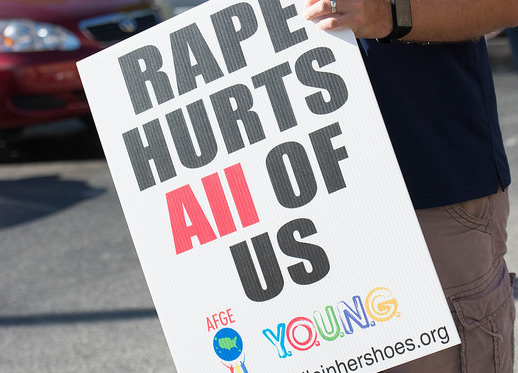
Photo of a sign that reads, “rape hurts all of us.” Photo by FGTE, Flickr CC

Last week, HBO released the documentary, Leaving Neverland, which chronicles two young men’s accounts of sexual abuse by pop superstar Michael Jackson in the late 1980s and early 90s. The documentary provides harrowing details of abuse and grooming, although Jackson maintained his innocence throughout his life. Yet, beyond Jackson’s guilt or innocence, HBO’s airing of Leaving Neverland forces us to engage in larger discussions about an often-neglected group of sexual assault survivors — adolescent boys. Sociological research is examining how masculinity and heterosexuality shape boys’ experiences of sexual victimization.

Threat to masculinity often shapes how male youth interpret experiences of sexual coercion. Many boys view sexual victimization by another man as individual weakness and vulnerability. Forensic interviews with adolescent male survivors reveal how boys attempted to fight off their male perpetrators and/or avoid physical stimulation to show their unwillingness. Boys can be hesitant to disclose abuse by older men because they do not want others to think they are gay. Sexual abuse by women is often viewed as less harmful (e.g. saying it was “weird but fine” and “she wanted it”), suggesting that despite women’s use of sexual coercion and manipulation, these interactions posed less of a threat to boys’ masculinity.
Parents of boys who were sexually assaulted by other men also reinforce cultural messages that link same-sex sexual victimization to homosexuality. Many parents believed the trauma of sexual assault by another man would turn their son gay. In his interviews with 62 parents of Black and Puerto Rican male victims, Shawn McGuffey found that parents engage in “gender recovery work” after the abuse to reaffirm heteronormative gender roles. As such, they encouraged their sons to participate in heterosexual relationships, objectify women, and engage in sports. Fathers in particular expected that immersing their sons in traditionally masculine activities would strengthen their heterosexual identities after the trauma of same-sex assault.
Criminal justice institutions further reinforce gendered rape myths regarding male sexual assault victims. Court observations reveal how attorneys dismantle boys’ credibility by pointing to the lack of emotional trauma on the witness stand and physical evidence on their bodies. In the case of one 12-year-old boy, defense attorneys dismissed the victim’s claims of assault by two older men because the boy did not show enough emotion and failed to display the penetrative injury expected from a same-sex sexual assault. One defense attorney suggested a young Latino victim fabricated the use of sexual force by his sister’s boyfriend because he was ashamed to admit that he “consented” to homosexual sex.

As we continue to grapple with the implications of #MeToo for boys, sociology allows us to challenge how masculinity and heteronormativity silence young male sexual assault survivors. Dismantling these systems of power brings us one step closer to effective prevention and response to boys’ sexual victimization.

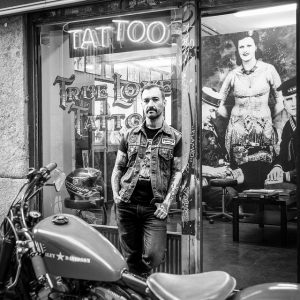
Photo of a person standing outside a tattoo shop. Photo by Ralf Scherer, Flickr CC

Tattoos can be important symbols in the underworld, but the exact meaning of these images are often a well-kept secret. Even the teardrop tattoo, considered the most popular emblem of prison culture, has contested meanings. While some consider that the tear underneath the eye symbolizes the death of a loved one, others believe that it serves as a tally of the carriers’ crimes. Beyond the actual meaning of their shapes and contours, prison tattoos serve several social functions in prison life.

Studies usually describe how prisons can strip prisoners of different parts of their ‘identity kit’. At intake to prisons, people are fingerprinted, photographed, and assigned an identification number. Penal institutions also routinely strip prisoners of their possessions, clothes, and cultural signifiers in a forced process of personal defacement. To neutralize this process, prisoners gradually acquire a ‘prison identity’. Tattoos enable prisoners to consolidate their self-perception, embrace a new identity, and announce their commitment to ‘convict’ status.
Prison scholars argue that prison subcultures endow status and prestige among peers, and strengthen prisoners’ sentiments of loyalty to the prison world. According to David Skarbek, formal and informal norms are effective in securing prison order. However, when a community becomes larger or more diverse, inmates often start organizing around prison gangs. These groups are forms of brotherhood or comradeship that provide information, safety, and a deeper sense of belonging. Tattoos provide gangs with a coded language that serve as an informal mechanism of communication, but also as a way of differentiation against outsiders. Through the visual display of a tattoo, prisoners convey their status, rank, accomplishments, and their allegiance to a specific organization.

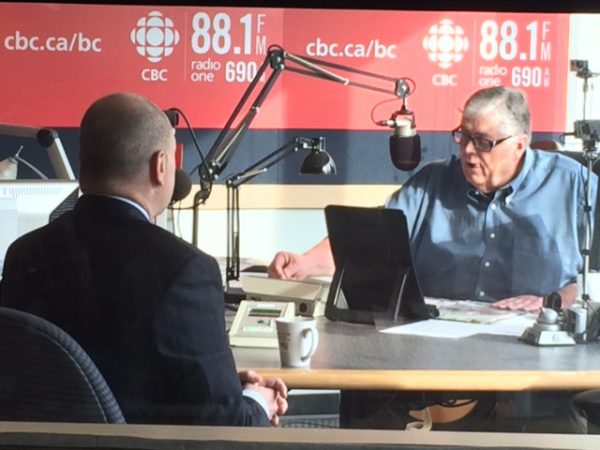
Photo of a radio interview by US Embassy Canada, Flickr CC

On January 31, The New York Times responded to a letter from Kimberly Probolus, an American Studies PhD candidate, with a commitment to publish gender parity in their letters to the editor (on a weekly basis) in 2019. This policy comes in the wake of many efforts to change the overwhelming overrepresentation of men in the position of “expert” in the media, from the Op-Ed project to womenalsoknowstuff.com to #citeblackwomen.

The classic sociology article “Doing Gender,” explains that we repeatedly accomplish gender through consistent, patterned interactions. According to the popular press and imagination — such as Rebecca Solnit’s essay, Men Explain Things to Me — one of these patterns includes men stepping into the role of expert. Within the social sciences, there is research on how gender as a performance can explain gender disparities in knowledge-producing spaces.

Women are less likely to volunteer expertise in a variety of spaces, and researchers often explain this finding as a result of self-esteem or confidence. In 2008, for example, only 13% of contributors to Wikipedia were women. Two reasons cited for this gender disparity were a lack of confidence in their expertise and a discomfort with editing (which involves conflict). Likewise, studies of classroom participation have consistently found that men are more likely than women to talk in class — an unsurprising finding considering that classroom participation studies show that students with higher confidence are more likely to participate. Within academia, research shows that men are much more likely to cite themselves as experts within their own work.
This behavior may continue because both men and women are sanctioned for behavior that falls outside of gender performances. In the research on salary negotiation, researchers found that women can face a backlash when they ask for raises because self-promotion goes against female gender norms. Men, on the other hand, may be sanctioned for being too self-effacing.
Knowledge exchange on the Internet may make the sanctions for women in expert roles more plentiful. As is demonstrated by the experiences of female journalists, video game enthusiasts, and women in general online, being active on the Internet carries intense risk of exposure to trolling, harassment, abuse, and misogyny. The social science research on online misogyny is recent and plentiful.

Social media can also be a place to amplify the expertise of women or to respond to particularly egregious examples of mansplaining. And institutions like higher education and the media can continue to intervene to disrupt the social expectation that an expert is always a man. Check out the “Overlooked” obituary project for previously underappreciated scientists and thinkers, including the great sociologist Ida B. Wells.

For more on gendered confidence in specific areas, such as STEM, see our TROT on Gendering Intelligence.

Photo of two microphones by Håkan Dahlström, Flickr CC

This post was created in collaboration with the Minnesota Journalism Center.

“Political polarization” refers to sharpening contrasts between political parties, groups, and individuals. The 2016 U.S. presidential election catalyzed a wave of research about political polarization, filter bubbles, and echo chambers. With this rise in polarization research, it is important to distinguish between ideological polarization, people having more extreme political views; affective polarization, people having negative sentiment toward other political parties; and party alignment, people affixing strong party labels to themselves. Being clear about the differences between these forms of polarization adds a layer of nuance to research on whether polarization is rising and what drives such changes.

The three types of polarization don’t always go hand-in-hand. For example, social science research shows rises in affective polarization and party alignment, but the same isn’t necessarily true for ideological polarization.
Political polarization exists within journalistic and social media contexts, as well; especially around topics like “fake news” that became buzzwords during President Donald Trump’s 2016 campaign. In this context, scholars have found that Americans are more likely to gravitate toward national media outlets that align with their political affiliation and often discuss political topics with people who share their same political views.
While social media sometimes forces people to confront conversations they would have otherwise avoided, studies have also found that exposure to opposing political viewpoints on social media can actually increase polarization rather than facilitating bipartisan dialogue. While polarization is evident in online spaces, there is evidence that individuals who are most likely to be polarized are older than 75 and are the least likely to use the internet and social media.

Several authors and scholars are skeptical of whether polarization can be overcome or will shrink; the research above suggests that polarization is entrenched in this contemporary moment. Nevertheless, understanding the sources of polarization and its different dimensions allows us to pursue bipartisan solutions that facilitate cooperation rather than contestation.

Photo of a wedding cake topper, where the bride is dragging the groom. Photo by Erich Ferdinand, Flickr CC

As Valentine’s Day quickly approaches, many couples will be deciding — and in some cases, disputing  — how best to celebrate their love and commitment to one another. Because people’s beliefs about marriage and family are shaped by social class conditions early in life, most people marry partners with income, education, and occupation levels similar to their own. While partnering with someone from a similar upbringing cannot prevent all marital strife, it may head off some of the challenges that are confronted by mixed-class couples. Such relationships exemplify the influence of class on experiences and understandings of family.

Sociologist Pierre Bourdieu explains how the life-long influences of class background can affect what couples value in terms of money, work, and household chores. Because of these divergent values, partners raised in different social classes may argue about marriage and the family, even if they rarely recognize their upbringing as the source of their contention. For instance, research indicates that partners from middle-class backgrounds heavily emphasize long-term planning and saving while their upwardly mobile partners may have a more “hands off” approach to finances and careers, taking advantage of opportunities when they came along but not proactively seeking them out.
Practices at the intersection of class and family life reproduce broader social inequalities. Because people who grew up in the same social class tend to be more similar in how they think about and manage family, they often partner with others who share their background. This “assortative mating” results in households with double the middle class advantages, as well as working class and poor households that are doubly disadvantaged. A wealth of scholarship investigates how growing class inequality has shaped patterns of marriage and family formation and describes how these patterns may be more unequal now than in previous decades.
People’s social class backgrounds also influence how they raise their children. For example, classic work by Annette Lareau shows how middle class white and African American families use child-rearing strategies that align with institutions like schools, yielding unequal rewards for these children while putting children from lower-class backgrounds at even more of a disadvantage. These families not only have more material resources but are able to impart more immaterial things to their children, like the “rules of the game” of how institutions work. These unspoken rules include everything from how to navigate bureaucratic environments, to how to communicate with authority figures as equals, to the right tone of voice to use in a meeting. Middle class parents engage in these strategies to secure advantages for their children in school and coach their children to do the same.

Whether we remain in the same social class our whole lives or find ourselves immersed in dramatically different financial circumstances, our social upbringing follows us through adulthood. People’s beliefs about what is right or normal are shaped by their upbringing, and such perceptions influence their expectations for marriage and family as adults. In an age of increasing income inequality in the United States, researchers must continue to explore the ways that class differences not only affect interpersonal relationships, but also reproduce broader social class inequalities.

For more information on marrying across class lines, check out this Contexts piece from Jessi Strieb.

Photo of a Steelers fan watching the Superbowl from a couch. Photo by daveynin, Flickr CC

Each year we are reminded of research on how many calories the average American eats on Super Bowl Sunday (hint: it’s more than Thanksgiving). Other research finds that fans of NFL teams that lose eat more saturated fat the next day than fans of teams that win. News outlets ranging from Men’s Health to Runner’s World to Healthy Women publish guides on how to stay healthy on game day. But sitting on the couch isn’t the only activity that is linked to both sports and food. As plan your healthy (or unhealthy) Super Bowl weekend, take a look at the research on how athletics can affect the eating habits of athletes ranging from body builders to youth basketball players.

Among female athletes, eating disorders are a prevalent issue. However, the research on whether female athletes are significantly different from their non-athlete peers regarding prevalence of eating disorders is mixed. Sport-specific factors such as performance pressure contribute to disordered eating, especially in sports that encourage leanness. The combination of disordered eating, amenorrhea, and osteoporosis is called the “female athlete triad.”
Male athletes are not immune from concerns over eating. Wrestlers may be at particular risk of disordered eating due to the intense emphasis on weight. Other sports encourage weight gain, and specific positions, such as linemen in American football, often achieve weight gain through stomach fat that puts them at risk for health complications like diabetes and cardiovascular disease. Athletes and non-athletes may turn to steroid use to achieve a more muscular body, which can include intense cycles of 6,000+ calories per day followed by weeks of a stringent, low-calorie diet.
Proponents of youth sports expect that these activities instill healthy food and exercise habits. However, one study found that many youth sports events provide participants with unhealthy food and lack healthier options. Although youth involved in sports are more likely to eat fruits, vegetables, and milk than those not involved in sports, they also consume more calories overall and are more likely to eat fast food and drink sugar-sweetened beverages. Parents and organizers of youth activities need to be aware of the food options and information available to young athletes in order to make youth athletics a net positive in the health of children.

Photo by Steve Rainwater, Flickr CC

Originally posted February 26, 2018.

Justin Timberlake’s recent performance at the Super Bowl Halftime Show wasn’t his first. Who can forget the now infamous “wardrobe malfunction,” when Timberlake tore Janet Jackson’s clothing, exposing her breast to millions across the United States? Jackson was subsequently blacklisted from the mainstream entertainment industry, while Timberlake’s career continued to flourish. To illustrate the gendered and racial double standards in this case, Black Twitter created the hashtag #JanetJacksonAppreciationDay. Yet, the music industry is not unique. Despite significant progress since the sexual revolution, research shows that sexual double standards persist between women and girls, and men and boys.

Women and girls experience social stigma for premarital sexual activity, having multiple sexual partners, and even participating in non-physical interactions like sexting. Men and boys, conversely, encounter praise for engaging in similar (hetero)sexual conduct. For example, one study showed peers were less likely to accept adolescent girls with a high number of sexual partners, but more likely to accept boys with several sexual partners. At the same time, boys who failed to engage in multiple sexual ‘conquests’ endure stigma from peers. So, both sexually permissive girls and sexually inactive boys face social consequences for not following heterosexual gender roles.
Women who engage in casual sexual activity like hookups outside of a committed relationship, are often judged more harshly and called derogatory names like ‘ho’ and ‘slut.’ One study participant noted, “Guys, they can go around and have sex with a number of girls and they’re not called anything” (Hamilton and Armstrong, p. 598). Both women and men, however, may encounter negative attitudes for hooking up. According to one study, almost 50 percent of college-aged respondents indicated that they lost respect for women and men that engage in a lot of casual sex. However, men were still more likely to only stigmatize women for engaging in casual sex.

Protest calling to remove Fort Snelling in Minnesota. Photo by Fibonacci Blue, Flickr CC

Originally posted October 9, 2018.

In recent months, a homeless encampment of over 300 people — most of whom are American Indian — has formed along a highway noise wall in Minneapolis. The encampment has been self-proclaimed the “Wall of Forgotten Natives” by residents and Indigenous activists who point out that much of Minneapolis is built on stolen Dakota land. Social and health service providers have mobilized around the encampment, and city officials have worked with community leaders to begin a relocation of people at the encampment to more stable housing on Red Lake Nation land. The wider context for the establishment of the camp, American Indian solidarity and resistance to disbanding the camp, as well as the government’s response, all highlight the process of settler colonialism.

In the United States, settler colonialism is defined as the control of land and its resources by white settlers who seek political power/control in a new space (i.e. like “regular” colonialism) through both displacement and violence against Indigenous persons in order to eventually replace the Native population (i.e. unlike “regular” colonialism). Until recently, studies of Indigenous people have largely been absent from sociological research and some have referred to this as sociology’s “complicity in the elimination of the native.” Scholars have begun to incorporate settler colonialism into research on the domination and dispossession of various racial and ethnic groups.
In Minnesota, American Indians face the consequences of settler colonialism everyday: generational trauma from historical violence and boarding schools while at the same time, confronting a host of contemporary inequities in health, exposure to violence and the foster care system between Natives and non-Natives. At the national level, the U.S. government’s urban relocation programs during the 1950s serve as further examples of settler colonial logic and contemporary homelessness among Minnesota’s urban Natives today and their political response. While these policies encouraged Natives to move from what were economically deprived reservations to what was promised as training and employment in urban areas, they faced intense discrimination. By 1969, unemployment among urban Natives was nearly ten times the national average and Native incomes were less than half of the national poverty level.
After the U.S. government failed to assimilate Native people through relocation in the 1950s, their attempt to end the legal status of what it meant to be a “federally recognized tribe” led to American Indian resistance across the United States and into the social movement fold of the 1960s and 1970s. Founded in 1968, the American Indian Movement was started in Minneapolis, and Minnesota is a historically important site of resistance to settler colonialism among Native peoples. American Indians continue to resist settler colonial practices and beliefs today. One example of this includes Indigenous protests against federally recognized holidays like Columbus Day and Thanksgiving, which are embedded in settler colonial stories of the past that “whitewash” events and stereotype Indigenous people. Other acts of resistance include ceremonies acknowledging genocide and other violent acts by the U.S. government. Just last spring, Dakota activists illustrated such resistance to the Walker Art Center’s decision to host a piece of a “scaffold” similar to that of 38 Dakota men who were hanged following the U.S.-Dakota War of 1862.

The “Wall of Forgotten Natives” highlights both the settler colonial practices that make such a homeless encampment possible but also demonstrate how American Indians have continually resisted settler colonial ideas and actions.


The authors respectfully acknowledge that the University of Minnesota stands on Dakota and Ojibwe peoples’ traditional lands.