culture

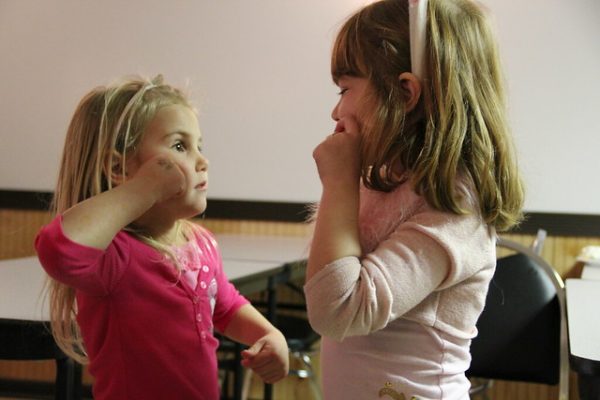
An elementary school student shows her younger friend how to sign using American Sign Language. Photo by daveynin, Flickr CC.

Since the passage of the Education for All Handicapped Children Act (EHA) in 1975 and the more comprehensive Individuals with Disabilities Education Act (IDEA) in 1990, the number of children receiving special education services has increased dramatically. Today, seven million children in the United States receive special education to meet their individual needs, with more than ever attending their neighborhood schools as opposed to separate schools or institutions.

Because special education has become so institutionalized in schools over the past three decades, we often take for granted that the categories we use to classify people with special needs are socially constructed. For instance, Minnesota has thirteen categorical disability areas, ranging from autism spectrum disorders to blind-visual impairment to traumatic brain injury. But these categories differ from state to state, as do states’ definitions for each category and their protocols for determining when a child meets the diagnostic criteria in a given area. A more sociological take suggests that the “special ed” label does more than just entitle children to receipt of services. For better or worse, it also helps to establish their position within the structure of the mass education system, and to define their relationships with other students, administrators, and professionals.
Research suggests that children of color are overdiagnosed and underserved. They are more likely to be referred for special education testing and to receive special education services than others. This disproportionality occurs more often in categories for which diagnosis relies on the “art” of professional judgment, like emotionally disturbed (ED) or learning disabled (LD). It occurs less often in categories that require little diagnostic inference like deafness or blindness. The attribution of labels can be particularly concerning for children of color, as these labels can be associated with lower teacher and peer expectations and reduced curricular coverage. Even when appropriately placed in special education classes, children of color often receive poorer services than disabled white children. Some research suggests that this happens because the culture and organization of schools encourages teachers to view students of color as academically and behaviorally deficient.
Given the disproportionate representation of students of color in special education, sociologists have investigated whether a child’s race or ethnicity elevates their likelihood of special education placement. By controlling for individual-, school-, and district-level factors, researchers have found that race and social class are not significant predictors of placement. However, school characteristics — like the overall level of student ability — play a role in determining who gets diagnosed. And, because children of color tend to be concentrated in majority-minority schools, they are less likely to be diagnosed than their white peers.

You may also be interested in a previous article: “Autism Across Cultures.”

For more information on children and youth with disabilities, check out the National Center for Education Statistics.

Photo by Kandukuru Nagarjun, Flickr CC

This post was created in collaboration with the Minnesota Journalism Center.

Technology has its share of perks and benefits. Past articles on The Society Pages demonstrate how artificial intelligence and technology can help enhance journalism and curb trafficking and trolling online — but scholars have also found technology has a dark side. Meredith Broussard calls it, “technochauvinism,” a belief that tech is always the solution to the world’s problems. It is a red flag, she says, because “there has never been, nor will there ever be, a technological innovation that moves us away from the essential problems of human nature.”
One of these problems is unequal access to the internet. On The Society Pages, we highlighted how access to the internet influences activism. Other research shows how access to the internet influences various societal practices including predictive policing, real estate markets, affordable housing, social services and medical care. For example, predictive policing is a developing area of inquiry. This practice has come under scrutiny for its lack of transparency and potential to assign inaccurate risk scores to individuals that may become a victim or offender in a violent crime, which can lead to the overpolicing of already marginalized areas.
Scholars have also discovered that blue-chip companies, including Google, produce search results that marginalize underrepresented populations. Further, there is fear that algorithms are writing people out of jobs. While algorithms do have the potential to write people out of jobs, different fields may experience this to various degrees. This may be true for professions including paralegals: Up to 69 percent of paralegals’ time could be automated. In the journalistic profession, reporters and editors are in better shape due to their ability to animate algorithms to their advantage: As a human-centered process, algorithms have the potential to increase reporting outputs with less human effort. But algorithms aren’t neutral — they are produced by people, and they have the potential to reproduce marginalization.

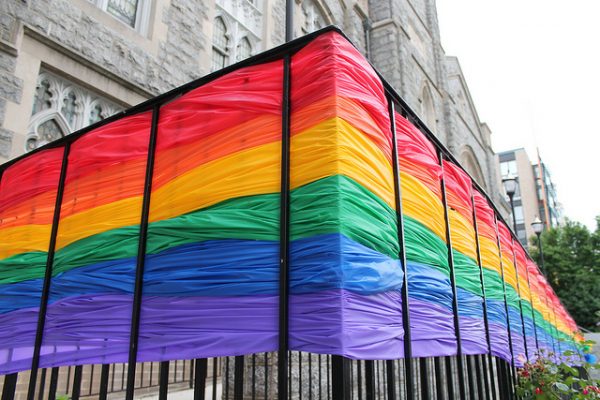
LGBT Celebration at Foundry United Methodist Church in Washington, D.C. Photo by Elvert Barnes, Flickr CC

Originally published on June 29, 2018.

In the United States, tension between religious institutions and the LGBT community persists, even after the legalization of same-sex marriage. While some faith groups are becoming open and affirming, the recent Supreme Court decision in Masterpiece Cakeshop v. Colorado Civil Rights Commission and stories of LGBTQIA+ exclusion at religiously-affiliated institutions like Hope College and Wheaton College show continued conflict between religion and sexuality, even in an era when Americans have become more accepting of same-sex relationships. Social science research shows that these challenges continue, but it also demonstrates how people don’t always have to choose between faith and being faithful to who they are.

Religious institutions are clearly changing. Even churches without formal welcoming statements often accept LGBT members, sometimes in contrast to the policies of their national organizations. At the same time, queer students are both learning to navigate their identities on religious campuses, and engaging in direct activism to create more welcoming and inclusive organizations.
Some people who are queer and religious experience tension between their identities, especially when they feel family members, faith leaders, or friends want them to choose one or the other. But other people work out all kinds of ways to be both religious and queer at the same time, from different doctrinal interpretations to forging their own communities.
Photo of cricket players in white uniforms holding their arms in the air to signal for an appeal
Players appeal for a wicket. Photo by Nic Redhead, Wikimedia Commons CC

“Howzat?”
“Kaaaaach it!”
“Bowled ‘im!”
“Wadda wrong’un!”

Americans may scratch their heads at these expressions, but a large body of international sports fans relishes those words. England and Wales are currently hosting the Cricket World Cup, the 12th edition of the tournament that began in 1975; ten national teams who have made it past qualifiers are slogging it out to lift the trophy. Social scientists around the world have studied cricket — as with many sports, a social science perspective on cricket shows that the pitch and stumps reside at a complex intersection of globalization, postcolonialism, boundaries, and identity.

Cricket is a global sport based on institutional and organizational processes as well as broader patterns of cultural and national identity. The centuries-old sport started in the United Kingdom and has since spread into a worldwide, modernized phenomenon, complete with fireworks, cheerleaders, and sophisticated analytics. An international network of cricketing organizations, athletes, broadcasting companies, sponsors, and state actors bring the game to its large, global audience.
In several countries, cricket’s growth has been shaped by the dilemmas, challenges, and sticky wickets of decolonization. In these countries, cricket has played an important role in building new cultural and national identities; social scientists explain that the popularization of cricket is both a cause and consequence of broader change. South Asian nations today are key players and decision-makers in the international cricketing world, which reverse-sweeps conventional logic that white countries hold greater global power.
The cricket field can also tell us a lot about race, belonging, and hierarchy. A classic in the social science of sport, C.L.R. James’ Beyond the Boundary uses his tales playing cricket to highlight status, exclusion, prejudice, and inequality within a social world shaped by racism, colonialism, and resistance. For example, he describes how team selection in cricket was shaped by skin-color rather than skill. Today, James’ ideas still influence scholars who study cricket as relevant to race, group boundaries, and social movements. Some researchers have studied anti-racist activism and the pursuit of equitable cricket representation in countries grappling with racial inequality. Others have shown that cricket offers an avenue of legitimization for marginalized and underrepresented groups in such nations.

Unfortunately, many issues of exclusion and marginalization still exist in the cricketing world today, both within and across different nations. As cricket continues to grow, globalize, and gather, such issues will hopefully be firmly driven outta here from the middle of the bat.

For an explanation of cricket terms, visit this ESPN glossary.

Photo by Fred:, Flickr CC

Originally published June 22, 2018.

The 2017 critically-acclaimed documentary Check It depicts the lives of a group gay and transgender youth from Washington D.C., who create a gang to help protect themselves from bullying and violence in their community. Although the film claims that the Check It group is “the only gay gang documented in America, maybe even the world,” evidence suggests that gay gang members may be more common. While research on crime typically portrays gang members as predominantly heterosexual men of color, such visions of gang life have overlooked the experiences of gay gang members. Recent scholarship attempts to incorporate LGBT voices into our understandings of gangs and violence, and move past the often one-sided depictions of LGBT people as victims of hate crimes.

Although researchers have been studying the hate crime victimization of gay men, and to a lesser extent other LGBT identities, they often limit queer experiences as passive or lacking agency. Evidence suggests that various intersections of a LGBT person’s identity including race, class, and gender identity, influence both their likelihood of being victims of hate crimes and their perceptions of the harmful impacts of the victimization experience itself. Scholars also critique hate crime politics and legislation for treating queer violence as individualized and abnormal, rather than highlighting the systematic ways that LGBT people are oppressed and excluded in mainstream society that facilitates this violence.
We know far less about how LGBTQ individuals participate in gang activity and violence. New investigations into gay gang members challenges heteronormative assumptions about participation in violent crime. This work, spearheaded by sociologist Vanessa R. Panfil, demonstrates how these gay men must reconcile their sexuality in an overtly masculine and homophobic gang culture. Panfil shows that while some of her participants participated in predominantly straight or mixed-sexuality gangs, others were part of queer friendship networks that created their own — and self-defined as — “gangs” in order to protect themselves from discrimination, bullying, and violence in their neighborhoods, much like the friends in Check It.

“Queering” criminal behavior breaks down inaccurate understandings of how violence operates. Among gay gang members, it isn’t just about untethered masculinity. LGBT perspectives highlight how binaries such as “victim” and “perpetrator,” and even the very idea of what constitutes a “gang,”  are often superfluous, inaccurate, and stigmatizing. Incorporating queer voices into studies of criminal behavior and punishment helps to disentangle how the various intersections of identities shape criminal behavior and criminalization.

Photo of a drone flying in the air near a statue of Joan of Arc.
Photo by Ted Eytan, Flickr CC

This post was created in collaboration with the Minnesota Journalism Center.

The landscape of journalism is changing every day. The Pew Research Center reported that newspaper newsroom employees declined by 45% between 2008 and 2017, and Nieman Lab argues that newsrooms are in the midst of a “do-or-die moment.” As traditional newsrooms lose hundreds of reporters and editors annually, content creators including WikiLeaks and Deadspin are coming alongside legacy media outlets including CNN, the BBC, and The New York Times to provide information to the public. All of these players publish content online in a journalistic fashion, raising the question of what journalism is as a profession.

In the midst of a shrinking workforce, scholars are starting to pay attention to “interlopers” and “intralopers:” Interlopers are actors or institutions who may consider the work they do to be part of news media, though they do not always define themselves as journalists; web analytics companies are one current example. Intralopers are similar to interlopers, but instead work from within news organizations as specialists in digital and social media and often produce emerging technology meant to complement journalists’ work. Both play increasingly key roles in journalistic spaces.
Machines and software packages are beginning to play a more central role in news gathering, news selection, news writing, news editing, and news distribution in newsrooms worldwide. Drones are one example of machines occupying space traditionally held by journalistic actors. 2016 was a turning point for the institutionalization of drones in newsrooms in the United States, when the Federal Aviation Administration (FAA) amended aviation regulations to allow for widespread experimentation with drones in American journalism. Since that date, journalists from outlets including The New York Times and The Washington Post have produced compelling stories, photos and videos but have also go through a comprehensive federal certification process (Columbia Journalism Review recently wrote about this phenomenon).
Analytics and metrics also play a key role in newsrooms nationwide. However, journalists have varying opinions of how influential their role is in their daily routines, with some arguing that analytics challenge journalists’ authority to decide which stories are newsworthy.
Beyond analytics and metrics, journalists and technologists often collaborate with each other on a regular basis to create open-source software programs. One example is “hackathons” — events where coders and journalists come together to find solutions to journalistic problems in the interest of creating a brighter future for news outlets worldwide.

Photo of a highway with a sign by the side of the road that says, welcome to northern ireland
Photo by Eric Jones, CC

Brexit negotiations have stalled on what to do about the Irish border. Some want to implement a hard border between Northern Ireland and the Republic of Ireland to control the flow of migrants into the United Kingdom. Others fear that a hard border will reignite violence that plagued the region in recent memory. Sociologists explain why peace is so fragile in this region by uncovering the structural, religious, and political roots of the conflict.

The conflict in Northern Ireland is religious, but that does not mean it is about doctrine. Religion does not just describe what individuals believe regarding the supernatural. It is a meaningful social identity that shapes how people experience and perceive the world. This is more true in Northern Ireland than in other parts of Europe. Protestants and Catholics not only worship in different churches, they also tend to live in different communities, send their children to different schools, and drink in different pubs. Through participating in these rituals, people in Northern Ireland construct strong identification with one or the other religious group, even if they do not personally believe in God at all.
Religion does not just signify group membership in Northern Ireland. It also signifies access to power and resources. Protestants there have been legally and socially privileged for centuries. This inequality set the stage for inter-group conflict. Because they constructed their social identity in opposition to Catholics, Protestants tended to see Catholic social ascent as a sign of their own descent. When Catholics mobilized for civil rights in the 1960s, the British-backed Protestants responded harshly. Violent repression strengthened the sense of group identification among Catholics. This collective victimhood identity was used to mobilize some Catholics to join violent resistance groups. A wave of bloodshed lasted for 30 years.
Conflict in Northern Ireland is more muted today. Globalization and trade liberalization have reduced the significance of the Irish border. The Good Friday Agreement signed in 1998 charted a path forward for peaceful power sharing in the territory. However, sectarianism did not end with the stroke of a pen. In the years following the agreement, residential segregation in Northern Ireland has increased, and periodic violence still occurs. The government has done little to dismantle structural sources of inequality, such as integrating schools. Instead, lawmakers place the blame of lasting inequality on bad individual actors. As a result, the Good Friday Agreement has not ushered in the era of religious and political cooperation that many hoped for.

The situation in Northern Ireland has parallels to social conflicts elsewhere, including racial inequality in the United States and South Africa. Social identities, such as religion and race, give meaning and texture to people’s lives. However, when one group’s success is defined by another group’s failure, harmful competition and conflict can tear at the fabric of society. Peace depends not only on individuals seeking and offering forgiveness, but on structural changes and daily rituals that construct an appreciation for differences in society.

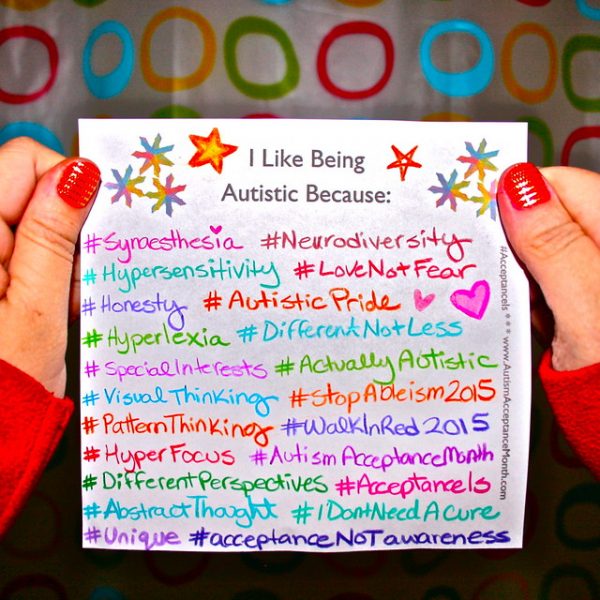
Photo of two hands holding a paper that says "I Like Being Autistic Because"
Photo by Walk InRed, Flickr CC

In 2007, the United Nations General Assembly designated April 2nd as World Autism Awareness Day. This community-wide event promotes the recognition and raises awareness about Autism Spectrum Disorder (ASD). The celebration brings individuals with autism and grassroots organizations together to connect and to promote appreciation for people with autism. Despite increasing awareness, the causes of ASD remain a puzzle. While scientific approaches consider it to be a developmental disorder associated with genetic or environmental factors, recent studies in social science illustrate how cultures themselves vary in their perception of both autism and other neurological differences.

The prevalence of autism has grown in past decades in North America.  Explanations of this trend point out to an increase in the prevalence of ASD, a broadening spectrum of autism diagnoses, and declining stigma that promotes recognition and acceptance of the condition. Sociologists have also suggested that this may be because parents, psychologists, and therapists have created alliances, using their expertise to develop a new system of institutions for approaching autism.
Regarding the causes of ASD per se, early scientific theories indicated that the condition was associated with genetic alterations, but social science studies have emphasized the role of environmental factors. Further, cultural factors across the world can also shape how people understand autism in the first place.
Both the description and diagnosis of the ASD depend on historical factors and vary across nations. In Korea, children with autism and their families experience profound stigma, especially the mother — who is considered to be responsible for her child’s condition. Since in Korea parents gain social respect based on the behavior of their children, having a child with autism constitutes a signal of defective parenting. On the other hand, in Nicaragua, there is an emergent culture around autism that encourages teachers and communities to create a supportive environment. However, both cultures still see autistic children as suffering with a disability. Both stances contrast with new ideas about neurodiversity that strive to create a new place for autism in larger socio-cultural contexts.
Somali immigrants call autism the “Western disease” because there is no word for autism in the Somali language and because many believe it does not exist in Somalia. Somali parents accuse the Western diet and medical environment in North America for the condition of their children. Their testimonies have not only opened possibilities to explore new scientific hypotheses regarding the environmental causes of autism, but also to reveal the power dynamics and struggles involved in validating different perspectives and narratives about the condition.  

Contemporary educational programs in the United States are now more aware of the importance of highlighting the strengths rather than the deficits of students with autism. They also recognize that accommodation and acceptance of autism is as important as finding its genetic and neurological causes.

Three women laughing side by side
Photo by Marc Kjerland, Flickr CC
It may be April Fools Day, but the sociology of humor is no joke! Social science research demonstrates that humor reflects societal conditions and can be important for social cohesion. For example, “inside jokes” — shared references between members of a group — promote social cohesion and ensure the group continues to exist by reminding members of the group’s shared history and their social ties to each other.
Women tend to use cohesion-building humor — treating the audience as a cohesive unit — and women rarely make jokes when men are present. Men, on the other hand, tend to use differentiating humor — calling out specific members of their audience and building hierarchies. In other words, using differentiating humor challenges the sense that “we’re all in this together” and instead point out distinctions between group members. Thus, humor can be viewed as a wedge or glue depending on who is using it.
Humor can also reveal cultural tensions in particular times and places. For instance, in Malawi “AIDS humor” reflects the huge shadow cast by the disease over everyday life. For instance, many jokes play on the multiple meanings of “to give” — relationships are often a place of expected exchange, but have also become a key location for the spread of HIV. One cartoon includes the picture of a man kneeling beside a woman saying, “well, you asked me for a romantic present — I’ve just given you AIDs, girl.” While many outsiders would not view these jokes as funny, AIDS is sometimes funny to those in Malawi because it touches the lives of those reading and listening to the jokes.

The next time you tell a joke, consider how you’re responding to a particular social context or situation and whether your humor is pointing out distinctions or bringing people together.

Woman with hand on forehead and eyes closed
Photo by jill, jellidonut… whatever, Flickr CC

We’re hearing more and more about the dangers of brain injuries, especially in sports. While the physical nature of these injuries often take the forefront, brain injury survivors must also deal with the emotional and social repercussions of their injuries. To mark Brain Injury Awareness month, we delve into social science research on how recovery from a brain injury involves changes to identity, social relationships, and everyday routines.

Post-injury, brain injury survivors must learn to adapt to the changes their injury caused — this could mean relearning how to walk or eat, learning to rely on others for help, and taking more breaks during the day. With these changes to daily life, many survivors believe their identities change too — and they must construct or reconstruct a new version of themselves. And while they retain aspects of their old selves, many survivors view their new identities as separate pieces. For example, brain injury survivors may distinguish between their new “brain injured self,” an “old self,” and a self that does “meaningful” activities, like parenting, helping others, paid work, art, or gardening. The process of healing and therefore the process of constructing a new self is not linear — like riding a rollercoaster, survivors get better for a while and then backtrack, then getter better, and so on. Consequently, a large part of accepting a new self also involves accepting an unpredictable future.