
culture

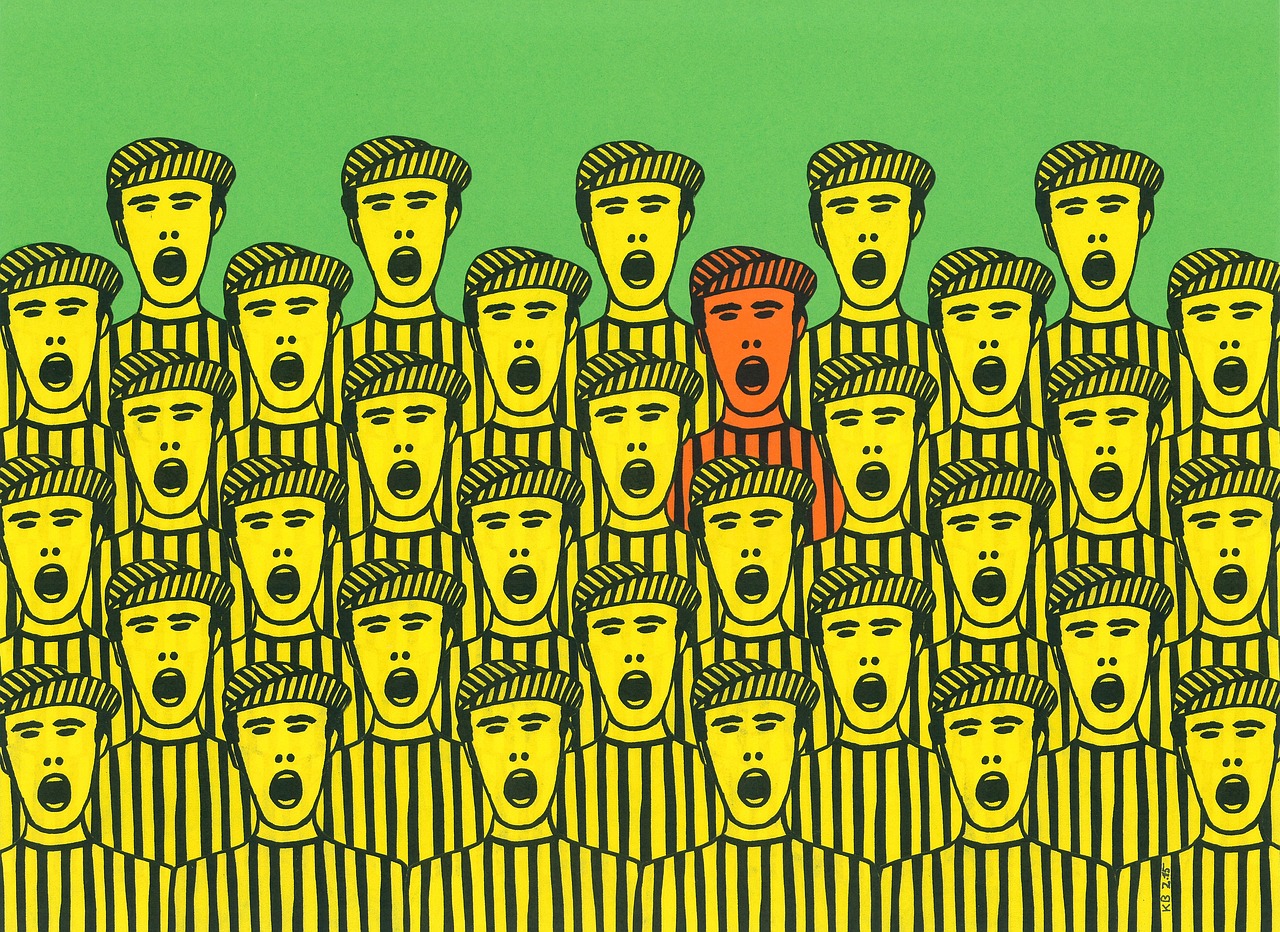
A illustrated image of men’s faces in striped shirts and hats. All of the men except one, who is orange, are yellow. Image via pixabay, Pixabay License.

For many, the start of the school year brings a mixed bag of emotions, from budding anticipation to feelings of unease and anxiety about self-worth and competence, otherwise known as imposter syndrome. Imposter syndrome exists well beyond academia, disproportionately affecting minorities and women, groups underrepresented in fields like business and medicine. What does social science research tell us about what imposter syndrome is, how it works, and how it can be addressed?

What it Is

Imposter syndrome, first described as the “impostor phenomenon,” refers to individuals’ perceived fraudulence and unworthiness within high-pressure environments and workplaces–the feeling that they don’t fit or aren’t really supposed to be there. It appears to be most prevalent among systematically marginalized groups like women, first-generation students, and BIPOC and queer people. Imposter syndrome flourishes in spite of, or perhaps even because of, increased diversity and representation. Individuals with imposter syndrome doubt the validity of their achievements and fear being exposed as frauds. These feelings of self-doubt and unworthiness are often compounded by social anxiety and depression, which can lead to self-sabotage. Imposter syndrome may partially explain higher drop-out rates among undergraduate groups in fields historically dominated by white men like medicine, mathematics, and science.

Impression Management

To manage feelings of inadequacy, individuals rely on what Erving Goffman called impression management. Impression management is the practice of keeping up appearances and matching one’s identity and behavior with societal expectations for social roles, positions, and identities. Imposter syndrome can emerge in settings with conflicting roles or expectations or when someone’s background, identity, and interaction style does not fit well with what is expected. This can lead people to using perfectionism and workaholism to exhibit competence. For instance, research on female facilities managers shows that performing competence often leads to higher performance outcomes despite persistent feelings of inadequacy. Displaying competency despite feelings of inadequacy can exacerbate the role conflict individuals experience or the tension between self-doubt and high achievement.

The Challenges of Diversifying

Efforts to “diversify” high-status fields like academia, law, and medicine sometimes fail to address the subtle cultural factors that can marginalize and exclude underrepresented groups. Lack of familiarity with field-specific concepts like peer review and tenure track or norms like networking or mentoring can leave individuals feeling alienated. This unfamiliarity is often at the root of the unease associated with imposter syndrome. To address imposter syndrome schools and workplaces have proposed a range of solutions including targeted mentorship programs and additional support for nontraditional students and employees. Scholars emphasize that addressing imposter syndrome should involve solutions that emphasize flourishing and well-being over identity-based inclusion efforts.
Image description: A blonde woman sits in a church pew, facing away from the camera. Image courtesy of pixabay, pixabay license.

This October, Pope Francis is kicking off a three year synod, assembling leaders and laypeople to discuss issues of church doctrine and practices. One big question on the table: should the Catholic church ordain women women as deacons? Driven in part by a growing movement of women around the world who feel called to ordination, the case for ordaining women will likely be to be one of the most hotly debated issues among Catholics worldwide. 

After hundreds of years restricting the role of women in church leadership, how did the Church even get to this point? The story begins with changes in mainstream culture. Historically, changing norms around sex and gender have encouraged church leaders to reexamine their existing doctrines, particularly if church participation is declining. As  mainstream culture changes, religious institutions face the challenge of “retraditioning” themselves for the future: adjusting their doctrines and practices to better align with changing mainstream culture. Religious leaders then debate proposed changes to church doctrines and practices–exactly the point that the Catholic Church is at today with the upcoming three-year synod.

What will happen at the end of the synod in 2024? Historical research suggests that after church leaders begin debating ideologies, changes to church policy often come through sheer luck, force, or the influence of powerful personalities. Only time will tell if the church leaders will have responded to the calls of these Catholic women.

Image description: Two college football players make contact on the field. Sports like football and basketball bring in huge amounts of money to colleges, but the student-athletes do not receive pay, raising questions about amateurism and exploitation that are now in front of the Supreme Court. Image via pixabay, pixabay license.

The NCAA was back in the Supreme Court last month, in the middle of its fabled March Madness basketball tournament. In NCAA v. Alston the association argued that the NCAA, not the courts, should decide the definition of amateurism. Or in other words, the NCAA should be in charge of deciding what types of compensation college athletes are able to receive–or not receive, as the case may be. 

The NCAA’s arguments built on their last Supreme Court case, in 1984, when the court ruled that the association’s actions in monopolizing TV contracts for college football violated antitrust regulations. But in his decision ruling against the NCAA Justice Stevens also included the line, “The NCAA plays a critical role in the maintenance of a revered tradition of amateurism in college sports.” The NCAA has leaned on this language over the past 35 years to maintain control over what benefits college athletes may receive, with the stated purpose of maintaining a separation between college and professional sports. 

The NCAA contends that the “product” of college sports will be devalued if college athletes are allowed to be paid, as fewer consumers will be interested in watching college sports if players are perceived as professional. Given that this argument amounts to an argument about consumer demand, what does the social science research say on whether the public believes that college athletes should be paid? 

A recent Ohio State survey (National Sports and Society Survey-NSASS) finds that a majority of Americans do support paying college athletes. This is a change from past research and potentially an important finding for the current legal challenges. 
What has not changed are the racial dynamics of who is more likely to support paying college athletes, with Black Americans more likely to support paying college athletes than white Americans. 
The main reason that public opinion has shifted is a growing sense that college athletes are being exploited, especially in football and men’s basketball. Exploitation is primarily a moral issue, with college athletes (and increasingly others) questioning whether the exchange relationship between themselves and the university is fair. Black athletes have long reported feelings of exploitation, and a recent NBER working paper illustrated how revenue brought in by Black men is being used to fund educational opportunities for other, white athletes.
Even aside from questions of exploitation, the concept of amateurism itself is suspect. Scholars have long argued that amateurism is a fundamentally classist concept based on nineteenth-century ideas of aristocracy, morality, and a “purity” of sport based on exclusion of the working-class. This flawed ideal has never described big-time American college sport, which has been commercialized and professionalized since its founding. It has certainly not described college athletics since the NCAA instituted one-year, renewable athletic scholarships in 1973, which in practice look and act like employment contracts

Taylor Branch’s now classic piece in The Atlantic, “The Shame of College Sports,”as well as the publicity around Ed O’Bannon’s court case to allow college athletes to profit off of their likeness, illustrate how issues of amateurism and exploitation in college sports have firmly entered popular discourse. The decision in Alston won’t answer many questions about the future of college sports, but it does represent an effort by the NCAA to assert control over a rapidly-changing situation. Court watchers feel that the Court is unlikely to rule for the NCAA after seeing oral arguments, which will make name/image/likeness and potentially pay-for-play legislation all the more important over the next few years.

Image description: Mohammed, a Somali exile, sits in a chair on the right-hand side of the image. his children sit on the floor around him, as they discuss art. Art covers the wall. Creating cultural products is one way that communities process trauma. Image courtesy of UNHCR, CC BY-NC 2.0.

Scientific developments in the field of epigenetics have called attention to intergenerational transfers of trauma. We know now that traumatic experiences can be passed down through the genes— to children, and even grandchildren, of the survivors of horrific experiences like the Holocaust or American slavery. Sociology can help show how past trauma is passed down through social ties, and about its effects on current health and wellbeing. These social consequences of trauma could be even more powerful than the genetic impacts, affecting group dynamics, identity, history, and culture. In addition to what is passed down, sociological research also provides examples of how groups are managing these social effects, in both helpful and harmful ways. 

Cultural Trauma and Group Identity
Cultural sociologists assert that in addition to individual bodily and psychiatric trauma, there is also collective “cultural trauma” when groups experience horrific events. This collective trauma compounds and complicates individual effects. In order for the process of cultural trauma to occur, the group must first recognize that a great evil has been done to them, and construct a cohesive and shared narrative that includes perpetration and victimhood. Then this narrative becomes incorporated into that group’s collective memory as an enduring aspect of their identity, like the Holocaust has been for Jews or collective memory of slavery for Black Americans.
Both perpetrators and victims of violence must contend with the horrific event in some way, as it is now permanently associated with their group. This can occur either through avoidance of the difficult past, or stigma management practices like acknowledgment, denial, and silencing.

Cultural Trauma and Group Conflict: Violence Begets Violence

Sometimes, this cultural trauma process results in further violence. As the group comes to understand the harms they have suffered and assign responsibility, they can seek violent retaliation against the offending perpetrators. Examples include the bombing of Pearl Harbor (and subsequent Japanese internment and Hiroshima/Nagasaki bombings), and the 9/11 attacks leading to the U.S. War on Terror. In ex-Yugoslavia, ancient collective memories were stoked and reconstructed by elites to provoke inter-ethnic violence that led to ten years of war, genocide, and ethnic cleansing. In Hawai’i, Irwin and Umemoto trace the emotional and psychological effects of violent colonial subjugation, such as distress, outrage, and depression, to contemporary violence among Pacific Islander youth.

Memory Work: Social Solidarity and Empowerment

Sociological research also provides examples of people “making sense” of difficult pasts by doing “memory work,” which can include art, music, and other cultural production. For example, second-generation Sikhs in the U.S. are using internet spaces to challenge dominant narratives of the 1984 anti-Sikh violence in India, contributing to group solidarity, resilience, and identity within their communities here in the U.S. Similarly, the children of Vietnamese refugees are using graphic novels and hip-hop music to articulate how the Vietnam War contributes to current struggles in the Vietnamese community. This shared understanding and validation then empower communities to fight for recognition and social justice. 

When a group experiences a horrific event, the social effects live on to future generations. Understanding these effects is crucial for developing solutions to group suffering moving forward. Going through the cultural trauma process is necessary to overcome difficult pasts, but it is critical that this process occurs in a way that promotes justice and peace rather than further violence.

Image: A black woman sits on the floor, leaning against a sofa, in a low-lit room. Her head is in her hands, obscuring her face. Courtesy of pixabay, Pixabay License.

We recently featured new research documenting a broad-based increase in mental health treatment-seeking in the United States. Access to such care remains unequal, however, presenting  real and persistent challenges to those in need. Sociologists, and other social scientists, offer important information about these inequalities and the barriers to equitable mental health care.

Over the past few decades there has been growing concern that people are being “overtreated” for mental health issues given increasing rates of mental health treatment and diagnosis in the population. Nevertheless, there are still many people with mental health conditions who are being “undertreated.” Specifically, there are large gaps between the number of people who have a diagnosable disorder and the number of people who actually receive treatment, particularly for serious mental health issues such as schizophrenia or substance abuse disorder.
Research in the sociology of mental health has often focused on the stigma around seeking or receiving mental health care, particularly for marginalized racial or ethnic groups. In fact, white men may be the most likely to have negative perceptions of care when compared to other demographic groups, as Ojeda and Bergstresser report. As the stigma related to mental illness decreases overall, additional research is needed to examine how, why, and for whom this stigma persists.
Access to mental health care is also limited by mental health practitioners and the mental health care system. In a recent experimental audit study, Heather Kugelmass found that patients with less education and black patients were less likely to receive a response when they sought help from a mental health care provider. In addition, Lincoln and colleagues found that patients with lower levels of literacy found it more challenging to navigate the mental health care system, struggling to fill out paperwork and make health-care decisions along with their care provider. Both the structure of mental health care, and the actions of mental health care providers, can create inequality for patients even after they have decided to seek care.

As we’ve recently emphasized, more people are accessing mental health care now than ever before. As the stigma around care decreases, and more people are seeking care, it is particularly important to ensure equitable access. By shedding light on how factors like disability, class, and race affect mental health care, social scientists can ultimately play a role in addressing inequities and alleviating mental distress.

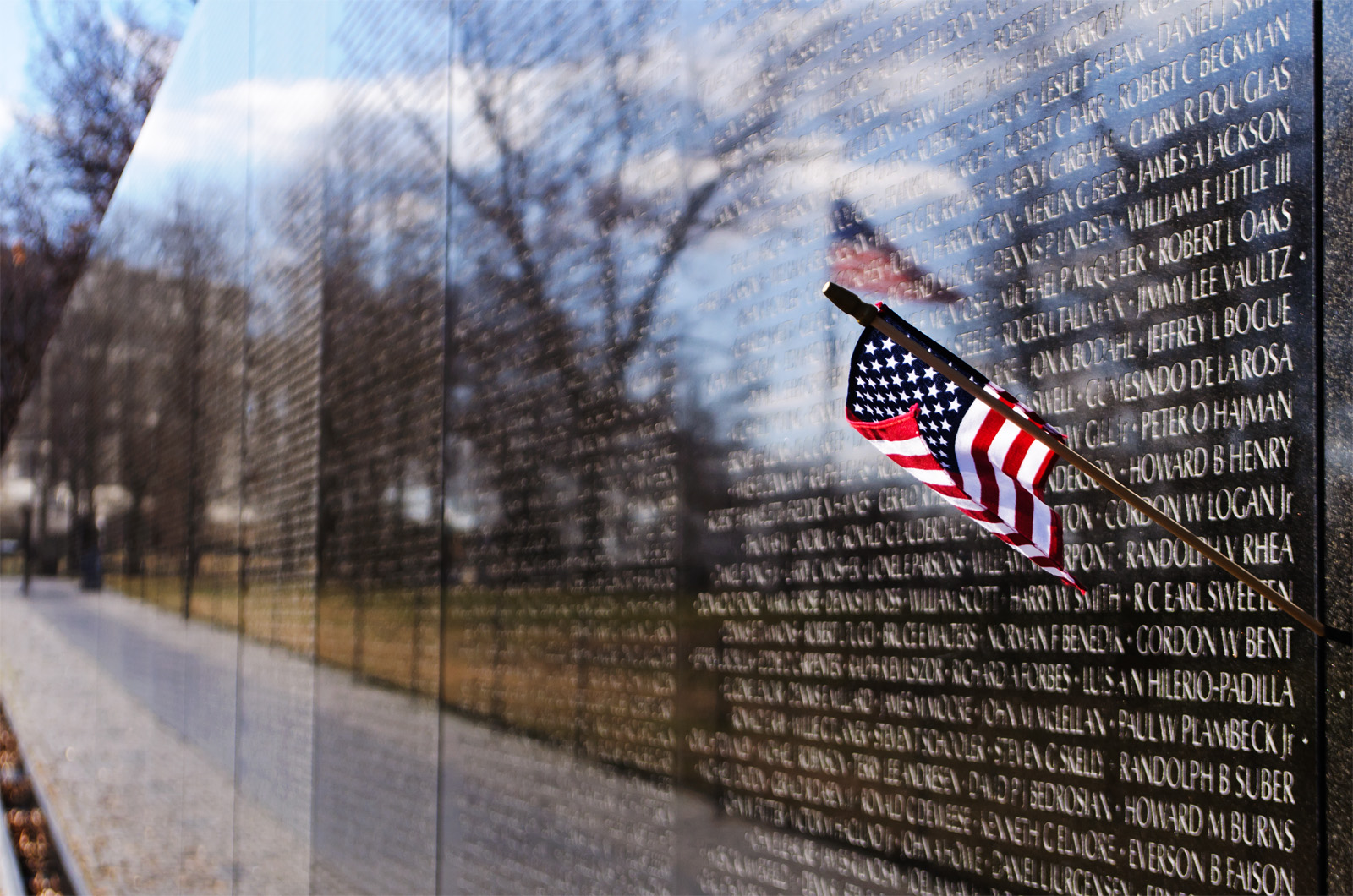
Image: A small American flag placed within the Vietnam Veteran’s Memorial in Washington, D.C. Image courtsey of InSapphoWeTrust, CC BY-SA 2.0.

On January 19, 2021, less than 24 hours before their swearing-in, Joe Biden and Kamala Harris, and their spouses, Dr. Jill Biden and Douglas Emhoff, stood at the foot of the Lincoln Memorial to light the first COVID-19 memorial. Looking out over the Reflecting Pool, they led a moment of silence to honor the more than 400,000 American lives lost to the deadly virus. Following months of government inaction and widespread denial,  this ceremony marked the first national commemoration of COVID victims. Despite its immediacy and ephemerality, the memorial shares much in common with other public memorials commemorating events of mass violence and loss of life. An interdisciplinary body of literature sheds light on public memorials’ complex, contested, and inherently political nature.  

Temporality, Immediate response, and Grassroots memorials

Many memorials begin organically, in the immediate aftermath of a traumatic event that captures public attention. For instance, in 1997, following Princess Diana’s sudden death, Londoners left more than 60 million flowers outside her homes at Kensington and Buckingham Palaces. Similarly, in the wake of 9/11, grassroots memorials to the victims sprang up on streetlights and walls throughout New York, in open areas near the Pentagon, and in the fields near the Flight 93 crash site outside Pittsburgh. These spontaneous and temporary memorials reflected the visceral public grief experienced and mediated in real time, in public and collective ways.

Official Memorials

When the immediate shock of traumatic events wears off, plans for official memorializations begin taking shape, often led by governmental bodies with input from both the public and private sectors. Around the globe, from Seoul, to Berlin, to Lower Manhattan, decisions about public memorials have grown increasingly democratic, as leaders seek out input and participation from community members and engaged groups. As with any other democratic process, memorial developments are subject to group conflicts and financial constraints. Decisions for public memorials such as the Vietnam Veterans Memorial in Washington, the Flight 93 National Memorial in Southeast Pennsylvania, or  the Memorial to Murdered Jews of Europe in Berlin, were  shaped by the interests of commemorated groups, long-term urban master plans, the goals of the tourism industry and the larger social significance memorials invoke among the broader public. 

The Contested Politics of Memory 

While highlighting traumatic events and experiences, permanent and temporary memorials often shape public discourse around politically charged topics. For example, the NAMES Project AIDS Memorial Quilt, which blanketed the National Mall from 1987 to 1996, commemorating the predominantly queer victims of HIV/AIDS, helped break the silence around the deadly disease. Located immediately off the National Mall, the subterranean Vietnam Veterans Memorial – designed by the American sculptor Maya Lin – incited a public reckoning over an unpopular war that continues to stoke controversy. 
Still, various communities affected by AIDS – including BIPOC and working class communities – have expressed concern over the installment’s predominantly-gay focus, arguing non-queer AIDS victims’ expereinces were being overlooked. Just last summer, following the killing of George Floyd at the hands of Minneapolis Police, cities across the US painted messages of support for global Black Lives Matter movement on city streets, sparking robust public debate on police violence and the use of public dollars on law enforcement. These debates are ongoing, signalling that rituals of commemoration are inherently fraught and contested processes.
Alongside loss of life, new forms of public commemorations have highlighted ‘experiences’ of trauma, abuse, and human rights violations and the survivors. With similar political goals, these politically-motivated installments aim to harness political energy around these salient topics in support of policy change, reparations, and broader societal awareness.
Image: A black female fighter braces for a tackle, a white female fighter wrapped around her center. Image courtesy of Matt Brouse, Porrada Photography.

On a recent podcast, ESPN commentator, Stephen A. Smith, expressed his dislike for women’s participation in combat sports. He said, “… I don’t want to see women punching each other in the face. I don’t want to see women fighting in the octagon and stuff like that, but that’s just me.”  Female fighters like Kaitlin Young have expressed outrage at his comments, as they often do when men question the validity of their participation in combat sports. This public exchange highlights the contentious balancing act between female fighters and the masculine combat sports in which they partake — shedding light on the intricate ways women navigate gender norms in hyper-masculine spaces.

Female fighters in mixed martial arts transgress patriarchal gender norms by merely participating in violence, which often elicits responses like those from Smith. Men and women with essentialist views of gender difference, such as the belief that women are weak, often struggle to view women as capable of violence. Although sociologists and those studying gender have rebuked these essentialist claims, arguing instead that gender is socially constructed and continuously performed, society struggles to conceptualize women not only as fighters but as physically powerful.
Women’s participation in combat sports often results in individual empowerment and sometimes even progressive social change. But viewing female fighters as solely women who transgress gender norms can also overlook the many ways some female fighters uphold gender norms in their sport. Female fighters often grapple with displaying an “appropriate” amount of femininity. Wearing pink boxing gloves, for example, is an appropriate display of femininity, but wearing make-up or crying while sparring is generally not. 
While women may employ their femininity to encourage other women to join the gym, commercialize their sport, and challenge sexist beliefs about women’s capabilities, the pressure to conform to gender norms while engaging in gender-transgressing activities, like combat sports, may enforce the very gender norms and sexist beliefs that women often fight against. 
Image: Black and white nude silhouettes of Ronda Rousey and Miesha Tate face off at the center of an advertisement for their upcoming fight. Image used under fair use guidelines, for educational purposes only.
It is worth highlighting how gender and sexuality are conflated in the media coverage of women’s combat sports as well. When women compete professionally, their bodies often become sexualized by the media. A recent study found that when female athletes were sexualized in fight promotions, men reported more positive attitudes toward the ad. This also resulted in respondents finding the female fighter less talented, successful, and tough than those not sexualized in the combat ads. 

Women in combat sports have come a long way since UFC President Dana White declared women would never fight in the UFC, but both recent events and research suggest that the sports world and society itself still have a long way to go when it comes to gender equity and inclusion in sport.

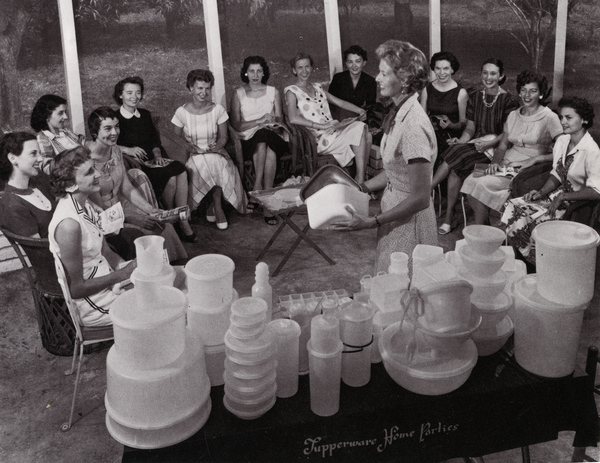
Image: A black and white photo of a white woman standing in the center of a circle of women, holding tupperware. Image via wikimedia commons, creative commons usage. Tupperware was one of the first direct sales companies that targeted women, specifically.

As the COVID-19 recession deepens, many of us have been receiving more calls from long-lost friends or relatives selling energy drinks, workout videos, jewelry, or various household goods. In the absence of social insurance policies to soften the pandemic’s devastating toll, more and more Americans desperate for financial stability are turning to multilevel marketing (MLM), also known as direct sales or network marketing to provide for themselves and their loved ones. For decades, MLMs have offered participants flexible hours, a support network of other dedicated sellers, and the tantalizingly elusive promise of getting rich to those facing uncertainty.

But these programs promise more than just an opportunity to flex your entrepreneurial skills. Apart from selling, these multilevel marketing programs offer participants the promise of luxury cars, tropical getaways, and an end to financial squalor for those who work hard enough. But how does this industry work? Social science research points to this decades-old business model’s potential pitfalls for disadvantaged participants.

Business structure

From essential oils to protein powder to plus-sized clothing and just about everything in between, MLMs sell a wide range of consumer goods. Here’s the catch: you can’t buy these items online or in stores. Sellers – “distributors” in direct sales parlance – purchase product in bulk from companies (think Avon, Herbalife, LulaRoe, Plexus) to sell to friends, family, and contacts. While companies profit from these transactions, sellers seldom see these dollars themselves. To profit, these distributors must recruit new team members. The more members – or “downlines” – on their “team,” the higher commission the “upline” – the recruiters – receives. Perhaps unsurprisingly, given the high start-up cost and lack of benefits, research from the AARP suggests that 73 percent of those who participate in MLMs lose or make no money at all, deepening the vulnerability of already disadvantaged participants. 

Direct sales and gender

Since its inception at the turn of the 20th century, the predominantly male traveling sales industry evolved into the female-dominated MLM model we know today. To curb the unsavory reputation itinerant sellers engendered – reputations commonly laced with antisemitic tropes and xenophobic stereotypes – companies began culling vendors from a more acceptable population: middle-class, predominantly white women and, at first, young college students. With companies pledging flexible hours and easy sales to their social circles, this business model took off following WWII. Tupperware revolutionized the way products were sold; instead of door to door sales or sales calls, buyers — mostly unemployed housewives — attended parties filled with product demonstrations and socializing. While social media and the internet have changed the nature of direct marketing, feminized notions of work and domestic responsibility still permeate this market, from the products sold (cleaning products, kitchen supplies) to the emotion-laden bonds forged within teams of distributors. Such MLM opportunities remain attractive, in part, due to the persistence of sex discrimination in employment, and the antiquated expectations that still limit women’s earning potential, self-image, and job prospects.

Charisma and Risk

Much to the chagrin of regulatory agencies, many MLM products have been marketed as “cure-alls” for all manner of maladies and ailments. In April 2020, the FDA publicly chastised seven direct sales companies about misleading claims, arguing their products protected against coronavirus. Alongside these audacious claims, these companies have long used self-empowerment rhetoric to energize distributors and build their following. This charismatic language has drawn often vulnerable populations seeking economic stability and community into the MLM orbit. Research demonstrates how these emotion-laden themes work alongside promises of socioeconomic advancement to make multilevel marketing a promising career path for a wide variety of aspiring entrepreneurs and desperate sellers alike. Instead of offering financial security, MLMs dangle audacious promises and a competitive environment for individuals to pursue prosperity, often with little success.
Image: Backlit profile of a young girl, sitting next to a body of water, with her head down in her arms. Image courtesy of Pixabay License.

This past Sunday the New York Times reported that Las Vegas was reopening its schools, despite the ongoing threat of covid-19, in response to a “surge of student suicides.” Educators and parents shared concerns that school closures have left young people isolated, hopeless, and vulnerable, but this action was a real clarion call. Conversation about the link between school closures and adolescent suicide is politically charged and the recency of covid and virtual learning leaves us without strong evidence to assess this situation. However, sociology has long been interested in suicide, and social science offers us important tools for considering the nature and causes of adolescent suicide.

In a classic sociological work, Émile Durkheim examined suicide as a social fact, exploring how suicide was caused by social, rather than individual, forces. In particular, Durkheim attributed rates of suicide to differing levels of “integration,” or social belonging and inclusion, and “moral regulation,” or external monitoring, oversight and guidance in communities. Durkheim’s work is particularly relevant when considering the link between school closures and adolescent suicide. Adolescents may be missing the sense of belonging, and the external oversight from trusted adults, that the school environment can provide.
Contemporary sociologists are reexamining the relationship between integration, regulation, and suicide in light of changing social institutions. For instance, sociologists have examined how, in a community valuing high academic achievement and discouraging professional psychological support, adolescents’ integration and regulation may leave them vulnerable to intense feelings of academic failure that put them at-risk for suicide.
The news media is reporting that school districts are experiencing “suicide clusters” since the lockdowns, instances where several individuals connected by social relationships all commit suicide. This may not be quite as unusual or unexpected as it sounds. Social scientific research supports the idea that suicide might be “contagious,” in that certain peer relationships can increase suicidal ideation among individuals connected with someone who committed or attempted suicide, or experienced thoughts of suicide. This contagion effect is particularly strong for adolescent girls.
Social media is one way that knowledge of friends’ or peers’ suicidal ideation or suicide attempts can spread. It is this knowledge (rather than expressed negative emotion) that contributes to the “contagion” effect. Media, such as news reporting or television shows, can also “suggest suicide” to adolescents. However, the nature and strength of the relationship between media reporting and suicidal thoughts and behaviors warrants further research. Overall, the potential for suicide contagion suggests that media, social scientists, and social networks need to use caution when discussing, and reporting on, suicide
Sociologists can also describe, and explain the cause of, disparities in suicide risk according to gender, race, and socioeconomic status. For instance, research suggests that higher rates of suicide among adolescents living in poorer communities may result from differential exposure to violence or lack of safety. Higher rates of suicide among Native American youth may result, in part, from frequent racial misclassification, denying these youth access to racial pride and racial support networks. There are especially high rates of suicide among LGBTQ youth, and LGBTQ youth report higher levels of suicidal ideation. However, despite media coverage of the relationship between sexual orientation, bullying, and suicide, there is not clear evidence that experiencing bullying more frequently is associated with greater suicidal ideation.
For all that we know, individual suicides still often defy understanding. However, working together, social scientists can help explain the complex causes of suicide and, especially, suicide risks and rates. This is particularly important to consider for adolescents. Although media reporting is now focused on the relationship between school closures and suicide among young people, the reality is that rates of adolescent suicide have been increasing over the past decades. Concern for youth suicide is not new. This calls for careful attention to how social scientific tools can contribute to understanding of this complex problem.
A woman helps an elderly man get up from his chair
Photo by Brian Walker, Flickr CC

Originally published May 4, 2020

When we talk about work, we often miss a type of work that is crucial to keeping the economy going and arguably more challenging and difficult than ever under conditions of quarantine and social distancing: care work. Care work includes both paid and unpaid services caring for children, the elderly, and those who are sick and disabled, including bathing, cooking, getting groceries, and cleaning.

Sociologists have found that caregiving that happens within families is not always viewed as work, yet it is a critical part of keeping the paid work sector running. Children need to eat and be bathed and clothed. Families need groceries. Houses need to be cleaned. As many schools in the United States are closed and employees are working from home, parents are having to navigate extended caring duties. Globally, women do most of this caring labor, even when they also work outside of the home. 
Photo of a woman cooking
Photo by spablab, Flickr CC
Globally, women do most of this caring labor, even when they also work outside of the home. Historically, wealthy white women were able to escape these caring duties by employing women of color to care for their children and households, from enslaved African Americans to domestic servants. Today people of color, immigrants, and those with little education are overrepresented in care work with the worst job conditions. 
In the past decade, the care work sector has grown substantially in the United States. However, care workers are still paid low wages and receive little to no benefits. In fact, care work wages are stagnant or declining, despite an overall rise in education levels for workers. Thus, many care workers — women especially — find themselves living in poverty.  

Caring is important for a society to function, yet care work — paid or unpaid — is still undervalued. In this time of COVID-19 where people are renegotiating how to live and work, attention to caring and appreciation for care work is more necessary than ever.