crime

A sculpture in Bangladesh commemorates atrocities of wartime rape. Photo via Wikimedia Commons.

Nadia Taha, a Yezidi woman, recently spoke to the UN about her horrendous experience as a sex slave for ISIS. The so-called Islamic State has also exploited Christian, Turkmen, and Shia women. Wartime rape is an age-old weapon, seen still in conflicts in Sierra Leone, Bosnia-Herzegovina, and Rwanda. Social scientists reveal the power dynamics at play by studying both the victims and perpetrators.

Rape is an individual crime as well as a weapon of war that enforces social power. Social groups use it to help carry out genocide, instilling fear, and force displacement. Rape also alters the racial and ethnic demographics of the targeted group and intimidates groups where women are considered to be bearers and keepers of culture.
Women and men are victims of rape during conflict. Women are targeted according to their cultural beliefs, desirability, reproductive ability, and virginity. Rape is used against men to “feminize” them, emasculating and implying homosexuality and weakness.
Perpetrators of rape during conflict include agents of the state (military, police, etc.), political groups (paramilitaries, terrorist groups, etc.), and politicized ethnic groups (e.g., Rwanda’s Hutu). As such, the International Criminal Tribunal for Rwanda decided that perpetrators of rape can be punished as individuals and states would be held responsible for either perpetrating sexual crimes or for failing to protect their citizens from such terror.
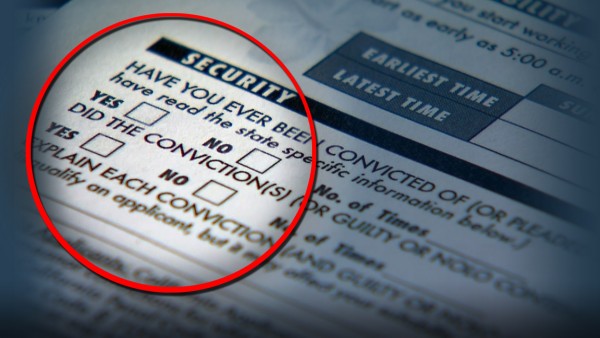
Job application via PBS.org.

Conservative and liberal legislators alike are calling for criminal justice reform. Last November, President Obama proposed a “ban the box” initiative that prevents federal agencies from inquiring about an applicant’s criminal history during the initial stages of the hiring process. The plan mirrors similar policies in over 100 U.S. cities that seek to reduce employment discrimination against people with criminal records and alleviate the socioeconomic burdens they often face as they reenter the job market. Social science highlights the scope of this problem and how ban the box policies may help.

Employers often dismiss applicants with criminal records, which disproportionately affects black men. A Milwaukee study revealed employers contacted only 5% of black men who disclosed a record; even black men without a criminal record were less likely to receive a callback than their white male peers with a criminal record. Thus, even in the absence of criminal background checks, employers may use racial indicators, education levels, and gaps in employment to evaluate potential criminality among job applicants.
Among candidates with a record, employers may consider the severity of the crime, the time since the crime was committed, and the outcome of the crime. Felony crimes and convictions appear to create the most barriers, while job applicants with misdemeanor arrests face lower hurdles. Since interviews with employers show that making personal contact with job applicants can help overcome the negative effects of a criminal record, “ban the box” measures that delay consideration of the criminal record until the interview process could make a real difference in individuals’ job prospects.
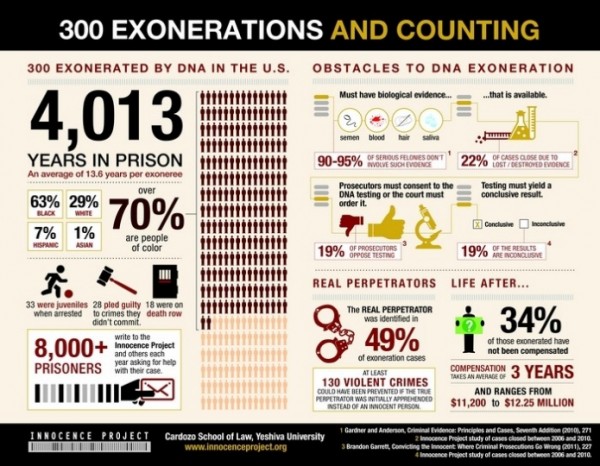
Innocence Project Stats
Click to visit the Innocence Project.

Netflix made a big splash in “true crime” with its series Making a Murderer, chronicling the investigations and trials of Wisconsin man Steven Avery. Exonerated after 18 years in prison for sexual assault in 2003, Avery was arrested for a new crime—murder—in 2007. Public debate about the documentary revolves around whether Avery’s innocent, potential misconduct in the justice system, and the ethics and consequences of documentary “vigilante justice,” but there is little doubt Avery was wrongfully convicted the first time around, in 1985. Social science helps us understand the more systematic consequences of incarceration and exoneration that cultural phenomena like Making a Murderer, the Serial podcast, and even the upcoming miniseries “The People v. O.J. Simpson: American Crime Story” bring to our attention.

Pop culture tends to focus on errors, like witness misidentification and shoddy forensics, but those are not the only things that lead to wrongful convictions. Sociological research shows blacks and Hispanics are at a higher risk, and these groups are, in fact, overrepresented in samples of exonerees. Black exonerees suffer longer periods of incarceration between their conviction and exoneration than other groups. And exonerations often raise questions about the criminal justice system’s authority and legitimacy in the eyes of the public.
Exonerees, even those who aren’t in a media spotlight, face practical problems after they are released from prison. The stigma of having served time diminishes chances in the employment and housing markets, even for those who are exonerated. Like others experiencing reentry after incarceration, exonerees also face unmet needs with regard to physical, dental, and mental healthcare, as well as the myriad challenges of rebuilding social networks and reintegrating to everyday life.
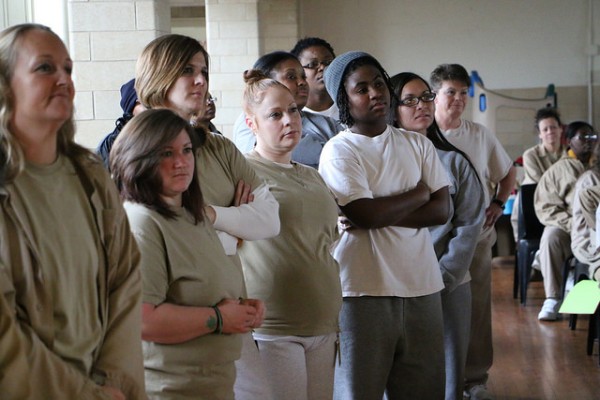
At the Indiana Women's Prison. Lwp Kommunikáció, Flickr CC.
At the Indiana Women’s Prison (established in 1873, the first adult women’s correctional facility in the U.S.). Lwp Kommunikáció, Flickr CC.

Many more men are incarcerated than women, but from 1980 to 2014, the number of women in state and federal prisons rose from just over 13,000 to more than 106,000, making women the fastest growing prison population in the U.S. This drastic increase is due in part to the War on Drugs and the shift to a “tough-on-crime” logic in the 1970s and ‘80s. For women, the mass incarceration era doesn’t just exert tougher penalties; it also carries over an earlier, paternalistic way of disciplining women.

Before mass incarceration, women’s prisons operated under rehabilitative models. These viewed women’s criminal behavior as a result of their vulnerability or dependency, rather than dangerousness. Inmates were sometimes called “girls” and referred to the warden as “daddy.” Later tough-on-crime policies increased security, abolished mandatory counseling, and emphasized order and control in women’s prisons. Still, some contemporary prisons maintain a paternalistic attitude by offering women “treatment” that focuses exclusively their perceived inability to make good choices in the face of challenges from men, drugs, or a history of abuse.

In other words, incarcerated women are hit with a double bind. Strict sentencing policies ignore social context and drastically increase the number of women in prison, while the paternalism of the past shapes how the criminal justice system interprets and judges their behavior and prospects for rehabilitation.
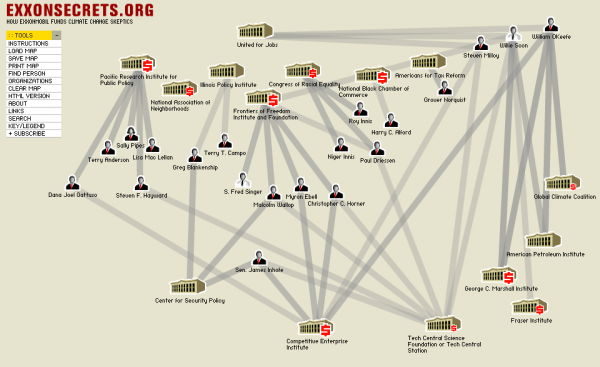
ExxonSecrets.org uses data visualizations to trace the company's influence on legislation and scientific research groups.
ExxonSecrets.org uses data visualizations to trace the company’s influence on legislation and scientific research groups.

New York’s State Attorney has opened an investigation into whether ExxonMobil lied to the public and investors about the risks of climate change and funded outside groups to question climate science, even as the company’s own expert researchers found that fossil fuel emissions do, indeed, contribute to rising temperatures.

The Exxon investigation reflects the broader politicization of climate change and the role of corporations in shaping public perceptions. Surveys have found that the U.S. public is poorly informed about the science of climate change. A climate change countermovement flush with funds from business and conservative organizations works to create skepticism and distort public understanding. These efforts mirror other controversies over science and risk, and past corporate campaigns to create doubt about the harmful impacts of chemicals such as tobacco, DDT, or holes in the ozone layer.
Climate change denial is not simply the result of well funded public relations campaigns, however. It also reflects collective and individual anxieties and the difficulties of coming to terms with abstract and long-term risks. Everyday experiences, cultural norms, political beliefs, and religion shape how people come to terms with problems like climate change.

For more on echo chambers and how climate change denial narratives gain credibility, check out this new piece over at Contexts!

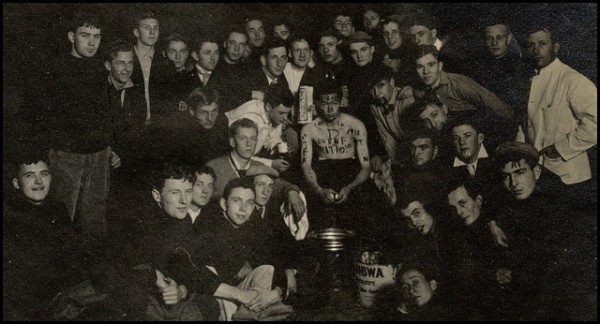
Hazing at the University of Michigan in 1907. Photo via VasenkaPhotography, Flickr CC.

Hazing has been in the news a lot recently. It exists across a variety of settings, including sports and the military.

Why does hazing occur? Some research discusses the function of hazing as rites of passage or as an expression of group solidarity. Hazing can bring members together, validate one another in the group’s eyes, symbolize transition into group membership, bolster group cohesion, and create group conformity within particular hierarchies.
Research on insider’s attitudes towards hazing highlights interesting dynamics within organizations. Individual members often have negative thoughts about hazing, but individuals are unlikely to protest the practice in-group settings. Power dynamics within those groups normalize hazing and silence opposition to it.
The research suggests that hazing takes on a particular character within Greek Letter Organizations (GLOs). In fraternities, for example, where membership and group identity are constructed around ideas of the “all-male” group, hazing can serve as a validation of masculinity and a suppression of femininity. In addition, in GLOs that have been historically raced, hazing can express racial identities, in-group unity, and belonging.
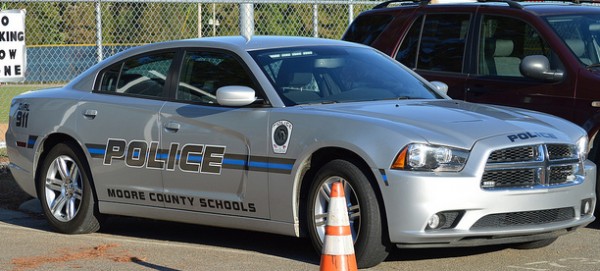
School Resource Officers are a common site on today's public and private campuses. Photo: Donald Lee Pardue, Flickr.
School Resource Officers are a common site on today’s public and private campuses. Photo: Donald Lee Pardue, Flickr.

The recent physical altercation between a police officer and a young black female student at Spring Valley High School in South Carolina raised questions about the role of disciplinary sanctions and law enforcement in schools. Since the 1990s, schools, particularly inner-city schools, have become increasingly criminalized, as school officials view students as suspects.

The criminalization of students includes the formalization of punishment through “zero tolerance” policies, the transfer of disciplinary discretion among teachers and school officials to disciplinary codes, and the integration of criminal justice technologies and personnel. Schools often replace traditional modes of school punishment with arrests and court referrals, and control students through security measures like metal detectors and on-campus police officers.
School Resource Officers (SROs), law enforcement officers stationed in a particular school or school district, are a central part of this trend. The number of SROs has increased over the past 12 years, but systematic studies offer no evidence that schools with SROs have better safety records. On the contrary, long-term studies show that more crimes involving drugs and weapons are recorded after schools add SROs. SROs are also associated with higher levels of student arrests for lower-level delinquent acts (e.g., disorderly conduct), suggesting that SROs may bring behavior that was once dealt with by the school (“in house”) into the criminal justice system. This “SRO effect” is exacerbated in schools characterized by higher levels of economic disadvantage.
African Americans and other minority students are affected disproportionately, both because SROs and other criminal justice tools are concentrated in urban schools and because minority students, even when controlling for differential behavior, are punished at higher rates than their white peers. Current research suggests that schools’ rising criminal justice apparatus does little to quell violence, but may unintentionally result in more black students experiencing the “school-to-prison pipeline.”
Fantasy sports have gained coverage as a sport of their own.

You’ve probably seen more than an ad or two this fall for DraftKings or FanDuel, two massive online fantasy sports websites valued at over $1 billion each. Since 2009, the number of fantasy sports players has doubled, and, as of August, 56.8 million participated in the United States and Canada (according to the Fantasy Sports Trade Association). It’s not all fun and games, though. The New York Attorney general launched an investigation into these sites, and a recent feature in The New York Times highlights how deep the rabbit hole goes for illegal online gambling on fantasy sports. It is easy to focus on scandalous stories of crime rings, big winnings, and crushing losses, but these sites are not just about gaming the system. Sociologists emphasize that they are also powerful social communities driven by cultures of masculinity and fandom.

Eric Leifer argues that the history of sports fandom in the U.S. is place- and team-based—fans supported the team in their town or region as a marker of community membership. Fantasy leagues and social media challenged this by shifting the focus from entire teams to individual athletes’ performance.
Sociologists, especially, focus on the racialized and gendered nature of sport-based communities. Members often forge strong social ties in male-dominated spaces that emphasize knowledge and expertise, and the groups can privilege racial stereotypes and racialized assumptions about athletic performance.
Fantasy sites (and the betting that ensues on them) are in line with other case studies that show how online socialization is not “less real” or consequential than offline social interaction—both teach everything from harmless play to deviant behavior. We see the power of online interaction in everything from hackers developing their own open-source political theory to online peers teaching others how to download music for free and sport message boards reinforcing racial stereotypes.
Of course, gambling is tied up in these social structures. While American society has “medicalized” compulsive gambling, treating it as an individual and treatable problem, more recent work shows how social environments create what gamblers want most: a chance to be in the “zone” and play for long periods of time. The strong communal aspect of fantasy sports websites makes them a perfect space for sustained play.
Coates' latest book reflects on race and the justice system. Click for publisher site.
Coates’ latest book reflects on race and the justice system. Click for publisher site.

In The Atlantic, Ta-Nehisi Coates’ “The Black Family in the Age of Mass Incarceration” details the historical development of the carceral state, its consequences on current and formerly imprisoned black Americans, and the unique challenges families face during their absences and returns. Coates cites and interviews several prominent sociologists for their insight into the carceral state’s repercussions for black Americans specifically. We rounded up some of their best work on the topic.

The 1970s saw increasing unemployment and concentrated poverty. Legislators developed “tough on crime” policies that resulted in the start of a massive increase in the number of incarcerated individuals in jails and prisons. Increases in incarceration, however, do not appear to have had a significant effect on decreasing crime rates.
Mass imprisonment has a wide range of collateral consequences. Those who serve time face health risks, familial struggles, and barriers to employment before and after they are released.
spatz_2011, Flickr CC

Volkswagen’s CEO, Martin Winterkorn, recently stepped down amid a scandal over manipulated emissions tests. Researchers at West Virginia University found that VW diesel models used “defeat devices” that activated emission control systems only when being tested—that’s how they dodged emissions standards set by the Environmental Protection Agency. To what extent is Winterkorn responsible for this corporate skullduggery? And does the use of these devices constitute a “crime”?

Classic theories about corporate scandal stress “amoral calculus,” where individual decision makers of an organization weigh the costs and benefits of their actions. One example is the Ford Pinto debacle, when the company failed to recall Pintos with defective gas tanks because its “internal ‘cost-benefit analysis’” indicated the financial costs of a recall outweighed the potential cost of human lives (Dowie 1977). The media often responds to these corporate scandals by labeling white-collar criminals “bad apples,” shifting the public’s attention to the guilt of individual decision makers while hiding the social context that shapes norms within organizations
Sociologists show risky decision making stems from the “normalization of deviance” within an organization. Conforming to the culture, work group members can redefine deviant actions as normal or commonplace. In the Ford Pinto case, fuel tank ruptures were categorized as acceptable risk due to prevailing safety priorities and long-standing industry norms. In the Challenger Space Shuttle Disaster, escalating levels of technical failure were redefined as normal and acceptable due to increased bureaucratic pressures, NASA’s cultural understandings of risk acceptance, and high levels of organizational secrecy.
Other scholarship suggests that the Volkswagen emission fraud will not be labeled as criminal. Our definitions of what is criminal reflect societal beliefs rather than the “objective” dangers and risks posed to us. As such, we tend to emphasize poor or petty “street crime” while downplaying the acts of elites and corporations, or “white collar crime.” These corporate acts, however, result in serious harm and often parallel (or exceed) the harm caused by “street crime”. Fudging emission performance, however, might be defined as “corporate non-compliance,” rather than a criminal act. Subsequently, some of the costs, both physical and social, of corporate crime can go unnoticed.