
crime


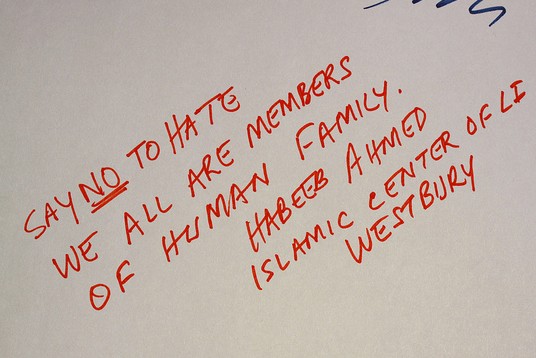
A message left at a memorial for Marcelo Lucero, a Hispanic victim of a hate crime on Long Island. Photo by Long Island Twins via Flickr.

The Emmanuel AME shootings in Charleston, South Carolina have reignited public discussion of both terrorism and hate crimes. While the media often focuses on foreign religious extremism as a motivation for domestic attacks, data show more radicalization has taken place on the political far-right (independent of religion or race) than among Muslims in the United States. Since 9/11, only 25 recorded attacks have been committed by Muslim extremists, while 65 attacks were driven by right-wing extremists at home. So what’s the difference between terror and a hate crime? Is there a difference? Sociological research shows how public discourse and community differences can change the story.

Words like “terrorism” and “hate crime” change across social contexts. In the U.S., acts of violence perpetrated by minority populations are more likely to be defined as acts of terrorism, whereas “home-grown” offenders are likely to be dismissed as crazy, deranged, or evil—“bad apples” rather than people motivated by hate or politics. For hate-crimes, the pattern is reversed. Hate crimes that involve majority perpetrators, particularly in interracial incidents, are linked to higher seriousness ratings. In both cases, the social position of both perpetrator and victim changes how we interpret the violence.
American anti-black hate crimes are most prevalent in communities with a high concentration of white residents that are undergoing black in-migration. This suggests that majority members may try to “defend turf” from the perceived threat of “outsiders”. Compliance with hate crime law is less likely in high-percentage black communities, particularly in the southern U.S. Within these black communities, past lynchings (between 1882-1930) are associated with lower compliance with hate crime law in the present and a lower likelihood of prosecution of hate crime cases.

For more on this issue, check out our other TROT! post, “How Hate Crimes Count.”
Via aclu.org.
Via aclu.org.

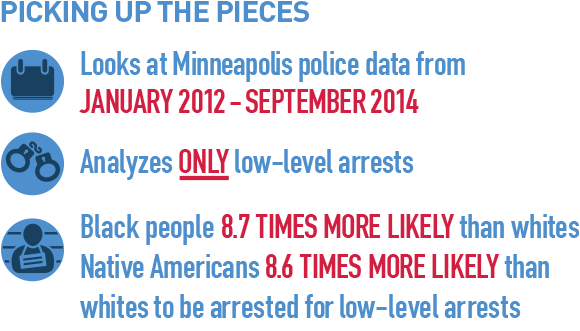
A recently released ACLU investigation a found that black residents of Minneapolis were 8.7 times more likely to be arrested for low-level offenses than white residents between January 2012 and September 2014. The report is the latest in eight city case studies, all of which “describe police departments that reserve their most aggressive enforcement for people of color.” The Minneapolis City Council also recently repealed spitting and lurking ordinances, two examples of the low level offenses cited by the report. Recent sociological research strikes a similar chord; it demonstrates how modern law enforcement isn’t just about crime, but controlling groups of people with minor rules and regulations.

Public discussion about crime tends to focus on felonies, but the majority of law enforcement activity today is geared toward misdemeanors. Even without conviction and sentencing, these minor offenses bring more people into the criminal justice system. The procedural hassle of dealing with a minor criminal record means more people are under this systematic control at any given time, regardless of their guilt or innocence.
The ACLU report finds people experiencing homelessness are the most vulnerable to this system, and many are charged for minor offenses that directly result from being homeless (like panhandling or sleeping outside). Many cities criminalize these behaviors as a way to control space, even to the point that those with criminal records are barred from entering certain neighborhoods.
This law enforcement isn’t just about crime, but also about power in communities of color. Neighborhood-level analysis shows that the stereotypical relationship between race and violent crime rates disappears for communities with more African Americans politically organizing and serving, either in office or on civilian review boards for the police. One of the ACLU’s recommendations to improve the situation in Minneapolis is to establish such review boards.

By Evan Stewart, Jack Delehanty, Ryan Larson, and Stephen Suh

The shooting of three young adults in Chapel Hill, North Carolina, raises a number of questions about hate crimes in the United States. All three victims were Muslim, and interviews with their family members about previous conflicts indicate the killings may have been motivated by anti-Islamic sentiment. On the other hand, police released a statement that the killings were motivated by a parking dispute, and the regional U.S. attorney called them “an isolated incident.” Research shows the social context of a crime matters, even when it isn’t officially labeled a “hate crime.”

Hate crimes are retaliatory and respond to particular social events and contexts. Racialized talk of hate crime, especially when discussed over the Internet, is provoked by anxieties over close social ties to minorities—such as interracial marriage or integrated neighborhoods—more than economic competition. Time, neighborhood, and labeling factors all point to social context as a necessary tool to understand hate crimes.
Social context is often ignored in hate crime data. Government offices and watchdog organizations often define hate crimes differently than others, and their data focus on the number of attacks rather than contextual risk factors. This makes it difficult to study hate crimes, especially when witness reports or police records show a parking dispute.
Anti-Islamic attitudes are also central to the UNC case. Emerging research indicates these attitudes are unique in the U.S. context as well, where racial bias interacts with cultural bias against public religious practice in a particular political climate.

Attorney General Eric Holder has reduced the ability of law enforcement agencies to seize assets without a criminal conviction, an “informal measure” of policing known as civil forfeiture. The program had been expanded by the 1984 Comprehensive Crime Control Act in an effort to curtail the sale and distribution of illegal drugs, and it has since allowed law enforcement agencies to divide and keep the majority of proceeds seized from forfeitures.

Proponents argue that civil forfeiture makes certain crimes less profitable and redistributes resources for socially beneficial programs. Critics say it might be part of a “hidden economic agenda” behind “tough on crime” initiatives and can lead to due process infringements
Institutional contexts are important: 40% of law enforcement agencies report dependence on the revenue produced from civil forfeitures. Agencies in states with strict forfeiture policies tend to use federal “equitable sharing” policies more often, even after accounting for factors such as official crime rates and drug arrests. This suggests agencies try to maximize their returns on civil forfeiture seizures.
Law enforcement agencies operating in high inequality areas and more conservative voting districts seize more value per drug arrest. This ratio also increases with agency complexity but drops in districts with higher black populations. Agencies may use more formal measures, such as arrests, in majority minority areas.

Last month the Senate Intelligence Committee released its report on the CIA’s use of “enhanced interrogation techniques.” News outlets have raised a number of disturbing takeaways from the report’s 500+ page summary, including the gritty details of torture, the failure of many of these practices to get results, and the $81 million paid out to the advisors who helped design them. We typically think of torture as either a barbaric practice or a necessary, if extreme, evil in some limited cases. But while the public wonders whether it actually works, research shows this question doesn’t really decide whether an organization will turn to torture in the first place.

Torture only works because of a highly developed social relationship where the perpetrator can perceive the victim’s pain, but continue with the practice. Randall Collins argues this makes it an extreme way to symbolize human social boundaries—who is in with the powerful community and who is not. This relationship maintains dominance, regardless of whether it gets information.
When torture hits the news, leaders care more about managing the public response than ending this social relationship. Analysis of the Senate Armed Services Committee meetings after Abu Ghraib came to light in 2004 shows how leaders interpreted widespread torture as “isolated incidents.” Experimental surveys of Iraqi judges found they were more likely to give lenient sentences in hypothetical cases of Coalition torture if they felt secure from future crime and protected by police.
All this points to a broader claim about the “dark side of organizations:” their misbehavior is often routine. When the public finds out, organizations are often more concerned with making sure the routine isn’t destroyed by being labeled as a widespread mistake, misconduct, or disaster. Instead, they admit to individual wrongdoing—like isolated incidents of torture that didn’t work—to avoid bigger questions about why torture happens in the first place.

The U.S. Supreme Court recently heard arguments in Young v. United Parcel Service. The outcome will affect many American women’s ability to financially support their families and even have children.

Pregnancy discrimination, while widely illegal, happens when some employers illegally terminate their female workers. They are not explicitly fired for being pregnant, but instead branded “bad workers” by managers. The organizations then use run-of-the-mill meritocratic policies to fire the women.

Reginald A. Byron and Vincent J. Roscigno. 2014. “Relational Power, Legitimation, and Pregnancy Discrimination,” Gender & Society 28(3):435–62.

Pregnancy is a particularly vulnerable time for women; it holds health, legal, and employment risks. A systematic examination of arrests of and forced interventions in the lives of pregnant women in the U.S. shows a variety of concerns about their health, dignity, and autonomy.

Lynn M. Paltrow and Jeanne Flavin. 2013. “Arrests of and Forced Interventions on Pregnant Women in the United States, 1973–2005: Implications for Women’s Legal Status and Public Health,” Journal of Health Politics, Policy and Law.

A variety of laws and their sometimes-selective enforcement affect women’s ability to be healthy and valued members of society.

Jeanne Flavin. 2009. Our Bodies, Our Crimes: The Policing of Women’s Reproduction in America. New York: NYU Press.

Beyond pregnancy discrimination, mothers are paid less than childless women. A portion of this motherhood wage penalty is due to discrimination.

Stephen Benard and Shelley J. Correll. 2010. “Normative Discrimination and the Motherhood Penalty,” Gender & Society 24(5):616–46.

Just when we thought the season’s hottest tablet or smartphone picked up on Black Friday might be a new FBI black site, The Economist reports some tech giants are working extra privacy measures into their gadgets to protect user data. By making services like text encryption available by default, this trend provides extra privacy for some users (mostly those who aren’t already targeted for surveillance), despite criticism from law enforcement that it shields criminal networks from investigation. While we usually think about privacy as an individual right to be left alone, social science shows why these trends are important for a public conversation about what privacy should be.

Americans’ emphasis on the right to privacy remains high, and while public opinion did tend to favor increased government surveillance immediately following September 11th, 2001, support for these practices has declined since.
But privacy isn’t just isolation from governments or other people. Classic research argues it is an ongoing social relationship where we negotiate interactions with others, and more current work shows this relationship changes across time and place.
Current studies of how people use technology show that privacy concerns kick in when people share information online. It also finds this focus on individual behavior ignores structural privacy concerns about the devices themselves and how people learn to interact with them. The “encrypted by default” trend starts a new conversation about what our shared, social definition of privacy should be.

On Thursday, November 6, Minneapolis-Saint Paul ABC affiliate KSTP ran a story claiming Minneapolis Mayor Betsy Hodges had “flashed a gang sign” with a “known felon” during a get out the vote drive in North Minneapolis. The photo shows Hodges embracing and pointing at a young black man, and him pointing back. To support the headline that law enforcement officials were “outraged” by Hodges’s interactions with this man, KSTP reporter Jay Kolls quoted retired Minneapolis police officer Michael Quinn, who accused Hodges of “legitimizing gangs who are killing our children.” The story drew an immediate backlash in other press outlets and on social media. Writing in the Star Tribune, University of St. Thomas law professor Nekima Levy-Pounds criticized the media’s routine portrayal of black men as dangerous criminals and argued that such stories desensitize people to institutional racism. Twitter users deployed the hashtag #pointergate to criticize KSTP and Kolls for their inflammatory reporting, and by mid-day Friday, #pointergate was the top non-sponsored hashtag in the U.S. What might KSTP have expected to gain from running a story like this? Should it have anticipated the furious backlash? And should we be surprised that the reaction on Twitter is as big a story as the original report? Playing on fear has long been a media tactic for drawing attention to stories, but the fear of crime and gangs is a special case.

News media organizations construct their stories as secular morality plays that deploy a “discourse of fear,” which transforms news consumers into victims of the problems that the stories construct. The use of these “problem frames” has increased during the 2000s, and the media applies them much more frequently to stories about race, drugs and gangs.
Social media allows marginalized groups to share frustration much more quickly and publicly. In these symbolic conflicts, both sides escalate their positions through the same venues, like Twitter, and the side that escalates fastest usually prevails. KSTP’s silence on Twitter has given their critics full, uncontested voice, and allowed them to make their protest itself a news item.

A new survey from the Pew forum sheds light on widespread online harassment. Young adults in the study reported experiencing more bullying overall, and women were more likely to have been stalked or sexually harassed. These are serious crimes, but routine harassment also isn’t harmless. A new viral video and recent piece from The Daily Show capture women’s everyday experiences with street harassment and catcalling in public. These accounts bring bullying back to light, and social science research shows how and why harassment emerges. 

Bullying isn’t just meaningless cruelty; it is one way groups enforce social norms (especially around gender and race). Challenging harassment often means criticizing society’s deeply held beliefs.
Bullying and harassment are also advanced through social organization. Bullying can emerge when an organization is in chaos and can’t moderate unequal relationships around race and gender, and our legal protection of free speech often makes anti-harassment efforts hard to enforce.

According to a new report making headlines this week, 21 American cities have passed laws designed to stop residents from sharing food with homeless people since 2013. The finding, which comes from the National Coalition for the Homeless, highlights an increasingly popular belief that hunger motivates troubled individuals to make lifestyle changes. Food aid, in this view, keeps the homeless complacent. In an interview with NPR, one consultant argued that “Street feeding is one of the worst things to do… it’s very unproductive, very enabling, and it keeps people out of recovery programs.” Many city officials quoted in the report have extended this line of thinking to community soup kitchens and food pantries as well. They see those offerings as well-intentioned, but ultimately misguided attempts to help. One, a police captain from Cincinnati, remarked “If you want the bears to go away, don’t feed the bears.” Research shows this isn’t the case, and these attitudes may actually harm people experiencing homelessness.

Social scientists have amassed a great deal of knowledge about the connection between homelessness and hunger. Over and over, they’ve shown that people with stable food access tend to fare better in other aspects of life.
More importantly, these people aren’t animals and homelessness is no mere matter of individual laziness or poor choice. A number of well known structural factors cause and sustain homelessness, including social stigma, poor access to affordable housing, limited employment opportunities, mental health factors, and physical disabilities.

For more on homelessness, check out TROT posts on last year’s polar vortex and this year’s VMAs.