
Archive: Oct 2013

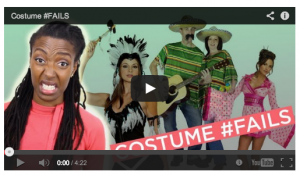
Click to watch Francesca Ramsey on #CostumeFails

As many Sociology and Feminist blogs are writing, it’s that time of year. The racist, classist, homophobic, sexist tendencies and expressions make me cringe.

This morning, for my Soc 101 class — a large lecture setting of over 150 students — I decided to offer an extra credit project. As discussed previously, students struggle with this large GE style class. I like to offer meaningful, analytical extra credit projects through out the semester.

I use Allen Johnson‘s text called, Forest & the Trees, Sociology as Life, Practice, and Promise and we are about to begin the inequality chapter. So, perfect timing. Feel free to use the assignment (below) and revise it as you wish.

I want to give a shout out to the scholars, blogs and websites that had all the material available. :-) I would love to keep adding to this assignment and publish a bit earlier in the fall for next year. So, I welcome you to post additional links. For example, I don’t have a “working class” resource but we certainly have seen offensive “white trash” parties, costumes, etc.

PS — My own kids are going trick-or-treating as twin witches. I have a 4 year old Pablo and a 3 year old Cecilia. Pablito chose their costumes. We usually do about four houses, and then head back to our own house to hand out candy. Our block is pretty scary for Halloween!

The Sociology of Halloween

STEP 1 – DO SOME RESEARCH AND LEARNING (RACE / GENDER) 

1) Watch the video and read the overviews…
http://www.gender-focus.com/2013/10/24/ffff-franchesca-ramseys-halloween-costume-fails/
http://bitchmagazine.org/post/costume-cultural-appropriation
http://www.sociologyinfocus.com/2012/10/29/were-a-culture-not-a-costume/
2) Learn about what is wrong with “black face” costumes here:
http://racismschool.tumblr.com/post/18422652908/black-face-vs-white-face-whats-the-difference 

3) Use this website as a way to analyze others’ costumes. (In encourage you to make adjustments to your own costume if needed!)
http://www.anorak.co.uk/337909/news/this-hampshire-halloween-checklist-is-your-costume-racist.html/

4) Couples costumes?
https://thesocietypages.org/socimages/2013/10/23/heteronormativity-in-halloween-costumes/

5) Sexist costumes – double standard (bacon, yes bacon)
https://thesocietypages.org/socimages/2012/10/24/a-halloween-gender-binary/

6) How things have changed? Are girls dressed up “sexier”?
https://thesocietypages.org/socimages/2013/10/27/halloween-costumes-then-and-now/

7) American Indian costumes – why they are offensive
http://nativeappropriations.com/2011/10/halloween-costume-shopping-a-sampling-of-the-racism-for-sale.html
http://nativeappropriations.com/2011/10/open-letter-to-the-pocahotties-and-indian-warriors-this-halloween.html

8) Dog costumes
https://thesocietypages.org/socimages/2013/10/24/can-we-at-least-agree-that-its-racist-to-dress-your-dog-up-like-a-racial-caricature/

9) How do you politely explain to a friend that their chosen Halloween costume could be racist?
http://www.washingtoncitypaper.com/blogs/sexist/2009/10/28/how-to-inform-a-friend-their-halloween-costume-is-racist/

STEP 2 — OBSERVE YOUR SOCIAL WORLD
 
Whether you dress up or not, on Thursday check out the costumes people are wearing. Become an embedded Sociologist as you attend parties, while you are at work, go trick-or-treating with your kids, or just walk around outside.

Note what people are wearing, note the racial undertones (or racist costumes), the gender performances of men and women in their costumes, etc. Note how people dress their dogs, kids, etc., on these issues as well.

Write up what you see / hear in detail. Insert photos in your word document if you wish. Do this Friday, so your memory is fresh!! (You can send me your notes if you want to show me your progress.)

Then, reflect explicitly on what you have learned from the above websites and resources. Include the course material from Unit 4 / Forest&Trees Chapter 3. Be sure you are clear about what sources you are using and drawing upon in your discussion. Tie all this together — what you see, what you learned, and your reflections.

No need to do “official” citations but do mention the website, video, or author as you reflect on them.

Aim for 2-3 pages of text. Turn in a paper copy to me in class AND post on “Caring is Sharing Forum” at the top of our course website.

DUE DATE — Wednesday, November 6 in class / uploaded that night.
 
Earn up to five points!!!

—–

You can follow Dr. Clark-Ibáñez on Twitter at @MCIcsusm
T1062673_01
We are looking to make teaching TSP a home for lists of useful films, documentaries, memoirs, and books of fiction to be used when teaching sociology (see our post on Sport and Society Films).

If you have a request for a specific topic or course, let us know in the comments. And, if you have a list to share, definitely let us know in the comments.

The following is a collection of films, both fiction and non-fiction, that have been recommended for use in a Sport and Society course.
We encourage you to recommend additional films, readings to be used alongside the films, or tell us about your experience.

*Special thanks to the NASSS community for providing so many suggestions.

Sport Films (Non-fiction):

  • Go Tigers! (2001)
  • Jump! (2007) – Awesome jump rope documentary
  • Rocks with Wings (2002) (dir: Rick Derby)
  • 100% Woman:  the Michelle Dumaresq Story (2004)
  • Golden Gloves (or the Real Million Dollar Babies) (2007)
  • A League of Their Own (the documentary film) (1993)
  • Training Rules (2009) – It concerns the scandal around former Penn State Women’s Basketball Coach, Rene Portland. Maybe available on Hulu.
  • When We Were Kings (1996)
  • Playing Unfair (2002)
  • Chasing October
  • Football Under Cover
  • Pink Ribbons, Inc. (2011) – Samantha King
  • A Hero for Daisy (1999) – a documentary about Title IX and rowing
  • PBS series “American Experience” has an episode on Jesse Owens – you can screen it online.
    Ahead of the Majority – It covers Patsy Mink’s political career and includes a section on her involvement in the politics of Title IX.
  • Bigger, Stronger, Faster (2008) – examples of hegemonic masculinity and how the media influences males’ self-images (not just females, as is so commonly discussed).
  • Hoop Dreams (1994) – [can be combined with the chapter by C.L. Cole and Samantha King, “The New Politics of Urban Consumption: Hoop Dreams, Clockers, and America,” in Ralph C. Wilcox, ed., Sporting Dystopias: The Making and Meaning of Urban Sport Cultures, pp. 14, 221-246.]
  • Viva Baseball
  • Unforgivable Blackness: The Rise and Fall of Jack Johnson (2004)
  • In Whose Honor
  • Not Just A Game (2010) – Dave Zirin provides a sociological analysis of how sport influences our society, particularly the parallels between the institution of sport and the military.
  • Pursuing the Perfect 10 – This was a CNN documentary that is available on YouTube in several parts. I used it as a review after lessons on youth sports and deviance in sports
    Link: http://www.youtube.com/watch?v=AvMpy6kEOZM
  • An Enforcer’s Story – This is a documentary style video available in conjunction with a piece that ran in the NY Times about hockey enforcer Derek Boogaard’s death.
    Link: http://www.nytimes.com/2011/12/04/sports/hockey/derek-boogaard-a-boy-learns-to-brawl.html )
  • Murderball (2005) – documentary film about tetraplegic athletes who play wheelchair rugby. It centers on the rivalry between the Canadian and U.S. teams leading up to the 2004 Paralympic Games.
  • Junior –documentary that follows a Canadian Hockey League team from the Quebec Major Junior Hockey League called Baie-Comeau Drakker
    http://www.nfb.ca/film/Junior_en
  • Head Games (2012) – related to concussion and sport.
  • More Than a Game – Documents the early career of the heralded LeBron James’ high school experiences.
  • FIT: Episodes in the History of he Body (1991). This focuses on the history of the how we understand a ‘fit’ body, including analysis related to race, social class, gender, disability and age.
  • The Journey of the African American Athlete” (Parts 1 and 2)
  • Blood on the Flat Track – documentary on the rat city roller girls
  • Sonicsgate: Requiem for a Team
  • Joe Louis – America’s Hero Betrayed
  • Two Days In April – follows four NFL prospects through the process of preparing for and participating in the 2006 NFL Draft
  • 4th and Goal – Tale of six men trying to make it to the NFL
  • Undefeated – Oscar-winning 2011 documentary directed by Daniel Lindsay and T.J. Martin. The film documents the struggles of a high school football team, the Manassas Tigers of Memphis, as they attempt a winning season after years of losses.
  • Born and Bred – documentary following young latino boxers in LA
  • The Morgan Lacrosse Story (pbs) – This film tells the story of the nation’s first and only college lacrosse team at a historically black institution.
  • Gridiron & Steel – Western Pennsylvania and football
  • On the Shoulders of Giants – Story of the Harlem Rens
  • Bra Boys (2007) – A movie about a particularly hyper-masculine group of male surfers (the Bra Boys) in Sydney, Australia. A good example of a fratriarchal sporting group, and all the problematic aspects associated with such groupings. Can be used in conjunction with the critique from Clifton Evers in the Sydney Morning Herald: http://www.smh.com.au/news/opinion/false-prophets-of-surfing-bastardise-our-beaches/2007/03/12/1173548110229.html
  • Dogtown and Z Boys (2001) – The development of skateboarding in Southern California, great for revealing subcultural dynamics.
  • First Descent (2005) – A history of snowboarding and insight into the gender and age dynamics within core action sport groups.
  • This Ain’t California (2012) – In German with English subtitles, but offers a fascinating perspective on the development of skateboarding (and youth counter cultures) in East Berlin during the 1980s.
  • STRONG! – an awesome new documentary on Cheryl Hayworth, Olympic weightlifter. It deals well with questions of athleticism, gender, and normativity. http://strongthefilm.com/
  • Offside (2006) – from Iran. Interesting to look at cross-cultural understandings and expressions of gender. It looks at how gender is used to define spaces of sport: specifically the soccer stadium.
  • Fearless (2012)  – about Sarah Burke and top athletes who risk their life for high performance sport
  • The Legacy of Brendan Burke (2010) – about Brendan Burke, homosexuality, hockey.
  • The Code (2010) – about hockey’s unwritten law of fighting and the men who live by it.
  • The Rise and Fall of Theo Flury – (Part 1, 2008) (Part 2, 2010), about sexual abuse, homosexuality, masculinity in Junior A hockey (and professional hockey)
  • The Other Final – Made by two Dutch filmmakers who were dismayed that the Dutch national team did not make the 2002 World Cup, they arranged to have the then two bottom-ranked (by FIFA), Bhutan and Montserrat,  to play a match.
  • A State of Mind (2004) – on the mass games in N. Korea.
  • Sumo East and West
  • The Game of Their Lives (2002) – by Daniel Gordon on the N. Korean 1966 World Cup Team.
  • Kokoyakyu: High School Baseball – On high school teams competing in Japan’s famous national “Koshien” tournament.
  • Tokyo Olympiad parts – great for considering how Japan sought to represent itself during the 1964 Games.
  • A Normal Life: Chronicle of a Sumo Wrestler (2009)
  • Gaea Girls (2000) – on female wrestlers in Japan.
  • Brighton Bandits (2007) – first ever in-depth documentary about a gay soccer team
    trailer: http://www.youtube.com/watch?v=kvKN3X_RCxY
  • Justin (2008) — about gay footballer Justin Fashanu and a campaign against homophobia
    trailer: http://www.youtube.com/watch?v=3_o1IEhRuiE&list=UUoLTOkSW0_Taj3iL9KTi44w&index=7
  • Algorithm (2012) – gorgeous film about blind chess players in India
    trailer: http://www.youtube.com/watch?v=pHVZD2yrb7k&list=UUoLTOkSW0_Taj3iL9KTi44w&index=5
  • River of Life –about the breast cancer survivor voyageur canoe team  “Paddlers Abreast” competing in the Yukon River Quest wilderness canoe race – 740 kms/460 miles in three days. Available for purchase (about $20 or so) through the NFB of Canada and free here:  http://www.nfb.ca/film/river_of_life/

30 for 30 (ESPN series) – many documentaries that could be useful for teaching. 

Sport Films (Fiction):

  • Friday Night Lights
  • North Dallas Forty
  • Girlfight
  • Eight Men Out
  • The Fighter
  • Invictus
  • Sugar – You can use this to talk about sports migrants, race, and ethnicity
  • Bingo Long Traveling All Stars and Motor Kings
  • Varsity Blues
  • Coach Carter
  • Hurricane Season
  • Bend it Like Beckham
  • Chariots of Fire – discuss sport and early 20th century nationalism


Wake Forest News


TSP recently unveiled a new initiative: There’s Research on That!  In the posts, TSP will provide insight into how social scientific research can inform current events. This information would be useful for any classroom, as it’s important to make the material relevant to students’ lived experiences. So, we recommend checking TROT if you are looking for a way to integrate current events into your class!

Dr. Abigail C. Saguy, an Associate Professor of Sociology and Gender Studies at UCLA, recently stopped by Office Hours to talk about her new book What’s Wrong with Fat?  

“The only people who see the whole picture,' he murmured, 'are the ones who step out of the frame.” - Salman Rushdie, The Ground Beneath Her FeetThis a a great podcast to assign to your students. It is not only a fascinating topic, but Dr. Saguy does a excellent job of explaining what a “frame” is how sociologists study framing strategies.

This podcast would be an excellent addition to a course or section on gender, medical sociology or the sociology of bodies. But, it would also work very well in a research methods or media course as an introduction to framing and counter-framing.

I suggest using this podcast as an example illustrating how sociologists study framing and then have students conduct a mini-research project of their own and find another social issue with competing frames. Use the questions below to guide your students in understanding how to study framing: 

PART ONE: Listen to the podcast and answer the following questions

  1. Define “framing” in your own words. Why does framing matter?
  2. What does it mean the “denaturalize” a frame?
  3. Using the abortion issue as a example of social movement framing, how do different framing strategies radically change how the issue could be understood by observers?
  4. List and describe all the ways that fatness is framed and counter-framed, according to Dr. Saguy.
  5. Dr. Saguy points out that how our society chooses to understand fatness will determine our responses to it. Choose one frame described by Dr. Saguy and explain what the social consequences of that frame might be.

PART TWO: Apply what you have learned and conduct your own framing analysis

  1. Now, use what you have learned about framing to find another example of a social issue with competing frames.
  2. Describe the social issue and at least two competing frames that you have observed.
  3. What are the goals of each framing strategy? How do those using this frame want you to understand this issue?
  4. For each competing frame, describe the logical response to the social issue that in encouraged by that frame. In other words, what are the  logical responses and potential social consequences of each frame?