race/ethnicity: Whites/Europeans

Cross-posted at CNN.

For the past few days, Americans have been weeping together and wringing our hands once again at the senseless tragedy of a mass murder inside a school. The horrific scene in Newtown, Connecticut, is now seared permanently in our collective conscience, as we search for answers. We’ll look at the photograph of Adam Lanza and ask over and over again how he could have come to such a deadly crossroads.

We still know nothing about his motives, only the devastating carnage he wrought. And yet we’ve already heard from experts who talk about mental illness, Asperger’s syndrome, depression, and autism. The chorus of gun boosters has defensively chimed in about how gun control would not have prevented this.

Former Arkansas Gov. Mike Huckabee offered the theory that since “we have systematically removed God from our schools, should we be so surprised that schools would become a place of carnage?” (As if those heathen children deserved it?)

All the while, we continue to miss other crucial variables — even though they are staring right back at us when we look at that photograph. Adam Lanza was a middle class white guy.

If the shooter were black and the school urban, we’d hear about the culture of poverty; about how inner-city life breeds crime and violence; perhaps even some theories about a purported tendency among blacks towards violence.

As we’ve seen in the past week, it’s not only those living on the fringes of society who express anger through gun violence.

Yet the obvious fact that Lanza — and nearly all the recent mass murderers who targeted non-work settings — were middle class white boys seems to barely register. Look again at the pictures of Jared Lee Loughner (Tucson), James Eagan Holmes (Aurora) and Wade Michael Page (Oak Creek) — a few of the mass killers of the past couple of years. (Yes, the case of Seung-Hui Cho, the perpetrator at Virginia Tech, the worst school shooting in our history, stands out as the exception. And worth discussing.)

Why are angry young men setting out to kill entire crowds of strangers?

Motivations are hard to pin down, but gender is the single most obvious and intractable variable when it comes to violence in America. Men and boys are responsible for 95% of all violent crimes in this country. “Male criminal participation in serious crimes at any age greatly exceeds that of females, regardless of source of data, crime type, level of involvement, or measure of participation” is how the National Academy of Sciences summed up the extant research.

How does masculinity figure into this? From an early age, boys learn that violence is not only an acceptable form of conflict resolution, but one that is admired. However the belief that violence is an inherently male characteristic is a fallacy. Most boys don’t carry weapons, and almost all don’t kill: are they not boys? Boys learn it.

They learn it from their fathers. They learn it from a media that glorifies it, from sports heroes who commit felonies and get big contracts, from a culture saturated in images of heroic and redemptive violence. They learn it from each other.

In talking to more than 400 young men for my book, Guyland: The Perilous World Where Boys Become Men, I heard over and over again what they learn about violence. They learn that if they are crossed, they have the manly obligation to fight back. They learn that they are entitled to feel like a real man, and that they have the right to annihilate anyone who challenges that sense of entitlement.

This sense of entitlement is part of the package deal of American manhood — the culture that doesn’t start the fight, as Margaret Mead pointed out in her analysis of American military history, but retaliates far out of proportion to the initial grievance. They learn that “aggrieved entitlement” is a legitimate justification for violent explosion.

The easy availability of guns is another crucial variable. After the terrible school shooting in Dunblane, Scotland, in 1996, Great Britain enacted several laws that effectively made owning handguns illegal in that country. The murder rate in the U.S. is more than three times higher than Britain.

And yes, boys have resorted to violence for a long time, but sticks and fists and even the occasional switchblade do not create the bloodbaths of the past few years. In 2011, more than 80% of all homicides among boys aged 15 to 19 were firearm related.

We need a conversation about gun control laws. And far more sweeping — and necessary — is a national meditation on how our ideals of manhood became so entangled with violence.

It’s also worth discussing why so many of these young mass murderers are white. Surely boys of color have that same need to prove their masculinity, and a similar sense of entitlement to annihilate those who threaten it. Perhaps the only difference is that it seems to be nearly the exclusive province of white boys to so dramatically expand the range of their revenge and seek to destroy the entire world, not simply the person or group that committed the supposed offense. Perhaps. It’s a conversation worth having.

I am not for a moment suggesting we substitute race or gender for the other proximate causes of this tragedy: lax gun laws, mental illness. I am arguing only that we can never fully understand it, unless we also add these elements to our equation. Without them, the story is entirely about him, the shooter. But the bigger story is also about us.

In the coming weeks, we’ll learn more about Adam Lanza, his motives, his particular madness. We’ll hear how he “snapped” or that he was seriously mentally ill. We’ll try to explain it by setting him apart, by distancing him from the rest of us.

And we’ll continue to miss the point. Not only are those children at Sandy Hook Elementary School our children. Adam Lanza is our child also. Of course, he was mad — as were Eric Harris and Dylan Klebold, and Seung-Hui Cho, Jared Lee Loughner, James Eagan Holmes, and Wade Michael Page — and the ever-longer list of boys and young men who have exploded in a paroxysm of vengeful violence in recent years. In a sense, they weren’t deviants, but over-conformists to norms of masculinity that prescribe violence as a solution. Like real men, they didn’t just get mad, they got even. Until we transform that definition of manhood, this terrible equation of masculinity and violence will continue to produce such horrific sums.

————————

Michael Kimmel is a professor of sociology at the State University of New York at Stonybrook.  He has written or edited over twenty volumes, including Manhood in America: A Cultural History and Guyland: The Perilous World Where Boys Become Men.  You can visit his website here.

Cross-posted at Kieran Healy’s blog.

The chart in “America is a Violent Country” has been getting a lot of circulation. Time to follow up with some more data. As several commentators at CT noted, the death rate from assault in the U.S. is not uniform within the country. Unfortunately, state-level and county-level mortality data are not easily available for the time period covered by the previous post — though they do exist, going back to the 1940s. What I have to hand is a decade’s worth of US mortality data courtesy of CDC WONDERcovering 1999 to 2009. I extracted the assault deaths according to the same criteria the OECD uses (for the time period in question, ICD-10 codes X85-Y09 and Y87.1). The estimates are adjusted to the 2000 U.S. population, which isn’t identical to the standard OECD adjustment. But the basic comparability should be OK, for our purposes.

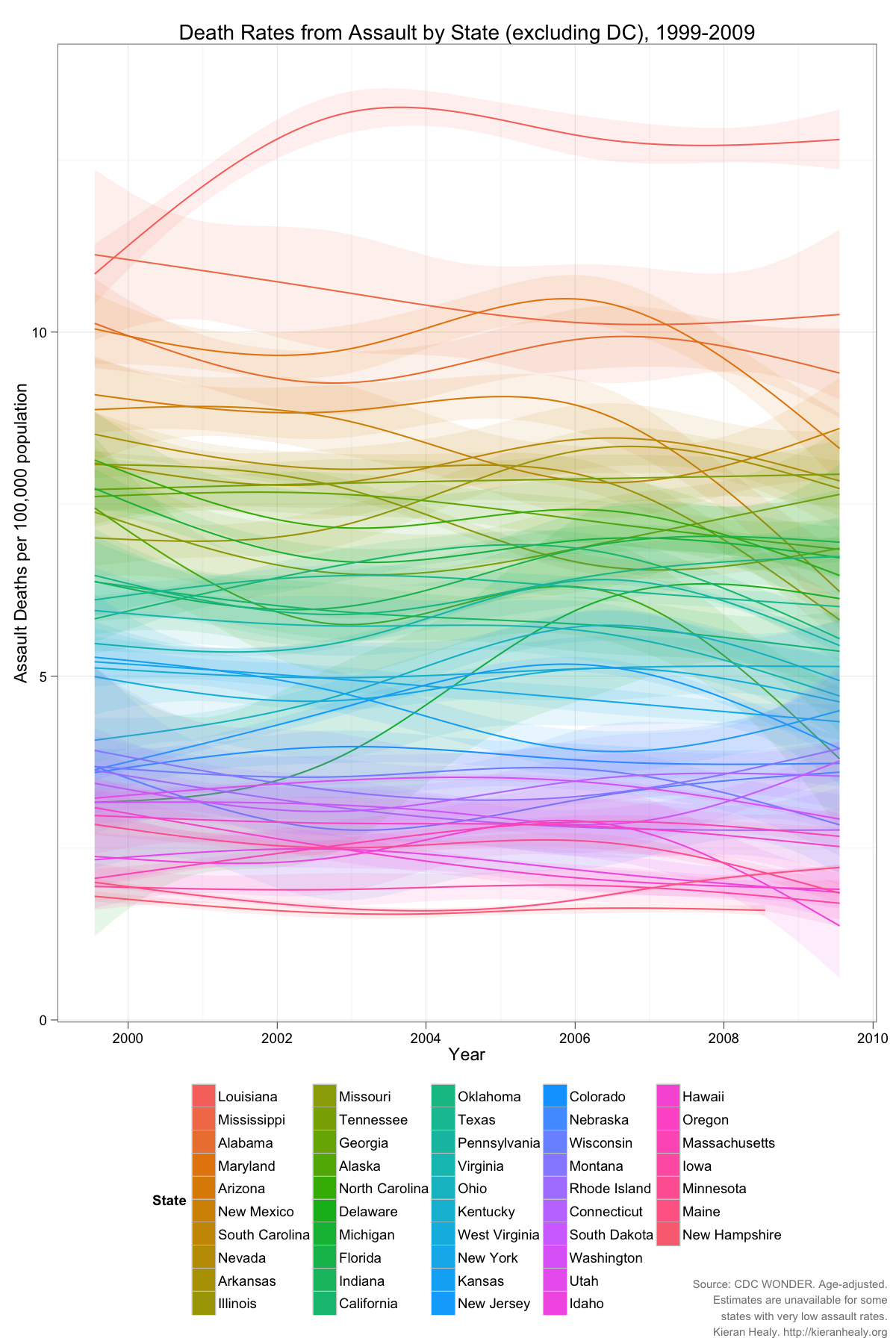
First, it’s well-known that there are strong regional differences in the assault death rate in the U.S. by state and region. Here’s what the patterns look like by state from 1999 to 2009 (click for a larger PNG or PDF):

This figure excludes the District of Columbia, which has a much higher death rate but is also a city. Also missing are a few states with small populations and low absolute numbers of assault deaths — Wyoming, North Dakota, Vermont — such that the CDC can’t generate reliable age-adjusted estimates for them. If you want a “small-multiple” view with each state shown separately from high to low, here you go.

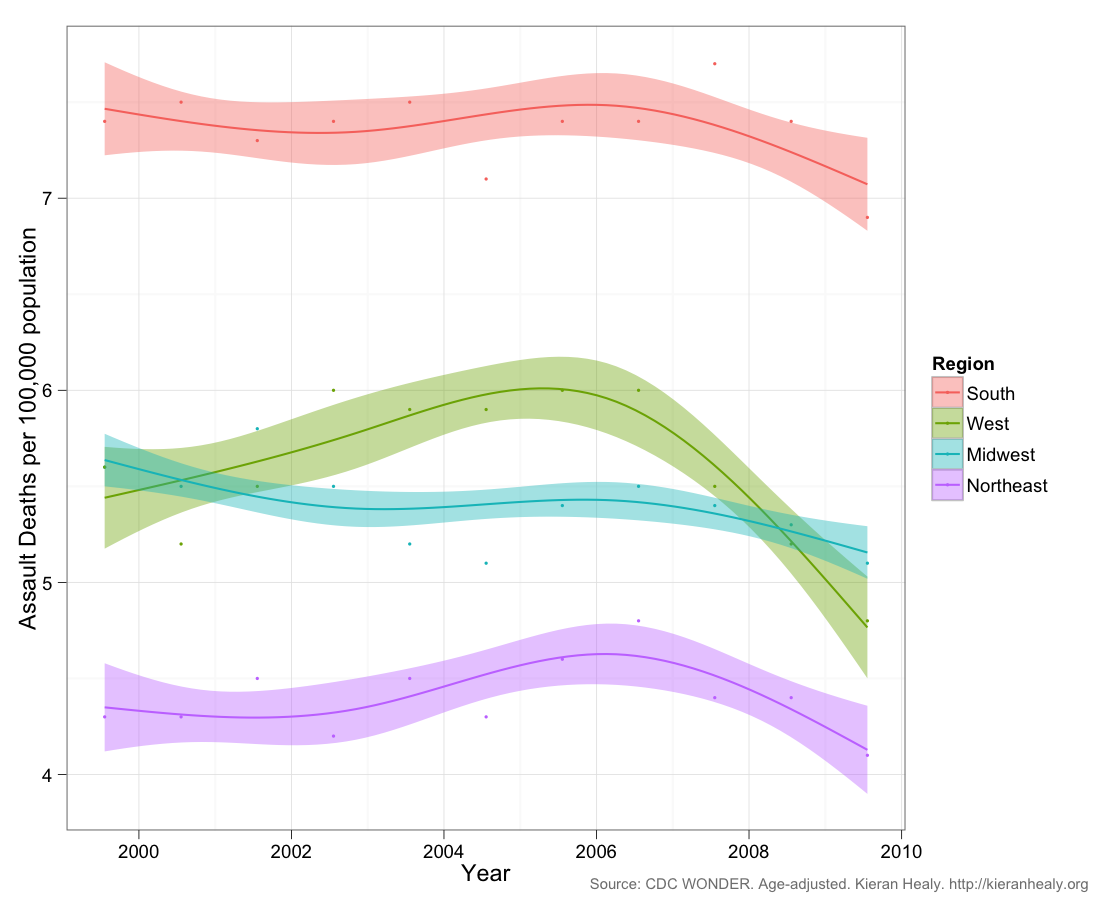
The legend for the figure above arranges the states from high to low, reading top to bottom and left to right. Although it’s clear that geographical region isn’t everything, those tendencies are immediately apparent. Let’s look at them using the official census regions (click for a larger PNG or PDF):

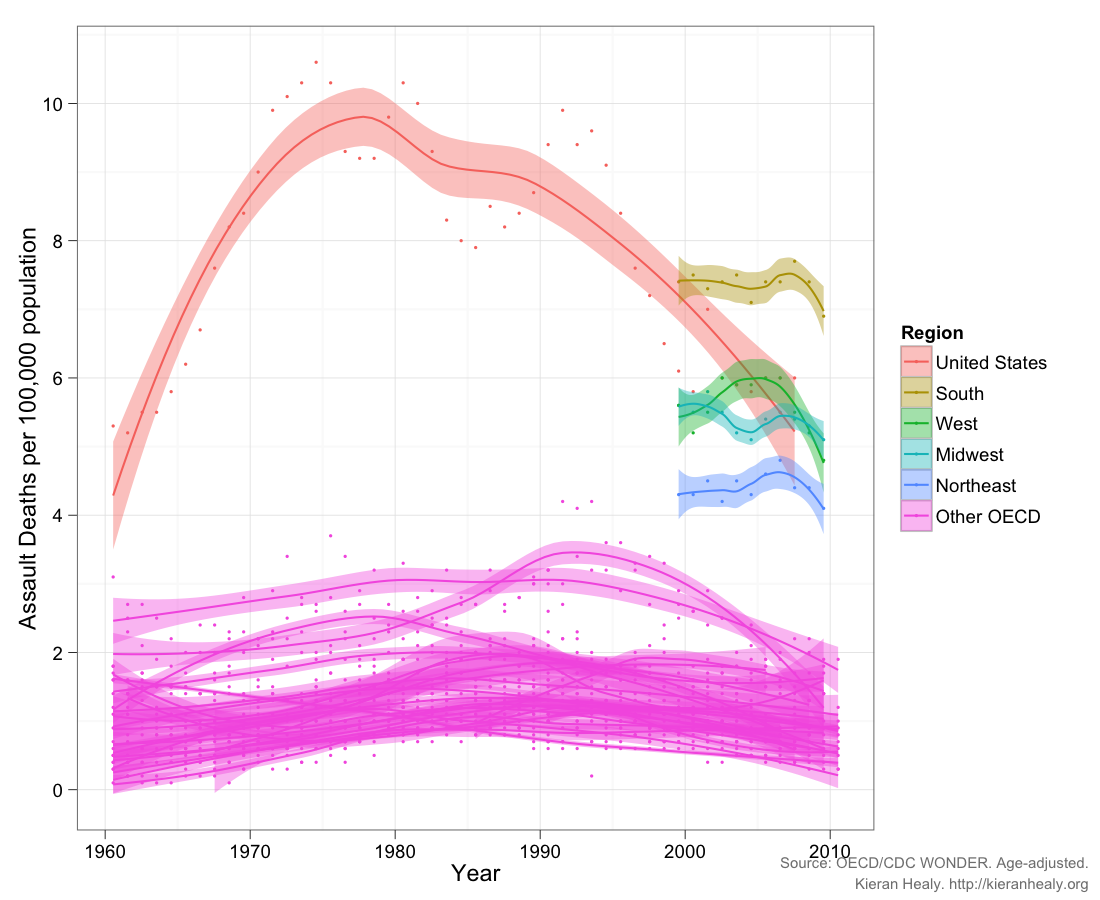
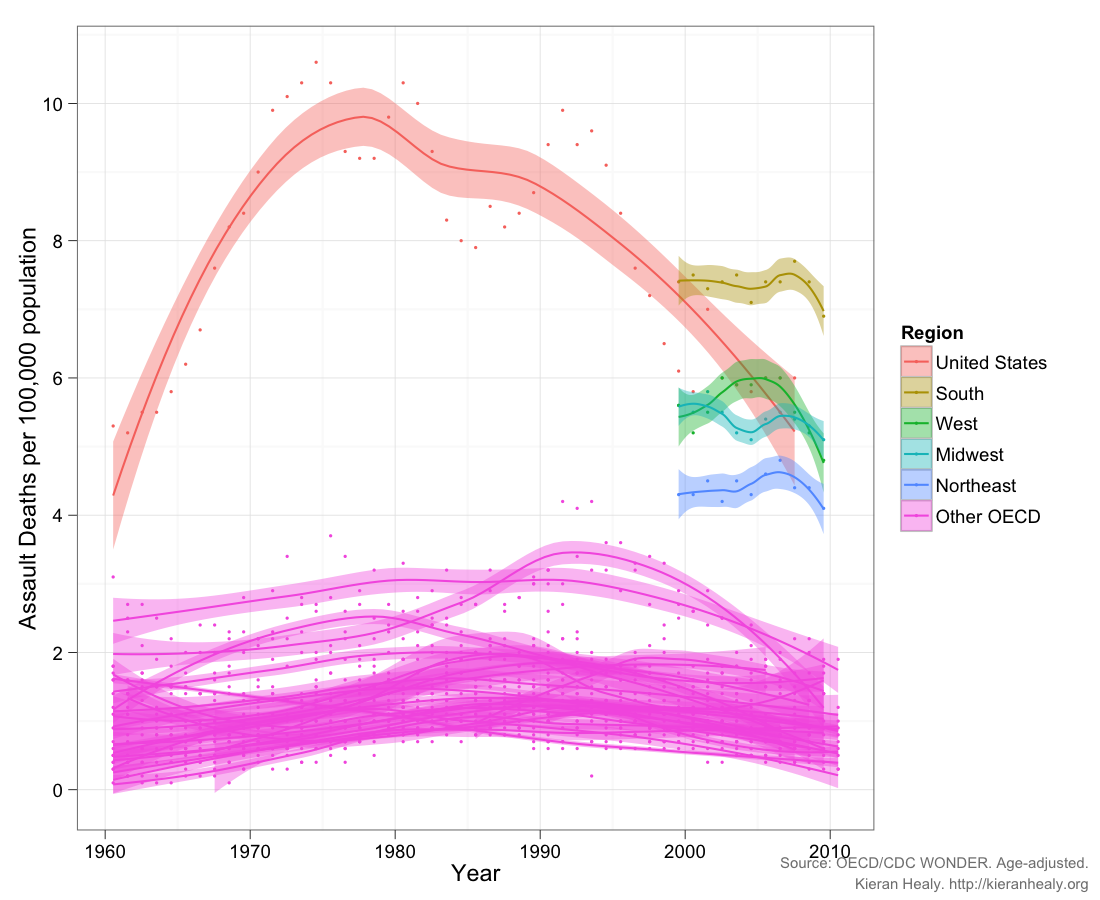
As is well known, the South is more violent than the rest of the country, by some distance. Given the earlier post, the natural thing to do is to put these regional trends into the cross-national comparison and see — for the decade we have, anyway — how these large U.S. regions would fare if they were OECD countries. Again, bear in mind that the age-adjustment is not quite comparable (click for a larger PNG or PDF):

Despite their large differences, all of the U.S. regions have higher average rates of death from assault than any of the 24 OECD countries we looked at previously. The placid Northeast comes relatively close to the upper end of the most violent countries in our OECD group.

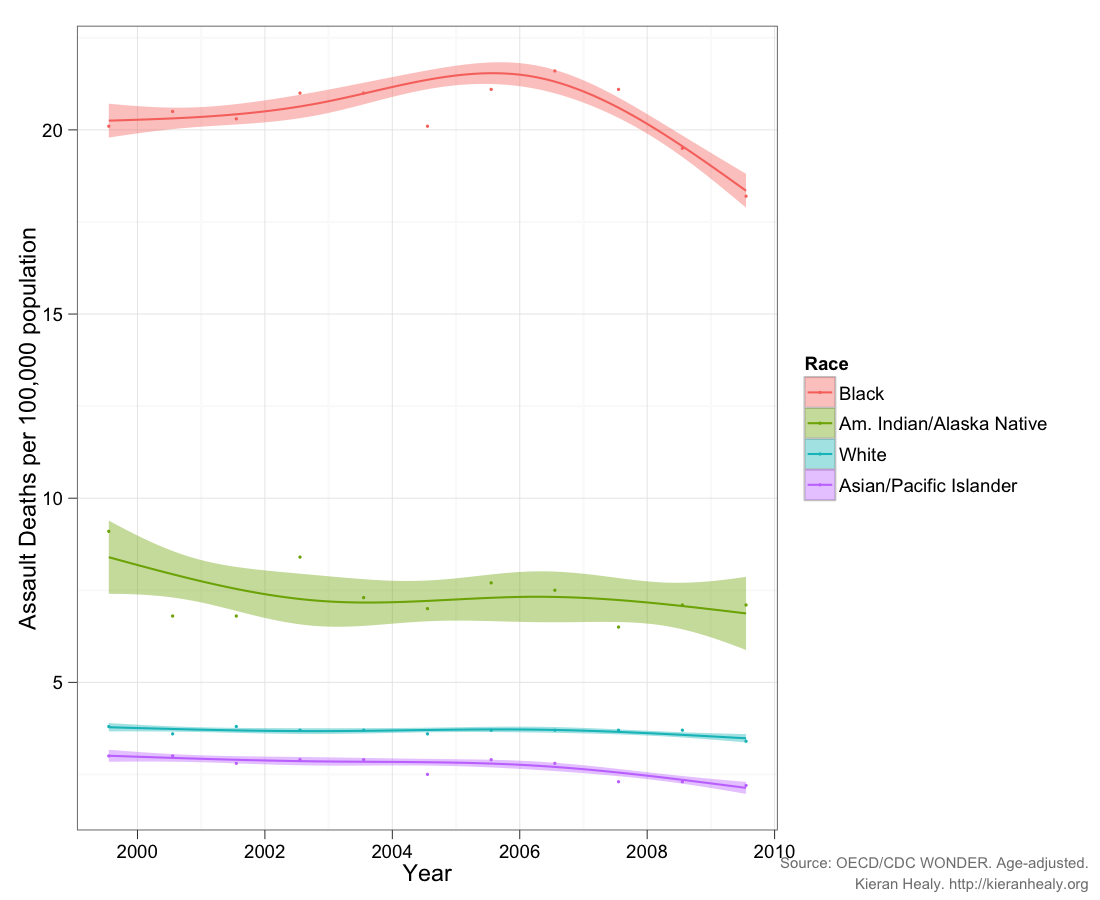
Finally, there’s the question of racial and ethic incidence of these deaths within the United States. Here are the decade’s trends broken out by the race of the victim, rather than by state or region (click for a larger PNG or PDF):

The story here is depressing. Blacks die from assault at more than three times the U.S. average, and between ten and twenty times OECD rates. In the 2000s the average rate of death from assault in the U.S. was about 5.7 per 100,000 but for whites it was 3.6 and for blacks it was over 20. Even 3.6 per 100,000 is still well above the OECD-24 average, which – if we exclude the U.S. – was about 1.1 deaths per 100,000 during the 2000s, with a maximum value of 2.9. An average value of 20 is just astronomical. And this is after a long period of decline in the death rate from assault.

—————————

Kieran Healy is a professor of sociology in the Kenan Institute for Ethics at Duke University.  His research is primary concerned with the moral order of a market society. You can follow him on twitter and at his blog.

Cross-posted at Guns, Rap, and Crime.

I have a heavy heart tonight.  My thoughts and prayers are with the families of Newtown.  The Newtown shooting is a terrible tragedy. It has reminded me of lessons learned while studying the families of murder victims.

For the past 2 years, I have been researching the everyday lives of families who lose someone in a murder.  This has been difficult — and often heartbreaking — research.  I have spent many nights thinking about how much I take my family, friends, and other people in my life for granted.   I think about the mothers, fathers, grandparents, aunts, uncles, and siblings whose first and last thoughts of each day are of the person they loved and lost. The things that I have seen and the stories that I have collected have left a deep and permanent mark on my soul.

Amongst the many thoughts swirling around in my head, I keep returning to a troubling “double standard” that we often taken for granted when shootings happen.

On one hand, the Newtown shooting reminds us that fatal violence can happen at anytime to anyone.  It is a painful reminder that life is precious and that it can be snapped away from us at any moment.  The Newtown shooting makes many of us feel an existential fall out. How could this happen?  Why did this have to happen?  And what does this mean for me?

For many of us, these shootings cut a little too close to home.  They happen in places to people who remind us of ourselves.  We begin to wonder: “Are we ever really safe?” “Will our children come home from school today?” “Will this happen at my favorite movie theater?”

In turn, these ideas shape how we feel about families who mourn in the wake of such tragedies.  We feel deep empathy, compassion, and sadness for families and victims in Newtown.  We talk about the victims here as innocent children who met a horrible death completely out of their hands.  We wonder how the families and friends of victims will cope with such a loss.

But, the same kinds of sympathy and compassion are often not extended to families who lose their children in street shootings every day.  These situations are treated very differently by the media, by our leaders, and by many of us.  We see these shootings as events that only happen to people who are caught up in the wrong crowd.  We assume that these victims — who are often children — must have been dealing drugs, in a gang, or doing something to meet such a horrible end.  Everyday violence in our inner-cities helps us hold onto a precious myth: Fatal violence only happens to people who bring it on themselves.  If we can believe this, or at least think it might be true, we can feel safe again.

How do we reconcile these conflicting responses to tragedy?

I’m here to tell you that many of our popular assumptions about the second group of victims are deeply problematic and misinformed.  Many of the people that I have followed over the years have been young men who were in the wrong place at the wrong time.  This is a powerful message that John Rich — a physician, scholar, and interventionist — teaches us in his powerful work on young black men’s experiences with trauma.

This is a theme that also resonates with my work:  One family I followed lost their youngest son in a street-style execution shooting.  The mother and two older brothers of the victim faced an unsympathetic and sometimes cruel world.  Newspaper articles talked about this case as an example of how families need to keep closer tabs on their children.  Local community leaders and church pastors used this event to denounce drugs in the community.  And, most hurtful of all, supervisors at the mother’s work filed complaints about her work productivity slipping after her son’s death.  When she told them that she was in the bathroom wailing over the loss of her youngest child — she was fired and released with severance.

This is only a small sample of the many tragedies that I followed in Philadelphia.  I hope that this underscores the need to rethink how we process and make sense of gun violence across the board.  The deep sympathy and pain that we all feel tonight for the victims of Newtown should be extended to families who lose sons, daughters, husbands, wives, grandparents, aunts, uncles, best friends, and siblings in our backyards everyday.

—————————

Jooyoung Lee is a professor of sociology at the University of Toronto. His research involves crime, gun violence, health, interaction, and culture.  You can follow him at his blog, Guns, Rap, Crime, and on twitter.

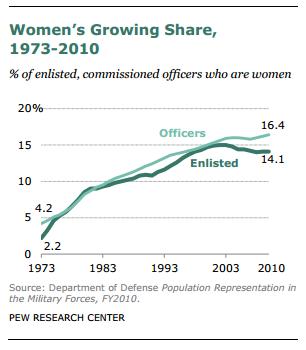
Pew Research Center reports that, as of 2010, women make up about 15% of enlisted soldiers and commissioned officers:

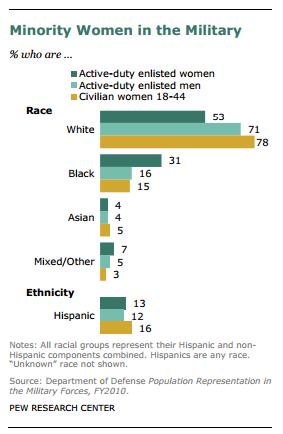
Not all types of women are entering the military at the same rate.  Nearly a third of women in the military are Black, about twice their proportion in the general population.  In contrast, about half are white, about 2/3rds their proportion among civilian women.

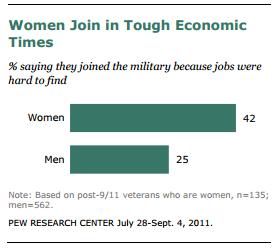
A larger proportion of women, compared to men, said that they joined the military because it was difficult to find a good civilian job:

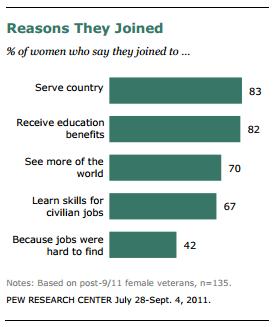
They were just as likely as men, however, to report other more common reasons for joining:

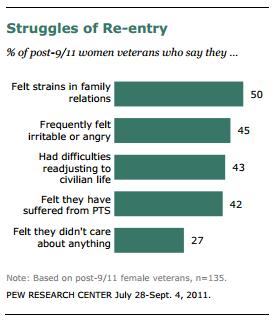
Interestingly, women reported high levels of strain re-entering the civilian population and the majority believe that the wars in Afghanistan and Iraq are not worth fighting:

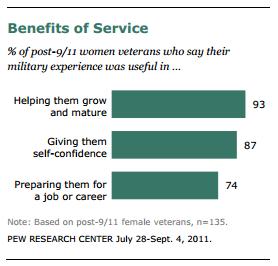
Nevertheless, a large majority felt that entering the military was good for their personal growth and career opportunities:

Lisa Wade, PhD is an Associate Professor at Tulane University. She is the author of American Hookup, a book about college sexual culture; a textbook about gender; and a forthcoming introductory text: Terrible Magnificent Sociology. You can follow her on Twitter and Instagram.

***TRIGGER WARNING for racism and enslavement***

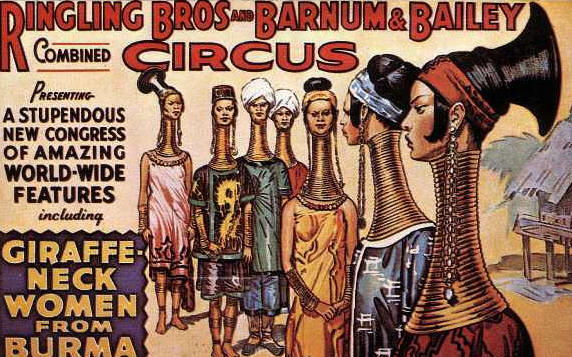
Last month I posted about the human zoo captives popular during the 1800s and early 1900s in Europe and America.  Today I discovered an archive documenting the capture and display of members of a Burmese ethnic minority, the Kayan (also called Padaung), who have historically practiced neck-lengthening.

The archive, at Sideshow World, includes posters from the Hagenbeck-Wallace Circus and the Ringling Bros. and Barnum and Bailey Circus, as well as promotional photographs of the captives.  This material typically referred to the women as “giraffe-necked.”

Promotional posters:

Promotional photograph:
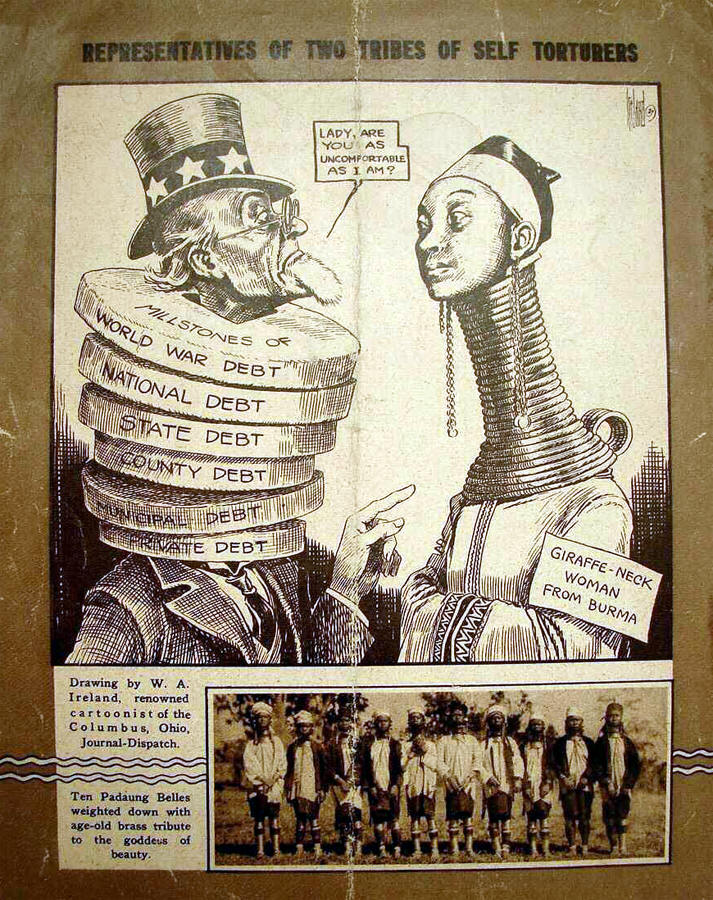
This political cartoon reveals the degree to which the “giraffe-necked woman” had become a well-known icon in the U.S.:

These women and the many others from various parts of the colonized world were typically kidnapped from their communities and put on display.  Many died young, exposed to diseases their bodies were not prepared to fight.  In some cases their remains — sometimes preserved as “freakish” samples — are still being repatriated.

Lisa Wade, PhD is an Associate Professor at Tulane University. She is the author of American Hookup, a book about college sexual culture; a textbook about gender; and a forthcoming introductory text: Terrible Magnificent Sociology. You can follow her on Twitter and Instagram.

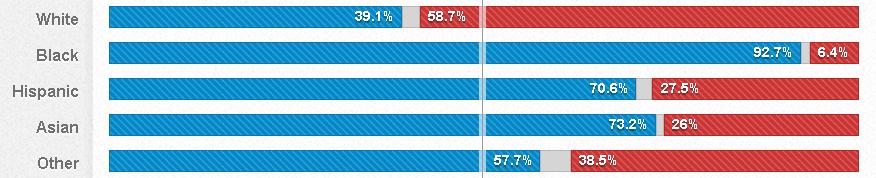
Barack Obama won just over 50% of the popular vote last week, but he earned 80% of non-white votes.  According to USA Today exit poll data, he secured 93% of the Black vote, 73% of the Asian vote, 71% of the Hispanic vote, and 58% of the non-white Other vote.

This data suggests are real and palpable difference between how (some) Whites and (most) non-Whites see the world, a difference that will become increasingly influential.

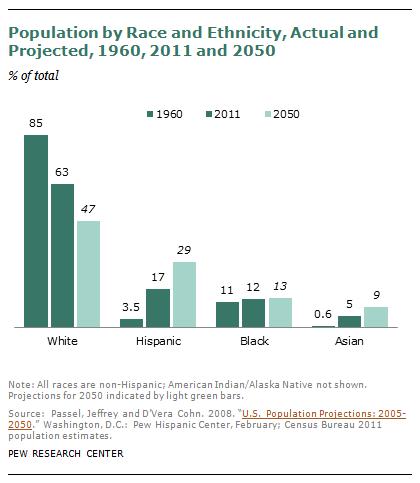
Earlier this month the Pew Research Center released an updated prediction for the racial/ethnic composition of the U.S. in 2050.  They expect that, by 2050, Whites will be a minority, adding up to only 47% of the population.  By that time, they expect Hispanics to account for 29% of the population, and Blacks and Asians to account for 13% and 9% respectively.

Paul Taylor and D’Vera Cohn, at Pew, observe that the demographics of the voting population will change a bit slower since the majority of the demographic change is from births and deaths, not immigration.  In 2011, for example, whites were 66% of those ages 18 and older, but only 56% of 18-year-olds.  In other words, it takes 18 years to grow a voter.

Whatever the pace of change, the era of winning U.S. elections by pandering to the worldview of a single group is ending.  Future politicians will likely have to put effort into attracting a wide range of voters, as Obama did on Tuesday.

Lisa Wade, PhD is an Associate Professor at Tulane University. She is the author of American Hookup, a book about college sexual culture; a textbook about gender; and a forthcoming introductory text: Terrible Magnificent Sociology. You can follow her on Twitter and Instagram.

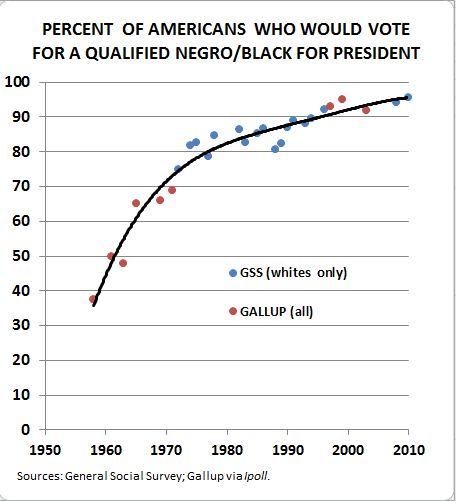
Over at his blog, Made in America, Claude Fischer discusses data showing that the percentage of (White) Americans who say that they will vote for a qualified Black president has been rising since the 1950s. Today it sits at about 96%.

Fischer rightly observes that it’s difficult to know exactly what to make of this information. The trend likely reflects a combination of a real decrease in prejudice and a rising appreciation for the fact that it’s unpopular to admit that you wouldn’t vote for a Black person, even on a survey.

Still, assuming for the moment that it represents real attitudinal change, Fischer asks, is “the glass 96 percent full or is it 4 percent empty?”  Given our two-party partisan political system, elections are frequently decided by margins this narrow.  Obama won with just 53% of the popular vote in 2008.  Political scientists estimate that there was a 5 point racial penalty (that is, if he had been White, he would likely have won 58% of the vote).

Tomorrow is election day and it’s difficult to know if race will play more or less of a role than it did in the last election.  On the one hand, most people who were worried that Obama would be a racially radical President now know that he is not (some people will never be convinced) and others may have become more used to seeing an African American face in the White House.  On the other hand, racial progress usually incites a backlash.  That face in such a venerated position of power may have aggravated people who are now actively racist instead of complacently so.

Finally, as Fischer observes, we have absolutely no data on the penalty Romney will pay for being Mormon.

Happy election day eve, America. May we all end tomorrow with a strong beverage of consolation or celebration.

Lisa Wade, PhD is an Associate Professor at Tulane University. She is the author of American Hookup, a book about college sexual culture; a textbook about gender; and a forthcoming introductory text: Terrible Magnificent Sociology. You can follow her on Twitter and Instagram.

At the Washington Post, John Cohen and Rosalind Helderman report:

The 2012 election is shaping up to be more polarized along racial lines than any presidential contest since 1988, with President Obama experiencing a steep drop
in support among white voters from four years ago.

They compare data from a recent poll with exit interviews from 2004 and 2008.  The results show that, while Obama is overwhelmingly the favorite among non-whites, he trails him among whites by 23 percentage points.

Cohen and Helderman say that Obama has lost support among whites even just recently.  Meanwhile, a whopping 91% of Romney supporters are believed to be white. We are, truly, a deeply divided nation.

Lisa Wade, PhD is an Associate Professor at Tulane University. She is the author of American Hookup, a book about college sexual culture; a textbook about gender; and a forthcoming introductory text: Terrible Magnificent Sociology. You can follow her on Twitter and Instagram.