race/ethnicity: Whites/Europeans

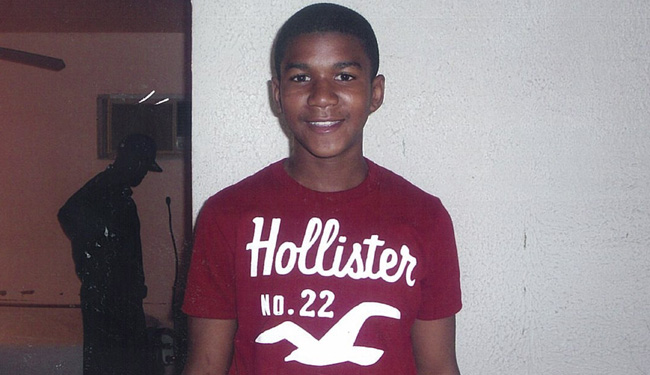
Trayvon Martin
AP Images

In conversation, I keep accidentally referring to Zimmerman’s defense lawyers as “the prosecution.” Not surprising, because the defense of George Zimmerman was only a defense in the technical sense of the law. Substantively, it was a prosecution of Trayvon Martin. And in making the case that Martin was guilty in his own murder, Zimmerman’s lawyers had the burden of proof on their side, as the state had to prove beyond a reasonable doubt that Martin wasn’t a violent criminal.

This raises the question, who’s afraid of young black men? Zimmerman’s lawyers took the not-too-risky approach of assuming that white women are (the jury was six women, described by the New York Times as five white and one Latina).

“This is the person who … attacked George Zimmerman,” defense attorney Mark O’Mara said in his closing argument, holding up two pictures of Trayvon Martin, one of which showed him shirtless and looking down at the camera with a deadpan expression. He held that shirtless one up right in front of the jury for almost three minutes. “Nice kid, actually,” he said, with feigned sincerity.
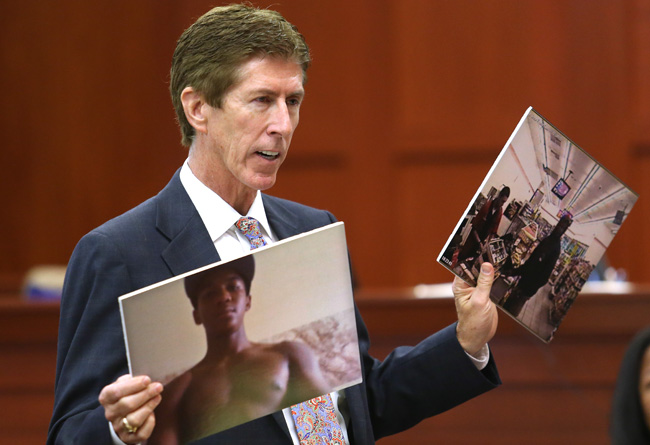
Mark O'Mara
Joe Burbank/AP Images

Going into the trial, according to one analysis, the female jurors were supposed to have more negative views about Zimmerman’s vigilante behavior, and be more sympathetic over the loss of the child Trayvon. As a former prosecutor put it:

With the jury being all women, the defense may have a difficult time having the jurors truly understand their defense, that George Zimmerman was truly in fear for his life. Women are gentler than men by nature and don’t have the instinct to confront trouble head-on.

But was the jury’s race, or their gender, the issue? O’Mara’s approach suggests he thought it was the intersection of the two: White women could be convinced that a young black man was dangerous.

Race and Gender

Racial biases are well documented. With regard to crime, for example, one recent controlled experiment using a video game simulation found that white college students were most likely to accidentally fire at an unarmed suspect who was a black male — and most likely to mistakenly hold fire against armed white females. More abstractly, people generally overestimate the risk of criminal victimization they face, but whites are more likely to do so when they live in areas with more black residents.

The difference in racial attitudes between white men and women are limited. One analysis by prominent experts in racial attitudes concluded that “gender differences in racial attitudes are small, inconsistent, and limited mostly to attitudes on racial policy.” However, some researchers have found white men more prone than women to accept racist stereotypes about blacks, and the General Social Survey in 2002 found that white women were much more likely than men to describe their feelings toward African Americans positively. (In 2012, a minority of both white men and white women voted for Obama, although white men were more overwhelmingly in the Romney camp.)

What about juries? The evidence for racial bias over many studies is quite strong. For example, one 2012 study found that in two Florida counties having an all-white jury pool – that is, the people from which the jury will be chosen – increased the chance that a black defendant would be convicted. Since the jury pool is randomly selected from eligible citizens, unaltered by lawyers’ selections or disqualifications, the study has a clean test of the race effect. But I can’t find any on the combined influence of race and gender.

The classical way of framing the question is whether white women’s group identity as whites is strong enough to overcome their gender-socialized overall “niceness” when it comes to attitudes toward minority groups. But Zimmerman’s lawyers appeared to be invoking a very specific American story: white women’s fear of black male aggression. Of course the “victim” in their story was Zimmerman, but as he lingered over the shirtless photo, O’Mara was tempting the women on the jury to put themselves in Zimmerman’s fearful shoes.

Group Threat

But do white women really feel threatened by black men? That’s an old, blood-stained debate. In the 20th century there were 455 American men (legally) executed for rape, and 89 percent of them were black — most were accused of raping white women. That was just the legal tip of Jim Crow’s lynching iceberg, partly driven by white men asserting ownership over white women in the name of protection. But the image of course lives on.

In the specific realm of U.S. racial psychology, one of the less optimistic, but most reliable, findings is that whites who live in places with larger black populations on average express more racism (here’s a recent confirmation). Most analysts attribute that to some sense of group threat – economic, political, or violent – experienced by the dominant majority.

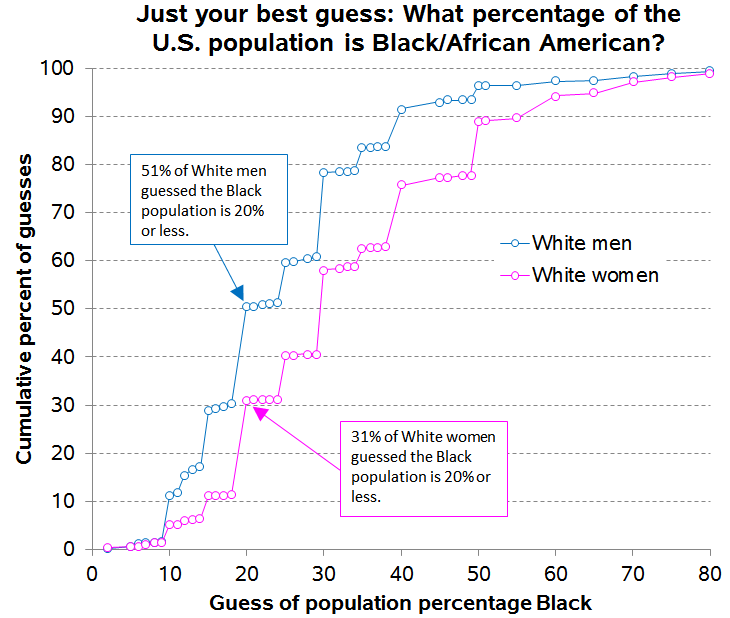
Because people inflate things they are afraid of, you can get a ballpark idea of how threatened white people feel by asking them how big they think the black population is. And since they don’t realize their racial attitudes are being measured, they aren’t as likely to shade their answers to appear reasonable.

The 2000 General Social Survey asked about 1,000 white adults to estimate the size of the black population. Both groups were way off, of course: 95 percent of white women and 85 percent of white men overestimated. But the skew was stronger for women than men: 69 percent of women and 49 percent of men guessed that blacks are more than 20 percent of the population (the correct answer at the time was 12 percent).

Here are those results, showing the cumulative percentage of white men and women who thought the black population was at or below each level:
1

Maybe white women’s greater overestimation of the black population is not an indicator of perceived threat. In the same survey white women were no more likely than white men to describe blacks as “prone to violence” (then again, there’s social pressure to say “no”).  Anyway, whether women feel more threatened than men do isn’t the issue, since the jury was all women. The question is whether the perceived threat was salient enough that the defense could manipulate it.

I don’t know what was in the hearts and minds of the jurors in this case, of course. Being on a jury is not like filling out a survey or playing a video game. But however much we elevate the rational elements in the system, emotion also plays a role. Whether they were right or not, Zimmerman’s lawyers clearly thought there was a vein of fear of black men inside the jurors’ psyches, waiting to be mined.

Originally posted at The Atlantic and Family Inequality.

Philip N. Cohen is a professor of sociology at the University of Maryland, College Park, and writes the blog Family Inequality. You can follow him on Twitter or Facebook.
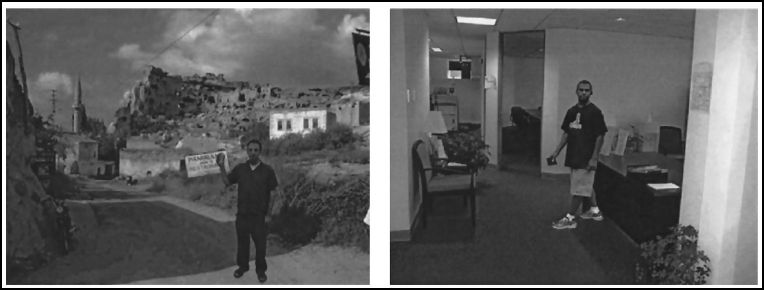
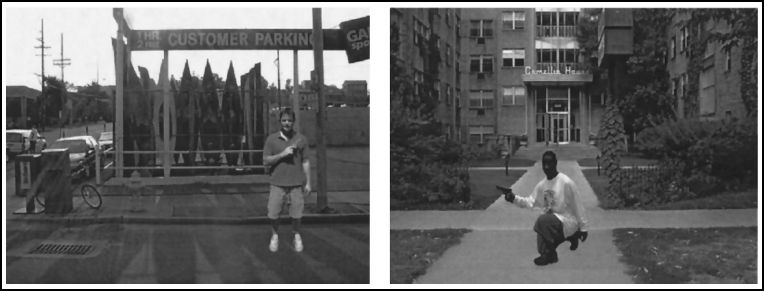
In 2002, a study by Joshua Correll and colleagues, called The Police Officer’s Dilemma, was published. In the study, researchers reported that they presented photos of black and white men holding either a gun or a non-threatening object (like a wallet) in a video game style setting.  Participants were asked to make a rapid decision to “shoot” or “don’t shoot” each of the men based on whether the target was armed.

They found that people hesitated longer to shoot an armed white target (and they were more likely to accidentally not shoot). Participants were quicker and more accurate with black armed targets but there were more “false alarms” (shooting them when they were unarmed). These effects were present even though participants did not hold any explicit discriminatory views and wanted to treat all targets fairly.

The effect we see here is a subconscious but measurable preference to give white men the benefit of the doubt in these ambiguous situations. Decision times can vary by a fraction of a second, but that fraction can mean life or death for the person on the other end of the gun.

A terrible reminder of this bias was brought back into the headlines on March 2nd when a black student in Gainesville Florida was shot in the face with a rifle by a police officer. The conditions surrounding the shooting are murky, as the police are extremely hesitant to release details.

It appears that Kofi Adu-Brempong, an international graduate student and teacher’s assistant, was in a stress-induced panic and was worried about his student visa. On the day of the incident, his neighbors heard yelling in his apartment and called the police. It has been suggested that he may have suffered from some mental health problems that related to his panics (although this is not known for sure) and that he had resisted police in the past.

Even so, when the police arrived they broke down his door, citing that they did not know if there was someone else in danger inside the apartment. Adu refused to cooperate and the situation escalated to the point where police tried to subdue him with a tazer and a bean-bag gun. Then a policeman shot him. Adu is now in the hospital in critical condition and has sustained serious damages to his tongue and lower jaw. The police claimed that Adu was wielding a lead pipe and a knife and started violently threatening them with the weapons.

In fact, there was no lead pipe and there was no knife in his hand. When the police approached Adu after he had been shot, the pipe showed itself to be a cane- a cane that Adu constantly used due to a case of childhood polio. And the knife they saw in his hand was actually sitting on the kitchen counter.

Instances like these are tragic reminders of the mistakes that can be made in split second decisions and how race can play into those decisions.

This post originally appeared in 2010. Re-posted in solidarity with the African American community; regardless of the truth of the Martin/Zimmerman confrontation, it’s hard not to interpret the finding of not-guilty as anything but a continuance of the criminal justice system’s failure to ensure justice for young Black men.

Lauren McGuire is an assistant to a disability activist.  She’s just launched her own blog, The Fatal Foxtrot, that is focused on the awkward passage into adulthood.  

Johnny Depp is playing the character of “Tonto” in the movie re-make of The Lone Ranger.  Critics of the original series have observed that Tonto, the American Indian sidekick of the White hero, was a negative racial stereotype.  He was subservient to the Ranger, spoke poor English, and seemed generally dumb (his name translates into “stupid” in Spanish).  Depp has insisted that he wants to play a different kind of Tonto and reinvent the characters’ relationship.

So far so bad, as least according to recently released publicity photos revealing Depp’s costume and make up (coverage suggests that Depp himself is designing the character’s appearance).  Thanks to YetAnotherGirl and Dolores R. for sending in the tip.

Depp’s look was inspired by the art of a man named Kirby Sattler. Sattler is famous for painting images of Native Americans, but has been criticized for stereotypical representations.  “Indian art” is a contentious issue: many non-Indian artists have made careers painting the “noble savage” and the “young girl with wolf.”  According to Native Appropriations, Sattler “…relies heavily on stereotypes of Native people as mystical-connected-to-nature-ancient-spiritual-creatures, with little regard for any type of historical accuracy.”  Sattler himself has written that his paintings come out of his own imagination or, as Native Appropriations puts it, “he makes these subjects up based on the (heavily stereotyped) images in his own head.”  Here’s a Google image search for the artist’s name:

This, unfortunately, is playing out an all-too-common story.  It goes like this:

  1. There are very few roles for non-White characters in Hollywood.
  2. When we have a non-White character, a White actor is cast into the role (e.g., The Last Airbender and Iron Eyes Cody, the crying Indian).
  3. That actor shows a lack of understanding of the real issues at hand. Depp, for example, has claimed a right to play the role because he has a little bit of Indian in him.  “Cherokee or maybe Creek,” he says, because he doesn’t actually know.
  4. So, the portrayal is consistent with harmful stereotypes.  In this case, when deciding on a costume, Depp doesn’t choose to represent a tribe as they really were (“are” is out of the question), but instead draws on the work of an artist who admits that he makes up an idea of “the Indian” that appeals to him, a White man with no interest in true-to-life portrayals.

So, there you have it.  Again.

This post originally appeared in May 2012.  For more, see Representations of the “Primitive” Indian and Anachronism and American Indians.

Lisa Wade, PhD is an Associate Professor at Tulane University. She is the author of American Hookup, a book about college sexual culture; a textbook about gender; and a forthcoming introductory text: Terrible Magnificent Sociology. You can follow her on Twitter and Instagram.

In the early 1990s, Bill Moyers began following two Milwaukee families, the Neumanns and the Stanleys, as they struggled to keep a foothold in the middle class in the face of economic changes that largely destroyed the city’s decently-paid, unionized manufacturing jobs. An earlier documentary, Surviving the Good Times, showcased the two incredibly hard-working families’ efforts to adapt to the new economic reality. Their stories highlight the difficulty of trying to achieve the American Dream on a series of jobs that rarely pay a living wage or offer any benefits.

And how about now? Twenty years after he first started following their lives, Moyers returned to Milwaukee to see how they had fared during the housing bubble and subsequent economic crisis. Two American Families shows the increasing economic precariousness each family experiences over two decades and the impacts this has on the opportunities they can provide their children. It’s a heartbreaking look at the effects of large-scale economic changes on individual families.

PBS has also posted interviews with a few of the family members about why they participated in the new film, as well as an update on how they’re doing since they were last filmed. And you can find a number of charts on the changing economy and its impacts on families here, and some data about Milwaukee specifically here.

Gwen Sharp is an associate professor of sociology at Nevada State College. You can follow her on Twitter at @gwensharpnv.

Cross-posted at Pacific Standard.

Last week the U.S. Supreme Court struck down the part of the Voting Rights Act of 1965 that required states with a documenting history of discrimination to get federal approval before changing their voting laws.  When the law was passed in 1965, one of its main targets were “literacy tests.”

Ostensibly designed to ensure that everyone who voted could read and write, they were actually tools with which to disenfranchise African Americans and sometimes Latinos and American Indians.  Minority voters were disproportionately required to take these tests and, when they did, the election official at the polling place had 100% jurisdiction to decide which answers were correct and score the test as he liked.  The point was to intimidate and turn them away from the polls.  If this sounds bad, you should see the range of disturbing and terrifying things the White elite tried to keep minorities from voting.

The tactics to manipulate election outcomes by controlling who votes is still part and parcel of our electoral politics.  In fact, since most voters are not “swing” voters, some would argue that “turnout” is a primary ground on which elections are fought.  This is not just about mobilizing or suppressing Democrats or Republicans, it’s about mobilizing or suppressing the turnout of groups likely to vote Democrat or Republican.  Since most minority groups lean Democrat, Republicans have a perverse incentive to suppress their turn out. In other words, this isn’t a partisan issue; I’d be watching Democrats closely if the tables were turned.

Indeed, states have already moved to implement changes to voting laws that had been previously identified as discriminatory and ruled unconstitutional under the Voting Act.  According to the Associated Press:

After the high court announced its momentous ruling Tuesday, officials in Texas and Mississippi pledged to immediately implement laws requiring voters to show photo identification before getting a ballot. North Carolina Republicans promised they would quickly try to adopt a similar law. Florida now appears free to set its early voting hours however Gov. Rick Scott and the GOP Legislature please. And Georgia’s most populous county likely will use county commission districts that Republican state legislators drew over the objections of local Democrats.

So, yeah, it appears that Chief Justice John Roberts’ justification that “our country has changed” was pretty much proven wrong within a matter of hours or days.  This is bad.  It will be much more difficult to undo discriminatory laws than it was to prevent them from being implemented and, even if they are challenged and overturned, they will do damage in the meantime.

In any case, here are two examples of literacy tests given to (mostly) minority voters in Louisiana circa 1964.  Pages from history (from Civil Right Movement Veterans):

Louisiana circa 1964a Louisiana circa 1964bThanks to @drcompton for the tip!

Lisa Wade, PhD is an Associate Professor at Tulane University. She is the author of American Hookup, a book about college sexual culture; a textbook about gender; and a forthcoming introductory text: Terrible Magnificent Sociology. You can follow her on Twitter and Instagram.

1This four-minute BBC video documents a population of ethnic German-Americans. They are the descendants of Germans who immigrated to Texas 150 years ago.  Over the generations, the language evolved into a unique dialect.  Today linguist Hans Boas is trying to document the dialect before it dies out.  While it persisted for a very long time, World War II, and the ensuing stigma against anything German, brought an end to its transmission.  Today’s speakers are all 60 or older and will soon be gone.

Lisa Wade, PhD is an Associate Professor at Tulane University. She is the author of American Hookup, a book about college sexual culture; a textbook about gender; and a forthcoming introductory text: Terrible Magnificent Sociology. You can follow her on Twitter and Instagram.

This post originally appeared in 2010.

Most of us familiar with Down‘s Syndrome know that it brings characteristic facial features and delayed or impaired cognitive development. People with Down, however, are also more vulnerable than the general population to diabetes, leukemia, and infectious and autoimmune disease, and about 40% are born with heart defects.

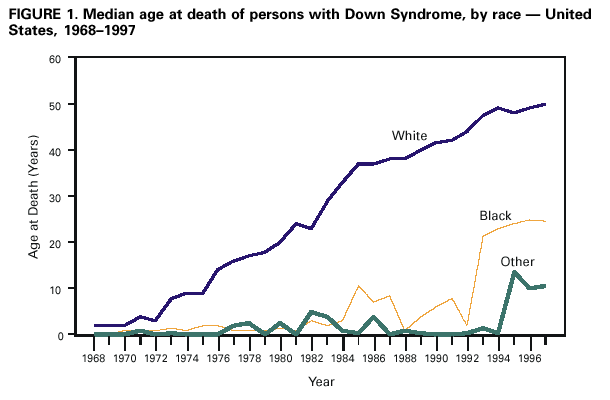
For most of history, then, the life expectancy of people with Down was very low.  But, with advances in knowledge and access to health care, life expectancy has risen dramatically… especially for white people:

The Centers for Disease Control explain that severity of Down does not vary by race, so most likely the cause of the gap in life expectancy is differences in the quantity and quality of health care.

Possibilities include differences in factors that may be associated with improved health in the general population such as socioeconomic status, education, community support, medical or surgical treatment of serious complications, or access to, use of, or quality of preventative health care.

This is just one striking example of the wide racial gap in health outcomes and access to care.  We see data with similar patterns most everywhere we look.  As examples, pre-term birthscancer diagnosis and treatment, and likelihood of living near a toxic release facility.

Morbidity and Mortality Weekly Report, via Family Inequality.

Lisa Wade, PhD is an Associate Professor at Tulane University. She is the author of American Hookup, a book about college sexual culture; a textbook about gender; and a forthcoming introductory text: Terrible Magnificent Sociology. You can follow her on Twitter and Instagram.

Cross-posted at The Atlantic and Family Inequality.

The Census Bureau has a new report on nonmarital births. Based on the American Community Survey — the largest survey of its kind, and the only one big enough to track all states — the report shows that 35.7 percent of births in 2011 were to unmarried mothers.

Beneath the headline number, two patterns in the data will receive a lot of attention: education and race/ethnicity. I have a brief comment on both patterns.

Education

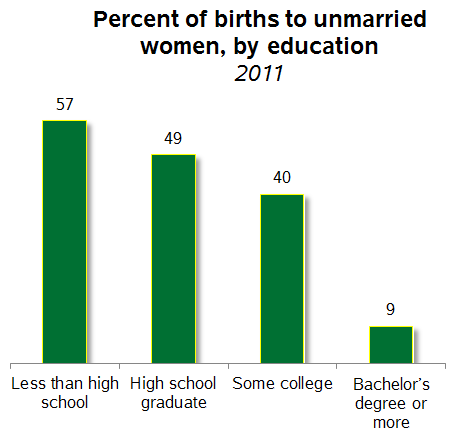
The education patterns show a very steep dropoff in nonmarital births as women’s education increases. From 57 percent unmarried among those who didn’t finish high school to just nine percent among those who have graduated college.

1

Given the hardships faced by single mothers (especially in the United States), it looks like women with more education are making the more rational decision to avoid childbearing when they’re not married. And I don’t doubt that’s partly the explanation. But we need to think about marriage, education and childbearing as linked events that unfold over time. The average high-school dropout mother was 26, while the average college-graduate mother was 33. Delaying childbearing and continuing education are decisions that are made together, based on the opportunities people have. And completing more education increases both the likelihood of marriage and the earning potential of one’s spouse.

So I think you could tell the story like this: Women with better educational opportunities delay childbearing, which increases their marriage prospects, and makes it more likely they will be married and financially better off when they have children in their 30s.

Race/Ethnicity

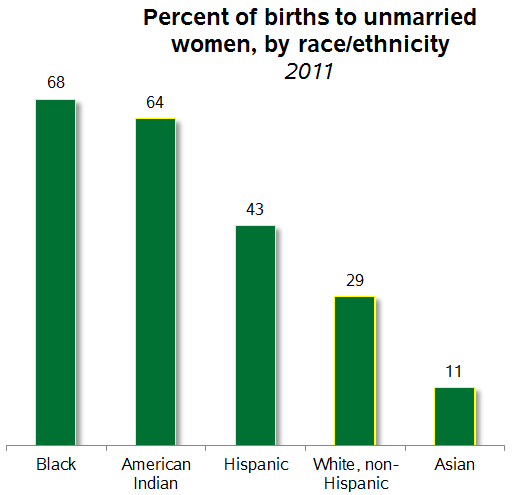
The differences in nonmarital birth rates between race/ethnic groups in the U.S. are shocking, from about two-thirds for black and American Indian women to 29 percent for whites and 11 percent for Asians.

2

This pattern is related to the education trend, naturally, but that’s not the whole story. One aspect of the story is race/ethnic geography of opportunity in this country. I’ve written before about the shortage of employed men available for women to marry, a particular expression of racial disparity first popularized by sociologist William Julius Wilson a quarter century ago.

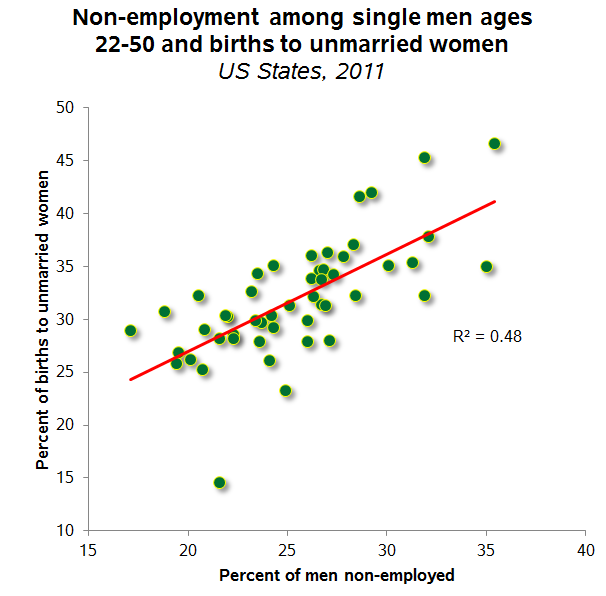
Using the new numbers on nonmarital birth rates for each state from the Census report, I compared them to the male non-employment rate — specifically, the percentage of unmarried men ages 22-50 that are not currently employed. Here’s the relationship:

3

The states with more single men out of work have higher rates of nonmarital births. Single mother, meet jobless man.

My conclusion from these patterns is that unmarried parenthood is primarily a symptom of lack of opportunity, especially for education and employment. Surely that’s not the whole story. Maybe we should be persuading people to marry younger or shaming them into avoiding parenthood. But I think those approaches increase stigma more than they change behavior or improve wellbeing — Pew surveys show that 77 percent of people already say raising a family is easier if you’re married and only 12 percent of single people say they don’t want to marry. So who needs convincing? Meanwhile, if we addressed the problems of education and employment, is there any doubt family security and stability would improve, and with it the wellbeing of children and their parents?

Philip N. Cohen is a professor of sociology at the University of Maryland, College Park, and writes the blog Family Inequality. You can follow him on Twitter or Facebook.