race/ethnicity: Whites/Europeans

Cross-posted at Pacific Standard.Screen Shot 2013-05-07 at 7.33.46 PM
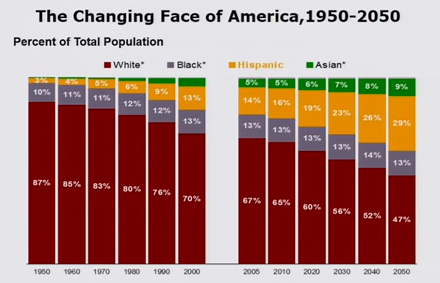
In this 20-minute video, the Pew Research Center’s Paul Taylor discusses trends in the racial/ethnic breakdown of the U.S. population over the last century. Taylor discusses a number of related issues, including the income and wealth gap, perceptions about interracial relations, and the electoral implications of the demographic changes. For instance, while Ronald Reagan once said Hispanics are “Republicans who don’t know it yet,” there’s no evidence that they’re any closer to realizing it. As Hispanics and Asians make up an increasing proportion of the voting population, old electoral strategies based on winning most of the White vote are no longer sufficient to win a national election.

I’d skip the introductory remarks and start just after the 2-minute mark.

Gwen Sharp is an associate professor of sociology at Nevada State College. You can follow her on Twitter at @gwensharpnv.
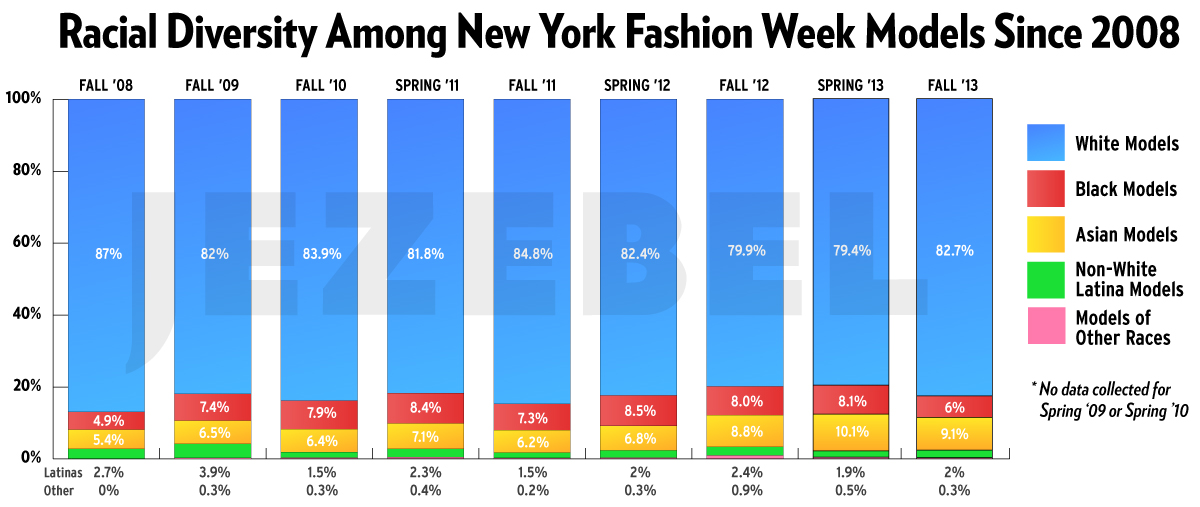
The fashion industry is not inclusive of racial and ethnic minorities. Many of the industry’s most celebrated and acclaimed fashion houses rarely cast models of color for their runway shows. Fall 2013 was one of the worst seasons in diversity for casting. Almost 83% of the models on the runway were white (source):

1The result is an incredibly homogeneous look on the runway.  Check out photos of the Fall 2013 Gucci show (source) and the Fall 2013 Calvin Klein show (source).

Faintly aware of this critique, some designers put a minority model on the runway every odd season. But while look-alike white models are hired en masse, designers often limit just how much color they’re willing to include.  Chanel Iman, an extremely successful multiracial model, told The Times: “Designers have told me, ‘We already found one black girl. We don’t need you anymore.’”

Leila Ananna, a casting director for Burberry, Gucci, Emilio Pucci, Saint Laurent, and more, thinks that this is okay.  Commenting on the lack of runway diversity, she said: “We think we need to keep in mind that these are shows. A show needs to make you dream, and it doesn’t necessarily need to represent reality.”

Ananna’s words pose many concerns. The idea that fashion shows are supposed to make you dream suggests that everyone is white in this idealized world. In contrast, I find the idealization of the homogeneous aesthetic to be a reflection of racism; this is a nightmare, not a dream.

Rebs (Wooyoung) Lim is currently a student attending Occidental College. She is interested in minoring in Sociology and majoring in Urban and Environmental Policy. She does not have a twitter account, sadly.

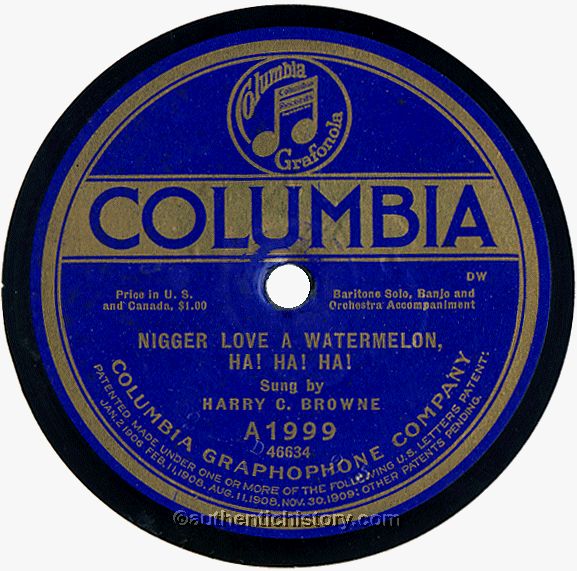
Here’s a random creepy fact: one of the tunes that float out of ice cream trucks all summer is a racist song called “Nigger Love a Watermelon Ha! Ha! Ha!,” first recorded 1916 or before.  Have a listen.

1

During slavery, the African population’s supposed taste for watermelon was used to suggest that they were stupid.  As I wrote in an earlier post:

…defenders of slavery used the watermelon as a symbol of simplicity.  African Americans, the argument went, were happy as slaves.  They didn’t need the complicated responsibilities of freedom; they just needed some shade and a cool, delicious treat.

Googling around, I learned almost nothing about the song.  It seems clear that it’s not an inside joke between Black people, making fun of the stereotype.  Instead, it’s an earnest, intended-to-be-humorous song meant to make fun of Black people.  But I could find little contextualizing information.  I also don’t know if the tune was also set to other lyrics that were or weren’t racist.

Still, the fact that the tune is an ice cream truck classic reveals how our racist history is still part and parcel of our everyday lives.

Hat tip to Theodore Johnson.

Lisa Wade, PhD is an Associate Professor at Tulane University. She is the author of American Hookup, a book about college sexual culture; a textbook about gender; and a forthcoming introductory text: Terrible Magnificent Sociology. You can follow her on Twitter and Instagram.

Cross-posted at Tim Wise’s website and Pacific Standard.

As the nation weeps for the victims of the horrific bombing in Boston yesterday, one searches for lessons amid the carnage, and finds few. That violence is unacceptable stands out as one, sure. That hatred — for humanity, for life, or whatever else might have animated the bomber or bombers — is never the source of constructive human action seems like a reasonably close second.

But I dare say there is more; a much less obvious and far more uncomfortable lesson, which many are loathe to learn, but which an event such as this makes readily apparent, and which we must acknowledge, no matter how painful.

It is a lesson about race, about whiteness, and specifically, about white privilege.

I know you don’t want to hear it. But I don’t much care. So here goes.

White privilege is knowing that even if the Boston Marathon bomber turns out to be white, his or her identity will not result in persons like yourself being singled out for suspicion by law enforcement, or the TSA, or the FBI.

White privilege is knowing that even if the bomber turns out to be white, no one will call for your group to be profiled as terrorists as a result, subjected to special screening, or threatened with deportation.

White privilege is knowing that if the bomber turns out to be white, he or she will be viewed as an exception to an otherwise non-white rule, an aberration, an anomaly, and that he or she will be able to join the ranks of Tim McVeigh and Terry Nichols and Ted Kaczynski and Eric Rudolph and Joe Stack and George Metesky and Byron De La Beckwith and Bobby Frank Cherry and Thomas Blanton and Herman Frank Cash and Robert Chambliss and James von Brunn and Robert Mathews and David_Lane and Michael F. Griffin and Paul Hill and John Salvi and James Kopp and Luke Helder and James David Adkisson and Scott Roeder and Shelley Shannon and Wade Michael Page and Byron Williams and Kevin Harpham and William Krar and Judith Bruey and Edward Feltus and Raymond Kirk Dillard and Adam Lynn Cunningham and Bonnell Hughes and Randall Garrett Cole and James Ray McElroy and Michael Gorbey and Daniel Cowart and Paul Schlesselman and Frederick Thomas and Paul Ross Evans and Matt Goldsby and Jimmy Simmons and Kathy Simmons and Kaye Wiggins and Patricia Hughes and Jeremy Dunahoe and David McMenemy and Bobby Joe Rogers and Francis Grady and Demetrius Van Crocker and Floyd Raymond Looker, among the pantheon of white people who engage in politically motivated violence meant to terrorize and kill, but whose actions result in the assumption of absolutely nothing about white people generally, or white Christians in particular.

And white privilege is being able to know nothing about the crimes committed by most of the terrorists listed above — indeed, never to have so much as heard most of their names — let alone to make assumptions about the role that their racial or ethnic identity may have played in their crimes.

White privilege is knowing that if the Boston bomber turns out to be white, you will not be asked to denounce him or her, so as to prove your own loyalties to the common national good. It is knowing that the next time a cop sees you standing on the sidewalk cheering on runners in a marathon, that cop will say exactly nothing to you as a result.

White privilege is knowing that if you are a student from Nebraska — as opposed to, say, a student from Saudi Arabia — that no one, and I mean no one would think it important to detain and question you in the wake of a bombing such as the one at the Boston Marathon.

And white privilege is knowing that if this bomber turns out to be white, the United States government will not bomb whatever corn field or mountain town or stale suburb from which said bomber came, just to ensure that others like him or her don’t get any ideas. And if he turns out to be a member of the Irish Republican Army we won’t bomb Dublin. And if he’s an Italian American Catholic we won’t bomb the Vatican.

In short, white privilege is the thing that allows you — and me — to view tragic events like this as merely horrific, and from the perspective of pure and innocent victims, rather than having to wonder, and to look over one’s shoulder, and to ask even if only in hushed tones, whether those we pass on the street might think that somehow we were involved.

It is the source of our unearned innocence and the cause of others’ unjustified oppression.

That is all. And it matters.

Tim Wise is among the most prominent anti-racist writers and educators in the United States.  The author of six books on race in America, he has spoken on over 800 college and high school campuses and to community groups across the nation.  His new book, The Culture of Cruelty, will be released in the Fall of 2013.

Last week someone sent me a link to an article about Brad Paisley’s new song, “Accidental Racist,” which features LL Cool J. Given that you’re a Soc Images reader, chances are good you’ve heard about this song. I don’t remember what I was expecting when I saw the title of the song, but man. I really was not prepared for that experience. There’s no official video available on YouTube at the moment, but someone made a video of the song with the lyrics:

In Racism without Racists: Color-Blind Racism and the Persistence of Racial Inequality in the United States, Eduardo Bonilla-Silva discusses the rhetorical strategies that Whites often use to minimize the existence of racial inequality today. As being openly racist has become increasingly stigmatized in the U.S., a version of “color-blind” racism has emerged.

One argument that underpins color-blind racism is the framing of racial oppression and injustice as elements of the past that, while regrettable, can’t be remedied now. Moreover, it’s history; since African Americans aren’t enslaved or legally segregated today, we need to move on from here and treat everyone as equals, with no special considerations for anyone. As one of Bonilla-Silva’s interviewees explained, “…what happened in the past is horrible and it should never happen again, but I also think that to move forward you have to let go of the past…And it should really start equaling out…” (p. 78).

Along with this is often an attempt to equate the discrimination faced by some groups of European immigrants (Italians, the Irish, Jews, etc.) to the experience of African Americans, as this interviewee did: “…they were slaves back in the past and yet, how often do you hear about the people who were whites that were slaves…Boy, we should get reparations, the Irish should get reparations from the English…” (p. 79). From this perspective, African Americans are just one of many groups that had it bad; the impacts of a legally institutionalized racist system that denied African Americans full citizenship or access to opportunities is ignored. This storyline of “we all had it bad” equalizes various experiences of racial and ethnic inequality.

And this is the problem with Paisley’s song (well, it’s one of the problems, but let’s focus). Take these lyrics (found here):

And it ain’t like you and me can re-write history
Our generation didn’t start this nation
We’re still pickin’ up the pieces, walkin’ on eggshells, fightin’ over yesterday
And caught between southern pride and southern blame

And we’re still paying for the mistakes
That a bunch of folks made long before we came

And these contributions from LL Cool J:

If you don’t judge my gold chains…I’ll forget the iron chains

The past is the past, you feel me…Let bygones be bygones

While Paisley may mean well, his song presents racial inequality or conflict as the result of long-past history, “mistakes…made long before we came,” something we need to just get past so we can appreciate each other. And it equates wildly divergent issues, presenting everyone has having a fair, legitimate complaint. Slavery (“iron chains”) and adopting an aesthetic style (“gold chains”) that some Whites might not like are, apparently, equivalent issues. Ending racism is just a matter of everybody deciding to be nicer. If Whites can get over not liking what some African Americans wear, well then hey, African Americans will get over a history of institutionalized racial oppression and the impacts it still has today.

In the world of color-blind racism, this is a fair, plausible compromise.

You might also enjoy SNL’s take.

Gwen Sharp is an associate professor of sociology at Nevada State College. You can follow her on Twitter at @gwensharpnv.
Screen Shot 2013-04-10 at 10.55.52 PM

Back in 2010 we featured a post about a segment from the “What Would You Do?” series from abc News that illustrated the way that race plays a role in who is labeled as deviant and who is given the benefit of the doubt.

The producers had teens vandalize a car in public to see what onlookers would do. To see if race played a role, they tried it with a group of White boys and then with a group of African American boys. Only one 911 call was made on the White boys, but 10 calls were made on the African American teens. Moreover, while the White teens were vandalizing the car, 911 received a call to report the African American boys simply for being asleep in a car, which the caller took as a possible sign they were planning to engage in criminal activity.

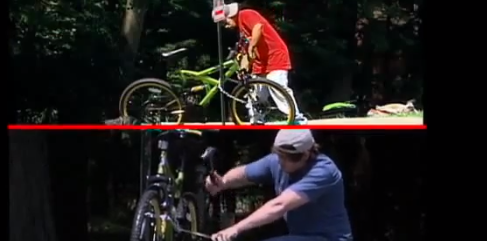
We see this same pattern in another “What Would You Do?” segment. This time, a young White man and a young African American man try to remove a lock from a bike as the cameras capture the reactions of onlookers.

The onlooker interviewed toward the end says race played no role in his reaction. But the extremely different reactions to the two teens indicate differences in who is perceived as likely to be engaged in criminal activity, and whose criminal activity we may think deserves being reported to the police, rather than given a disapproving tsk-tsk as we walk on by.

Gwen Sharp is an associate professor of sociology at Nevada State College. You can follow her on Twitter at @gwensharpnv.
Cross-posted at Asian-Nation and Racialicious.

1
Photo by Lulu Vision (Flickr/Creative Commons)

As an undergraduate majoring in linguistics, I was fascinated with the concept of endangered languages. Colonization, genocide, globalization, and nation-building projects have killed off untold numbers of languages. As linguist K. David Harrison (my undergrad advisor) tells NPR, speakers of stigmatized or otherwise less-favored languages are pressured to abandon their native tongue for the dominant language of the nation and the market (emphasis mine):

The decision to give up one language or to abandon a language is not usually a free decision. It’s often coerced by politics, by market forces, by the educational system in a country, by a larger, more dominant group telling them that their language is backwards and obsolete and worthless.

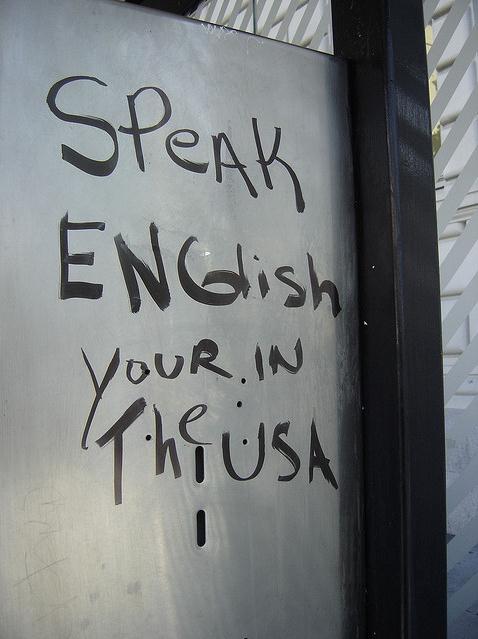
These same pressures are at work in immigrant-receiving countries like the United States, where young immigrants and children of immigrants are quickly abandoning their parents’ language in favor of English.

Immigrant languages in the United States generally do not survive beyond the second generation. In his study of European immigrants, Fishman (1965) found that the first generation uses the heritage language fluently and in all domains, while the second generation only speaks it with the first generation at home and in limited outside contexts. As English is now the language with which they are most comfortable, members of the second generation tend to speak English to their children, and their children have extremely limited abilities in their heritage language, if any. Later studies (López 1996 and Portes and Schauffler 1996 among them) have shown this three-generation trend in children of Latin American and Asian immigrants, as well.

The languages that most immigrants to the U.S. speak are hardly endangered. A second-generation Korean American might not speak Korean well, and will not be speaking that language to her children, but Korean is not going to disappear anytime soon — there are 66.3 million speakers (Ethnologue)! Compare that with the Chulym language of Siberia, which has less than 25.

Even if they’re not endangered per se, I would argue that they are in danger. While attitudes towards non-English languages in the U.S. seem to be improving, at least among wealthier and better educated people in some more diverse cities and suburbs, the stigma of speaking a non-English language still exists.

How many of you have:

  • been embarrassed to speak your heritage language in front of English speakers?
  • been reprimanded for speaking your heritage language in school?
  • been told to “go back to [country X]” when someone overhears you speak your heritage language?

I’ve heard innumerable stories about parents refusing to speak their native language to their children. Usually, the purported rationale is that they do not want the child to have language or learning difficulties, a claim that has been debunked over and over again by psychologists, linguists, and education scholars.

I’m sure that these parents truly believe that speaking only English to their children will give them an edge, though the reverse is true. What I wonder is how much this decision had to do with an unfounded belief about cognition and child development, and how much it had to do with avoiding the stigma of speaking a language that marks you as foreign, and as “backwards and obsolete and worthless”?

Calvin N. Ho is a graduate student in sociology at the University of California, Los Angeles studying immigration, race/ethnicity/nationalism, and Asian diasporas.  You can follow him at The Plaid Bag Connection and on Twitter.

Cross-posted at Tim Wise’s website.

It’s one of those stories that can leave even the most jaded and cynical critic of racist thinking scratching their head; the kind that manages to shock even those of us for whom acts of bigotry and intolerance seem all-too-typical, and who have, sadly, come to expect them in a culture such as this.

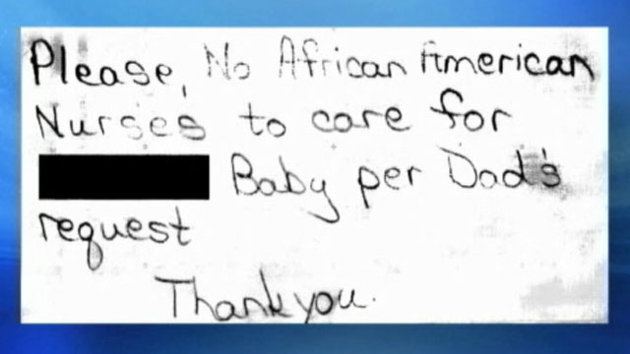
And so it was that in Flint, Michigan recently, a new father — and this is a term he has earned in only the most narrow, biological sense — demanded that when his recently arrived child was sent to the Neonatal Intensive Care Unit of the hospital where she had been born, no African American nurses were to attend to her needs, to care for her, to do what neonatal ICU nurses do, which is to say keep sick babies alive. White hands only for this white, fresh as snow child, whose father, sporting a shiny new swastika tattoo (a Christmas present no doubt from his pathetic skinhead bride) prioritized his own hatreds above and beyond the needs of his precious little girl.  That the future does not bode well for her seems hardly worth saying. To be delivered from an ICU into the arms of one as unhinged as this can only, by reasonable people, be seen as a turn for the worse. Incubators and breathing machines might be preferable to having parents such as she has, through no fault of her own, inherited.

But what is worse, perhaps, than the bigotry of this one neo-Nazi — which is at least to be expected and so, can, despite its irrationality in a case such as this, remain somewhat within the realm of the banal — is that the hospital in question, Hurley Medical Center, actually capitulated to his psychotically racist demands, posting a sign on the little girl’s chart instructing the unit to disallow any black nurses from as much as touching this baby.

1

Presumably, were Tonya Battle, a black Hurley neonatal nurse since 1988 the only nurse within arms reach of the girl as she entered cardiac arrest or as her kidneys began to shut down — both of which have been known to happen to those in a NIC-U — Battle was to scream loudly for a white nurse to come and save the child’s life. Because God forbid a black woman with 25 years experience do the job. And if she dies, well, at least her precious white skin wouldn’t have been sullied by black hands.

Hurley’s acquiescence to this insanity, in contravention of all ethical responsibility, not to mention legal obligations to treat their employees in a non-discriminatory fashion, is going to cost them no doubt, as they are apt to discover once the lawsuit currently brought against their witless administrators plays out. They are going to pay, and pay big, as they should, for their enabling of overt white supremacy. But that is hardly the most important part of this story. Just as it was not the most important part of the story back in 2000 when a heart specialist at St. Thomas Hospital in Nashville did a similar thing, agreeing to the lunatic ravings of another racist white man, who demanded that his wife, who needed open heart surgery to save her life, not be attended to by any black doctor, because he didn’t want a black man to see his wife naked.

More interesting, I think, is what this story (and the earlier one from Nashville) says about racism in America, and not just of the sort evinced by one bottom-feeder, troglodytic fan of Adolf Hitler. For while we are too quick to presume racism to be merely an individual pathology manifested by individually bad people, much like the father in the story from Flint, the fact is, an incident like this illustrates as well as anything can, the way that racism continues to operate as a systemic force in the United States, civil rights laws and all our vaunted post-raciality notwithstanding.

To understand what I mean by this, consider something I am often asked as I travel the country, speaking about racism, or in reply to one or another column or book that I’ve written: namely, it is queried, why don’t I ever talk about black racism, or, just generally, racism against white people? Why, it is wondered, do I focus on racism only when it’s deployed by whites?

There are many things I could say, and do, when asked something like this. But for now, let it suffice to say that this story, from Michigan, involving a white institution as respected as a hospital bending to the whims of a fucking Nazi, is more than enough of a reason for my selective attention. And this is true for multiple reasons.

First, what the story demonstrates is how much more potent white racism is than any potentially parallel version practiced by peoples of color. Simply put, there is no way that any bigoted black person, or Latino, or Asian American, or indigenous person, could possibly have made a similar demand in the reverse direction — that no white nurses attend to their newborn — and expect to have that insistence met with approval and acquiescence. Anyone who thinks a hospital would have agreed to such a thing — to actually deny opportunity to white nurses or doctors, and to limit the care of such a child to same-race caregivers because of the expressed bigotry of a patient — is either so overly medicated or mentally damaged as to make further discussion impossible. In other words, even when a white racist who is likely not of substantial economic means makes a racist demand, his desires can get ratified, and in ways that not even the wealthiest person of color could expect to have happen.*

And this is because — and this is what is especially pertinent to the matter of institutional racism — even if a hospital was willing to go along with the ridiculous and bigoted demands of a hateful person of color, that no whites be allowed to touch their black or brown baby, it would be virtually impossible to fulfill such a request. And why? Simple. Because given the history of unequal opportunity in medical professions, from doctoring to nursing — and also just given the demographic and power dynamics within pretty much any institution you can name — to work around white professionals, even if one wanted to, is almost impossible.

Bottom line: the hospital in this case went along with the demand to exclude blacks from attending to this child because they could. Given the history of discrimination in access to the medical profession, including nursing, and the barriers to professional practice faced by too many people of color, there exists today a more limited number of such professionals from which to draw. As such, excluding them from a particular hospital unit or assignment is hardly a huge burden for the institution in question.

But imagine what would happen if the situation were reversed, and a racist black man had demanded the exclusion of whites from caring for his child. Even if there were a doctor willing to agree to such conditions, it would be virtually impossible for him or her to follow through, because whites — having received the opportunities needed to enter the nursing profession in larger numbers — are hard to work around. “No whites” policies would result in a lot of empty NIC-Us, whereas “No blacks” policies require only a small administrative headache at best, so fewer are such professionals in the first place. And so, given the history of racial inequity, the consequences of which we still experience, white bigotry of the individual type is operationalized and activated if you will, by the institutional injustices that have resulted in the over-represantaion of whites and under-representation of black and brown folks in certain jobs to begin with.

In other words, institutional racism is akin to the gasoline, allowing the otherwise stationary combustion engine of individual racism to function: the former gives the latter life, and the ability to impact others in a meaningful and detrimental way. Without the power to enforce one’s racism, or expect it to be enforced or enforceable by others, that racism is largely sterile. Which is why white racism is simply more worthy of our attention and concern than any other form.

Much the same would be true in other realms of life, beyond medical and hospital settings. Blacks who wish to avoid whites in their neighborhoods will typically find themselves limited to the poorest, most crowded areas of town — places whites long ago abandoned — since finding Caucasian-free zones in more prosperous suburbs can be a tough task. Whites can more or less live wherever we wish. If we are not to be found in a particular census tract you can bet it’s because we’ve chosen to be absent. Such cannot be said for why blacks are often absent from more affluent areas, however. Money or no money, good credit or bad, millions face discriminatory barriers in residential opportunity every year.

Once again, even if people of color despise whites and seek to avoid us, their ability to do so will be directly constrained by the larger opportunity structure that has skewed power and resources in our direction. Whites seeking to avoid blacks and Latinos on the other hand, can do so readily, with the help of mortgage discrimination, redlining, zoning laws and so-called “market forces” pricing many blacks out of the better housing markets (even though we only got into those markets because of government subsidies and preferences, both private and public).

So for those seeking to understand what racism is — and the difference between the merely individual as opposed to institutional forms of it — and why white racism is more potent and problematic than any other potential form, you need look no further than the recent headlines. When institutions can and will collaborate with and directly empower the racism of even the most deranged of bigots, you know that we have yet to arrive at that place of racial ecumenism claimed for us by those who would rather gloss over the ongoing injustices we face, and pretend to have attained, as a people, a perch to which we have no ethical right to lay claim.

————————–

*Please note, I wish to differentiate here between those patients whose desire for same-race/ethnic nurses or doctors is motivated by apparent bigotry, on the one hand, and those whose desire for such a thing might be motivated by such things as linguistic familiarity, on the other. So, for instance, a Spanish-speaking, or for that matter, German or Russian-speaking mother-to-be might request a nurse, or anesthesiologist who speaks their language, for reasons of comfort and communication. Additionally, it is possible that given the history of difficulties in cross-cultural communication between authority figures who are white and patients/clients who are persons of color (which has been studied and documented for years), a black patient might prefer, if possible, to have a black nurse or anesthesiologist to wait on them. Although even these cases are likely rare, they would not be remotely comparable to a blatant bigot demanding same-race care for reasons comparable to the facts in this story, or the 2000 story from Nashville.

————————–

Tim Wise is among the most prominent anti-racist writers and educators in the United States.  The author of six books on race in America, he has spoken on over 800 college and high school campuses and to community groups across the nation.  His new book, The Culture of Cruelty, will be released in the Fall of 2013.