Search results for embed

Dmitriy T.M. sent in a video put together by the Center for Investigative Reporting about some of the hidden costs of gasoline use in the U.S.:

Also check out our earlier posts on Lisa Margonelli’s TED talk about the political economy of oil in the U.S. as well as the inconsistent relationship between gas prices and how much we drive.


I don’t play video games. The few times I have played a game it involved a furry animal working his way through some kind of tropical forest and the most violent it got was when he hit a villainous turtle on the head with a coconut. So, I am not familiar with Duke Nukem.

Of course, one Google search tells me he is a supremely popular, freakishly over-muscled, machine gun-wielding, hyper-aggressive action “hero” who is described in the Wikipedia entry as “frequently politically incorrect.” His character profile also claims that when he was first introduced, he was a CIA operative hired to save Earth from Dr. Proton. But the current marketing materials make clear what the really important aspects of the game are. Exhibit A is this ad, which greeted me as I came out of the subway this morning:

Duke Nukem is sitting on a throne while two women in schoolgirl outfits sit at his feet. The caption leaves no doubt about the main attractions: “This game has bazookas. Both types.”

The game’s website presents a guy who looks intensely devoted to his steroid regimen, has a penchant for unloading 50 rounds into anything with tentacles, and who appears to live in a post-apocalyptic land which is somehow still able to generously supply women with fetish outfits, bikinis, and manicures. In a video promo for the game on YouTube there are scenes of Duke on a shooting rampage interspersed with what appears to be him walking into a room and seeing a switched-on vibrator skidding around the room. He then encounters two women (the Holsom Twins, Mary and Kate) in schoolgirl outfits who drop their weapons to touch and caress each other in sexually suggestive ways. Duke is watching this while pointing a gun at them, saying, “allll right, time for my reward” (NSFW due to images and language):

Unfortunately for the twins, they later have sex with an alien and get themselves into trouble (thanks to Michael R. for this clip; also NSFW):

Many other reviews of Duke Nukem have also pointed out its violent sexual imagery and encouragement of sexually violent behavior towards women. Just to tally up, we have:

  1. Fetishizing and infantilizing women by putting them in outfits associated with children.
  2. Referring to their breasts as “bazookas,”  both objectifying women and equating  their bodies with a military weapon.
  3. A lesbian encounter presented as titillation for the male viewer.
  4. Watching women engage in sexual activity with one another, and even threatening women with weaponry to continue engaging in sexual activity with one another, is your reward. You deserve it – you deserve to be sexually gratified.

People learn by watching. This can be good and bad. It can make us more accepting of others’ opinions and outlooks, and it can also desensitize and normalize harmful opinions and behaviors. In regards to Duke, the latter is where the risk lies — the more one sees images like those presented by Duke Nukem, the more likely they are to be seen as what is acceptable and usual. Normalizing harmful, degrading, and insulting stereotypes of and behavior toward women seems like a high price to pay for a video game’s success.

———————-

Larkin Callaghan is a doctoral student at Columbia University studying health behavior and education. She is particularly concerned with gender disparities in access to healthcare and prevention services, and has done research on adolescent female sexual health, how social media operate as an educational platform, and differences by gender in the effectiveness of brief health interventions. You can follow her on Twitter, Tumblr, and at her blog.


One thing I like about Anita Sarkeesian’s series, Tropes vs. Women, is that she doesn’t go for the obvious. Instead, she draws our attention to insidious and ubiquitous tropes that many of us have, nonetheless, never quite noticed before, exactly because they’ve simply become the water we swim in (e.g., the Manic Pixie Dreamgirl).

In this episode she reveals the Mystical Pregnancy trope, common in science fiction, in which women are involuntarily impregnated by aliens and monsters for nefarious and frightening purposes.  Following Laura Shapiro, she calls out writers and directors for using pregnancy as a form of “torture porn” and using women’s biological capacity as a plot device, meanwhile ignoring the real, non-fiction threats to women’s reproductive rights.

Lisa Wade, PhD is an Associate Professor at Tulane University. She is the author of American Hookup, a book about college sexual culture; a textbook about gender; and a forthcoming introductory text: Terrible Magnificent Sociology. You can follow her on Twitter and Instagram.

In Cultures of War: Pearl Harbor/Hiroshima/9-11/Iraq, John Dower discusses how the U.S. responded to the Japanese attack on Pearl Harbor on December 7, 1941. Militarily, it pushed the U.S. into officially entering World War II, but Dower is just as interested in cultural responses, particularly efforts to stigmatize all U.S. residents of Japanese descent as unpatriotic or even traitorous.

A prime example of this is the film December 7th, created by John Ford, legendary director of classics such as Stagecoach and The Grapes of Wrath. The first version of the film was 82 minutes long. In it, an idealistic figure representing the U.S. talks with “C,” a figure meant to represent his conscience. Uncle Sam naively believes the racial and ethnic diversity of Hawaii isn’t a problem, but C helps him see that the large Japanese American population is a threat, even when they appear to be loyal, patriotic, assimilated Americans. Japanese-language telephone books and newspapers are ominously shown as evidence of their lack of true American-ness. Start at about 8:40:

The message is unequivocal: Japanese Americans are untrustworthy, and any actions or behaviors that seems to indicate that a Japanese American is loyal to the U.S. provides potential evidence of just how deceitful they are — they cover their treachery with an appearance of patriotism. At around 18:25, Uncle Sam tries to defend freedom of religion, but C patiently explains the problem with this view. C says he’s not saying all Japanese Americans are disloyal, but that he’s “just presenting the facts,” and can’t be responsible for separating the loyal from the disloyal.

Ford cut the film down to 34 minutes before releasing it. This shortened version of December 7th won the 1943 Oscar for Best Documentary Short Subject:

The attack scene from December 7th is often assumed to be actual documentary footage of the attack on Pearl Harbor, but Dower points out that it was almost entirely staged by Ford, since there was almost no existing film of the surprise attack available.

Dower also discusses the animated Disney film Victory through Air Power. The film was based on the book Victory through Air Power, by Alexander Seversky. Seversky’s book justifies bombing non-combatant targets as a way to demoralize the enemy and disrupt supply lines and communication. Civilians would no longer be seen as inherently off-limits for military operations. The film served as propaganda for this view, which increasingly took hold in the U.S. military, eventually justifying dropping nuclear bombs on Hiroshima and Nagasaki.

You can find the entire film on Youtube, but the most relevant segment is at the end; the widespread bombing of (noticeably resident-free) Japanese cities is presented as key to a glorious victory by the U.S.:

These films served to justify military strategies (internment camps and bombing non-military targets) that could have faced stiff resistance by drawing on popular fears in the wake of the Pearl Harbor attack. In both cases, they widened the circle of legitimate potential targets of war-related government actions to not just Japanese soldiers and government officials but to the entire civilian population of Japan, as well as anyone with Japanese ancestry living in the U.S.

Megan H. and Ami R. sent in contrasting examples of using gender to market fuel-efficient cars. Megan saw this ad (one in a series that plays on the “I’m a Mac/I’m a PC” Apple ads) advocating electric cars over gasoline-powered ones. In this ad, femininity is associated with environmental responsibility. The most stereotypically masculine man in the ad — the blue-collar worker in a hard hat and filthy clothes — represents the harmful oil industry. Beneficial, good wind energy, on the other hand, is personified by a pretty woman in a filmy dress. Her beauty renders the bad guys speechless:

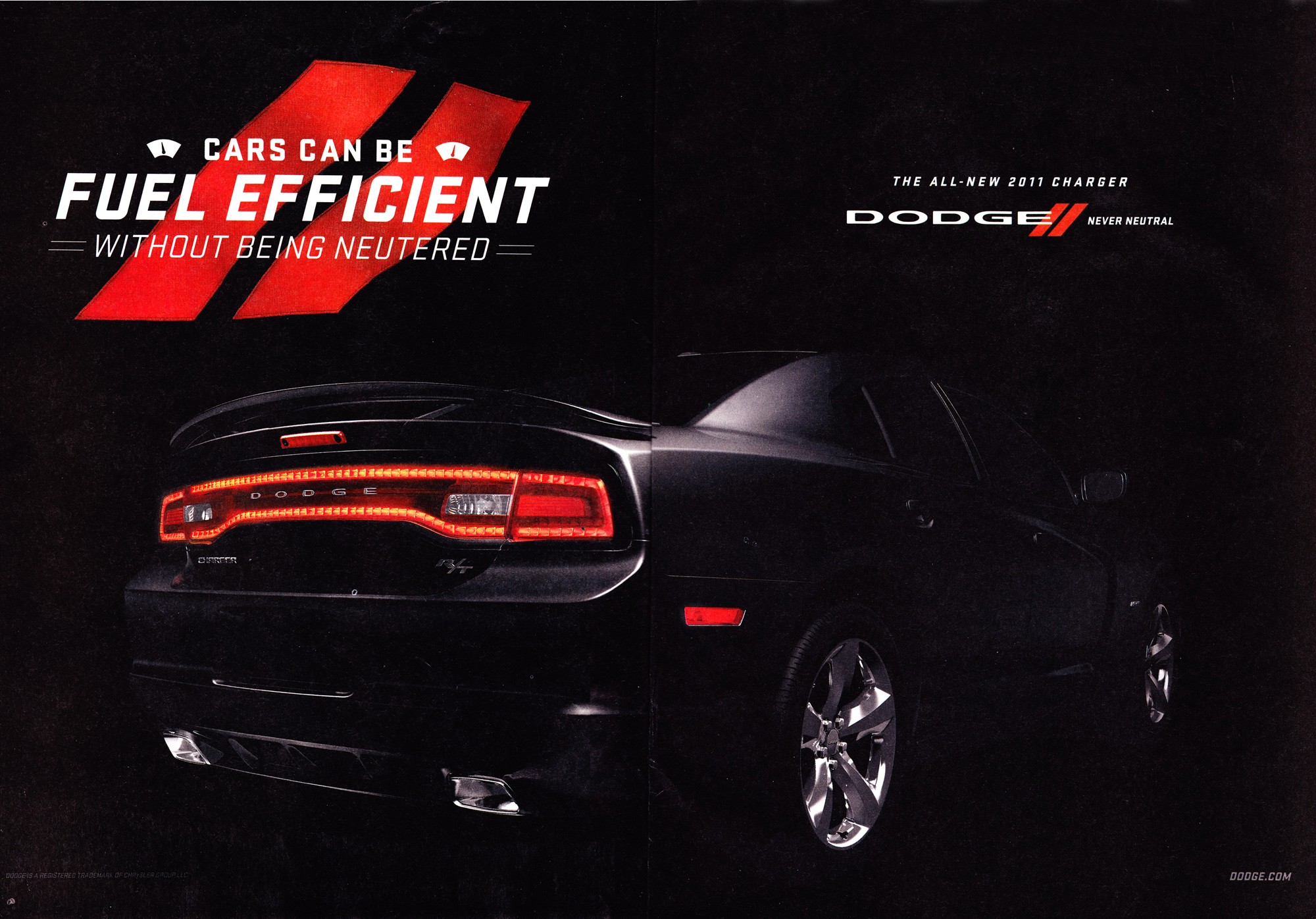
Dodge, on the other hand, wants to distance its claims to fuel efficiency from any association with femininity. Ami found this ad for the new Dodge Charger in the magazine for Go! Chapel Hill, an organization that advocates less car use:

So here, fuel efficiency with is also associated with femininity, but in the negative sense of emasculation. The Charger is the one exception to the other fuel efficient cars out there. You can get better gas mileage and still protect your manly reputation.

For other examples of gender representations of the environment or environmental movement, see our previous posts on femininity and benign nature, using PETA tactics to oppose the BP oil spill, nature in vintage men’s magazines, and even girls can drive electric cars!

Cheerleading started in the United States in the late 19th century as a male activity whose purpose was to organize crowds cheering at football games.   In 1923, women joined cheerleading squads and have increasingly dominated this sport.  Cheerleading traditionally features chanting, gymnastics, and tumbling.  The dominant image of cheerleaders  is a perky, always smiling, female who fits a particular body mold.

However, in the late 1970s, a new style of cheerleading emerged in North Carolina and Virginia.  This African American originated style of cheerleading is called “Stomp n Shake”.  Stomp n Shake cheerleaders have the same goals as “traditional cheerleaders” — to motivate their sports team and raise the enthusiasm of fans. However, Stomp n Shake uses African American dance/stepping aesthetics and African American bragging and insult traditions (dozens/snapping) to “pump up” their audience.  Some Stomp n Shake squads include tumbling and stunts in their repertoire, while other squads don’t.  Mostly women, Stomp n Shake cheerleaders rarely smile.  Instead their goal is to look serious and intimidating when they are chanting their cheers and performing their cheer routines.  As the name implies, hip and butt shaking are common features of Stomp n Shake routines, something usually disallowed in most mainstream competitive cheerleading.

Virginia State University Woo Woos (Work It…):

Howard University Bison Cheerleaders:

Prince Edward County High School, SASSY (We Shake The Best):

It’s also interesting to note that Stomp n Shake cheerleading squads  appears to be more accepting of cheerleaders who don’t fit the relatively slender body build of mainstream cheerleaders.  Comment threads for YouTube videos of usually include comments that certain squad members are overweight and therefore should not be cheerleaders.   Usual responses to those comments are that a “thick”(big boned) body frame is common for many Black females, and, besides,  a cheerleader’s weight has nothing to do with her cheerleading skills.

Stomp n Shake is changing the way cheerleading is performed in the United States and elsewhere, often to the dismay of many cheerleading coaches, cheerleaders, and fans who very much prefer that cheerleading remain the way it is.  However, the influence of such movies as the Bring It On cheerleader series (five movies from 2000-2009) and the posting of videos on YouTube — along with the desire of cheerleading squads to be cutting edge and “hip”– have already influenced the performance styles of some more “traditional” cheerleading squads.  It will be interesting to see whether Stomp n Shake cheerleading will also increase the acceptance in mainstream cheerleading for cheerleaders whose physical builds  are different than those of the typical cheerleader in the past and the present.

Azizi Powell earned a B.A. in sociology from Upsala College, East Orange New Jersey.  She is a retired health & human services administrator, a mother and grandmother, and a free lance artist (African storyteller).  She curates two cultural websites Cocojams and Jambalayah.  For more information and videos on Stomp n Shake cheerleading, click here.

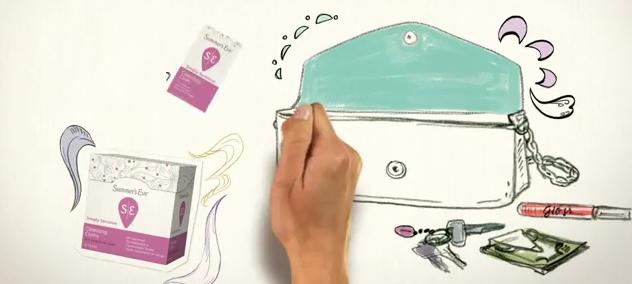
Last week I went to see the last Harry Potter movie. I was a bit startled that the pre-movie commercials included this ad (thanks to Melissa H.-J., Tom Megginson, and carlafrantastic for the link!):

I was startled both because I hadn’t expected a Summer’s Eve ad at a Harry Potter showing (the 14-year-old boy I had taken with me seemed to desperately wish he could disapparate on out of there) and by the idea that the most powerful thing in the entire world is women’s vaginas — or, as Melissa points out, men’s desperate desire to get access to them through violence toward one another, with women passively waiting around to see who wins so they know who to have sex with.

And as Tom (who blogs at Work that Matters) says, if someone is going to show their vagina “a little love,” perhaps they would best do so by avoiding irritating, unnecessary products that can actually exacerbate problems like yeast infections.

Summer’s Eve also released several more “Hail to the V” ads (all posted at Gawker), sent in by Leila R., Jamie D., Joel T., YetAnotherGirl, Maeghan D., and Finette. The ads inform women that they need to carry wipes for their genitals with them at all times, because you need to clean yourself down there multiple times a day to avoid being gross; Summer’s Eve helpfully created ads targeting different ethnic groups to be sure everyone understands how important this issue is:

Here’s the African-American version:
[Video removed]
This Latina version:
[Video removed]
And the White version:
[Video removed]
Vertical smile? Are they serious with this? And as Finette says, “They’ve managed to combine ‘less than fresh down there’ vagina-shaming [omg, what subtle hints has your vagina been trying to get your attention with?!] with ethnic stereotypes! Awesome!”

UPDATE: After a lot of criticism, Summer’s Eve has pulled the ads and seems to have gotten them removed from YouTube, so none of the videos we initially posted are available any more. However, Laura S. found a clip from TYT Network discussing the ad campaign, so you can get an idea of what they were like. Thanks, Laura!

My wife introduced me to two television shows, both built on a similar premise but with radically different results.

First, check out this clip from Clean House, airing on the Style Network.

Now, compare that to this ad for Hoarders, airing on the A&E Network.

This is a wonderful example of medicalization. We have people engaging in almost the exact same behavior, but their actions are interpreted in two diametrically opposed ways. Clean House generally (though not exclusively) frames their subjects as having poor habits that, with a little tough love, can be corrected. Hoarders, on the other hand, frames their subjects as having serious mental illnesses. Indeed, they regularly bring in clinicians to treat their subjects. The former invokes judgment (note the eye-rolling and smirking in the first clip), while the latter invokes sympathy (hear the dire music).

Our behaviors do not come with meaning necessarily embedded in them. We have to made sense of them, and the way that we ultimately do so has consequences. We did this in the past with the behavior of children, particularly of little boys. Is Johnny being rambunctious? There once was a time when Johnny was sent to the principal’s office for a spanking, but today, he is much more likely to be diagnosed with ADHD and given a pill. As we medicalize more and more in our society, our acceptance of and reaction to our behaviors change.

————————

Bradley Koch, PhD, is an assistant professor of sociology at Georgia College. Brad primarily studies religion but is also interested in sexuality, stratification, teaching and learning, and higher ed. Brad muses, appropriately enough, at Brad’s Blog.


If you would like to write a post for Sociological Images, please see our Guidelines for Guest Bloggers.