

Katrin let us know about this great clip from PBS News Hour (and posted at Boing Boing) about inequality and Americans’ perceptions about how wealth is distributed in the U.S. It’s a great clip:
PBS posted the pie charts used in the video as well.
Katrin let us know about this great clip from PBS News Hour (and posted at Boing Boing) about inequality and Americans’ perceptions about how wealth is distributed in the U.S. It’s a great clip:
PBS posted the pie charts used in the video as well.

Erg. Ugh. Just…[cringe]. That is my reaction upon seeing a clip (first posted at Jezebel), sent in by Dmitriy T.M., of a segment from a recent episode of the reality show Bachelor Pad. The show is a spinoff of the popular shows The Bachelor and The Bachelorette, consisting initially of 20 former contestants from those two shows, one of whom is voted off by the rest of the cast each week. This week, the contestants indicated their votes for who should leave by getting to anonymously throw paint-filled “eggs” at others’ backs. But in case that wasn’t sufficiently humiliating, the host also had contestants throw eggs in response to the question “Who are you least attracted to?” Here’s the segment with the women:
It’s a depressing illustration of the current TV obsession with public humiliation and bullying as entertainment. It’s hard not to feel for Erica as she stands there feeling each successive hit, being publicly held up as the least desirable woman there. But her response is also revealing; it exemplifies the way women are encouraged to think of themselves as being in competition. At 2:54 Erica talks about the experience and the difficulty of having a body that, while appearing incredibly thin to me, in that environment qualifies as notably curvaceous.
But in her ability to defend herself and push back against the judgments of others, she falls back on a common strategy: not questioning the standards of beauty themselves, but simply trying to refocus them, in this case (at about 3:05) pointing to another woman who is “way bigger” and not “that pretty.” The result is to reaffirm both the idea that body size is an objective and essential measure of attractiveness (so being bigger automatically should make you less attractive than a smaller woman) and that women’s self-esteem and resistance to negative judgments of their own attractiveness must come at the expense of other women, with whom them are always, and inevitably, in competition.

Emma M.H. sent in a new example of marketers attempting to masculinize beauty/hygiene products to make them more acceptable to men. The ad for Dove’s Men + Care Canadian body wash line, refers to men’s skin as “man hide,” similar to tough, totally manly cowhide, and thus in need of a good moisturizing now and again, just like your work gloves:
For other examples of making it safe for men to use body care products, see our posts on Brut’s slapping game, a post with several examples, and Allie Brosch’s awesome satire of this type of marketing (as well as all the links at the bottom of that post).

In case you were wondering whether some people continue to conflate Blackness with criminality, listen to Historian David Starkey in this BBC interview about the London riots (key language transcribed below; start at 1min and stop at 2min for an idea). Trigger warning:
Transcript of selected phrases:
A particular sort of violent, destructive, nihilistic, gangster culture has become the fashion. And black and white, boy and girl, operate in this language together… A Jamaican patois that has intruded in England… literally a foreign country… It’s not skin color, it’s cultural…
Starkey has made a career saying offensive things; he appears to hate everyone except for white gay men (which is what he is). So it’s no surprise that he is the one saying these things. Still, his long career as a cultural critic and pundit suggests that producers believe that there is a market for hateful language. That market is likely composed of both people who find offense and draw attention to Starkey in order to oppose his views, and people who agree with him and are pleased to hear a famous PhD saying what they believe.
In a perfect world no one would say these types of things but, in a non-perfect world, perhaps it’s good that occasionally people do. It’s an opportunity to have a conversation about our collective values. Then again, this is easy for a white person to say. As a committed anti-racist, these words are hard for me to hear. But they no doubt resonate painfully deep in the heart of many of the people targeted by this venom, another twist of the knife in a lifetime of personal and political wounds.
Thanks to Laura F., Ernie P., and Jari P. for suggesting we write about this.
Lisa Wade, PhD is an Associate Professor at Tulane University. She is the author of American Hookup, a book about college sexual culture; a textbook about gender; and a forthcoming introductory text: Terrible Magnificent Sociology. You can follow her on Twitter and Instagram.
Katrin sent along a vintage (apparently 1957) Pepsi commercial I thought you might enjoy, as it has all the classics: lightly mocking tone about women’s supposed competitiveness with one another and obsession with shopping, reminder that attractive = thin, and presentation of marriage as the ideal, ultimate victory for all women:
Sangyoub Park let us know that the Bureau of Labor Statistics has released the results of the 2010 American Time Use Survey, a study that looks at what we do with our time. They haven’t released any charts of the 2010 data yet, but the Wall Street Journal posted an article with an image that summarizes the changes since 2007, before the recession began. Not surprisingly, on average Americans are spending less time working and more time sleeping and watching TV, among other activities: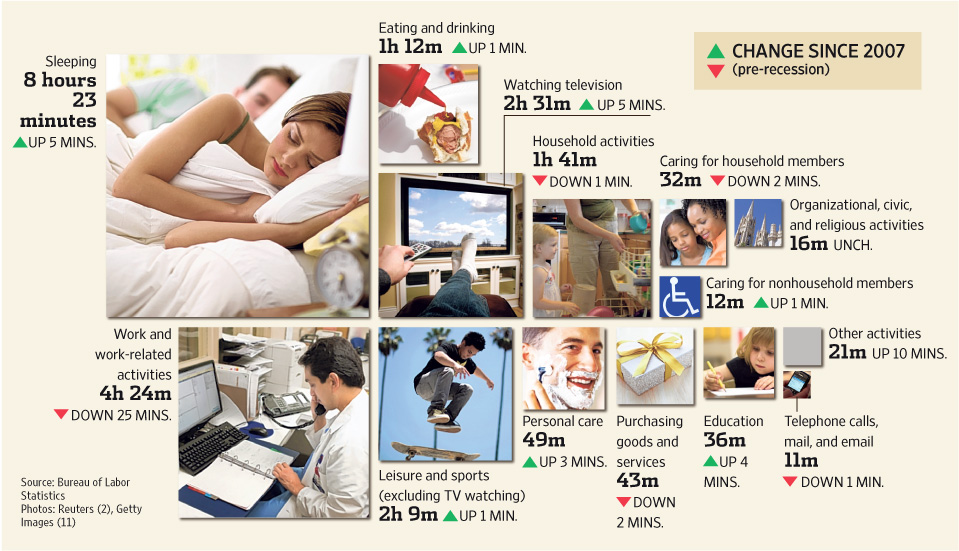
Keep in mind those numbers are daily averages that even out activity that is often not evenly distributed in real life (such as work, where weekly hours worked are averaged across all 7 days).
These changes seem insignificant when you look at them; so what if Americans are, on average, sleeping 5 extra minutes a day, or spending 2 minutes less buying things? But when aggregated across the entire U.S. population aged 15 years or older, these add up to major shifts in family and work life as well as economic activity.
There’s a video to accompany the story:
Finally, they have an interactive website where you can enter your own time use in major categories (to the best you can estimate it) and see how you compare to national averages.
We’ll follow up with more detailed posts once the BLS starts posting relevant charts.

Katie L. sent along a fascinating Starbucks commercial. In it, a succession of workers grow, harvest, roast, taste, and prepare coffee from scratch for a hypothetical customer named “Sue.” At first glance, I thought that the commercial did a nice job of at least acknowledging their workers (if in an overly romanticized way), unlike some commercials for agricultural products that erase them. But I thought again. Because the entire commercial revolves around Sue, the inclusion of all the workers isn’t meant to focus our attention on them, it’s meant to highlight how much work goes into pleasing Sue. We’re supposed to identify with Sue, not the series of workers.
This reminds me of a post about a “hand-rolled” tea sold at The Coffee Bean and Tea Leaf. The consumer was supposed to be excited about the tea not because of its flavor, but because, as I wrote, “it takes a significant amount of human labor to “hand-roll” tea leaves into balls… What could be more luxurious than the casual-and-fleeting enjoyment of the hard-and-long labor of others? ”
This ad has a similar feel. The workers are portrayed only in order to make the intended consumer feel special. They work with Sue in mind, tending carefully to Sue’s future pleasure intently and with care. They find satisfaction in Sue’s satisfaction. Sue is everything. Everyone is for Sue.
This tells us something interesting, no doubt, about American cultural values.
Lisa Wade, PhD is an Associate Professor at Tulane University. She is the author of American Hookup, a book about college sexual culture; a textbook about gender; and a forthcoming introductory text: Terrible Magnificent Sociology. You can follow her on Twitter and Instagram.

The “Let’s Move” campaign is Michelle Obama’s initiative to curb the childhood obesity epidemic in the United States. According to the campaign website, its goals include “creating a healthy start for children” by empowering their parents and caregivers, providing healthy food in schools, improving access to healthy, affordable foods, and increasing physical activity. Here is an example of the kind of “social marketing” that the campaign is releasing:
This campaign video is particularly notable for 1) its raced, classed, and gendered assumptions about the responsibility for promoting physical activity among young people; 2) the way it emphasizes personal responsibility while ignoring structural determinants of health; and 3) its Foucauldian implications (for the real social science nerds out there).
First, the video portrays a middle-aged white mother (in the kitchen, no less) who encourages her daughter to get exercise by having her running around their (apparently large, middle-class suburban) home in order to find the $1 she asked for. It ends by stating: “Moms everywhere are finding ways to keep kids healthy.” Not only does this assume that “moms” (not “parents”) have responsibility for keeping their kids healthy through intensive mothering practices, it fails to account for the fact that the childhood obesity epidemic (itself a social construct in many ways) is greatly stratified by race and socio-economic status. It is not clear to the viewer how they might encourage their children to exercise if they live, say, in a small apartment or a neighborhood without safe places for kids to play outside.
Second, a growing body of research points to the fact that structural-level inequalities, not individual-level health behaviors, account for the majority of poor health outcomes. This research illuminates a disconnect in most health promotion initiatives — people have personal responsibility (engage in physical activity) for structural problems (poverty; the high price of nutritious food; safe, well-lit, violence-free places for kids to play).
Finally, the video illustrates what some social scientists have noted about new forms of power in modern public health practice — for example, health promotion campaigns such as this one can be thought of as the exercise of “biopower,” or Foucault’s term for the control of populations through the body: health professionals and/or the government are entitled by scientific knowledge/power to examine, intervene, and prescribe “healthy lifestyles.” In this example, the campaign uses marketing strategies to remind the (very narrowly defined) audience of their duty to engage with dominant health messages and concerns (i.e., childhood obesity) through the control of bodies (that is, their children’s).
In the “Let’s move” campaign video, then, we see that (white, middle-class) moms have a responsibility for encouraging their children to get physical activity without an acknowledgement of the gendered expectations of caregiving, structural determinants of health that effect childhood obesity, and the implications of top-down control of the body.
————————
Christie Barcelos is a doctoral student in Public Health/Community Health Education at the University of Massachusetts Amherst where she studies social justice and health, critical pedagogy, and epistemology in health promotion.
If you would like to write a post for Sociological Images, please see our Guidelines for Guest Bloggers.