Search results for embed


Terri Oda, a PhD student in computer science, put together this fun and quick slideshow explaining why sex differences in math ability can’t explain why there are so few women in computer science. It’s great:

Found at Geek Feminism. Thanks to Peter S. for the submission!

Lisa Wade, PhD is an Associate Professor at Tulane University. She is the author of American Hookup, a book about college sexual culture; a textbook about gender; and a forthcoming introductory text: Terrible Magnificent Sociology. You can follow her on Twitter and Instagram.
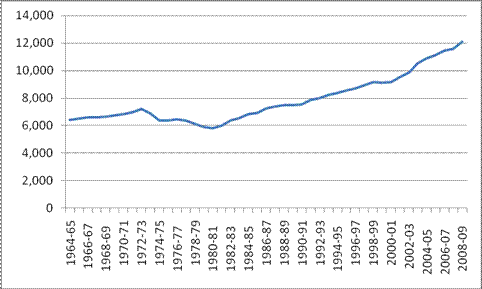
Whether you are in college or not, fall semester 2011 is upon us. Below, courtesy of Everyday Sociology, is a graph illustrating the rising cost of college, controlled for inflation.

Public College/University Tuition, Room and Board (held constant in 2007-2008 dollars):

Consequent to this increase, the average student in 2008 graduated with twice the debt as a student in 1996, from $12,750 to $23,200.

The pay-off of a college education, however, is higher than ever. So why don’t more people go?

In the seven-and-a-half minute video below, UC Berkeley Professor Michael Hout gives a history of higher education putting all of this in perspective. The answer is class-specific and how different classes think about debt and possibility. More:

Lisa Wade, PhD is an Associate Professor at Tulane University. She is the author of American Hookup, a book about college sexual culture; a textbook about gender; and a forthcoming introductory text: Terrible Magnificent Sociology. You can follow her on Twitter and Instagram.

The Demographics

During disasters, poor people, people of color, and the elderly die in disproportionate numbers (source), and Katrina was no exception. Many decisions were made in the days leading up to and shortly after Katrina that amplified loss of life for these groups. New Orleans is both a poor (23% poverty rate pre-Katrina – twice the national average) and segregated city, and these factors led to loss of life. First, an effective evacuation plan was not in place that accounted for the 112,000 poor, mostly black New Orleanians without cars. Additionally, the timing of the storm at the end of the month meant that those receiving public assistance were unusually cash-strapped. To make matters worse for poor people with children, school had just started so expenses for the month were higher than usual.

The immobile poor were disproportionately left behind and lost their lives. A comprehensive study of evacuees to Houston (who had stayed behind during the storm) found that 22% were physically unable to evacuate, 14% were physically disabled, 23% stayed in New Orleans to care for a physically disabled person, and 25% were suffering from a chronic disease (source). Also,

• 55% did not have a car or a way to evacuate
• 68% had neither money in the bank nor a useable credit card
• 57% had total household incomes of less than $20,000 in the prior year
• 76% had children under 18 with them in the shelter
• 77% had a high school education or less
• 93% were black
• 67% were employed full or part-time before the hurricane

Age was also a factor in fatalities. Nearly 40% of those who died in Katrina were elderly, and many more elderly individuals died from the stress of evacuation and home loss.

Government Response

Mayor Nagin received nearly $20 million to establish a workable evacuation plan in plenty of time for Katrina, but it’s questionable whether it was ever developed, and it was never disseminated. Two months before Katrina, Nagin spent money to produce and distribute DVDs in poorer neighborhoods to inform residents that they would be on their own if a storm hit because the city could not afford to evacuate them.  In the days before the storm, Nagin sent empty Amtrak trains out of the city, failed to mobilized available school and other buses, and waited an entire day to call for a mandatory evacuation so he could determine whether the City would face lawsuits from local businesses (source). All of these decisions were deadly.

The federal response was no better. The city was quiet after the storm whipped through late Sunday night/early Monday morning when President Bush announced that New Orleans had “dodged a bullet.” Within hours, three major levees breaches and over fifty minor breaches flooded the city. Despite Governor Blanco’s request for federal assistance on Saturday (two days before the storm made landfall) and concern from local media on Sunday (one day before the storm) that the levees wouldn’t hold, they breached on Monday morning with only two Federal Emergency Management Agency (FEMA) workers on the ground (see the timeline). It would take two days for 1,000 additional officials to arrive.

Once on the ground, FEMA slowed the evacuation with unworkable paperwork and certification requirements. Marc Cresswell, a medic from a private ambulance company, reported that “At one point I had 10 helicopters on the ground waiting to go, but FEMA kept stonewalling us with paperwork. Meanwhile, every 30 or 40 minutes someone was dying.” FEMA was also criticized for turning away personnel, vehicles, medical equipment, food and other supplies, and diesel fuel.

The 30,000 people who evacuated to the Superdome (per Nagin’s instructions) were stranded for a week. Those who evacuated to the Superdome experienced deplorable conditions – unbearable heat, darkness, the stench of sewage, and a lack of food and water. They were not allowed to leave, and, according to several evacuees I interviewed in Texas shortly after the storm, this led one man to take his life by jumping from a balcony. This death was one of only six deaths at the Superdome: one person overdosed and four others died of natural causes. Another 20,000 people gathered at the Convention Center for assistance, an evacuation site the federal government was unaware of until three days after the storm.

President Bush was otherwise occupied during this time. The day Katrina hit, he traveled to Arizona and California to promote his prescription drug plan, had birthday cake with John McCain, and attended a Padres game.

Panicked at the slow federal response, Governor Blanco sent an urgent request: “Mr. President, we need your help. We need everything you’ve got.” The president retired to bed that night without responding to Blanco. The next day, he sang songs with country singer Mark Willis and returned to Texas for the final night of his vacation. The President was so oblivious to the suffering in New Orleans that his staff made a video of news coverage four days after the storm to sensitize him. And, in response, President Bush’s team assembled a carefully crafted PR plan to blame local officials seven days into the ordeal while thousands of people were still stranded. Later that same day, President Bush made the infamous statement, “Brownie, you’re doing a heckuva job.”

Cross-posted at Caroline Heldman’s blog.

Of the many people who did not or could not evacuate New Orleans in the face of Hurricane Katrina, prisoners were especially helpless.  The American Civil Liberties Union gathered testimony from 400 of the 7,000 people locked up in New Orleans Prison at the time of Katrina, including approximately 100 juveniles.

Many reported being left in their cells while the water rose above their heads; being beaten and sprayed with mace once evacuated (to state maximum security prisons); and left on Interstate-10 in the hot sun for days without food or water. An entire building with about 600 prisoners was left behind in the evacuation process and weren’t rescued for days (source).

Most of the 7,000 prisoners had been charged with misdemeanor offenses and would have been released within a few weeks, even if convicted. But Governor Blanco effectively suspended habeas corpus (due process; right to a speedy trial) for six months, so some were incarcerated for over a year – doing “Katrina time.”  “The court system shut its doors, the police department fell into disarray, few prosecutors remained, and a handful of public defenders could not meet with, much less represent, the thousands detained” (source). Prison officials deny that anyone died in the crisis, despite several reports of deaths from both police officers and prisoners (source).

The Orleans Parish Prison continues to have civil rights concerns. In 2009, the Civil Rights Division of the Justice Department found that conditions at OPP violate inmates’ constitutional rights. The report found that prisoners experience violence from other prisoners, excessive force from guards, are not provided adequate medical services, and live in unsanitary conditions with pests.

This hour-long BBC video documents their experiences:

Cross-posted at Caroline Heldman’s blog.  

Caroline Heldman is a professor of politics at Occidental College. You can follow her at her blog and on Twitter and Facebook.


Duff sent in a video showing candidates from the 2011 Miss USA contest answering the question, “Should evolution be taught in schools?” Their answers are a great example of the normalization of the idea that evolution is “one side” of a story, with religion being the other side, and that we should just choose between these two stories based on what we’re most comfortable with personally:

There’s a striking discourse here of allowing children (or, by extension, their parents) to “choose” whether to learn about evolution or whether it’s a perspective they like, in a way we don’t apply to other scientific theories. I suspect if you allowed students to choose, they might, just perhaps, decide that calculus, grammatical rules, and the laws of physics aren’t things they happen to feel like learning, a fact that most curriculum review committees see as rather irrelevant.

This discourse of choice works, in part, because of the word “theory.” In popular usage, “theory” is often used as though it’s interchangeable with “idea” or “opinion” or “random thought I just made up in my head right now.” Of course, scientists use the word in a very different way, and the scientific process is to test theories and find evidence for or against them. But the conflation of “theory” in the scientific sense with “opinion” in the public-usage sense facilitates the discourse of choice.

I suspect that some watching the video will see this as little more than an example of air-headed, dumb women not understanding science. But it’s important to remember that these women are carefully prepped for this competition; they have been through years of lower-level beauty pageant competitions and, to get to the Miss USA contest, they’ve clearly learned the rules of the beauty pageant circuit. They may or may not personally completely agree with what they’re saying; the point is to provide an answer that they believe is most likely to appeal to a group of judges who are looking for a candidate who will be palatable to a broad audience and unlikely to stir controversy. Whatever their personal opinions might be, the women are providing an answer based on a perception of what the most acceptable response is — and the discourse of choice is sufficiently normalized to be a viable, and perhaps the only viable, option they can give and hope to win.

And, if you’re interested, here’s a parody video asking if math should be taught in schools:

Gwen Sharp is an associate professor of sociology at Nevada State College. You can follow her on Twitter at @gwensharpnv.


This month thousands of sociologists met in Las Vegas for our annual meeting.  There were lots of opinions about the city and our accommodations at Caesar’s Palace.  In the two-minute clip below, a sociologist who studies cities, Sharon Zukin, offers her thoughts on Las Vegas:

Lisa Wade, PhD is an Associate Professor at Tulane University. She is the author of American Hookup, a book about college sexual culture; a textbook about gender; and a forthcoming introductory text: Terrible Magnificent Sociology. You can follow her on Twitter and Instagram.

Cross-posted, in Portuguese, at Petiscos de Sociologia.

Noam sent in a link to a website with a post featuring “beautiful” Chinese women who have been executed.  These women are apparently important not because of their sacrifice, or because of what they say about Chinese politics, but because they’re beautiful.  Non-beautiful women who have been executed apparently draw no interest.

Noam’s submission gave me a fantastic excuse to post a video of our very own Gwen Sharp giving a 4-1/2 minute lecture about a similar phenomenon, the Missing White Woman Syndrome (originally posted at the NSC School of Liberal Arts and Sciences; transcript after the jump).


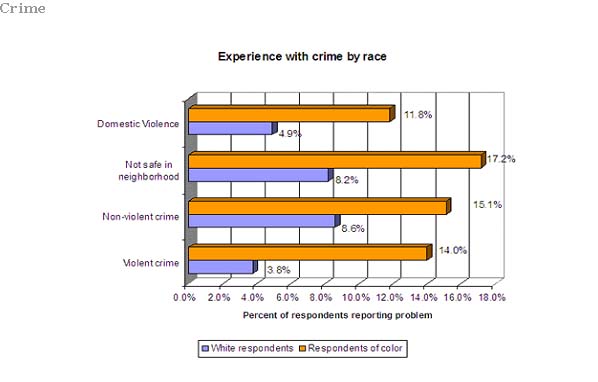
She covers quite a bit of ground.  After introducing the concept, she discusses data on the disproportionate coverage of crimes against white women, and how this shapes perceptions of risk.  In fact, white women are among the least likely type of person to be victimized.  This graph, coincidentally sent in by Grace S., doesn’t break down the data by gender, but it shows a clear pattern by race.

The constant attention to white women’s vulnerability, even though it’s disproportionate, makes it seem as if they are especially likely to be a victim of violent crime.  The risk that women of color will be victimized, then, is underestimated and not taken as seriously as it should be.  Meanwhile, white women may confine themselves to safer-seeming leisure activities and occupational pursuits.

These patterns affirm the role of racism in news making — with violence against women of color apparently less newsworthy — and also shows that white women, though valorized, may self-curtail their lives out of fear that they are, accordingly, the most likely target of violence.

Follow Gwen on Twitter!

References:

Chiricos, T., S. Eschholz, & M. Gertz. (1997). Crime, news and fear of crime: toward an identification of audience effects. Social Problems 44(3), 342-357.

Lundman, R.J. (2003). The newsworthiness and selection bias in news about murder: comparative and relative effects of novelty and race and gender typifications on newspaper coverage of homicide. Sociological Forum, 18(3), 357-386.

Transcript after the jump:

more...

Every once in a while we here at SocImages pick a fight and a couple of years ago we sunk our teeth into satire and didn’t let go. Satirical humor is often used to expose prejudice and bigotry and it can be damn effective, as many viewers of The Colbert Report will testify.  But it’s also a risky strategy.  It makes fun of by doing; so, for example, it exposes racism by being extremely, over-the-top, no-one-will-ever-believe-we’re-serious racist. Except for… someone might think you’re being serious.  In fact, a significant proportion of political conservatives viewing The Colbert Report believe that he is conservative like them. They recognize that he’s trying to be funny, but they don’t think he’s joking.

In our effort to think more critically about satire, we covered Amy Sedaris’ hipster racism, Ellen DeGeneres’ CoverGirl commerciala New Yorker cover depicting Obama as a Muslim, covers of the National Review featuring Bill Clinton and Sonia Sotomayor, and board games.  We also featured Jay Smooth’s commentary on Asher Roth using the phrase “nappy headed hos.”

Now Anita Sarkeesian, of Feminist Frequency, offers another illustration of how satire doesn’t always work the way progressives would like it to.  She takes on TV commercials, arguing that ironic racism and sexism is still racism and sexism. Ironic advertising, she argues, allows marketers to “…use all the racist, sexist, misogynist imagery they want, and simultaneously distance themselves from it with a little wink and a nod.”  You be the judge:

Lisa Wade, PhD is an Associate Professor at Tulane University. She is the author of American Hookup, a book about college sexual culture; a textbook about gender; and a forthcoming introductory text: Terrible Magnificent Sociology. You can follow her on Twitter and Instagram.