
Search results for embed

Thank Maude for the British—because, without Kim and Aggie teaching us how to clean our homes, and Jo Frost teaching us how to raise our kids, and Victoria Stilwell teaching us how to control our dogs, and Trinny and Susannah teaching us how to dress ourselves, and Simon Cowell teaching us how to sing, and Nigel Lithgoe teaching us how to dance, Americans would be naked, cultureless beasts who lived in garbage heaps with feral children and wild dogs.

This is all true.

The latest Brit in the British How-To Invasion is “Naked Chef” Jamie Oliver, whose new show I Hate Fat People Jamie Oliver’s Food Revolution features Oliver traveling to Huntington, West Virginia—the Obesitiest Place in the Multiverse!—where he was determined to use his “magic” to help Huntington’s Fatties get less fat. I mean, healthier!

The reality series based on this generous thin martyr giving up his time to help stupid fat people premieres tomorrow night. But! By the magic of the internetz, you can watch it here right now!

[Editor’s note: this is the entire episode, but the first 8 minutes will give you the idea; also, I’m sorry non-U.S. readers, I know you can’t see Hulu.]

If you can’t view the video, here’s a quick summary: Headless fatties? Check. Enormous food stock footage? Check. OHNOES Obesity CrisisTM? Check. Being fat is ugly? Check. Fat people are lazy? Check. Fat people are stupid? Check. Fat people are sick? Check. DEATHFAT? Check. Mother-blaming for fat kids? Check. Fat as a moral failure? Check. Religious shaming of fat? Check. Fat people don’t have “the tools” to not be fat? Check. Fat people need a skinny savior? Checkity-check-check!

I want to note that there is, buried somewhere beneath the 10 metric fucktons of fat-shaming (and not an incidental dose of misogyny, for good measure), information about healthful eating (e.g. not eating any fresh veg, ever, isn’t good for anyone), but this is information that could be delivered without a scene in which a mother of four whose husband is gone three weeks a month is told that she’s killing her children while she’s weeping at her kitchen table.

The premiere episode has absolutely zero structural critique, not even a passing comment about the reason that millions of mothers feed their kids processed foods is because it’s cheap and fast, which is a pretty good solution for people who are short on money and time.

Oliver places the responsibility for unhealthful eating exclusively at the feet of the individual, seemingly without concern for the cultural dynamics that inform individual choices. The extent of the explanation provided for why someone might choose to stock their freezer with frozen pizzas is that they’re lazy and/or don’t know any better.

And then he wonders why he isn’t greeted by the citizens of Huntington with open arms.

At the end of the episode, a newspaper article comes out in which Oliver’s evident contempt for the community has been reported. Oliver claims his words were taken out of context; the people with whom he’s been working to revamp elementary school meals don’t believe him—and understandably so, given that he’s been a patronizing ass to them.

In the final scene, Oliver speaks directly to the camera, and he is crying, wiping tears from his eyes as he throws himself a little pity party:

It’s quite hard to cut through negativity, always. And defensiveness. You know, I’m giving up massive time that is really compromising my family—because I care! You know, um, the tough thing for me [exhales deeply] is they don’t understand me, ‘cuz they don’t know why I’m here. [sniffs] They don’t even know what I’ve done, the things I’ve done in the last ten years! And I’m just doing it ‘cuz it feels right [sniffs], and when I do things that feels right, magic happens! [sniffs; shakes his head disbelievingly] I’ve done some amazing things, you know? And that’s when I follow my heart. And when I never follow my heart, I always get it wrong.

Look, I’m gonna be really honest: You do live in an amazing country. You put people on the moon! You live in an amazing country. And so do I, you know? And, right now in time, is a moment where we’re all confused about how brilliant we are and how technically advanced we are, and that is fighting with what once made our countries great, which is family, community, being together, and something honestly as simple as putting a few ingredients together and sitting your family or your friends or your girlfriend or your mother-in-law around that table and breaking bread. And if you think that’s not important, then shame on you!

Wow.

In an interview to promote the show, Oliver says, “You can’t really blame the parents when the whole culture and the whole horizon of food is all the same.” Which is an interesting comment from someone who chose a scene where he’s telling a mother she’s killing her kids for the premiere episode of his show.

That underlines a key problem with Jamie Oliver’s Food Revolution: He doesn’t want to be seen as the guy who blames parents for killing their kids and shaming fat people for being fat—but there he is in his show, blaming parents for killing their kids and shaming fat people for being fat. Oops.

And, on top of it, he ends the premiere episode by crying because those goddamn fat ingrates don’t appreciate him.

Reportedly, Huntington eventually warmed up to Oliver, but I don’t think I’ll be sticking around to watch that happy ending unfold.

And, for the record, Mr. Oliver, the “whole horizon of food” is actually not all the same in the US: In some places, things are much, much worse.

—————————-

Melissa McEwan is the founder and manager of the award-winning political and cultural group blog Shakesville, a founding member of the Big Brass Blog, and a contributor to The Guardian’s Comment is Free and AlterNet. Melissa graduated from Loyola University Chicago with degrees in Sociology and Cultural Anthropology and an emphasis on the political marginalization of gender-based groups.

If you would like to write a post for Sociological Images, please see our Guidelines for Guest Bloggers.


Crossposted at Jezebel.

Simon O. sent in this Ukrainian army video meant to recruit women:

The translation (taken from YouTube, and I think it’s a somewhat rough translation; I cleaned up the punctuation and spelling a bit):

Girl 1: Would you take us for a ride in your BMW?
BMW-driver: Even to the end of the world!
Soldier: Hey, I’d like to drown [drink?] some vodka, girls!
Girl 1: Just a second!
Girl 2: Where do you live?
Soldier: Right here- daytime at work, and at night in the clubs!
Girl 1: Which work???
Soldier: Contract, of course!
Blonde girl: Contract? Marriage contract or what?
Girl 3: Army contract, stupid!
BMW driver: Hey, don’t you wanna ride in my car?
Girls: Forget it, take yourself for a ride!
Narrator: It’s about time for new heroes! With contract-based service in Ukrainian armed forces!

Apparently the Austrian army thought it was awesome and made their own version:

Translation (again from YouTube):

Audi Driver: Hey girls, wanna go for a spin in my fast ride?
Girls: Ehh not sure, there’s not even enough space for all of us.
Soldier: Wazzup girls, in the mood for a joyride?
Girls: *Yaaaaay*
Soldier: Join the army if you wanna drive a tank.
Soldier2: Jump in, starting engine.
Audi Driver: Hey, what about the spin?
Girl: Forget it, I want to drive something big.
Narrator: The Austrian Armed Forces offer unique opportunities for young people who are at least 18, everything else is just everyday life.

Both versions play on the idea of women as materialistic, looking for the guy with the best car. Vehicles become a stand-in for masculinity; the bigger/faster the ride, the more attractive you are to women. And what’s more manly than a tank, with a long, phallic-shaped barrel? Women are simply entranced and can’t help running off after the biggest, strongest, manliest vehicle they can find…and, if we take the phallic imagery seriously, presumably the guy with the largest penis, too.

When American figure skater Evan Lysacek won the gold medal at the 2010 Olympics, he was the only man on the podium who had not attempted a quadruple jump in either of his two skating programs. The silver medalist, 2006 Olympic Champion Evgeni Plushenko of Russia, was quick to point out that “a quad is a quad. If an Olympic champion doesn’t do a quad, well I don’t know… Now it’s not men’s figure skating, it’s dancing.” Plushenko’s website later proclaimed (though the claim was soon redacted) that his superior performance had earned him a “platinum” medal. Figure skaters and others who heard his comment understood this wasn’t just sour grapes; by questioning Lysacek’s jumping ability, Plushenko was also questioning his manhood.

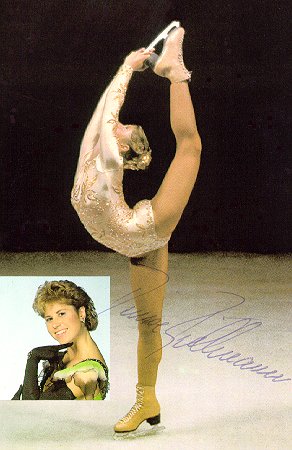
As Daniel, a former singles and pairs skater, knows from personal experience, when you look below the surface of figure skating, a coded gendering of the sport emerges. Figure skating has both athletic and artistic components, and traditionally these have been apportioned to men and women, respectively. Men are expected to be able to land enormous jumps. Women, on the other hand, are more likely to grab one of their feet and pull it up behind their heads, sometimes while spinning fast enough to set off a nose-bleed, as Mirai Nagasu did in Vancouver. Women’s programs also emphasize a great deal of emotion when they skate, while men are expected to display their athletic strength and power.

This is not to say that women are not expected to jump or that men can be soulless automata, but there are lower expectations for each in the other gender’s territory. A male skater who doesn’t emote passionately can be forgiven if he has a fantastic triple axel, and a woman can even win the Olympics with jumps that aren’t fully rotated. Artistry and flexibility are where women are expected to excel, while boys strive to jump higher and rotate more. To this day, only one woman (Japan’s Miki Ando) has landed a clean quadruple jump in competition, while it has become a mainstay of men’s event. This video shows Ando’s jump, at a 2002 competition:

In the aftermath of his silver platinum silver medal finish in Vancouver, Plushenko questioned the qualifications of Evan Lysacek to win gold without a quad. Aside from being poor sportsmanship, his approach highlighted the deep association of jumps with male figure skating. Though, in the women’s event, Mao Asada completed the technically difficult triple axel on three separate occasions, no fuss was made over her second-place finish behind the ethereal Kim Yu-Na. Kim has strong jumps, to be sure, but what sets her apart from her competitors is that she skates in a way that is graceful, balletic and undeniably feminine.

Ironically, one of the most promising things about a young Evgeni Plushenko when he arrived on the international skating scene in 1997 was his blending of artistry and athleticism. His style was avant-garde and overwrought, and his jumps were magnificent; he had, in skating parlance,”the whole package.” It might seem excessive to map gender onto his performances, but he is famous for being one of the only men to perform the Biellmann spin, in which the skater grabs the blade of one skate and pulls it up behind the top of his or her head.

This was a clear and unabashed case of gender-bending, as the spin had previously been the province of women. The figure skating world, after being sufficiently impressed by the flexibility of his hips, shrugged and moved on. No one thought any less of him for doing a “girly” spin.

Compare this to the skating world’s reaction to two-time Olympic gold medalist Katarina Witt, who was often said to skate “like a man.” Witt had big jumps (and big thighs to go with them), and skated to the soundtracks of epic movies, a practice that was usually reserved for men, while other women tended to skate to classical ballet suites. Witt’s artistic style was also not typical of women skaters: while her competitors demonstrated flowing, balletic arm movements to match their floaty chiffon skating dresses, Witt opted for stronger, cleaner arm movements and famously skated in leggings and a tunic in a program set to music from Robin Hood. She also skated with a stoic bearing that was similar to that of Canadian Elvis Stojko, who won the silver medal in Lillehammer in 1994.

Despite the popular perception of figure skating as a uniformly “girly” sport, there exists within the figure skating world a unique and nuanced code for constructing and understanding gender. In the figure skating world, as in the rest of our culture, that code changes over time, with different representations of masculinity and femininity being rewarded, marked down, or phased out entirely as the sport evolves. And as Plushenko’s comments about Lysacek demonstrated, figure skating’s coding of gender can be invoked by skaters trash-talking their rivals in subtle, but complicated, ways. As yet, Plushenko has made no comment on Lysacek’s upcoming appearance on “Dancing with the Stars,” but it’s not hard to imagine what he might have to say.

——————–

Chloe Angyal is a Contributor at Feministing.com, where she writes about gender in popular culture. She is also a failed figure skater. Daniel Eison is a former nationally-ranked pairs and singles skater who retired in 2005. He is not a failed feminist.

——————–

Gender differences in figure skating are also institutionalized in the form of costume requirements. Women are required to wear dresses, while men are not allowed to wear leggings or sleeveless outfits.

UPDATE: Reader Jeff says,

This isn’t true anymore; “this rule was repealed in 2004, allowing women to wear tights, trousers, or unitards” [1] ([1] http://www.frogsonice.com/skateweb/faq/rules.shtml)

Thanks for the correction!

Related posts: Johnny Weir and Canadian skating gets tough.

Rob D. sent along a commercial, made by the non-profit organization Iranians Be Counted, aimed at encouraging Iranian Americans filling out the U.S. Census to check “Other” and write in “Iranian.” It features a famous Iranian commedian doing a bunch of outrageous personalities, but in between the schtick is an argument that there is power in numbers and, therefore, a benefit to being identified as specifically Iranian:

This type of effort is really interesting and taps into a larger debate about Census categories.  How do we divide up the categories that we count?  Iranians are a much smaller group than, say, Arab American Persian (which is currently not an option on the U.S. Census).  If there is power in numbers, then wouldn’t it be better to write in “Arab American” “Persian”?  But, if you write in Arab Persian instead of Iranian, the resources to be gained from being counted may not benefit your community specifically. [As two commenters have pointed out, Iranian Americans are not Arab, except for a small minority. Iranians are Persian and most speak Farsi, not Arabic.  My mistake.]

The Asian American community in the U.S. is a good example of this conundrum.  “Asian” is a social construction; it is an umbrella label that includes very, very different groups.  There is great power in the social construction because it gives “Asians” a presence in American politics that, for example, the Hmong or the Vietnamese alone could never have.  But counting Asians as a group also means obscuring some very important differences among them.

For example, Asians outearn Whites in income surveys, suggesting that Asians should be excluded from programs trying to help groups escape poverty.  But, in reality, the groups we categorize as Asian vary tremendously in their average socioeconomic status.  Some Asian groups (e.g., the Japanese) outearn Whites; other Asian groups (e.g., the Hmong) have very high poverty rates.  When we look at the data broken out by smaller groups, we see more need, but the group itself is small enough that it can be ignored by politicians.

UPDATE: Roshan, in the comments, corrects me further:

Not all Iranians are Persians… Persians compose only 51 percent of the population. Other groups include the Azeris (24 percent), Gilaki and Mazandaranis (eight percent), Kurds (seven percent), Arabs (three percent), Lurs (two percent), Baluchs (two percent), and Turkmens (two percent) (Hakimzadeh, 2006).

Lisa Wade, PhD is an Associate Professor at Tulane University. She is the author of American Hookup, a book about college sexual culture; a textbook about gender; and a forthcoming introductory text: Terrible Magnificent Sociology. You can follow her on Twitter and Instagram.

Christina W. sent in this 1969 video imagining, basically, the internet:

I found it hysterical. I mean, they were sort of bizarrely accurate in their general predictions. The gender roles also cracked me up.

And since we’re on the topic of the internet, the BBC recently conducted an international poll about the internet and David F. sent us a link to it. The methodology:

Photobucket

The finding that has gotten the most attention is that half of people strongly agree, and another 29% somewhat agree, that internet access should be a “fundamental right of all people”:

Photobucket

Concerns about the internet:

PhotobucketOf those who use the internet, beliefs about several topics:

Photobucket

The fact that 45% of respondents said they couldn’t cope without the internet has also gotten quite a bit of attention. However, it turns out that answers vary quite a bit by country; 79% of respondents in the Philippines and Pakistan said they could cope without it, while on the other end, 84% of Japanese respondents said they couldn’t:

Photobucket

Photobucket

I have to say, I find that question and the responses to it odd. You couldn’t cope without access to the internet? What does that mean, exactly? You’d be depressed and miserable without it? Suffer a mental breakdown? Become suicidal? I am a very heavy internet user–my computer is open with email displayed most of the time, even if I’m doing something else, and I spend enormous amounts of time every day actively using the internet. I get anxious when I can’t get access to it. But would I say I couldn’t cope without it? I would be very unhappy, but I wouldn’t, you know, become entirely incapable of functioning and give up the will to live, I don’t think. So I don’t know what to make of that.

Anyway. Hours spent online per week:

Photobucket

And finally, Michael C. sent us this video of a “skeptic’s take” on Google, including consolidation and privacy issues:

It’s interesting given Google’s recent decision to stop censoring internet access in China due to concerns that human rights activists’ emails were being tracked, as well as accusations of privacy issues with Buzz. A friend and I were talking recently about how normally we’re concerned about corporate concentration and control, and yet we both have entirely enmeshed ourselves with Google–using gmail, storing things on Google Docs and Notebook, tracking websites through Google Reader, using YouTube, getting directions from Google Maps…basically my entire online life is routed through Google services (I tried Chrome but didn’t like it, but if I had, even my browser would have been a Google product).

We’re not sure what to make of this — that it’s easier to lull people into a sense of complacency about corporate control if you provide them really nifty stuff they like using? That we aren’t yet really taking concerns about internet privacy seriously? The way these services are set up, it’s simply easier to use all of them than to insist on using a cloud server, reader, email, and so on separately just so we wouldn’t be supporting the concentration of internet services, and this undoubtedly plays a role in reducing our resistance. And our reliance on Google slowly grew over time so that neither of us really noticed how much we used the company’s products until we were actively talking about it (which we were only doing because of the events in China).

What do you think? Do you worry a lot about control over the internet, and particularly Google’s reach into so many aspects of internet usage? Do you really worry about how internet privacy issues affect you personally?

Liz C. sent in the video for the song “A Kiss with a Fist (Is Better Than None)” by Florence and the Machine. She analyzes it nicely:

The lyrics seem to condone domestic violence, and the video seems to trivialize it, in the sense that the lead singer prances and jumps around while singing about getting punched in the face, having her leg broken, and having plates broken over her head by her partner, while she, in turn, hits and slaps him, breaks his jaw, and refers to “The Burning Bed” by setting fire to their bed.

The lyrics:

You hit me once
I hit you back
You gave a kick
I gave a slap
You smashed a plate over my head
Then I set fire to our bed

You hit me once
I hit you back
You gave a kick
I gave a slap
You smashed a plate over my head
Then I set fire to our bed

My black eye casts no shadow
Your red eye sees nothing
Your slap don’t stick
Your kicks don’t hit
So we remain the same
Love sticks
Sweat drips
Break the lock if it don’t fit

A kick to the teeth is good for some
A kiss with a fist is better then none

A kiss with a fist is better then none

I broke your jaw once before
I spilled your blood upon the floor
You broke my leg in return
So sit back and watch the bed burn
Love sticks
Sweat drips
Break the lock if it don’t fit

A kick to the teeth is good for some
A kiss with a fist is better then none

A kiss with a fist is better then none

You hit me once
I hit you back
You gave a kick
I gave a slap
You smashed a plate over my head
Then I set fire to our bed

You hit me once
I hit you back
You gave a kick
I gave a slap
You smashed a plate over my head
Then I set fire to our bed

UPDATE: Reader Kyle pointed out another example, Chester French’s video for the song “She Loves Everybody.” He asks whether we can imagine seeing this video if the gender roles were reversed:

And commenter Dave gave us a link to a recent discussion of this topic at Jezebel.
Also see our post on sexualized violence in Lady Gaga’s “Paparazzi” video.

A few days ago, a mini-controversy erupted when this vidcap from the sports network RDS started making the rounds. Here’s the Deadspin article. Two Montréal Canadiens fans {nicknamed Habitants or Habs} donned the jersey of a hot prospect, P. K. Subban, who happens to be Jamaican Canadian. They also painted their faces black and wore afro wigs.

Toronto Mike blogged about the incident and one of the Habs fans came on to comment. The words got pretty heated, but in the end, the fan apologized and Habs and Leafs fans once again could resume their hockey-based hatred of one another.

What struck me as interesting was how this drama played out. The French language cable network covering the 11 March game against the Edmonton Oilers chose to air 10 seconds of the two friends. Was the intent to be controversial? Was the intent to be a facepalm moment?  The back-and-forth on Toronto Mike’s blog was interesting, as the polarizing effect of race brought up assumptions about the Habs fan and his intent by commenters. In the end, I thought the Habs fan handled himself well, given how people were responding and what was being said. Toronto Mike did a good job of not divulging the fan’s name. This was one of those rare moments where Web 2.0 seemed to actually foster a dialogue and didn’t degenerate into a protracted flame war. That said, it wasn’t always pretty, but a lot prettier than what one typically sees on news article comments on issues of race, which are often tantamount to text equivalent strangers yelling at each other at the top of their lungs in an open hall.

Here on ThickCulture, we have examined race in the post-racial era. Racism isn’t dead, it’s just gotten to a late stage where there is a consciousness about what is offensive and debates of this now enter into the public discourse space. I get a sense that race gets so intertwined with speech and knowledge structures that it often becomes a confusing and convoluted morass for many. This impinging upon liberties of speech, in terms of what one can and cannot say or should and should not say, creates a tension, which may result in a backlash.

Where are the lines in the post-racial era? Here in Toronto, last fall there was a party where a group of guys dressed up as the Jamaican bobsled team, depicted in the film, Cool Runnings {1993}. This story caused a stir and points were argued through social media comments on whether or not this was racist.

Four guys darkened their skin and one guy lightened his. The Torontoist chronicles how the story unfolded and offers a tutorial on what blackface is and its cultural significance. The students offered their explanation for their choice of costume:

First and foremost we would like to apologize if anyone was offended…Throughout our childhood, Cool Runnings was something we reflected on with fond memories and therefore in the process [of] choosing Halloween costumes, seemed to be a promising candidate. With this idea in mind, we took notice of how the primary cast, consisting of four black characters and one white character, coincided with our group ratio of four white and one black member. This sparked the idea to add another comedic element to the costume, and have the black student go as John Candy and the white students going as the four bobsledders. At this point, several of us was already of aware of what blackfacing was and therefore took out various means of investigation to further our knowledge of the topic and ensure that what we were doing be doing may not be considered similar in anyway. The conclusion that we came to that simply painting our faces dark brown would not be a portrayal of blackface….understand that we did not act in a negative or stereotypical manner [at the party]. We acted ourselves the whole night, and did not internalize the characters.

Here’s the theatrical trailer for Cool Runnings:

University of Toronto Sociology professor Rinaldo Walcott offered a different take:

I think that in particular [Cool Runnings] became a part of the popular culture imagination of [white] Canadians in a way that [they] took responsibility for that film as though it was somehow an extension of them. And one of the reasons that I think Canadians identified with that film so deeply is because that film weathered something that many white Canadians come to believe strongly—that black people don’t actually belong here. That we are an insertion into a landscape that is not actually an landscape where we naturally fit.

For black people who understand this history [of blackface], Cool Runnings was never a funny film; it in fact replicated all of the techniques of blackface. It is in fact one of the ways that we have come to see that blackface does not require painting of blackface anymore. Just look at the work of Marlon Riggs. We know that in North America there is a deep resonance around producing images of black people that make black people look disgusting. Cool Runnings is a milder version of that. So we should ask… why do they remember Cool Runnings so fondly?

Post-racial means navigating these choppy waters where intent collides head-on with history and its interpretations. Not to get all postmodern here, but while the metanarrative is dead, social media is a site where clashing mini-narratives that structure perceptions of the world, culture, society, etc. battle it out. I think the fellow Contexts blog Sociological Images is a social media site where clashing mini-narratives are de rigueur. I’m wondering if we will ever “get over” issues of race. I’m beginning to think we won’t, given globalization, etc., but perhaps it’s due to the fact that what this is really all about is identity.

What troubles me more than this is when the “right” language is used by individuals doing so strategically. The talk is talked, but the walk isn’t walked. That’s a topic for another blog.

—————————

Kenneth M. Kambara interests and expertise include social media, innovation strategy, environmental sustainability, business and marketing, sociology, urbanism, critical theory and economic sociology.  His insights (and unexpected pop culture segues) can be found on the fellow Contexts blog, ThickCulture, and on his own blog at rhizomicon. Like every good social media guru, he also tweets.

If you would like to write a post for Sociological Images, please see our Guidelines for Guest Bloggers.
Lisa Wade, PhD is an Associate Professor at Tulane University. She is the author of American Hookup, a book about college sexual culture; a textbook about gender; and a forthcoming introductory text: Terrible Magnificent Sociology. You can follow her on Twitter and Instagram.


Dmitriy T.M. sent in this video about the production and marketing of bottled water. It’s a little over-the-top at the beginning, but it brings up a lot of really interesting issues surrounding the selling of a product that is, in the U.S., available to the vast majority of people at a much cheaper price in their kitchen. And yes, I know, some people’s water tastes terrible, etc. etc. The point, in general, still stands that we are spending a lot of money and resources carting water around, and I find the advertising for bottled water fascinating.

Also see The Story of Stuff.
