Search results for The

Eric S. sent us a link to the webpage for the Sun-Maid Girl, the girl used to represent Sun-Maid raisins. Here is the original painting of the first Sun-Maid Girl, Lorraine Collett Peterson:

The logo was most recently updated in 1970; here is the current incarnation:

In discussing the original painting, the website says,

Sometimes we forget that in 1915 there were no electric hair dryers, that television would not be invented for decades to come, and that automobiles were not in every home. Life was much simpler, more rural, a lot less hectic and sunbonnets were still part of women’s fashion in California.

I like the romanticization of the past there. In 1915…World War I was going on. I guess life was “less hectic” in that you didn’t have a Blackberry to check every 15 seconds, but overall, I’m not sure I’d say it was “simpler” in a way that implies everyone had time to just sit around eating raisins and drying their hair in the sun.

Also from the website:

To Payne, the sight of the red sunbonnet and the pretty girl in the morning sun was the ideal personification of E.A. Berg’s brand name SUN-MAID.

This might be an interesting addition to some of the images in this, this, and this post about the sexualization of food. Whereas the women in those instances are mostly explicitly sexualized, in this case, the product is being associated with an idealized, non-sexual “maiden” version of femininity. I just thought it might make a good contrast if you’re discussing connections between women and food–the use of female sexuality and idealized female chasteness as marketing tactics related to food products. I wonder if Sun-Maid has stayed with the de-sexualized icon because raisins are associated with children?

FYI, Sun-Maid was one of the companies boycotted by United Farm Workers of America, the group let by Cesar Chavez.

Thanks, Eric S.!

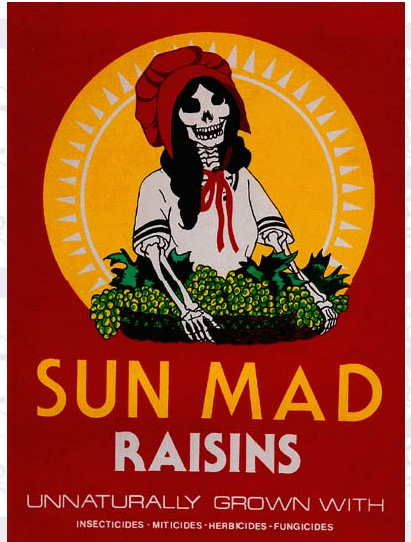
NEW: In a comment Adriana pointed us to Ester Hernandez’s parody of the Sun-Maid girl:
Thanks, Adriana!
Found here thanks to tmt.

Text:

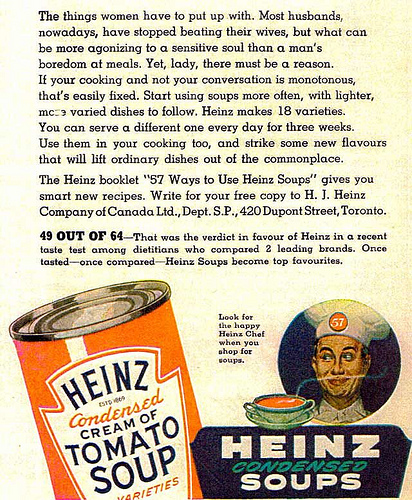
The things women have to put up with. Most husbands, nowadays, have stopped beating their wives, but what can be more agonizing to a sensitive soul than a man’s boredom at meals. Yet, lady, there must be a reason. If your cooking and not your conversation is monotonous, that’s easily fixed. [Ed. – Though apparently boring conversation is a life sentence.] Start using soups more often, with lighter, more varied dishes to follow. Heinz makes 18 varieties. You can serve a different one every day for three weeks. Use them in your cooking too, and strike some new flavours that will lift ordinary dishes out of the commonplace.

Vintage ad found here thanks to Laura R.

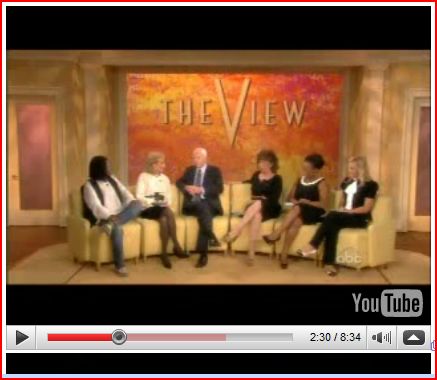
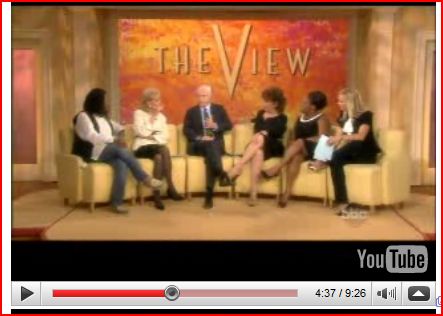
This is a screen shot of McCain’s appearance on The View. I thought it nicely demonstrated both rules of femininity and the breaking of rules.  Notice how all of the women, with the exception of Whoopi, have beautifully crossed legs aimed towards McCain so as to express interest.  Whoopi, in contrast, is resisting conventional expectations by taking a masculine pose (ankle on knee) aimed away from McCain.  (Of course, Whoopi as been seen taking controversial “positions” before.)  Finally, McCain himself appears to be failing to live up to normative standards of masculinity in matching the leg cross of his female hosts.  (See the second video in this post about anxiety over masculine leg crossing.)

I’ll grant that Whoopi doesn’t hold this pose:

Though she appears to be the only one who appears to pose according to comfort:

Still stolen from videos at Perez.


In this election, no one wants to be “elitist.” You know, the kind of person who went to an Ivy League, speaks perfect English, and avoids processed foods like high-fructose corn syrup.

Ben O. sent us these two ads, made by the Corn Refiners association, in which two historically marginalized groups–women and blacks–get it over on historically privileged groups–men and whites respectively–by exposing their obsessive-health-food-mania. Ben writes:

…the implication is that critics of [high-fructose corn syrup] HFCS are privileged (white and/or male) people who are condescending to inform black and/or female people that HFCS is bad, although they’re not only paternalistic but ignorant. And in both ads, standing up for the supposed virtues of high-fructose corn syrup appears to be an empowering action.

[youtube]https://www.youtube.com/watch?v=gxH[/youtube]

[youtube]https://www.youtube.com/watch?v=lQ-ByUx552s[/youtube]

Nice observation, Ben!

Lisa Wade, PhD is an Associate Professor at Tulane University. She is the author of American Hookup, a book about college sexual culture; a textbook about gender; and a forthcoming introductory text: Terrible Magnificent Sociology. You can follow her on Twitter and Instagram.

In the comments to another post, OTM brought my attention to this segment from Target Women, by the wonderful Sarah Haskins (go here if the video doesn’t show up):

The sexualization of the cleaning products reminds me a lot of the way food is sexualized (search under the Food tag for lots of examples).

I suggest going to the Current TV website and just browsing through every segment of Target Women they have up. They’re all fantastic.

Thanks, OTM!

UPDATE: In another example of cleaning products being portrayed as “special friends,” Swiffer created a YouTube “break-up” channel where people were encouraged to “Show us how you ‘broke up’ with your mop and bucket, broom or feather duster and ‘traded up’ to Swiffer…” by creating videos of themselves singing break-up songs to their old cleaning products. The winner got $15,000.

Swiffer also has a series of ads where women “break up” with their old cleaning products:

NEW! (Nov. ’09) This Lysol commercial (found at BrandFreak) plays on the same theme:

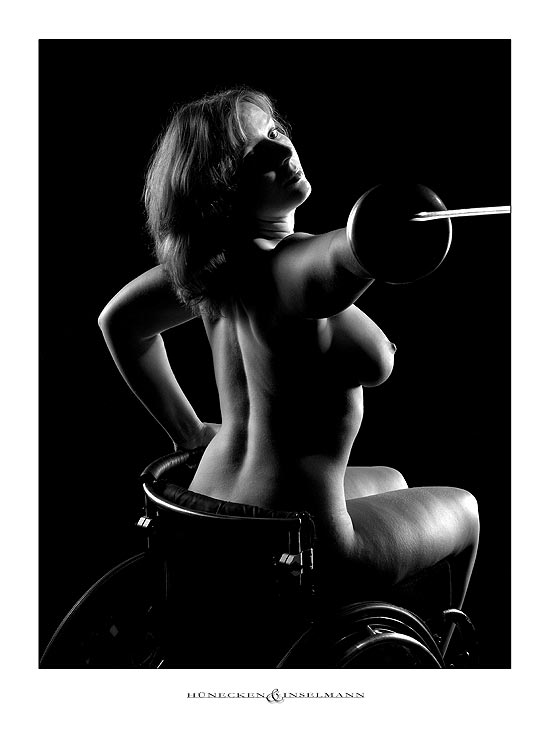
Thorsten S. alerted us to a calendar illustrated with black-and-white nude photographs of Germans who have competed in the Paralympic Games. On the Web site of the photographers, Huenecken & Inselmann [link NSFW!], subjects include people in wheelchairs and people who use lower-limb prostheses.

Compare these portrayals of persons with disabilities to the portrayal of fetish model Viktoria, who was a Bizarre mag cover girl, apparently in part because she has a below-the-knee amputation. Do these calendar photos highlight the German athletes’ disabilities in the same way that the shoot of Viktoria fetishizes her disability? Alternatively, check out our earlier post about Disaboom, a community site whose ads for its dating service feature muscular and attractive people with disabilities. Do these calendar photos challenge the mainstream stereotype that people with disabilities can’t be sexy or strong?

By the way, how do gender expectations and stereotypes play out in these photos? If you go to the gallery linked early in this entry, you can see a man holding a gun in a position that clearly makes it analogous to his penis. You can also see an especially objectified [decapitated = identity erased] woman on horseback, as well as a woman in a stereotypical beach bunny/pinup pose. The tendency of the calendar to revert to dull assumptions of how men and women should be posed and photographed complicates any radical agenda of celebrating the bodies of people with disabilities.

Pictures with artistic NSFW nudity below the cut.

more...

Shirley Ann M. sent in this picture of a car advertising Skill Maids:

She says,

I was blown away by the blatant sexual stereotyping in this picture: the maid in high heels, bent over with knees together, Jessica Rabbit figure.

Well, Shirley, what you don’t understand, and what I can tell you because my mom cleaned houses for a living when I was a kid, is that there is no more better outfit to wear for efficiently cleaning a large house than a dress and heels. See, the heels make you taller, so it’s easier to dust the top shelves!

Thanks, Shirley!